


 |
市場調查報告書
商品編碼
2125320
汽車安全氣囊:市場佔有率分析、產業趨勢與統計、成長預測(2026-2031)Automotive Airbags - Market Share Analysis, Industry Trends & Statistics, Growth Forecasts (2026 - 2031) |
||||||

※ 本網頁內容可能與最新版本有所差異。詳細情況請與我們聯繫。
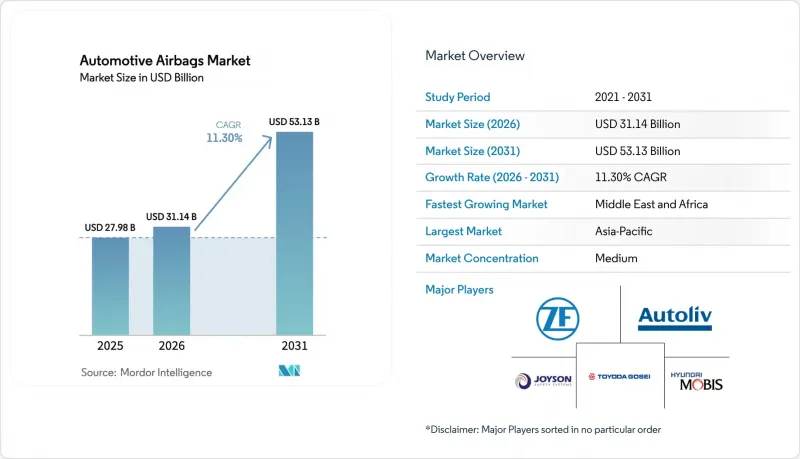
根據 Mordor Intelligence 預測,汽車安全氣囊市場規模將從 2025 年的 279.8 億美元成長到 2026 年的 311.4 億美元,然後在 2031 年達到 531.3 億美元,2026 年至 2031 年的複合年成長率為 11.30%。
本報告按車輛類型(乘用車和商用車)、驅動系統(內燃機車輛等)、零件(安全氣囊模組、充氣裝置等)、材料(尼龍66等)、安裝位置/安全氣囊類型(前座安全氣囊等)、銷售管道(OEM等)及地區進行細分。市場預測以價值(美元)和數量(輛)表示。
全球汽車安全氣囊市場趨勢與洞察
新興國家嚴格的正面和側面碰撞安全標準
法規的快速訂定正在推動汽車安全氣囊市場的擴張。僅印度一項法規——自2025年1月起強制所有乘用車配備雙前座安全氣囊——預計每年將使需求增加約1000萬個。巴西類似的法規已使該國的安全氣囊普及率接近100%。這些法規,加上消費者意識宣傳活動和優惠的保險條款,正在加速工廠將安全氣囊作為標準配置的進程。供應商正在擴大本地生產規模,以滿足前置作業時間目標,同時維持全球品質標準,並確保價格敏感型細分市場的成本一致性。
電動車平台的封裝要求正在推動多模組整合。
電動車的電池佈局和扁平式座艙結構改變了碰撞動態,迫使設計師採用專用安全氣囊。奧托立夫的伯努利安全氣囊™可適應各種座艙形狀,並將充氣機產生的熱量降低30%。例如,2025年現代摩比斯等車型配備的中央安全氣囊,可在側面碰撞中防止駕駛員和乘客接觸。這些客製化模組增加了每輛電動車的平均安全氣囊數量,拓展了汽車安全氣囊市場的機遇,同時也推動了輕量化氣體發生器的研發,以最大限度地減少高壓電池組周圍的熱應力。
半導體短缺正在擾亂生產。
安全氣囊電子控制單元 (ECU) 依賴 32位元微處理器,而這些微控制器的供不應求導致 2024 年全球汽車產量減少了 230 萬輛。供應商報告訂單積壓長達 28 週,促使汽車製造商優先生產利潤率更高的車型。與 2023 年的基準值相比,零件成本上漲了 12% 至 15%,給二級供應商的利潤率帶來了壓力。儘管透過戰略庫存管理和晶圓代工廠層面的契約,供應正在趨於穩定,但這種情況仍然會抑制汽車安全氣囊市場的短期擴張。
細分市場分析
到2025年,乘用車將佔汽車安全氣囊市場的71.88%,這主要得益於乘用車產量的成長以及每輛車安全氣囊數量的增加。同時,商用車市場成長速度更快,預計2031年將以8.12%的複合年成長率成長。這主要歸功於歐洲通用安全法規(GER),法規強制要求從2025年起,所有新型重型商用車都必須安裝高階約束系統。車隊管理人員高度重視實證數據,這些數據表明,全套安全氣囊可將與事故相關的運作減少42%,這項收益足以抵消初始成本。預計商用車安全氣囊市場規模將穩定成長,這主要得益於基於遠端資訊處理技術的保險折扣政策,該政策鼓勵卡車配備安全功能。
電子商務的快速發展推動了長途貨運量的成長,也因此對擁塞路段的駕駛安全防護提出了更高的要求。在北美,8級牽引車現在必須配備側簾式氣囊和膝部氣囊,預計平均氣囊數量將從2020年的兩個增加到2025年的五個。隨著監管機構致力於進一步提升乘員安全,商用車平台為汽車氣囊市場帶來了強勁的成長機會。
儘管到2025年內燃機汽車仍將佔據86.65%的銷售佔有率,但純電動車(BEV)在汽車安全氣囊市場中成長最快,預計到2031年複合年成長率將達到14.85%。電池組的存在縮小了傳統的碰撞區域,導致外部預碰撞安全氣囊和低溫充氣裝置的應用日益普及。奧托立夫的低溫氣體發生器解決了高壓系統周圍的防火安全問題,並提高了設計的柔軟性。預計到2024年,全球電動車銷量將超過1,700萬輛,隨著每輛車都需要輔助約束模組,純電動車的汽車安全氣囊市場預計將會擴大。
混合動力汽車和插電式混合動力汽車型正以8.85%的複合年成長率快速成長,推動了對能夠同時相容於內燃機和電動零件的雙模式展開演算法的需求。供應商正在將機器學習邏輯整合到電子控制單元(ECU)中,每秒分析400個資料點以調整充氣力。這種日益成長的複雜性正在推高ECU的銷售佔有率,並重塑汽車安全氣囊市場格局,尤其是在那些以軟體為核心產品系列的公司中。
區域分析
到2025年,亞太地區將佔據全球汽車安全氣囊市場42.10%的佔有率。這主要得益於中國超過2.2億個安全氣囊的年產量以及印度強制實施的雙安全氣囊系統。預計到2025年,中國每輛車的平均安全氣囊數量將從2020年的2.3個增加到4.8個,這主要得益於國內品牌致力於使其出口車型符合歐洲新車安全評鑑協會(Euro NCAP)的標準。日本和韓國正利用其先進的技術能力和大規模的生產能力,為全球整車製造商(OEM)平台提供模組。像均勝電子這樣的區域供應商則利用其與主要組裝的地理接近性,縮短前置作業時間,並深化在下一代電動車專案中的合作。
中東是成長最快的次區域,預計到2031年將以14.90%的複合年成長率成長。隨著海灣合作理事會(GCC)成員國收緊安全法規以及消費者對大型SUV的偏好,該地區每輛車的安全氣囊數量已超過全球平均水平。沙烏地阿拉伯和阿拉伯聯合大公國(阿拉伯聯合大公國)的本地組裝合資企業正在吸引一級供應商建立充氣裝置和氣囊的製造地,使該地區成為向非洲和歐洲部分地區出口產品的中心。配備包括膝部氣囊在內的七個安全氣囊的2025款日產途樂(Nissan Patrol)正是消費者日益成長的期望的體現。
北美和歐洲合計佔全球銷售量的近一半。北美市場的成長主要得益於SUV的流行以及美國聯邦機動車輛安全標準(FMVSS)下更嚴格的側面碰撞法規。同時,歐洲通用安全法規(GSR)將於2026年起對迎面而來的車輛和行人用安全氣囊提出新的要求。這兩個地區在人工智慧賦能的電子控制單元(ECU)和更環保的推進劑等創新領域均處於領先地位,這些創新隨後將推廣至新興市場,從而加強全球汽車安全氣囊市場安全標準的統一性。
其他好處:
- Excel格式的市場預測(ME)表
- 3個月的分析師支持
目錄
第1章:引言
- 研究假設和市場定義
- 調查範圍
第2章:調查方法
第3章執行摘要
第4章 市場狀況
- 市場概覽
- 市場促進因素
- 新興國家嚴格的正面和側面碰撞安全標準
- 電動車平台的封裝需求正在推動多模組整合。
- 在北美,SUV 比例的不斷增加推動了對側簾式安全氣囊的需求。
- 印度和類似發展中市場強制要求配備雙安全氣囊
- 透過使用保險和遠端資訊處理技術來提高車輛安全性能的獎勵。
- 中國汽車製造商正努力擴大出口,對符合 Euro-NCAP 標準的安全氣囊的需求也不斷成長。
- 市場限制因素
- 由於半導體和充氣機推進劑短缺,生產受到干擾。
- 假冒偽劣的售後氣囊正在損害消費者信心。
- 為追求「零缺陷」而大幅增加的研發投入,為二線企業的利潤率帶來了壓力。
- 電動車的輕量化正在加速替代約束材料的研究和開發。
- 價值供應鏈分析
- 監理展望
- 波特五力分析
- 供應商資訊
第5章 市場規模與成長預測
- 車輛類型
- 搭乘用車
- 商用車輛
- 依推進類型
- 內燃機車(ICE)
- 電池式電動車(BEV)
- 混合動力汽車和插電式混合動力汽車(HEV/PHEV)
- 燃料電池汽車(FCEV)
- 按組件
- 安全氣囊模組
- 氣筒
- 碰撞感知器和ECU
- 安全氣囊布料
- 材料
- 尼龍66
- 尼龍 6
- 聚酯纖維
- 位置/安全氣囊類型
- 前座安全氣囊
- 側邊氣囊
- 側簾式氣囊
- 膝部氣囊
- 充氣式安全帶
- 按銷售管道
- 目的地設備製造商 (OEM)
- 售後/替換件
- 按地區
- 北美洲
- 美國
- 加拿大
- 其他北美國家
- 南美洲
- 巴西
- 阿根廷
- 其他南美國家
- 歐洲
- 德國
- 英國
- 法國
- 西班牙
- 義大利
- 其他歐洲國家
- 亞太地區
- 中國
- 日本
- 印度
- 韓國
- 其他亞太國家
- 中東和非洲
- 沙烏地阿拉伯
- 阿拉伯聯合大公國
- 土耳其
- 南非
- 埃及
- 其他中東和非洲國家
- 北美洲
第6章 競爭情勢
- 市場集中度
- 策略趨勢
- 市佔率分析
- 公司簡介
- Autoliv Inc.
- ZF Friedrichshafen AG(ZF TRW)
- Joyson Safety Systems
- Toyoda Gosei Co. Ltd
- Hyundai Mobis Co. Ltd
- Continental AG
- Daicel Corporation
- Nihon Plast Co. Ltd
- Ashimori Industry Co. Ltd
- Sumitomo Corporation(Airbag Fabric)
- Robert Bosch GmbH
- Kolon Industries Inc.
- Yanfeng Automotive Trim Systems Co. Ltd
- Jinzhou Jinheng Automotive Safety System Co. Ltd
- Denso Corporation
第7章 市場機會與未來展望
According to Mordor Intelligence, the automotive airbags market size is expected to grow from USD 27.98 billion in 2025 to USD 31.14 billion in 2026 and is forecast to reach USD 53.13 billion by 2031 at 11.30% CAGR over 2026-2031.
This report is Segmented by Vehicle Type (Passenger Cars and Commercial Vehicles), Propulsion Type (Internal Combustion Engine (ICE) Vehicles and More), Component (Airbag Module, Inflator, and More), Material (Nylon 66 and More), Position/Airbag Type (Front Airbags and More), Sales Channel (OEM and More) and Geography. The Market Forecasts are Provided in Terms of Value (USD) and Volume (Units).
Global Automotive Airbags Market Trends and Insights
Stringent Frontal and Side-Impact Safety Mandates in Emerging Economies
Rapid regulatory rollouts have amplified unit volumes for the automotive airbags market. India's rule requiring dual front airbags on all passenger vehicles from January 2025 alone adds nearly 10 million annual units. Brazil's comparable mandate pushed national airbag penetration close to full coverage. These rules dovetail with consumer awareness campaigns and favorable insurance terms, accelerating factory install rates. Suppliers are ramping localized production to meet lead-time targets while maintaining global quality standards, ensuring cost parity for price-sensitive segments.
EV-Platform Packaging Needs Driving Multi-Module Integration
Battery placement and flat-floor cabins in EVs reshape crash dynamics, compelling designers to adopt specialized airbags. Autoliv's Bernoulli Airbag(TM) accommodates wide cabin geometries and reduces inflator heat by 30%. Center airbags like Hyundai Mobis' 2025 unit prevent driver-passenger contact in side impacts. These bespoke modules increase average airbags per EV, widening the automotive airbags market opportunity while pushing R&D toward lighter gas generators that minimize thermal stress around high-voltage packs.
Semiconductor Shortages Disrupting Output
Airbag ECUs rely on 32-bit microcontrollers, and allocation shortfalls cut 2024 global vehicle output by 2.3 million units. Suppliers reported order backlogs stretching 28 weeks, prompting automakers to favor high-margin models. Component costs climbed 12-15% against 2023 benchmarks, squeezing Tier-2 margins. Strategic buffering and foundry-level agreements are stabilizing supply, yet the situation continues to cap near-term expansion for the automotive airbags market.
Other drivers and restraints analyzed in the detailed report include:
- Rising SUV Mix Spurring Demand for Side-Curtain Airbags in North America
- Mandatory Dual-Airbag Rules in India and Similar Developing Markets
- Counterfeit Aftermarket Airbags Erode Consumer Confidence
For complete list of drivers and restraints, kindly check the Table Of Contents.
Segment Analysis
Passenger cars accounted for 71.88% of the automotive airbags market in 2025, buoyed by larger build counts and rising airbags per car. Commercial vehicles, however, are pacing faster with an 8.12% CAGR through 2031, as Europe's General Safety Regulation mandates advanced restraint systems for new heavy-duty models starting in 2025. Fleet managers value the documented 42% reduction in injury-related downtime delivered by full airbag suites, a payoff that offsets upfront costs. The automotive airbags market size for commercial vehicles is projected to climb steadily, leveraging telematics-driven insurance discounts that reward safety-equipped trucks.
Surging e-commerce has intensified long-haul freight activity, calling for better driver protection in congested corridors. North American fleets are specifying side-curtain and knee airbags in Class 8 tractors, elevating average airbag content from two units in 2020 to five units in 2025. With regulators eyeing further occupant-safety enhancements, commercial platforms present a robust incremental opportunity for the automotive airbags market.
ICE vehicles still dominate volume with an 86.65% share in 2025, yet BEVs exhibit the fastest growth in the automotive airbags market with a 14.85% CAGR through 2031. Battery packs curb traditional crumple zones, prompting the adoption of external pre-crash airbags and lower-temperature inflators. Autoliv's low-heat gas generator addresses fire-safety constraints near high-voltage systems, widening design flexibility. The automotive airbags market size for BEVs is set to compound as global electric-vehicle sales exceed 17 million units in 2024, each requiring supplementary restraint modules.
Hybrid and plug-in hybrid models are growing at a 8.85% CAGR, driving demand for dual-mode deployment algorithms that accommodate both combustion and electric components. Suppliers integrate machine-learning logic into ECUs, parsing 400 data points per second to adjust inflation force. Such complexity lifts ECU revenue share and consolidates the automotive airbags market around players with software-heavy portfolios.
Complete Report Scope:
- By Vehicle Type
- Passenger Cars
- Commercial Vehicles
- By Propulsion Type
- Internal Combustion Engine Vehicles (ICE)
- Battery Electric Vehicles (BEV)
- Hybrid & Plug-in Hybrid Vehicles (HEV/PHEV)
- Fuel-Cell Electric Vehicles (FCEV)
- By Component
- Airbag Module
- Inflator
- Crash Sensor & ECU
- Airbag Fabric
- By Material
- Nylon 66
- Nylon 6
- Polyester
- By Position/Airbag Type
- Front Airbags
- Side Airbags
- Curtain Airbags
- Knee Airbags
- Inflatable Seat-Belts
- By Sales Channel
- Original Equipment Manufacturer (OEM)
- Aftermarket/Replacement
- By Geography
- North America
- United States
- Canada
- Rest of North America
- South America
- Brazil
- Argentina
- Rest of South America
- Europe
- Germany
- United Kingdom
- France
- Spain
- Italy
- Rest of Europe
- Asia-Pacific
- China
- Japan
- India
- South Korea
- Rest of Asia-Pacific
- Middle East and Africa
- Saudi Arabia
- United Arab Emirates
- Turkey
- South Africa
- Egypt
- Rest of Middle East and Africa
- North America
Geography Analysis
Asia-Pacific controlled 42.10% of the automotive airbags market in 2025, anchored by China's production of over 220 million airbag units and India's dual-airbag mandate. Average airbag count per vehicle in China rose from 2.3 in 2020 to 4.8 in 2025, underpinned by domestic brands chasing Euro NCAP compliance for export models. Japan and South Korea contribute engineering depth and manufacturing scale, supplying modules to global OEM platforms. Regional suppliers such as Joyson leverage proximity to major assemblers, shortening lead times and deepening integration in next-generation EV programs.
The Middle East is the fastest-growing sub-region, projected to grow at a 14.90% CAGR through 2031. Gulf Cooperation Council countries tighten safety regulations and favor large SUVs, boosting airbags per vehicle beyond global averages. Local assembly ventures in Saudi Arabia and the United Arab Emirates lure Tier-1s to establish inflator and cushion facilities, positioning the region as an export hub into Africa and parts of Europe. The 2025 Nissan Patrol, fitted with seven airbags including knee units, exemplifies rising consumer expectations.
North America and Europe collectively make up nearly half of global revenue. North American growth rides on SUV popularity and stringent FMVSS side-impact updates, while Europe's General Safety Regulation layers new obligations for far-side and pedestrian airbags starting 2026. Both regions spearhead AI-enabled ECUs and greener propellants, innovations that later cascade to emerging markets, reinforcing global homogeneity in safety standards across the automotive airbags market.
- Autoliv Inc.
- ZF Friedrichshafen AG (ZF TRW)
- Joyson Safety Systems
- Toyoda Gosei Co. Ltd
- Hyundai Mobis Co. Ltd
- Continental AG
- Daicel Corporation
- Nihon Plast Co. Ltd
- Ashimori Industry Co. Ltd
- Sumitomo Corporation (Airbag Fabric)
- Robert Bosch GmbH
- Kolon Industries Inc.
- Yanfeng Automotive Trim Systems Co. Ltd
- Jinzhou Jinheng Automotive Safety System Co. Ltd
- Denso Corporation
Additional Benefits:
- The market estimate (ME) sheet in Excel format
- 3 months of analyst support
TABLE OF CONTENTS
1 Introduction
- 1.1 Study Assumptions & Market Definition
- 1.2 Scope of the Study
2 Research Methodology
3 Executive Summary
4 Market Landscape
- 4.1 Market Overview
- 4.2 Market Drivers
- 4.2.1 Stringent frontal & side-impact safety mandates in emerging economies
- 4.2.2 EV-platform packaging needs driving multi-module integration
- 4.2.3 Rising SUV mix spurring demand for side-curtain airbags in North America
- 4.2.4 Mandatory dual-airbag rule in India and similar developing markets
- 4.2.5 Insurance-telematics-linked incentives for fleet safety upgrades
- 4.2.6 Chinese OEM export push demanding Euro-NCAP-compliant airbags
- 4.3 Market Restraints
- 4.3.1 Semiconductor & inflator propellant shortages disrupting output
- 4.3.2 Counterfeit aftermarket airbags eroding consumer confidence
- 4.3.3 Escalating zero-defect R&D costs squeezing Tier-2 margins
- 4.3.4 EV lightweighting driving exploration of alternative restraints
- 4.4 Value/Supply-Chain Analysis
- 4.5 Regulatory Outlook
- 4.6 Porter's Five Forces Analysis
- 4.6.1 Threat of New Entrants
- 4.6.2 Bargaining Power of Buyers
- 4.6.3 Bargaining Power of Suppliers
- 4.6.4 Threat of Substitutes
- 4.6.5 Intensity of Competitive Rivalry
- 4.7 Supplier Information
5 Market Size & Growth Forecasts (Value (USD) and Volume (Units))
- 5.1 By Vehicle Type
- 5.1.1 Passenger Cars
- 5.1.2 Commercial Vehicles
- 5.2 By Propulsion Type
- 5.2.1 Internal Combustion Engine Vehicles (ICE)
- 5.2.2 Battery Electric Vehicles (BEV)
- 5.2.3 Hybrid & Plug-in Hybrid Vehicles (HEV/PHEV)
- 5.2.4 Fuel-Cell Electric Vehicles (FCEV)
- 5.3 By Component
- 5.3.1 Airbag Module
- 5.3.2 Inflator
- 5.3.3 Crash Sensor & ECU
- 5.3.4 Airbag Fabric
- 5.4 By Material
- 5.4.1 Nylon 66
- 5.4.2 Nylon 6
- 5.4.3 Polyester
- 5.5 By Position/Airbag Type
- 5.5.1 Front Airbags
- 5.5.2 Side Airbags
- 5.5.3 Curtain Airbags
- 5.5.4 Knee Airbags
- 5.5.5 Inflatable Seat-Belts
- 5.6 By Sales Channel
- 5.6.1 Original Equipment Manufacturer (OEM)
- 5.6.2 Aftermarket/Replacement
- 5.7 By Geography
- 5.7.1 North America
- 5.7.1.1 United States
- 5.7.1.2 Canada
- 5.7.1.3 Rest of North America
- 5.7.2 South America
- 5.7.2.1 Brazil
- 5.7.2.2 Argentina
- 5.7.2.3 Rest of South America
- 5.7.3 Europe
- 5.7.3.1 Germany
- 5.7.3.2 United Kingdom
- 5.7.3.3 France
- 5.7.3.4 Spain
- 5.7.3.5 Italy
- 5.7.3.6 Rest of Europe
- 5.7.4 Asia-Pacific
- 5.7.4.1 China
- 5.7.4.2 Japan
- 5.7.4.3 India
- 5.7.4.4 South Korea
- 5.7.4.5 Rest of Asia-Pacific
- 5.7.5 Middle East and Africa
- 5.7.5.1 Saudi Arabia
- 5.7.5.2 United Arab Emirates
- 5.7.5.3 Turkey
- 5.7.5.4 South Africa
- 5.7.5.5 Egypt
- 5.7.5.6 Rest of Middle East and Africa
- 5.7.1 North America
6 Competitive Landscape
- 6.1 Market Concentration
- 6.2 Strategic Moves
- 6.3 Market Share Analysis
- 6.4 Company Profiles (Includes Global level Overview, Market level overview, Core Segments, Financials as available, Strategic Information, Market Rank/Share for key companies, Products & Services, and Recent Developments)
- 6.4.1 Autoliv Inc.
- 6.4.2 ZF Friedrichshafen AG (ZF TRW)
- 6.4.3 Joyson Safety Systems
- 6.4.4 Toyoda Gosei Co. Ltd
- 6.4.5 Hyundai Mobis Co. Ltd
- 6.4.6 Continental AG
- 6.4.7 Daicel Corporation
- 6.4.8 Nihon Plast Co. Ltd
- 6.4.9 Ashimori Industry Co. Ltd
- 6.4.10 Sumitomo Corporation (Airbag Fabric)
- 6.4.11 Robert Bosch GmbH
- 6.4.12 Kolon Industries Inc.
- 6.4.13 Yanfeng Automotive Trim Systems Co. Ltd
- 6.4.14 Jinzhou Jinheng Automotive Safety System Co. Ltd
- 6.4.15 Denso Corporation
7 Market Opportunities & Future Outlook
- 7.1 White-space & Unmet-Need Assessment

 2026-2030年全球汽車安全氣囊市場
 2026-2030年全球汽車安全氣囊感知器市場
 汽車安全氣囊市場:按產品類型、纖維類型、塗層類型、組件類型、車輛類型和地區分類
 中國安全氣囊系統:市佔率分析、產業趨勢與統計及成長預測(2026-2031年)
 汽車安全氣囊市場報告:趨勢、預測與競爭分析(至2035年)汽車側簾式氣囊:市場佔有率分析、產業趨勢與統計及成長預測(2026-2031)
 汽車安全氣囊市場:2026-2032年全球市場預測(依安全氣囊類型、車輛類型、展開方式、材料及銷售管道分類)
 汽車安全氣囊市場分析及預測(至2035年):按類型、產品、技術、組件、應用、材料類型、部署方式、最終用戶、功能和安裝類型分類
 安全氣囊控制單元市場規模、佔有率和成長分析:按產品類型、車輛類型、感測器類型、相容安全氣囊類型、銷售管道、驅動系統和地區分類-2026-2033年產業預測
 安全氣囊系統市場規模、佔有率和成長分析:按產品類型、組件、車輛類型、應用、最終用戶產業、技術和地區分類-2026-2033年產業預測