


 |
市場調查報告書
商品編碼
2124177
汽車內後視鏡:市場佔有率分析、產業趨勢與統計、成長預測(2026-2031)Automotive Inside Rearview Mirrors - Market Share Analysis, Industry Trends & Statistics, Growth Forecasts (2026 - 2031) |
||||||

※ 本網頁內容可能與最新版本有所差異。詳細情況請與我們聯繫。
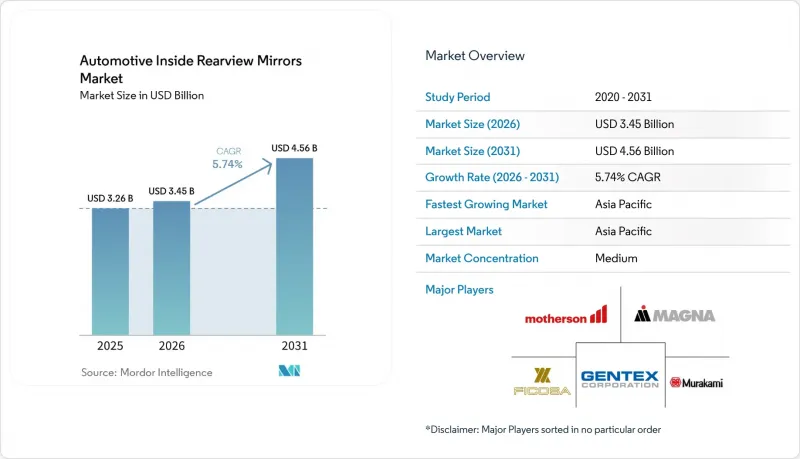
根據 Mordor Intelligence 預測,汽車後視鏡市場規模預計將從 2025 年的 32.6 億美元成長到 2026 年的 34.5 億美元,然後在 2031 年達到 45.6 億美元,2026 年至 2031 年的複合年成長率為 5.74%。
本報告按車輛類型(乘用車和商用車)、動力傳動系統類型(內燃機和電動)、功能類型(棱鏡式、自動防眩目、盲點監測和其他智慧功能)、銷售管道(OEM 和售後市場)以及地區(北美、歐洲、亞太地區和世界其他地區)進行細分。市場規模和預測均以美元計價。
全球汽車後視鏡市場趨勢及洞察
加強後方視野方面的安全標準和法規
全球監管機構不斷收緊對後方視野、盲點和碰撞規避的要求,直接推動了對高性能後視鏡的需求。新的車輛評估項目和交通安全機構越來越傾向於將星級評定和合規標籤與視野性能、眩光控制和駕駛員警告系統掛鉤。這迫使汽車製造商(OEM)升級其後視鏡,從基本的棱鏡設計轉向整合更廣視角、改進的防眩光功能和警告指示器的新型產品。
同時,針對巴士、長途客車和卡車等商用車輛的法規明確規定了後視鏡的覆蓋範圍,在某些地區,安裝輔助攝影機系統是強制性的。即使加裝了鏡頭,通常仍需使用經過認證的內後視鏡或數位後視鏡顯示螢幕,這再次表明後視鏡模組是一項重要的安全部件。這些法規雖然在緩慢發展,但正變得越來越嚴格,從而在所有主要汽車市場中形成了對後視鏡零件和品質的長期結構性需求。
採用ADAS和智慧型後視鏡模組
高級駕駛輔助系統 (ADAS) 擴大透過後視鏡模組進行控制和顯示。自動防眩光、盲點監測、車道偏離預警以及來自後視和環景顯示系統的攝影機影像等功能現在通常整合在後視鏡外殼中。這種設計使得重要資訊能夠集中在駕駛者的自然視線範圍內,而不會使儀表板顯得雜亂。
隨著ADAS(高級駕駛輔助系統)套件在大眾市場車輛中日益普及,後視鏡正逐漸成為整合感測器、攝影機和顯示器的理想樞紐。為此,供應商紛紛推出智慧後視鏡平台,並提供諸如電致變色玻璃、內建LED、語音助理麥克風,甚至駕駛監視錄影機等模組化附加組件。這一趨勢正將後視鏡從低利潤的普通商品轉變為高價值的電子樞紐,推高平均售價,並加強供應商與整車製造商(OEM)之間的夥伴關係。
價格敏感型市場中先進反射鏡高成本
與傳統的棱鏡式後視鏡相比,配備自動防眩光、內建相機和眾多感測器的後視鏡顯著增加了零件成本。在成熟市場,這些成本會透過提高配置價格來消化,但在以入門級乘用車和基礎商用車為主的新興市場,汽車製造商很難將這些成本轉嫁給消費者。因此,在印度、東南亞、非洲和拉丁美洲,許多車型仍配備基礎後視鏡,智慧功能僅限於高階配置或選配套件。
當電子元件價格飆升和外匯波動加劇時,成本障礙問題尤其突出。規模較小的原始設備製造商 (OEM) 和區域品牌可能會推遲升級後視鏡規格,以避免利潤率下降,即使監管部門允許採用更先進的解決方案。因此,中低收入市場的智慧後視鏡普及率成長停滯不前,拖慢了原本應由安全性和技術進步驅動的全球成長。
細分市場分析
乘用車在汽車後視鏡市場佔據主導地位,預計到2025年將佔據約81.94%的市場。這一主導地位得益於掀背車、轎車、SUV和跨界車的全球高產量,以及日益嚴格的乘員安全標準,這些因素促使先進的後視鏡在許多車型配置中成為標配或接近標配。目前,中檔和豪華乘用車通常配備自動防眩光、整合式顯示器和內建感應器,提高了每輛車的後視鏡配置等級。此外,隨著腰線較高、後排配備頭枕的緊湊型SUV和跨界車的興起,最佳化後視鏡設計和數位後視鏡的需求也日益成長,以確保後方視野。
商用車雖然規模較小,但卻是一個具有重要戰略意義的細分市場,尤其是在安全至關重要的應用領域。卡車和巴士需要專用的內後視鏡,通常需要與複雜的外後視鏡組件和攝影機系統配合使用,以消除大面積的盲點。車隊營運商和監管機構正在推動提高校車、長途客車和長途卡車的後方視野,敦促原始設備製造商(OEM)將數位後視鏡模組和駕駛員監控功能整合到可供車隊使用的駕駛室中。隨著各國政府加強對職業駕駛的安全監管,以及物流和客運車隊升級到更先進的後視鏡系統,預計商用車市場將在預測期內穩定成長。
預計2025年,內燃機(ICE)汽車仍將佔據車內後視鏡需求的約84.92%。這反映了全球內燃機汽車運作量龐大,以及新興市場內燃機汽車的持續銷售。隨著汽車製造商(OEM)積極應對新的安全法規和競爭基準,內燃機汽車車內後視鏡的規格也在不斷提升,例如在後視鏡外殼上增加了自動防眩光、指南針/溫度顯示以及基本的ADAS(高級駕駛輔助系統)警報等功能。因此,即使電動車(EV)的成長速度加快,內燃機汽車市場對於後視鏡供應商而言仍佔有重要的地位。
儘管電動車 (EV) 市場目前規模較小,但預計到 2031 年,車內後視鏡市場將以 20.95% 的複合年成長率 (CAGR) 實現顯著成長。電動車架構通常標配基於攝影機的後視鏡系統和整合式駕駛員監控功能,這增加了每個後視鏡的電子元件和軟體數量。隨著汽車製造商 (OEM) 圍繞大型中央顯示器和數位駕駛座重新設計內飾,車內後視鏡正成為高級駕駛輔助系統 (ADAS) 感測器、駕駛員監控攝影機和串流影片顯示器的理想安裝位置。這使得電動車成為推動先進後視鏡技術應用的主要動力,新型數位後視鏡配置通常會先應用於高階電動車車型,然後再推廣到銷量較高的燃油車平台。
區域分析
亞太地區是汽車後視鏡的主要需求中心,預計到2025年將佔全球市場價值的41.05%,並在2026年至2031年間以約6.63%的複合年成長率成長。這反映了該地區在汽車生產領域的主導地位,中國、日本、印度和韓國合計佔據了全球輕型汽車產量和新車註冊量的最大佔有率。乘用車產量高、SUV和跨界車銷量不斷成長以及電動車普及加速,都在推動汽車製造商採用傳統和智慧內後視鏡。隨著本土品牌不斷提升產品價值,自動防眩光和多功能後視鏡等功能在中高階車型的應用日益廣泛,進一步提升了亞太地區每輛車的功能配置數量。
北美和歐洲市場規模仍然龐大,但成長速度相對緩慢,這主要得益於嚴格的安全法規和ADAS(高級駕駛輔助系統)的高普及率。同時,世界其他地區(拉丁美洲、中東和非洲)的需求規模雖小,但正穩步成長,這主要歸功於車輛數量的增加和安全性能的逐步提升。然而,這些地區都無法與亞太地區在規模和成長方面的均衡性相提並論。光是中國和印度的汽車製造商(OEM)專案就足以左右全球對先進後視鏡的需求,只需將一項功能從選配升級為標準配備即可。在整個預測期內,這些趨勢將確保亞太地區保持全球最大且成長最快的區域市場地位,使其成為後視鏡供應商擴大產能、實現本地化生產以及與全球和區域汽車製造商開展聯合開發項目的戰略重點。
其他好處:
- Excel格式的市場預測(ME)表
- 3個月的分析師支持
目錄
第1章:引言
- 研究假設和市場定義
- 調查範圍
第2章:調查方法
第3章執行摘要
第4章 市場狀況
- 市場概覽
- 市場促進因素
- 加強後方視野方面的安全標準和法規
- 採用ADAS和智慧型後視鏡模組
- 提升大眾市場高階車型的配置與設備。
- 電氣化及電動車內裝重新設計
- 車隊和商用車輛安全計劃
- 新興市場汽車產量成長
- 市場限制因素
- 在價格敏感型市場中,高性能後視鏡成本高成本。
- 半導體和電子元件的供應波動
- 來自原始設備製造商的成本削減壓力和後視鏡的商品化
- 純相機鏡系統相關的監管和設計方面的不確定性
- 價值供應鏈分析
- 監理情勢
- 技術展望
- 波特五力模型
第5章 市場規模與成長預測
- 車輛類型
- 搭乘用車
- 商用車輛
- 依動力傳動系統類型
- ICE
- 電的
- 依特徵類型
- 自動調光
- 棱鏡
- 盲點警告燈
- 其他智慧/數位鏡子
- 銷售管道類型
- OEM
- 售後市場
- 按地區
- 北美洲
- 美國
- 加拿大
- 其他北美國家
- 歐洲
- 德國
- 英國
- 法國
- 其他歐洲國家
- 亞太地區
- 印度
- 中國
- 日本
- 韓國
- 其他亞太國家
- 世界其他地區
- 巴西
- 阿拉伯聯合大公國
- 其他國家
- 北美洲
第6章 競爭情勢
- 供應商市佔率
- 公司簡介
- Gentex Corporation
- Samvardhana Motherson Reflectec
- Magna International, Inc.
- Ficosa International SA
- Continental AG
- Murakami Corporation
- Tokai Rika Co., Ltd.
- Mitsuba Corporation
- SL Corporation
- Flabeg Automotive Holding GmbH
第7章 市場機會與未來展望
According to Mordor Intelligence, the automotive inside rearview mirrors market size is expected to grow from USD 3.26 billion in 2025 to USD 3.45 billion in 2026 and is forecast to reach USD 4.56 billion by 2031 at 5.74% CAGR over 2026-2031.
This report is Segmented by Vehicle Type (Passenger Car and Commercial Vehicle), Powertrain Type (ICE and Electric), Feature Type (Prismatic, Auto-Dimming, Blind Spot Indicator, and Other Smart Features), Sales Channel (OEM and Aftermarket), and Geography (North America, Europe, Asia-Pacific, and Rest of the World). Market Sizes and Forecasts are Provided in Terms of Value (USD).
Global Automotive Inside Rearview Mirrors Market Trends and Insights
Stricter Safety & Rear-Visibility Regulations
Regulators worldwide continue to tighten rear visibility, blind-spot, and crash-avoidance requirements, which directly lifts demand for better-performing rearview mirrors. New car assessment programs and road-safety agencies increasingly link star ratings or compliance labels to visibility performance, glare reduction, and driver awareness systems. This pushes OEMs to upgrade mirrors from basic prismatic designs to units with wider fields of view, improved anti-glare functionality, and integrated warning indicators.
In parallel, commercial-vehicle rules for buses, coaches, and trucks mandate defined mirror coverage zones and, in some regions, supplementary camera systems. Even when cameras are added, a certified interior mirror or digital mirror display is usually still required, reinforcing the mirror module as a non-negotiable safety component. Because these regulations evolve slowly but ratchet upward, they create a long-term structural pull on mirror content and quality across all major automotive regions.
Adoption of ADAS & Smart Mirror Modules
Advanced driver-assistance systems (ADAS) are increasingly being routed through or displayed in the inside rear-view mirror module. Auto-dimming, blind-spot indicators, lane-departure alerts, and camera streaming from rear or surround-view systems are now frequently anchored in the mirror housing. This design choice centralizes critical information in the driver's natural line of sight, without increasing dashboard clutter.
As more mass-market vehicles add ADAS bundles, the mirror becomes a logical integration node for sensors, cameras, and displays. Suppliers respond by offering smart mirror platforms with modular add-ons: electrochromic glass, embedded LEDs, microphones for voice assistants, and even driver-monitoring cameras. This trend turns the mirror from a low-margin commodity into a higher-value electronics hub, lifting average selling prices and deepening supplier-OEM partnerships.
High Cost of Advanced Mirrors in Price-Sensitive Segments
Auto-dimming, camera-integrated, and sensor-rich mirrors significantly increase bill-of-materials cost versus traditional prismatic units. In mature markets, this is absorbed into higher trim prices, but in emerging economies, where entry-level cars and basic commercial vehicles dominate, OEMs face strong resistance to passing these costs to consumers. As a result, many models in India, Southeast Asia, Africa, and Latin America still ship with basic mirrors, and smart features are limited to premium variants or optional packs with low take-rates.
This cost barrier is especially acute when combined with rising electronics prices and currency volatility. Smaller OEMs and regional brands may delay upgrading mirror specifications to avoid margin erosion, even when regulations permit more advanced solutions. Consequently, the adoption curve for smart mirrors flattens in low- and mid-income markets, muting global growth that would otherwise be supported by safety and technology trends.
Other drivers and restraints analyzed in the detailed report include:
- Premium Vehicle Mix & Feature Upgrades in Mass Segments
- Electrification & EV Interior Re-Architecture
- Semiconductor & Electronics Supply Volatility
For complete list of drivers and restraints, kindly check the Table Of Contents.
Segment Analysis
Passenger cars dominate the automotive inside rearview mirrors market, with around 81.94% share in 2025. High global production volumes of hatchbacks, sedans, SUVs, and crossovers underpin this dominance, alongside increasingly stringent occupant-safety norms that make advanced interior mirrors standard or near-standard on many trims. Auto-dimming, integrated displays, and embedded sensors are now frequently specified in mid-range and premium passenger vehicles, lifting mirror content per vehicle. The rise of compact SUVs and crossovers with higher beltlines and rear head restraints has also increased reliance on optimized mirror designs and digital mirrors for rearward visibility.
Commercial vehicles form a smaller but strategically important segment, particularly for safety-critical applications. Trucks and buses require specialized inside mirrors, often paired with complex exterior mirror sets and camera systems to manage extended blind spots. Fleet operators and regulators push for enhanced rear visibility in school buses, coaches, and long-haul trucks, incentivizing OEMs to integrate digital rearview modules and driver monitoring into fleet-spec cabs. Over the forecast period, commercial vehicles are expected to grow steadily as governments tighten safety rules for professional drivers and as logistics and passenger transport fleets upgrade to more advanced mirror systems.
Vehicles with internal combustion engines (ICE) continue to represent roughly 84.92% of inside rearview mirror demand in 2025, reflecting the large global in-use fleet and ongoing ICE vehicle sales in emerging markets. Inside rearview mirror specifications for ICE vehicles are being upgraded as OEMs respond to new safety regulations and competitive benchmarks, adding auto-dimming, compass/temperature displays, and basic ADAS alerts into the mirror housing. This keeps the ICE segment structurally important for mirror suppliers even as EV growth accelerates.
The electric vehicle (EV) segment, though smaller today, is forecast to grow at an impressive 20.95% CAGR through 2031 in the inside rearview mirrors market. EV architectures often incorporate camera-based mirror systems and integrated driver monitoring as standard features, increasing the electronics and software content per mirror. As OEMs redesign cabins around large central displays and digital cockpits, the inside rearview mirror becomes a logical location for ADAS sensors, driver monitoring cameras, and streaming-video displays. This makes EVs an outsized driver of advanced mirror technology adoption, with premium electric models frequently debuting new digital mirror configurations that later trickle down into higher-volume ICE platforms.
Complete Report Scope:
- By Vehicle Type
- Passenger Car
- Commercial Vehicle
- By Powertrain Type
- ICE
- Electric
- By Feature Type
- Auto-Dimming
- Prismatic
- Blind spot indicator
- Other Smart / Digital Mirrors
- By Sales Channel Type
- OEM
- Aftermarket
- By Geography
- North America
- United States
- Canada
- Rest of North America
- Europe
- Germany
- United Kingdom
- France
- Rest of Europe
- Asia Pacific
- India
- China
- Japan
- South Korea
- Rest of Asia-Pacific
- Rest of the World
- Brazil
- United Arab Emirates
- Other Countries
- North America
Geography Analysis
Asia-Pacific is the clear demand hub for automotive inside rearview mirrors, accounting for an estimated 41.05% of global market value in 2025 and growing at about 6.63% CAGR over 2026-2031. This reflects the region's dominance in vehicle production, with China, Japan, India, and South Korea together contributing the largest share of global light-vehicle output and new registrations. High volumes of passenger cars, rising SUV and crossover sales, and accelerating EV adoption all translate into strong OEM fitment of both conventional and smart IRVMs. As local brands move up the value ladder, mid-range and premium trims increasingly adopt auto-dimming and feature-rich mirrors, further lifting content per vehicle in Asia-Pacific.
North America and Europe remain substantial but comparatively slower-growing markets, driven by stringent safety regulations and high ADAS penetration, while the Rest of the World (Latin America, Middle East & Africa) offers smaller but steadily expanding pockets of demand tied to vehicle parc growth and gradual safety upgrades. However, neither region matches Asia-Pacific's combination of scale and growth: OEM programs in China and India alone can shift global demand for advanced mirrors when they migrate a feature from optional to standard. Over the forecast period, this dynamic keeps Asia-Pacific both the largest regional market and the fastest-growing geography, making it the strategic focal point for mirror suppliers' capacity expansion, localization, and co-development programs with global and regional automakers.
- Gentex Corporation
- Samvardhana Motherson Reflectec
- Magna International, Inc.
- Ficosa International SA
- Continental AG
- Murakami Corporation
- Tokai Rika Co., Ltd.
- Mitsuba Corporation
- SL Corporation
- Flabeg Automotive Holding GmbH
Additional Benefits:
- The market estimate (ME) sheet in Excel format
- 3 months of analyst support
TABLE OF CONTENTS
1 Introduction
- 1.1 Study Assumptions and Market Definition
- 1.2 Scope of the Study
2 Research Methodology
3 Executive Summary
4 Market Landscape
- 4.1 Market Overview
- 4.2 Market Drivers
- 4.2.1 Stricter Safety and Rear-Visibility Regulations
- 4.2.2 Adoption of ADAS and Smart Mirror Modules
- 4.2.3 Premium Vehicle Mix and Feature Upgrades in Mass Segments
- 4.2.4 Electrification and EV Interior Re-architecture
- 4.2.5 Fleet and Commercial-Vehicle Safety Programs
- 4.2.6 Vehicle Production Growth in Emerging Markets
- 4.3 Market Restraints
- 4.3.1 High Cost of Advanced Mirrors in Price-Sensitive Segments
- 4.3.2 Semiconductor and Electronics Supply Volatility
- 4.3.3 OEM Cost-Down Pressure and Mirror Commoditization
- 4.3.4 Regulatory and Design Uncertainty Around Pure Camera-Mirror Systems
- 4.4 Value / Supply-Chain Analysis
- 4.5 Regulatory Landscape
- 4.6 Technological Outlook
- 4.7 Porter's Five Forces
- 4.7.1 Threat of New Entrants
- 4.7.2 Bargaining Power of Buyers/Consumers
- 4.7.3 Bargaining Power of Suppliers
- 4.7.4 Threat of Substitute Products
- 4.7.5 Intensity of Competitive Rivalry
5 Market Size and Growth Forecasts (Value)
- 5.1 By Vehicle Type
- 5.1.1 Passenger Car
- 5.1.2 Commercial Vehicle
- 5.2 By Powertrain Type
- 5.2.1 ICE
- 5.2.2 Electric
- 5.3 By Feature Type
- 5.3.1 Auto-Dimming
- 5.3.2 Prismatic
- 5.3.3 Blind spot indicator
- 5.3.4 Other Smart / Digital Mirrors
- 5.4 By Sales Channel Type
- 5.4.1 OEM
- 5.4.2 Aftermarket
- 5.5 By Geography
- 5.5.1 North America
- 5.5.1.1 United States
- 5.5.1.2 Canada
- 5.5.1.3 Rest of North America
- 5.5.2 Europe
- 5.5.2.1 Germany
- 5.5.2.2 United Kingdom
- 5.5.2.3 France
- 5.5.2.4 Rest of Europe
- 5.5.3 Asia Pacific
- 5.5.3.1 India
- 5.5.3.2 China
- 5.5.3.3 Japan
- 5.5.3.4 South Korea
- 5.5.3.5 Rest of Asia-Pacific
- 5.5.4 Rest of the World
- 5.5.4.1 Brazil
- 5.5.4.2 United Arab Emirates
- 5.5.4.3 Other Countries
- 5.5.1 North America
6 Competitive Landscape
- 6.1 Vendor Market Share
- 6.2 Company Profiles
- 6.2.1 Gentex Corporation
- 6.2.2 Samvardhana Motherson Reflectec
- 6.2.3 Magna International, Inc.
- 6.2.4 Ficosa International SA
- 6.2.5 Continental AG
- 6.2.6 Murakami Corporation
- 6.2.7 Tokai Rika Co., Ltd.
- 6.2.8 Mitsuba Corporation
- 6.2.9 SL Corporation
- 6.2.10 Flabeg Automotive Holding GmbH
7 Market Opportunities and Future Outlook

 無框後視鏡市場規模、佔有率和成長分析:按產品類型、功能、車輛類型、銷售管道和地區分類 - 產業預測,2026-2033年
 汽車智慧後視鏡市場:全球市場預測,2026-2032年後視鏡市場:2026-2032年全球市場預測(按技術、鏡面類型、安裝位置、功能類型、最終用途和車輛類型分類)
 汽車智慧後視鏡市場預測至2034年-全球分析(按後視鏡類型、技術、組件、顯示類型、應用、最終用戶和地區分類)
 2026年全球後視鏡市場報告2026年全球智慧後視鏡市場報告
 後視鏡市場 - 全球產業規模、佔有率、趨勢、機會、預測:按車輛類型、產品類型、功能類型、地區和競爭格局分類,2021-2031年
 全球汽車智慧後視鏡市場,2026-2030年後視鏡晶片市場按功能、車輛類型、技術和分銷管道分類-2026-2032年全球預測按晶片類型、解析度等級、車輛類型和應用分類的串流後視鏡晶片市場—2026-2032年全球預測