


 |
市場調查報告書
商品編碼
2122833
停車管理:市場佔有率分析、產業趨勢與統計、成長預測(2026-2031)Parking Management - Market Share Analysis, Industry Trends & Statistics, Growth Forecasts (2026 - 2031) |
||||||

※ 本網頁內容可能與最新版本有所差異。詳細情況請與我們聯繫。
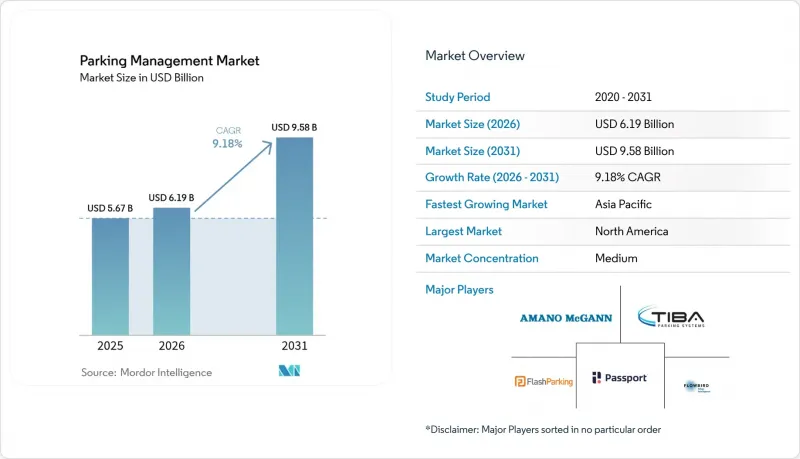
據 Mordor Intelligence 稱,2025 年停車管理市場價值為 56.7 億美元,預計將從 2026 年的 61.9 億美元成長到 2031 年的 95.8 億美元,預測期(2026-2031 年)的複合年成長率為 9.18%。
本報告按部署模式(本地部署和雲端部署)、停車類型(路外停車、路邊停車)、解決方案組件(硬體、軟體平台、服務)、最終用戶行業(市政當局、政府機構、商業路外停車營運商等)、技術(基於感測器、基於攝影機/車牌識別等)和地區進行細分。市場預測以美元計價。
全球停車管理市場趨勢與洞察
緩解都市區的交通堵塞
動態路邊管理專案展示了停車管理如何減少車輛閒置和溫室氣體排放。舊金山的「SF Park」每六週調整一次停車費,以維持85%的運轉率,並在試點區域內實現了30%的交通流量因尋找停車位而減少。波特蘭和霍博肯類似的基於感測器的部署,為缺乏資源進行自身研究的中型城市提供了可藉鏡的成功案例。市政機構現在正將停車API與公共交通運營數據相結合,使導航應用程式能夠即時引導駕駛員找到最便宜的停車位。這種方法重新定義了停車費,使其不再只是固定的稅收,而是成為鼓勵行為改變、調整尖峰負載的手段。洛杉磯和新加坡正在提出的擁塞收費提案,進一步提升了停車數據在監管執法中的關鍵作用。
智慧城市智慧交通系統(ITS)資金
聯邦政府和超國家機構提供的專案津貼可以降低融資困難的市政當局在實施過程中面臨的風險。在美國,聯邦公路管理局已撥款23億美元,計劃在2026年前用於建設5G道路和停車系統,但資金撥付的前提是必須遵守開放架構和網路安全標準。歐洲城市正在利用「地平線歐洲」計畫的資金開展試點項目,將路邊電動車充電和自動停車引導相結合。長期資金籌措支持多機構合作項目,這些項目將停車場運作、交通號誌配時和公共交通到站時間等數據整合到一個統一的城市交通資訊平台。互通性是必要的合格標準,這使得支援標準化API的供應商在競標過程中擁有結構性優勢。
網路安全和資料隱私漏洞
從2024年4月起強制過渡到PCI-DSS 4.0標準,暴露了仍在運作已有十年歷史的控制器的設施的安全漏洞。加州和荷蘭未授權存取車牌資料庫事件加劇了公眾的關注,並促使監管機構擴大審計範圍,將匿名化協議納入其中。雖然大型平台已透過實施零信任架構並與專業安全公司合作來應對,但小規模停車場業者卻難以負擔持續滲透測試的費用。如果歐盟提案的將路邊管理資料歸類為「高風險人工智慧處理」的提案獲得通過,則可能要求演算法具有更高的透明度,從而進一步加重合規預算的負擔。
細分市場分析
預計2025年,本地停車管理市場規模將達到32.9億美元,佔總營收的58.02%。由於地下深處行動電話訊號不穩定,運營商優先考慮在關鍵節點部署本地控制。然而,隨著大都會圈Wi-Fi和專用LTE骨幹網路的日趨成熟,雲端原生服務市場正以11.12%的複合年成長率快速成長。跨站點控制面板使資產組合所有者能夠使用一套規則集中調整收費系統,而自動化災害復原協議則最大限度地降低了停機風險。
雲端採用為供應商提供更清晰、更穩定的收入來源,並透過基於訂閱的營運支出 (OPEX) 而非不規則的資本支出 (CAPEX) 為資產所有者提供穩定的現金流。集中式軟體修補程式縮短了漏洞存在的時間,符合 PCI-DSS 4.0 稽核週期。此外,雲端架構簡化了與出行即服務 (MaaS) 的整合,使第三方應用程式能夠在不暴露停車網路的情況下執行令牌化預訂處理。因此,在停車管理市場中,混合部署(即本地閘道器快取交易並同時與雲端分析同步)正逐漸變得越來越普遍。
2025年,在機場、醫院和多租戶零售綜合體等穩定需求的支撐下,路外停車設施的收入將達到34.9億美元,佔停車管理市場佔有率的61.57%。同時,路邊停車設施也呈現強勁成長勢頭,年複合成長率達11.28%,主要得益於伯明罕和圭爾夫等城市實施的數位化彎道管理法規。
路邊停車管理技術的進步反映出政策正朝著將路邊空間視為多模態資產的方向轉變。即時儀錶板能夠僅在感測器偵測到停車超時才派遣執法巡邏,從而將加班成本降低18%。非接觸式停車計時器和車牌支付應用程式降低了現金處理的安全風險,而浮動定價則提高了周轉率,並吸引了人流前往附近的零售商店。提供整合票務工作流程和開放資料饋送的供應商正獲得負責人的支持,他們尋求的是端到端的透明度。
區域分析
到2025年,北美將佔全球整體收入的38.96%,反映出該地區數位化進程的成熟以及動態定價的早期應用。地方政府正在利用開放資料政策,要求供應商公開停車狀態API,從而促進第三方在導航和路邊配送路線最佳化方面的創新。 PCI-DSS 4.0的實施以及《加州消費者隱私法案》(CCPA)的修訂,增加了對防篡改架構的需求。營運商正在利用人工智慧視覺技術取消閘機,從而將平均通行時間縮短40%,並提高用戶滿意度。
亞太地區的發展軌跡有所不同,其複合年成長率高達9.78%,位居該地區之首。中國、日本和韓國的快速都市化給土地利用帶來了巨大壓力,使得高效分配路邊停車位成為一項重要的政策議題。各國都在大力推動智慧城市建設,投資感測器網路和5G骨幹網,以降低雲端導航的延遲。汽車製造商正在將Parkopedia資訊整合到車輛儀錶板中,即使在三線城市,透過整合在超級應用程式中的QR碼支付,非接觸式停車也變得越來越普遍。該地區消費者較高的技術素養正在加速技術普及,並縮短試點解決方案全面部署所需的時間。
在歐洲,嚴格的資料隱私保護與永續性目標之間需要取得平衡。修訂後的《一般資料保護規範》(GDPR)跨境資料傳輸條款將於2025年進行修訂,該條款要求資料在地化或採用經批准的合約機制,這促使許多營運商選擇區域性雲端服務區。綠色交易將路邊停車政策與出行方式轉變目標掛鉤,鼓勵使用預留給微型交通工具停靠站和電動車充電樁的空間。斯德哥爾摩和馬德里的動態定價試點計畫與排放氣體等級掛鉤,以鼓勵消費者選擇更清潔的車輛。儘管市場成長較為緩慢,但監管的明確性增強了供應商對其投資的信心。
南美、中東和非洲仍然是新興市場,但它們在我們業務拓展藍圖中的地位日益重要。在聖保羅,我們正在將停車感應器與洪水預警網路整合,以便在季風季節疏導交通。同時,在杜拜,我們正在將智慧停車的營運權納入我們的「無紙化政府」策略。儘管專案數量不多,但待開發區專案能夠讓我們直接邁向雲端架構,而無需受制於舊有系統。
其他好處:
- Excel格式的市場預測(ME)表
- 3個月的分析師支持
目錄
第1章:引言
- 研究假設和市場定義
- 調查範圍
第2章:調查方法
第3章執行摘要
第4章 市場狀況
- 市場概覽
- 市場促進因素
- 緩解都市區的交通堵塞
- 為智慧城市智慧交通系統提供資金
- 實現雲端原生“停車即服務”
- 行動支付和電子票務的普及率
- 整合主導出行即服務 (MaaS) 驅動的動態路邊定價
- 透過房地產投資信託基金(REITs)套現停車場資產
- 市場限制因素
- 網路安全和資料隱私漏洞
- 巨額資本支出 (CAPEX) 以及與整合舊有系統。
- 股市反彈對抗動態定價
- 缺乏互通性標準(廠商鎖定)
- 監理情勢
- 技術展望
- 波特五力分析
- 宏觀經濟因素對市場的影響
- 投資分析
第5章 市場規模與成長預測
- 按部署模式
- 現場
- 基於雲端的
- 停車
- 除路邊停車外的其他停車方式
- 在街上
- 按解決方案組件
- 硬體(儀表、感測器、攝影機、車牌辨識系統(LPR)、自助服務終端)
- 軟體平台
- 服務(實施、管理服務、諮詢)
- 按最終用戶行業分類
- 地方政府和政府
- 商業路外停車場營運商
- 大眾運輸和機場
- 飯店和零售業
- 醫學和大學
- 其他終端用戶產業
- 透過技術
- 感測器類型(超音波、磁力計)
- 攝影機/車牌辨識底座
- 行動應用與藍牙
- RFID和NFC
- 地區
- 北美洲
- 美國
- 加拿大
- 墨西哥
- 歐洲
- 英國
- 德國
- 法國
- 義大利
- 其他歐洲國家
- 亞太地區
- 中國
- 印度
- 日本
- 韓國
- 其他亞太國家
- 南美洲
- 巴西
- 阿根廷
- 其他南美國家
- 中東和非洲
- 中東
- 阿拉伯聯合大公國
- 沙烏地阿拉伯
- 土耳其
- 其他中東國家
- 非洲
- 南非
- 埃及
- 其他非洲國家
- 中東
- 北美洲
第6章 競爭情勢
- 市場集中度
- 策略趨勢
- 市佔率分析
- 公司簡介
- Amano McGann Inc.
- Conduent Transportation Solutions Inc.
- SKIDATA GmbH
- Flowbird Group SAS
- TIBA Parking Systems(FAAC SpA)
- FlashParking Inc.
- Passport Labs Inc.
- Q-Free ASA
- Siemens AG(Intelligent Traffic Systems)
- Bosch Security and Safety Systems(Robert Bosch GmbH)
- Indigo Park Services UK Ltd.
- LAZ Parking Ltd. LLC
- Cleverciti Systems GmbH
- IPS Group Inc.
- ParkMobile LLC
- EasyPark Group AB
- SenSen Networks Ltd.
- Parkopedia Ltd.
- Streetline Inc.
- ParkHelp Technologies SL
- ParkPlus Inc.
第7章 市場機會與未來展望
According to Mordor Intelligence, the parking management market size was valued at USD 5.67 billion in 2025 and estimated to grow from USD 6.19 billion in 2026 to reach USD 9.58 billion by 2031, at a CAGR of 9.18% during the forecast period (2026-2031).
This report is Segmented by Deployment Model (On-Premises and Cloud-Based), Parking Site (Off-Street, On-Street), Solution Component (Hardware, Software Platform, Services), End-User Vertical (Municipal and Government, Commercial Off-Street Operators, and More), Technology (Sensor-Based, Camera/LPR-based, and More), and Geography. The Market Forecasts are Provided in Terms of Value (USD).
Global Parking Management Market Trends and Insights
Urban Traffic Congestion Mitigation
Dynamic curb management programs demonstrate how parking can reduce vehicle circling and greenhouse-gas emissions. San Francisco's SF Park recalibrates rates every six weeks to maintain 85% occupancy, producing documented 30% reductions in search traffic within pilot zones. Similar sensor-based deployments in Portland and Hoboken showcase transferable playbooks for mid-sized cities that lack the resources for bespoke research. Municipal agencies now position parking APIs alongside transit feeds, allowing navigation apps to direct drivers to the lowest-cost bay in real time. The approach reframes parking fees from static taxes to behavior-modifying levers that re-balance peak-hour loads. Emerging congestion-pricing proposals in Los Angeles and Singapore further elevate the role of parking data as an enforcement backbone.
Smart-City Funding for Intelligent Transport Systems
Dedicated federal and supra-national grants are lowering adoption risk for cash-strapped municipalities. In the United States, the Federal Highway Administration earmarked USD 2.3 billion through 2026 for 5G-enabled roadway and parking systems, with disbursements contingent on open-architecture and cybersecurity compliance. European cities tap into Horizon Europe funds to pilot curb-side EV-charging combined with automated parking guidance. Long-cycle capital unlocks multi-agency projects that fuse parking occupancy, traffic-signal timing, and public-transit arrival data into a single urban-mobility dashboard. Because eligibility criteria require interoperability, vendors that support standardized APIs gain a structural advantage when bids are scored.
Cyber-Security and Data-Privacy Vulnerabilities
Mandatory migration to PCI-DSS 4.0 after April 2024 exposed security gaps at facilities still running decade-old controllers. Breaches of license-plate databases in California and the Netherlands amplified public scrutiny, prompting regulators to widen audit scopes to include anonymization protocols. Large platforms responded by embedding zero-trust architectures and partnering with specialist security firms, but smaller garages struggle to fund continual penetration testing. EU proposals to classify curb-management data as "high-risk AI processing" may add algorithmic-transparency requirements that further stretch compliance budgets.
Other drivers and restraints analyzed in the detailed report include:
- Cloud-Native Parking-as-a-Service Adoption
- Mobile Payment and Digital Ticketing Penetration
- High CAPEX and Legacy-System Integration Complexity
For complete list of drivers and restraints, kindly check the Table Of Contents.
Segment Analysis
The parking management market size for on-premise systems reached USD 3.29 billion in 2025, translating into a 58.02% revenue share. Operators value on-premise control for mission-critical gateways where sub-basement cellular signals remain unreliable. Even so, cloud-native offerings are expanding at an 11.12% CAGR as metropolitan Wi-Fi and private-LTE backbones mature. Cross-site dashboards allow portfolio owners to adjust tariffs globally with a single rule set, and automated disaster-recovery protocols minimize downtime risk.
Cloud adoption strengthens recurring-revenue visibility for vendors and stabilizes cash flows for asset owners via subscription OPEX rather than lumpy CAPEX. Because software patches roll out centrally, vulnerability windows shrink, aligning with PCI-DSS 4.0 audit cycles. Cloud architectures also simplify MaaS integrations, letting third-party apps conduct tokenized reservations without exposing garage networks. As a result, the parking management market sees a progressive blending of hybrid deployments where local gateways cache transactions but sync to cloud analytics.
Off-street facilities generated USD 3.49 billion in revenue in 2025, underpinned by stable demand at airports, hospitals, and multi-tenant retail complexes. This accounted for 61.57% of the parking management market share. Yet on-street deployments show superior expansion, rising at an 11.28% CAGR on the back of digital curb-management ordinances in cities such as Birmingham and Guelph.
The on-street advance reflects a policy pivot that treats curb space as a multimodal asset. Real-time dashboards dispatch enforcement patrols only when sensors flag overstays, cutting overtime costs by 18%. Contactless meters and pay-by-plate apps lower cash-handling security risks, while variable rates raise turnover, boosting surrounding retail footfall. Vendors that offer integrated citation workflows and open-data feeds gain mindshare among planners seeking end-to-end transparency.
Complete Report Scope:
- By Deployment Model
- On-premises
- Cloud-based
- By Parking Site
- Off-street
- On-street
- By Solution Component
- Hardware (Meters, Sensors, Cameras, LPR, Kiosks)
- Software Platform
- Services (Installation, Managed, Consulting)
- By End-User Vertical
- Municipal and Government
- Commercial Off-street Operators
- Transit and Airports
- Hospitality and Retail
- Healthcare and Universities
- Other End-User Verticals
- By Technology
- Sensor-based (ultrasonic, magnetometer)
- Camera / LPR-based
- Mobile-app and Bluetooth
- RFID and NFC
- Geography
- North America
- United States
- Canada
- Mexico
- Europe
- United Kingdom
- Germany
- France
- Italy
- Rest of Europe
- Asia Pacific
- China
- India
- Japan
- South Korea
- Rest of Asia Pacific
- South America
- Brazil
- Argentina
- Rest of South America
- Middle East and Africa
- Middle East
- United Arab Emirates
- Saudi Arabia
- Turkey
- Rest of Middle East
- Africa
- South Africa
- Egypt
- Rest of Africa
- Middle East
- North America
Geography Analysis
North America retained 38.96% of global revenue in 2025, reflecting mature digitization mandates and early adoption of dynamic pricing. Municipalities leverage open-data policies that compel vendors to expose occupancy APIs, spurring third-party innovation in navigation and curb-delivery routing. PCI-DSS 4.0 enforcement and California Consumer Privacy Act amendments drive demand for tamper-resistant architectures. Operators deploy AI vision to remove gates, cutting average ingress times by 40% and elevating user satisfaction scores.
Asia Pacific follows a different trajectory, posting the fastest regional CAGR at 9.78%. Rapid urbanization in China, Japan, and South Korea creates acute land-use pressures, making efficient curb allocation a policy imperative. National smart-city blueprints fund sensor grids and 5G backbones that lower latency for cloud guidance. Automakers integrate Parkopedia feeds into dashboards, and QR payments embedded in super-apps normalize contactless parking even in tier-three cities. The region's consumer tech literacy accelerates adoption curves, compressing time-to-scale for pilot solutions.
Europe balances data-privacy rigor with sustainability objectives. Revised GDPR cross-border transfer clauses in 2025 require data-localization or approved contractual mechanisms, leading many operators to choose regional cloud zones. EU Green Deal legislation links curb policy to modal-shift targets, incentivizing spaces reserved for micro-mobility docks and EV charging. Dynamic-pricing pilots in Stockholm and Madrid tie tariffs to emission classes, nudging fleets toward cleaner vehicles. While market growth is moderate, regulatory clarity supports vendor investment certainty.
South America and the Middle East and Africa remain emergent but increasingly visible in expansion roadmaps. Sao Paulo integrates parking sensors with flood-alert networks to reroute traffic during monsoon events, while Dubai positions smart-parking concessions as part of a "paperless government" strategy. Although project counts are lower, greenfield builds allow leapfrogging directly to cloud architectures without legacy constraints.
- Amano McGann Inc.
- Conduent Transportation Solutions Inc.
- SKIDATA GmbH
- Flowbird Group SAS
- TIBA Parking Systems (FAAC SpA)
- FlashParking Inc.
- Passport Labs Inc.
- Q-Free ASA
- Siemens AG (Intelligent Traffic Systems)
- Bosch Security and Safety Systems (Robert Bosch GmbH)
- Indigo Park Services UK Ltd.
- LAZ Parking Ltd. LLC
- Cleverciti Systems GmbH
- IPS Group Inc.
- ParkMobile LLC
- EasyPark Group AB
- SenSen Networks Ltd.
- Parkopedia Ltd.
- Streetline Inc.
- ParkHelp Technologies S.L.
- ParkPlus Inc.
Additional Benefits:
- The market estimate (ME) sheet in Excel format
- 3 months of analyst support
TABLE OF CONTENTS
1 INTRODUCTION
- 1.1 Study Assumptions and Market Definition
- 1.2 Scope of the Study
2 RESEARCH METHODOLOGY
3 EXECUTIVE SUMMARY
4 MARKET LANDSCAPE
- 4.1 Market Overview
- 4.2 Market Drivers
- 4.2.1 Urban traffic congestion mitigation
- 4.2.2 Smart-city funding for intelligent transport systems
- 4.2.3 Cloud-native parking-as-a-service adoption
- 4.2.4 Mobile payment and digital ticketing penetration
- 4.2.5 MaaS-driven dynamic curb-pricing integration
- 4.2.6 Real-estate REIT monetisation of parking assets
- 4.3 Market Restraints
- 4.3.1 Cyber-security and data-privacy vulnerabilities
- 4.3.2 High CAPEX and legacy-system integration complexity
- 4.3.3 Equity backlash against dynamic pricing
- 4.3.4 Lack of interoperability standards (vendor lock-in)
- 4.4 Regulatory Landscape
- 4.5 Technological Outlook
- 4.6 Porter's Five Forces Analysis
- 4.6.1 Threat of New Entrants
- 4.6.2 Bargaining Power of Buyers
- 4.6.3 Bargaining Power of Suppliers
- 4.6.4 Threat of Substitutes
- 4.6.5 Competitive Rivalry
- 4.7 Impact of Macroeconomic Factors on the Market
- 4.8 Investment Analysis
5 MARKET SIZE AND GROWTH FORECASTS (VALUE)
- 5.1 By Deployment Model
- 5.1.1 On-premises
- 5.1.2 Cloud-based
- 5.2 By Parking Site
- 5.2.1 Off-street
- 5.2.2 On-street
- 5.3 By Solution Component
- 5.3.1 Hardware (Meters, Sensors, Cameras, LPR, Kiosks)
- 5.3.2 Software Platform
- 5.3.3 Services (Installation, Managed, Consulting)
- 5.4 By End-User Vertical
- 5.4.1 Municipal and Government
- 5.4.2 Commercial Off-street Operators
- 5.4.3 Transit and Airports
- 5.4.4 Hospitality and Retail
- 5.4.5 Healthcare and Universities
- 5.4.6 Other End-User Verticals
- 5.5 By Technology
- 5.5.1 Sensor-based (ultrasonic, magnetometer)
- 5.5.2 Camera / LPR-based
- 5.5.3 Mobile-app and Bluetooth
- 5.5.4 RFID and NFC
- 5.6 Geography
- 5.6.1 North America
- 5.6.1.1 United States
- 5.6.1.2 Canada
- 5.6.1.3 Mexico
- 5.6.2 Europe
- 5.6.2.1 United Kingdom
- 5.6.2.2 Germany
- 5.6.2.3 France
- 5.6.2.4 Italy
- 5.6.2.5 Rest of Europe
- 5.6.3 Asia Pacific
- 5.6.3.1 China
- 5.6.3.2 India
- 5.6.3.3 Japan
- 5.6.3.4 South Korea
- 5.6.3.5 Rest of Asia Pacific
- 5.6.4 South America
- 5.6.4.1 Brazil
- 5.6.4.2 Argentina
- 5.6.4.3 Rest of South America
- 5.6.5 Middle East and Africa
- 5.6.5.1 Middle East
- 5.6.5.1.1 United Arab Emirates
- 5.6.5.1.2 Saudi Arabia
- 5.6.5.1.3 Turkey
- 5.6.5.1.4 Rest of Middle East
- 5.6.5.2 Africa
- 5.6.5.2.1 South Africa
- 5.6.5.2.2 Egypt
- 5.6.5.2.3 Rest of Africa
- 5.6.5.1 Middle East
- 5.6.1 North America
6 COMPETITIVE LANDSCAPE
- 6.1 Market Concentration
- 6.2 Strategic Moves
- 6.3 Market Share Analysis
- 6.4 Company Profiles (includes Global level Overview, Market level overview, Core Segments, Financials as available, Strategic Information, Market Rank/Share for key companies, Products and Services, and Recent Developments)
- 6.4.1 Amano McGann Inc.
- 6.4.2 Conduent Transportation Solutions Inc.
- 6.4.3 SKIDATA GmbH
- 6.4.4 Flowbird Group SAS
- 6.4.5 TIBA Parking Systems (FAAC SpA)
- 6.4.6 FlashParking Inc.
- 6.4.7 Passport Labs Inc.
- 6.4.8 Q-Free ASA
- 6.4.9 Siemens AG (Intelligent Traffic Systems)
- 6.4.10 Bosch Security and Safety Systems (Robert Bosch GmbH)
- 6.4.11 Indigo Park Services UK Ltd.
- 6.4.12 LAZ Parking Ltd. LLC
- 6.4.13 Cleverciti Systems GmbH
- 6.4.14 IPS Group Inc.
- 6.4.15 ParkMobile LLC
- 6.4.16 EasyPark Group AB
- 6.4.17 SenSen Networks Ltd.
- 6.4.18 Parkopedia Ltd.
- 6.4.19 Streetline Inc.
- 6.4.20 ParkHelp Technologies S.L.
- 6.4.21 ParkPlus Inc.
7 MARKET OPPORTUNITIES AND FUTURE OUTLOOK
- 7.1 White-space and Unmet-Need Assessment

 智慧停車和彎道管理市場預測至2034年-按解決方案類型、硬體基礎設施、服務模式、部署模式、技術、最終用戶和地區分類的全球分析
 停車管理市場:按交付方式、技術、最終用戶和應用分類-2026-2032年全球市場預測停車場管理市場:按組件、停車類型、營運模式、預訂方式、停車時長、設施類型、容量、部署狀態和客戶類型分類-2026-2032年全球市場預測
 停車管理市場:市場機會、成長促進因素、產業趨勢分析及未來預測(2026-2035)智慧路側管理市場預測至2034年-按路緣類型、定價模式、部署模式、功能、應用、最終用戶和地區分類的全球分析
 自動停車管理系統市場:分析與預測(至2035年)-類型、產品類型、服務、技術、組件、應用、部署模式、最終使用者、安裝模式、解決方案
 非路邊停車管理系統市場:按系統元件和服務、解決方案、最終用戶產業、地區分類智慧路緣管理系統市場預測至2034年-按組件、解決方案類型、部署模式、最終用戶和地區分類的全球分析停車場門禁控制市場:按產品類型(平開門/滑動門、車庫門、工業門、收費機、過期檢測器/編碼站、感測器、攝影機、指示牌、其他)、按解決方案、按技術、按行業、按地區分類路邊管理解決方案市場預測至2034年-按組件、解決方案類型、部署模式、最終用戶和地區分類的全球分析