


 |
市場調查報告書
商品編碼
2124314
雲端IT服務管理(ITSM):市場佔有率分析、產業趨勢與統計數據、成長預測(2026-2031年)Cloud Information Technology Service Management (ITSM) - Market Share Analysis, Industry Trends & Statistics, Growth Forecasts (2026 - 2031) |
||||||

※ 本網頁內容可能與最新版本有所差異。詳細情況請與我們聯繫。
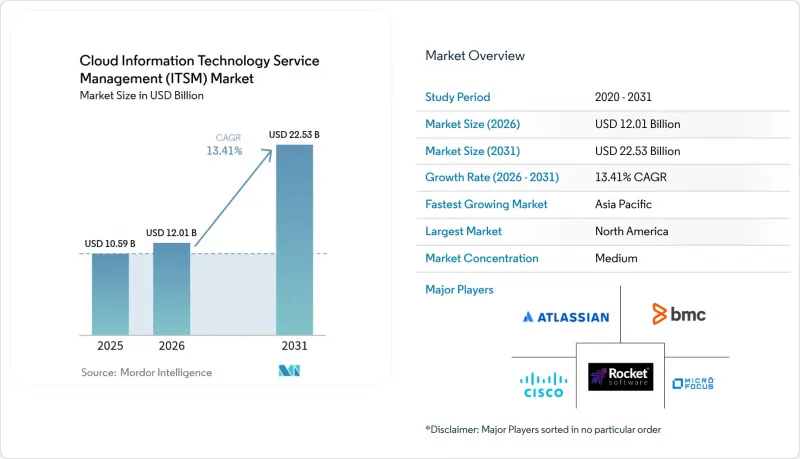
根據 Mordor Intelligence 估計,到 2026 年,雲端 IT 服務管理 (ITSM) 市場價值將達到 120.1 億美元,從 2025 年的 105.9 億美元成長到 2031 年的 225.3 億美元。
預計 2026 年至 2031 年的複合年成長率為 13.41%。
本報告按組件(解決方案和服務)、部署模式(公共雲端、私有雲端、混合雲端)、組織規模(大型企業、中小企業)、應用(配置管理、性能管理及其他)、最終用戶行業(IT與電信、銀行、金融服務及保險業及其他)和地區進行細分。市場預測以美元計價。
全球雲端IT服務管理(ITSM)市場趨勢與洞察
分散式 DevOps 團隊對多重雲端管治的需求日益成長。
對於在 AWS、Microsoft Azure 和 Google Cloud 等雲端平台上執行工作負載的公司而言,隨著微服務跨越多個區域和供應商,複雜性也隨之增加。整合式雲端 IT 服務管理 (ITSM) 平台提供自動化發現和依賴關係映射功能,能夠關聯混合環境中的事件,使 DevOps 團隊無需切換單一工具即可維持服務水準。整合式視覺性功能可對容器化應用程式進行預測分析,減少冗餘監控的開銷,並提供符合稽核人員評估跨境資料流要求的合規性報告。
向遠端和混合辦公模式的快速轉變,使得IT服務管理(ITSM)自動化勢在必行。
在永久性混合辦公環境中,企業需要始終運作的自助服務入口網站和與 Teams 和 Slack 等協作平台整合的 AI 聊天機器人。現代雲端 IT 服務管理平台整合了支援自然語言的虛擬代理,能夠在幾秒鐘內解決常規問題,並能提供完整的上下文資訊來回報複雜問題,從而減少支援隊列並改善員工體驗。預測分析能夠在設備故障中斷用戶操作之前檢測到故障,這項功能被認為是分散式營運中必不可少的基礎架構。
資料位置法規限制了跨境事件資料的流動。
歐盟的《數位運作彈性法案》和韓國的資料主權法規等框架要求將可能包含個人資訊的事件日誌儲存在本地。這限制了集中式分析,並迫使雲端IT服務管理市場的供應商建構區域資料中心。跨國公司為了遵守法規而部署獨立實例,但這增加了營運成本,並導致全球儀錶板分散。
細分市場分析
到2025年,解決方案將佔據雲端IT服務管理市場佔有率的72.45%,這反映出客戶優先考慮建立穩健的平台基礎。 ServiceNow等供應商的訂閱收入在2024年第二季超過25億美元,顯示市場對人工智慧自動化模組、工作流程引擎和低程式碼應用程式建構器有著強勁的需求。
隨著企業認知到配置智慧路由、整合配置管理資料庫 (CMDB) 和整合 DevOps 管道所需的變革性努力,業務收益正以 18.65% 的複合年成長率成長。託管服務提供者現在提供與平均修復時間 (MTTR) 和淨推薦值 (NPS) 掛鉤的基本契約,在轉移營運風險的同時保證價值交付。
公共雲端在受混合雲端正以16.08%的複合年成長率快速成長,其特點是將敏感資料儲存在私有節點上,同時利用公共雲端的AI引擎進行分析。
混合模式也有助於降低廠商鎖定風險,因為企業可以根據工作負載在價格或效能變更時遷移到不同的環境。因此,廠商正在投資開發可攜式架構,以實現跨環境策略同步並符合區域限制,同時避免重複管理任務。
區域分析
預計到2025年,北美將佔全球總支出的39.60%,這主要得益於雲端運算的廣泛應用、豐富的AI技能人才儲備以及超大規模資料中心業者和平台供應商之間充滿活力的夥伴關係生態系統。企業比以往任何時候都更密切地關注雲端計費,並積極推動財務營運(FinOps)管治,以檢驗業務擴張的價值。在自動化能夠帶來顯著生產力提升的領域,尤其是在競爭激烈的服務業,企業將持續增加投資。
亞太地區是成長最快的區域,預計到2031年複合年成長率將達到17.08%。韓國和新加坡的國家數位化策略正在鼓勵建置本地資料中心,而企業也正在採用雲端IT服務管理平台以滿足資料位置要求。 Atlassian決定在首爾提供Jira服務管理服務,這清楚地表明了供應商對各國特定法規的回應。印度和印尼中小企業的快速發展也推動了市場規模的擴張。
受GDPR和DORA(針對2025年生效的金融領域)的影響,歐洲市場正穩定擴張。企業更傾向於選擇能夠提供強大加密、精細審計日誌和完善的資料外洩通知流程的供應商。在中東和非洲,隨著政府機構推動智慧城市計畫並需要彈性IT基礎設施,IT解決方案的採用率也不斷提高。在拉丁美洲,注重成本效益的適度採用正在推進,輕量級軟體包能夠處理基本的事件追蹤和知識管理,因此更受青睞。
其他好處
- Excel格式的市場預測(ME)表
- 3個月的分析師支持
目錄
第1章:引言
- 研究假設和市場定義
- 調查範圍
第2章:調查方法
第3章執行摘要
第4章 市場狀況
- 市場概覽
- 市場促進因素
- 分散式 DevOps 團隊對多重雲端服務管治的需求日益成長。
- 加速向遠端和混合辦公模式的過渡需要IT服務管理(ITSM)自動化。
- 企業對 ITIL 4 的日益普及正在推動基於 SaaS 的 ITSM 的升級。
- 透過整合人工智慧和機器學習進行預測性事件管理,縮短平均修復時間。
- 尤其對於中小企業而言,基於訂閱的營運成本 (OpEx) 模式比資本支出 (Capex) 模式更受歡迎。
- 市場限制因素
- 資料位置法規限制了跨境事件資料的流動。
- 傳統工具的氾濫阻礙了向雲端統一配置管理資料庫 (CMDB) 的遷移。
- 容器化微服務環境的可見性差距
- 不斷上漲的雲端營運成本 (OPEX) 導致財務營運受到審查,並造成合約續約延遲。
- 價值鏈分析
- 監理展望
- 波特五力分析
- 市場宏觀經濟趨勢的評估
第5章 市場規模與成長預測
- 按組件
- 解決方案
- 服務
- 按部署模式
- 公共雲端
- 私有雲端
- 混合雲端
- 按組織規模
- 大公司
- 中小企業
- 透過使用
- 配置管理
- 績效管理
- 網管
- 資料庫管理
- 服務台事件管理
- 問題管理
- 其他
- 按最終用戶行業分類
- 資訊科技/通訊
- BFSI
- 零售和消費品
- 醫療保健和生命科學
- 製造業
- 政府/公共部門
- 教育
- 其他終端用戶產業
- 按地區
- 北美洲
- 美國
- 加拿大
- 墨西哥
- 歐洲
- 英國
- 德國
- 法國
- 義大利
- 西班牙
- 其他歐洲國家
- 亞太地區
- 中國
- 日本
- 印度
- 韓國
- 其他亞太國家
- 南美洲
- 巴西
- 阿根廷
- 智利
- 其他南美國家
- 中東
- 沙烏地阿拉伯
- 阿拉伯聯合大公國
- 卡達
- 土耳其
- 其他中東國家
- 非洲
- 南非
- 埃及
- 奈及利亞
- 肯亞
- 其他非洲地區
- 北美洲
第6章 競爭情勢
- 市場集中度
- 策略趨勢
- 市佔率分析
- 公司簡介
- ASG Technologies Group, Inc.
- BMC Software Inc.
- IBM Corporation
- Atlassian Corporation Plc
- Micro Focus International Plc
- Broadcom(CA Technologies)
- Freshworks Inc.
- Cherwell Software LLC
- Hewlett Packard Enterprise
- ServiceNow Inc.
- Ivanti Inc.
- Citrix Systems Inc.
- Axios Systems Plc
- Sunrise Software Ltd.
- ManageEngine(Zoho Corp.)
- EasyVista SA
- SysAid Technologies Ltd.
- SolarWinds Corp.
- Fujitsu Limited
- Oracle Corporation
- Microsoft Corporation
第7章 市場機會與未來展望
According to Mordor Intelligence, the cloud information technology service management (ITSM) market size in 2026 is estimated at USD 12.01 billion, growing from 2025 value of USD 10.59 billion with 2031 projections showing USD 22.53 billion, growing at 13.41% CAGR over 2026-2031.
This report is Segmented by Component (Solutions, and Services), Deployment Model (Public, Private, and Hybrid), Organization Size (Large Enterprises, and Small and Medium Enterprises), Application (Configuration Management, Performance Management, and More), End-User Vertical (IT and Telecom, BFSI, and More), and Geography. The Market Forecasts are Provided in Terms of Value (USD).
Global Cloud Information Technology Service Management (ITSM) Market Trends and Insights
Rising demand for multi-cloud governance across distributed DevOps teams
Enterprises running workloads across AWS, Microsoft Azure, and Google Cloud face escalating complexity as microservices span multiple regions and providers. Unified cloud information technology service management market platforms now offer automated discovery and dependency mapping that correlate incidents across hybrid estates, allowing DevOps teams to maintain service levels without juggling point tools. Consolidating visibility enables predictive analytics on containerized applications, reduces duplicated monitoring overhead, and provides compliance reporting that satisfies auditors evaluating cross-border data flows.
Accelerated shift to remote and hybrid work requiring ITSM automation
Permanent hybrid workforces demand always-on self-service portals and AI chatbots integrated with collaboration hubs such as Teams and Slack. Modern cloud information technology service management market platforms embed natural-language virtual agents that resolve routine tickets in seconds and escalate complex issues with full context attached, trimming support queues and enhancing employee experience. Predictive insights flag device failures before users are disrupted, a capability viewed as essential infrastructure for dispersed operations.
Data residency regulations limiting cross-border incident data flow
Frameworks such as the EU's Digital Operational Resilience Act and South Korea's data sovereignty mandates require local storage of incident logs that may contain personal information, constraining central analytics and forcing cloud information technology service management market vendors to build regional data centers. Multinationals deploy separate instances to comply, which increases operational costs and fragments global dashboards.
Other drivers and restraints analyzed in the detailed report include:
- Proliferation of ITIL 4 adoption driving SaaS ITSM upgrades
- Integration of AI/ML for predictive incident management
- Legacy tool sprawl hindering unified CMDB migration to cloud
For complete list of drivers and restraints, kindly check the Table Of Contents.
Segment Analysis
Solutions captured 72.45% of the cloud information technology service management market share in 2025, reflecting customers priority to secure a robust platform foundation. Subscription revenues at vendors such as ServiceNow surpassed USD 2.5 billion in Q2 2024, illustrating demand for AI automation modules, workflow engines, and low-code app builders.
Services revenue is climbing at 18.65% CAGR as enterprises realize the transformation effort required to configure intelligent routing, federate CMDBs, and embed DevOps pipelines. Managed providers now offer outcome-based agreements tied to MTTR and Net Promoter Scores, transferring operational risk and assuring value delivery.
The public cloud is expected to represent 57.30% of the cloud information technology service management market size in 2025, driven by rapid provisioning and lower infrastructure overhead. Yet, Hybrid cloud is rising at a 16.08% CAGR because regulated sectors keep sensitive data on private nodes while exploiting public-cloud AI engines for analytics.
A hybrid stance also mitigates vendor lock-in: organizations can redirect workloads if pricing or performance shifts. Vendors, therefore, invest in portable architectures that synchronize policies across environments and respect locality constraints without duplicating administrative effort.
Complete Report Scope:
- By Component
- Solutions
- Services
- By Deployment Model
- Public Cloud
- Private Cloud
- Hybrid Cloud
- By Organization Size
- Large Enterprises
- Small and Medium Enterprises (SMEs)
- By Application
- Configuration Management
- Performance Management
- Network Management
- Database Management
- Service Desk and Incident Management
- Problem Management
- Other Applications
- By End-user Vertical
- IT and Telecom
- BFSI
- Retail and Consumer Goods
- Healthcare and Life Sciences
- Manufacturing
- Government and Public Sector
- Education
- Other End-user Verticals
- By Geography
- North America
- United States
- Canada
- Mexico
- Europe
- United Kingdom
- Germany
- France
- Italy
- Spain
- Rest of Europe
- Asia-Pacific
- China
- Japan
- India
- South Korea
- Rest of Asia-Pacific
- South America
- Brazil
- Argentina
- Chile
- Rest of South America
- Middle East
- Saudi Arabia
- United Arab Emirates
- Qatar
- Turkey
- Rest of Middle East
- Africa
- South Africa
- Egypt
- Nigeria
- Kenya
- Rest of Africa
- North America
Geography Analysis
North America contributed 39.60% of total spending in 2025, enabled by deep cloud adoption, readily available AI skills, and active partnership ecosystems between hyperscalers and platform providers. Enterprises monitor cloud bills more closely and pursue FinOps governance to validate the business value of expansions. Investment continues where automation yields measurable productivity gains, particularly in highly competitive service industries.
The Asia-Pacific region is the fastest-growing region, with a 17.08% CAGR through 2031. National digital agendas in South Korea and Singapore incentivize local data centers, while businesses adopt cloud information technology service management market platforms to comply with data residency mandates. Atlassian's decision to offer Seoul-hosted Jira Service Management illustrates the vendor's response to country-specific rules. Rapid SME formation in India and Indonesia also contributes to the growth in volume.
Europe expands at a steady pace, shaped by GDPR and, from 2025, DORA for finance. Organizations prefer suppliers offering strong encryption, granular audit logs, and documented breach-notification workflows. Middle East and Africa join the adoption curve as government entities pursue smart-city ambitions and require resilient IT backbones. Latin America follows with moderate, cost-sensitive uptake, favoring lighter bundles that address essential incident tracking and knowledge management.
- ASG Technologies Group, Inc.
- BMC Software Inc.
- IBM Corporation
- Atlassian Corporation Plc
- Micro Focus International Plc
- Broadcom (CA Technologies)
- Freshworks Inc.
- Cherwell Software LLC
- Hewlett Packard Enterprise
- ServiceNow Inc.
- Ivanti Inc.
- Citrix Systems Inc.
- Axios Systems Plc
- Sunrise Software Ltd.
- ManageEngine (Zoho Corp.)
- EasyVista S.A.
- SysAid Technologies Ltd.
- SolarWinds Corp.
- Fujitsu Limited
- Oracle Corporation
- Microsoft Corporation
Additional Benefits:
- The market estimate (ME) sheet in Excel format
- 3 months of analyst support
TABLE OF CONTENTS
1 INTRODUCTION
- 1.1 Study Assumptions and Market Definition
- 1.2 Scope of the Study
2 RESEARCH METHODOLOGY
3 EXECUTIVE SUMMARY
4 MARKET LANDSCAPE
- 4.1 Market Overview
- 4.2 Market Drivers
- 4.2.1 Rising Demand for Multi-Cloud Service Governance Across Distributed DevOps Teams
- 4.2.2 Accelerated Shift to Remote and Hybrid Work Requiring ITSM Automation
- 4.2.3 Proliferation of ITIL 4 Adoption Among Enterprises Driving SaaS ITSM Upgrades
- 4.2.4 Integration of AI/ML for Predictive Incident Management Reducing MTTR
- 4.2.5 Subscription-Based Opex Models Preferred Over Capex Especially Among SMEs
- 4.3 Market Restraints
- 4.3.1 Data Residency Regulations Limiting Cross-Border Incident Data Flow
- 4.3.2 Legacy Tool Sprawl Hindering Unified CMDB Migration to Cloud
- 4.3.3 Visibility Gaps in Highly Containerised Micro-services Environments
- 4.3.4 Rising Cloud Opex Costs Triggering FinOps Scrutiny and Renewal Delays
- 4.4 Value Chain Analysis
- 4.5 Regulatory Outlook
- 4.6 Porter's Five Forces Analysis
- 4.6.1 Threat of New Entrants
- 4.6.2 Bargaining Power of Buyers
- 4.6.3 Bargaining Power of Suppliers
- 4.6.4 Threat of Substitutes
- 4.6.5 Intensity of Competitive Rivalry
- 4.7 Assessment of Macro Economic Trends on the Market
5 MARKET SIZE AND GROWTH FORECASTS (VALUES)
- 5.1 By Component
- 5.1.1 Solutions
- 5.1.2 Services
- 5.2 By Deployment Model
- 5.2.1 Public Cloud
- 5.2.2 Private Cloud
- 5.2.3 Hybrid Cloud
- 5.3 By Organization Size
- 5.3.1 Large Enterprises
- 5.3.2 Small and Medium Enterprises (SMEs)
- 5.4 By Application
- 5.4.1 Configuration Management
- 5.4.2 Performance Management
- 5.4.3 Network Management
- 5.4.4 Database Management
- 5.4.5 Service Desk and Incident Management
- 5.4.6 Problem Management
- 5.4.7 Other Applications
- 5.5 By End-user Vertical
- 5.5.1 IT and Telecom
- 5.5.2 BFSI
- 5.5.3 Retail and Consumer Goods
- 5.5.4 Healthcare and Life Sciences
- 5.5.5 Manufacturing
- 5.5.6 Government and Public Sector
- 5.5.7 Education
- 5.5.8 Other End-user Verticals
- 5.6 By Geography
- 5.6.1 North America
- 5.6.1.1 United States
- 5.6.1.2 Canada
- 5.6.1.3 Mexico
- 5.6.2 Europe
- 5.6.2.1 United Kingdom
- 5.6.2.2 Germany
- 5.6.2.3 France
- 5.6.2.4 Italy
- 5.6.2.5 Spain
- 5.6.2.6 Rest of Europe
- 5.6.3 Asia-Pacific
- 5.6.3.1 China
- 5.6.3.2 Japan
- 5.6.3.3 India
- 5.6.3.4 South Korea
- 5.6.3.5 Rest of Asia-Pacific
- 5.6.4 South America
- 5.6.4.1 Brazil
- 5.6.4.2 Argentina
- 5.6.4.3 Chile
- 5.6.4.4 Rest of South America
- 5.6.5 Middle East
- 5.6.5.1 Saudi Arabia
- 5.6.5.2 United Arab Emirates
- 5.6.5.3 Qatar
- 5.6.5.4 Turkey
- 5.6.5.5 Rest of Middle East
- 5.6.6 Africa
- 5.6.6.1 South Africa
- 5.6.6.2 Egypt
- 5.6.6.3 Nigeria
- 5.6.6.4 Kenya
- 5.6.6.5 Rest of Africa
- 5.6.1 North America
6 COMPETITIVE LANDSCAPE
- 6.1 Market Concentration
- 6.2 Strategic Moves
- 6.3 Market Share Analysis
- 6.4 Company Profiles (includes Global Level Overview, Market Level Overview, Core Segments, Financials as available, Strategic Information, Market Rank/Share, Products and Services, Recent Developments)
- 6.4.1 ASG Technologies Group, Inc.
- 6.4.2 BMC Software Inc.
- 6.4.3 IBM Corporation
- 6.4.4 Atlassian Corporation Plc
- 6.4.5 Micro Focus International Plc
- 6.4.6 Broadcom (CA Technologies)
- 6.4.7 Freshworks Inc.
- 6.4.8 Cherwell Software LLC
- 6.4.9 Hewlett Packard Enterprise
- 6.4.10 ServiceNow Inc.
- 6.4.11 Ivanti Inc.
- 6.4.12 Citrix Systems Inc.
- 6.4.13 Axios Systems Plc
- 6.4.14 Sunrise Software Ltd.
- 6.4.15 ManageEngine (Zoho Corp.)
- 6.4.16 EasyVista S.A.
- 6.4.17 SysAid Technologies Ltd.
- 6.4.18 SolarWinds Corp.
- 6.4.19 Fujitsu Limited
- 6.4.20 Oracle Corporation
- 6.4.21 Microsoft Corporation
7 MARKET OPPORTUNITIES AND FUTURE OUTLOOK
- 7.1 White-space and Unmet-Need Assessment

 雲端IT服務管理市場:依組件、部署類型、應用、最終用途、國家及地區分類-產業分析、市場規模、市場佔有率及2026年至2033年預測
 雲端IT服務管理市場-全球產業規模、佔有率、趨勢、機會、預測:按組件、組織規模、產業、地區和競爭對手分類,2021-2031年
 雲端ITSM市場:依產品、定價模式、組織規模、部署模式和最終用途分類-2026-2032年全球市場預測
 2026年全球雲端IT服務管理(ITSM)市場報告2026年全球雲端IT服務管理市場報告
 全球雲端IT服務管理市場:市場規模-按產品/服務、解決方案類型、部署模式、組織規模、產業和地區分類-預測至2031年
 全球雲端IT服務管理市場規模、佔有率、趨勢及成長分析報告(2026-2034年)
 雲端ITSM市場規模、佔有率和成長分析(按交付類型、部署類型、組織規模、最終用戶產業和地區分類)-產業預測(2026-2033年)
 全球雲端資訊技術服務管理市場規模、佔有率、行業分析報告:按組件、公司規模、技術、行業垂直、地區、展望和預測,2025 年至 2032 年
 雲端 IT 服務管理 (雲端 ITSM) 市場規模、佔有率、成長分析,按組織規模、按部署模式、按最終用戶產業、按地區 - 產業預測,2025 年至 2032 年