


 |
市場調查報告書
商品編碼
2121252
汽車用膠帶:市場佔有率分析、產業趨勢與統計、成長預測(2026-2031)Automotive Adhesive Tape - Market Share Analysis, Industry Trends & Statistics, Growth Forecasts (2026 - 2031) |
||||||

※ 本網頁內容可能與最新版本有所差異。詳細情況請與我們聯繫。
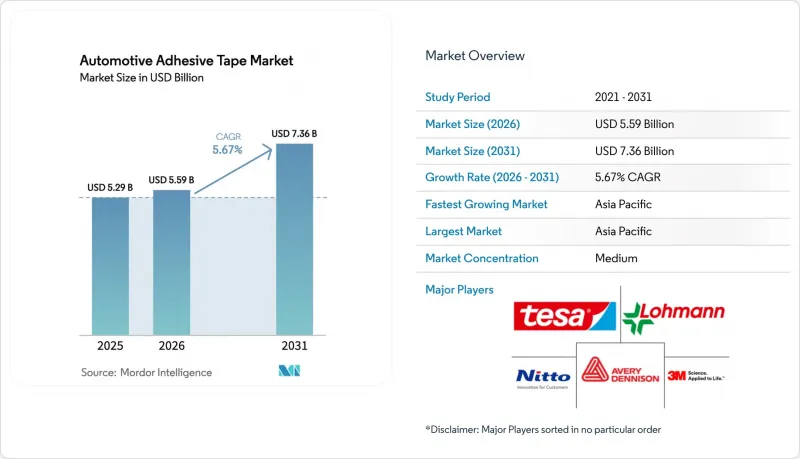
根據 Mordor Intelligence 預測,汽車膠帶市場規模預計將在 2025 年達到 52.9 億美元,2026 年達到 55.9 億美元,到 2031 年達到 73.6 億美元,2026 年至 2031 年的複合年成長率為 5.67%。
本報告按基材(PET、PVC、PP、紙張、PA 及其他基材)、黏合劑類型(環氧樹脂、丙烯酸酯、聚氨酯、矽酮及其他黏合劑)、應用領域(外部、內裝、動力傳動系統、電子產品)和地區(亞太地區、北美地區、歐洲地區、南美地區、中東和非洲地區)進行細分。市場預測以美元計價。
全球汽車膠帶市場趨勢及洞察
電動汽車電池用溫度控管膠帶的需求
隨著鋰離子電池組為防止熱失控而對持續散熱的需求日益成長,對導熱阻燃膠帶的需求也迅速超越了傳統的動力傳動系統應用。 Tesa 的 ACXplus 系列產品可將冷卻板直接黏合到電池模組上,並保持 180 度C的恆溫,無需機械夾具。 Lohmann 的 DuploFLEX 解決方案不僅符合嚴格的 UL 94 V-0 標準,而且在一公尺寬度範圍內厚度偏差小於 5%,這對於自動化點膠系統至關重要。這些技術的進步正推動市場朝向特種膠帶配方發展,其價格遠高於傳統的內裝膠帶。
輕量化是機械緊固部件的替代方案
為了符合美國企業平均燃油經濟性(CAFE)法規和歐洲歐7排放標準,汽車製造商正在加速用結構膠帶取代鉚釘和螺絲。例如,福特在2024年F-150 Lightning車身本體車型中,透過使用膠帶黏合車頂面板,實現了減重。這項改變不僅降低了車輛重量,還顯著縮短了黏合過程的周期時間。在組裝上使用膠帶可以均勻分散應力,防止因熱變形而導致的返工,並降低工具維護成本,從而提高生產效率。同樣,艾利丹尼森公司正在利用一致的丙烯酸化學成分生產原廠配套(OE)薄膜和圖形薄膜,從而有效地將研發成本分攤到不同的收入來源中。內裝零件供應商也在採用這種方法,使用雙面PET膠帶黏合裝飾條。這不僅可以隱藏可見的緊固件,還可以最大限度地減少吱吱作響的噪音,從而提升豪華品牌的內裝品質。
石化原料價格波動
原油價格波動直接影響聚丙烯和聚對苯二甲酸乙二醇酯(PET)薄膜的價格,因為這兩種樹脂都是透過石腦油裂解生產的。聚丙烯樹脂價格的急劇上漲給加工商的利潤率帶來了壓力。雖然汽車業的合約通常將膠帶價格固定一年,但樹脂供應商卻按季度調整價格。這種價格差異增加了沒有避險策略的中型加工商的風險。艾利丹尼森透過採用合約製造協議來降低這種風險,將樹脂採購責任委託給原始設備製造商(OEM)。然而,專注於特定區域的專業製造商仍然容易受到影響。樹脂成本的不確定性使生產力計畫變得複雜,並導致無溶劑塗佈生產線的投資延遲,而這些生產線可能會加速聚丙烯的普及應用。
細分市場分析
2025年,PVC佔銷售額的33.65%,尤其是在汽車線束塗層膠帶市場,這得益於其成本、可成型性和阻燃性方面的均衡優勢。然而,聚丙烯正以6.13%的成長率推動市場成長,因為其更輕的基紙張重量意味著膠帶基材中每節省一克重量,就能幫助原始設備製造商(OEM)實現減重目標。艾利丹尼森的聚丙烯薄膜不僅降低了材料成本,而且符合汽車阻燃標準,這促使多個歐洲計畫從PVC轉向聚丙烯。 2024年,羅曼公司推出了一種生物基聚丙烯基材。這符合日益成長的範圍3排放審計趨勢,並有助於供應商保持其作為獲得具有永續發展意識的OEM認可的供應商的地位。
在該細分市場的競爭格局中,加工能力是關鍵所在。與PVC膠帶相比,聚丙烯膠帶每卷母帶的長度更長,從而降低了單位面積的運輸成本,並提高了汽車膠帶生產線的生產效率。 PET膠帶在排氣系統周圍的高溫應用領域保持著穩定的市場地位,而PVC膠帶由於其氯含量,在底盤區域表現出色,氯可以抑制燃燒而無需添加其他添加劑。聚醯胺膠帶則在200 度C以上的超高溫黏合領域開闢了自己的利基市場。
區域分析
預計到2025年,亞太地區將佔全球導熱膠帶產量的53.26%,並在2031年之前維持5.90%的年均成長率。這一成長主要得益於中國新能源汽車的銷售以及寧德時代(CATL)旗下寧德工廠對導熱膠帶的大量消耗。隨後,印度也有望受益於在地化獎勵而實現成長。這些獎勵對成品膠帶徵收關稅,但免徵原料關稅,從而鼓勵加工商在當地投資。同時,日本和韓國繼續保持創新領先地位。例如,日東電工(Nitto Denko)的石墨烯導熱膠帶性能卓越,價格也高於傳統等級,因此在高階電動車平台中廣泛應用。
在北美,艾利丹尼森的銷售佔有率相當可觀,而其成功很大程度上歸功於墨西哥的組裝走廊。 2024年,艾利丹尼森透過增加無塵室空間,擴大了其位於蒂華納工廠的產能,以滿足日益成長的電子膠帶需求。此舉表明,該地區正將重心轉向更複雜的價值鏈。此外,美國原始設備製造商(OEM)正利用長期樹脂合約來降低原物料價格波動的風險,從而保障北美塗佈生產線加工商的利潤率。歐洲雖然在2025年佔據了相當大的銷售佔有率,但也面臨挑戰。德國的工業用電成本遠高於中國。這種差異正在擠壓通用膠帶的利潤空間,迫使加工商轉向為高階品牌生產高規格產品。
到2025年,南美洲和中東/非洲的市場總值佔比仍然不高。巴西市場在當地大眾和飛雅特的生產推動下實現了成長。然而,該市場對價格仍高度敏感,PVC背襯膠帶更受青睞。該地區電動車產量有限,限制了特種膠帶的普及,導致先進電子膠帶在汽車膠帶市場的滲透速度緩慢。
其他好處
- Excel格式的市場預測(ME)表
- 3個月的分析師支持
目錄
第1章:引言
- 研究假設和市場定義
- 調查範圍
第2章:調查方法
第3章執行摘要
第4章 市場狀況
- 市場概覽
- 市場促進因素
- 電動汽車電池用溫度控管膠帶的需求
- 輕量化是機械緊固部件的替代方案
- 需要合適膠帶的複合材料
- 採用EMI屏蔽膠帶進行ADAS感知器測試
- 透過模組化車輛架構實現拆卸膠帶
- 市場限制因素
- 石化原料價格波動
- 對黏合劑中 PFAS 法規的監測
- 多材料膠帶的可回收性低
- 價值鏈分析
- 波特五力分析
第5章 市場規模與成長預測
- 按基礎材料
- 聚對苯二甲酸乙二醇酯(PET)
- 聚氯乙烯(PVC)
- 聚丙烯(PP)
- 紙
- 聚醯胺(PA)
- 其他基質
- 黏合劑類型
- 環氧樹脂
- 丙烯酸纖維
- 聚氨酯
- 矽
- 其他黏合劑
- 透過使用
- 外部的
- 內部的
- 動力傳動系統
- 電子設備
- 按地區
- 亞太地區
- 中國
- 印度
- 日本
- 韓國
- 其他亞太國家
- 北美洲
- 美國
- 加拿大
- 墨西哥
- 歐洲
- 德國
- 英國
- 法國
- 義大利
- 西班牙
- 俄羅斯
- 北歐國家
- 其他歐洲國家
- 南美洲
- 巴西
- 阿根廷
- 其他南美國家
- 中東和非洲
- 沙烏地阿拉伯
- 南非
- 其他中東和非洲國家
- 亞太地區
第6章 競爭情勢
- 市場集中度
- 策略趨勢
- 市佔率和排名分析
- 公司簡介
- 3M
- American Biltrite Inc.
- Avery Dennison Corporation
- Berry Global Inc.
- Certoplast Technische Klebebander Gmbh
- Coroplast Fritz Muller Gmbh & Co. Kg
- Godson Tapes Private Limited
- IPG
- L&L Products
- Lintec Corporation
- Lohmann Gmbh & Co. Kg
- Nitto Denko Corporation
- Saint-Gobain
- Scapa Group Ltd
- Shurtape Technologies, LLC
- Sika AG
- tesa Tapes (India) Private Limited
- VIBAC Group SPA
第7章 市場機會與未來展望
According to Mordor Intelligence, the automotive adhesive tape market size is projected to be USD 5.29 billion in 2025, USD 5.59 billion in 2026, and reach USD 7.36 billion by 2031, growing at a CAGR of 5.67% from 2026 to 2031.
This report is Segmented by Backing Material (PET, PVC, PP, Paper, PA, and Other Backing Material), Adhesive Type (Epoxy, Acrylic, Polyurethane, Silicone, and Other Adhesive Type), Application (Exterior, Interior, Powertrain, and Electronics), and Geography (Asia-Pacific, North America, Europe, South America, and Middle-East and Africa). Market Forecasts are Provided in Terms of Value (USD).
Global Automotive Adhesive Tape Market Trends and Insights
EV Battery Thermal-Management Tape Demand
As lithium-ion packs increasingly demand continuous heat dissipation to prevent thermal runaway, thermally conductive, flame-retardant tapes have surged beyond their traditional powertrain applications. Tesa's ACXplus line adeptly bonds cooling plates directly to cell modules at a consistent 180 °C, eliminating the need for mechanical clamps. Lohmann's DuploFLEX solutions not only meet the stringent UL 94 V-0 standards but also maintain a thickness variation of less than 5% across one-meter widths, a critical requirement for automated dispensing systems. Collectively, these advancements are steering the market towards specialty tape formulations, which command prices significantly outpacing traditional interior-trim grades.
Lightweighting Replacing Mechanical Fasteners
In response to Corporate Average Fuel Economy mandates in the U.S. and Euro 7 regulations in Europe, automakers are increasingly replacing rivets and screws with structural adhesive tapes. Ford, for instance, lightened the 2024 F-150 Lightning's body-in-white by using adhesive tape to bond roof panels. This change not only lightened the vehicle but also significantly reduced the bonding cycle time. The use of adhesive tapes on assembly lines boosts throughput by evenly distributing stress, preventing rework due to heat distortion, and reducing tool maintenance costs. In a similar vein, Avery Dennison is capitalizing on consistent acrylic chemistries across both original equipment (OE) and graphic films, effectively distributing research and development costs across diverse revenue streams. Interior suppliers are also adopting this approach, using double-coated PET tapes to bond decorative trims. This not only conceals visible fasteners but also minimizes squeaks, elevating cabin refinement for luxury brands.
Petrochemical Feedstock Price Volatility
Crude oil fluctuations directly influence the prices of polypropylene and polyethylene terephthalate films, as both resins are products of naphtha cracking. Polypropylene resin prices have surged, leading converters to face margin compression. While automotive contracts typically lock in tape prices for a year, resin suppliers adjust their prices quarterly. This discrepancy heightens the risk for mid-scale converters lacking hedging strategies. Avery Dennison has adopted tolling arrangements, transferring resin procurement responsibilities to OEMs, thereby reducing its risk. However, regional specialists continue to face vulnerabilities. The unpredictable nature of resin costs complicates capacity-planning decisions, causing delays in investments for solvent-free coating lines, which could hasten the adoption of polypropylene.
Other drivers and restraints analyzed in the detailed report include:
- Composite Materials Need Compatible Tapes
- ADAS Sensor EMI-Shielding Tape Adoption
- PFAS Regulatory Scrutiny on Adhesives
For complete list of drivers and restraints, kindly check the Table Of Contents.
Segment Analysis
PVC held 33.65% of 2025 revenue because it balances cost, conformability, and flame retardancy, especially for wire-harness wrapping inside the automotive adhesive tape market. Polypropylene's lighter basis weight, however, propels a 6.13% growth rate as every gram saved in tape backing supports OEM lightweight targets. Avery Dennison's polypropylene film not only cut material spending but also adhered to interior flammability norms, leading several European programs to pivot from PVC. In 2024, Lohmann introduced a bio-based PP backing, aligning with the rising trend of scope-3 emission audits and aiding suppliers in retaining their approved-vendor status with sustainability-centric OEMs.
Throughput is a key focus in the segment's competitive discussions. A polypropylene tape yields more linear meters per master roll compared to a PVC tape, leading to reduced freight costs per unit area and enhanced line productivity in the automotive adhesive tape sector. While PET holds a consistent position in exhaust-adjacent heat zones, PVC outperforms in under-body areas due to its chlorine content, which curbs combustion without incurring additive costs. Polyamide carves out a niche for ultra-high-temperature joints surpassing 200 °C.
Complete Report Scope:
- By Backing Material
- Polyethylene Terephthalate (PET)
- Polyvinyl Chloride (PVC)
- Polypropylene (PP)
- Paper
- Polyamide (PA)
- Other Backing Material
- By Adhesive Type
- Epoxy
- Acrylic
- Polyurethane
- Silicone
- Other Adhesive Tape
- By Application
- Exterior
- Interior
- Powertrain
- Electronics
- By Geography
- Asia-Pacific
- China
- India
- Japan
- South Korea
- Rest of Asia-Pacific
- North America
- United States
- Canada
- Mexico
- Europe
- Germany
- United Kingdom
- France
- Italy
- Spain
- Russia
- NORDIC Countries
- Rest of Europe
- South America
- Brazil
- Argentina
- Rest of South America
- Middle-East and Africa
- Saudi Arabia
- South Africa
- Rest of Middle-East and Africa
- Asia-Pacific
Geography Analysis
Asia-Pacific contributed 53.26% of global volume in 2025 and is forecast to grow 5.90% annually through 2031. This growth is driven by the sale of new energy vehicles in China and a substantial consumption of thermal tape at CATL's single Ningde site. Following closely, India is set to grow, thanks to localization incentives. These incentives impose duties on finished tapes but exempt raw materials, prompting converters to invest locally. Meanwhile, Japan and South Korea continue to be at the forefront of innovation. For instance, Nitto Denko's graphene-enhanced thermal tape, boasting superior performance, commands a premium over conventional grades and has secured spots on premium EV platforms.
North America, with a notable revenue share, owes much of its buoyancy to Mexico's assembly corridor. In 2024, Avery Dennison bolstered its Tijuana capacity by adding clean-room space, catering to the rising demand for electronics-grade tape. This move underscores the region's pivot towards more intricate value streams. Additionally, U.S. OEMs are leveraging long-term resin contracts to mitigate feedstock volatility, thereby safeguarding margins for converters operating North American coating lines. Europe, while accounting for a significant portion of 2025's revenue, grapples with challenges. Industrial electricity costs in Germany are significantly higher than in China. This disparity squeezes margins on commodity tapes, nudging converters to pivot towards high-specification products tailored for luxury brands.
In 2025, South America and the combined regions of the Middle East and Africa accounted for a modest share of the total value. Brazil, buoyed by local outputs from Volkswagen and Fiat, registered growth. However, the market remains highly price-sensitive, showing a preference for PVC-backed tapes. The limited production of EVs in the region curtails the uptake of specialty grades, indicating a slower penetration of advanced electronics tapes in the automotive adhesive tape market.
- 3M
- American Biltrite Inc.
- Avery Dennison Corporation
- Berry Global Inc.
- Certoplast Technische Klebebander Gmbh
- Coroplast Fritz Muller Gmbh & Co. Kg
- Godson Tapes Private Limited
- IPG
- L&L Products
- Lintec Corporation
- Lohmann Gmbh & Co. Kg
- Nitto Denko Corporation
- Saint-Gobain
- Scapa Group Ltd
- Shurtape Technologies, LLC
- Sika AG
- tesa Tapes (India) Private Limited
- VIBAC Group S.P.A.
Additional Benefits:
- The market estimate (ME) sheet in Excel format
- 3 months of analyst support
TABLE OF CONTENTS
1 Introduction
- 1.1 Study Assumptions and Market Definition
- 1.2 Scope of the Study
2 Research Methodology
3 Executive Summary
4 Market Landscape
- 4.1 Market Overview
- 4.2 Market Drivers
- 4.2.1 EV battery thermal-management tape demand
- 4.2.2 Lightweighting replacing mechanical fasteners
- 4.2.3 Composite materials need compatible tapes
- 4.2.4 ADAS sensor EMI-shielding tape adoption
- 4.2.5 Modular vehicle architectures enable disassembly tapes
- 4.3 Market Restraints
- 4.3.1 Petrochemical feedstock price volatility
- 4.3.2 PFAS regulatory scrutiny on adhesives
- 4.3.3 Poor recyclability of multi-material tapes
- 4.4 Value Chain Analysis
- 4.5 Porter's Five Forces Analysis
- 4.5.1 Bargaining Power of Suppliers
- 4.5.2 Bargaining Power of Buyers
- 4.5.3 Threat of New Entrants
- 4.5.4 Threat of Substitutes
- 4.5.5 Degree of Competition
5 Market Size and Growth Forecasts (Value)
- 5.1 By Backing Material
- 5.1.1 Polyethylene Terephthalate (PET)
- 5.1.2 Polyvinyl Chloride (PVC)
- 5.1.3 Polypropylene (PP)
- 5.1.4 Paper
- 5.1.5 Polyamide (PA)
- 5.1.6 Other Backing Material
- 5.2 By Adhesive Type
- 5.2.1 Epoxy
- 5.2.2 Acrylic
- 5.2.3 Polyurethane
- 5.2.4 Silicone
- 5.2.5 Other Adhesive Tape
- 5.3 By Application
- 5.3.1 Exterior
- 5.3.2 Interior
- 5.3.3 Powertrain
- 5.3.4 Electronics
- 5.4 By Geography
- 5.4.1 Asia-Pacific
- 5.4.1.1 China
- 5.4.1.2 India
- 5.4.1.3 Japan
- 5.4.1.4 South Korea
- 5.4.1.5 Rest of Asia-Pacific
- 5.4.2 North America
- 5.4.2.1 United States
- 5.4.2.2 Canada
- 5.4.2.3 Mexico
- 5.4.3 Europe
- 5.4.3.1 Germany
- 5.4.3.2 United Kingdom
- 5.4.3.3 France
- 5.4.3.4 Italy
- 5.4.3.5 Spain
- 5.4.3.6 Russia
- 5.4.3.7 NORDIC Countries
- 5.4.3.8 Rest of Europe
- 5.4.4 South America
- 5.4.4.1 Brazil
- 5.4.4.2 Argentina
- 5.4.4.3 Rest of South America
- 5.4.5 Middle-East and Africa
- 5.4.5.1 Saudi Arabia
- 5.4.5.2 South Africa
- 5.4.5.3 Rest of Middle-East and Africa
- 5.4.1 Asia-Pacific
6 Competitive Landscape
- 6.1 Market Concentration
- 6.2 Strategic Moves
- 6.3 Market Share/Ranking Analysis
- 6.4 Company Profiles (includes Global Overview, Market Overview, Core Segments, Financials, Strategic Information, Market Rank/Share)
- 6.4.1 3M
- 6.4.2 American Biltrite Inc.
- 6.4.3 Avery Dennison Corporation
- 6.4.4 Berry Global Inc.
- 6.4.5 Certoplast Technische Klebebander Gmbh
- 6.4.6 Coroplast Fritz Muller Gmbh & Co. Kg
- 6.4.7 Godson Tapes Private Limited
- 6.4.8 IPG
- 6.4.9 L&L Products
- 6.4.10 Lintec Corporation
- 6.4.11 Lohmann Gmbh & Co. Kg
- 6.4.12 Nitto Denko Corporation
- 6.4.13 Saint-Gobain
- 6.4.14 Scapa Group Ltd
- 6.4.15 Shurtape Technologies, LLC
- 6.4.16 Sika AG
- 6.4.17 tesa Tapes (India) Private Limited
- 6.4.18 VIBAC Group S.P.A.
7 Market Opportunities and Future Outlook
- 7.1 White-space and Unmet-Need Assessment


