


 |
市場調查報告書
商品編碼
2124556
電氣測試設備:市場佔有率分析、產業趨勢及統計、成長預測(2026-2031)Electrical Test Equipment - Market Share Analysis, Industry Trends & Statistics, Growth Forecasts (2026 - 2031) |
||||||

※ 本網頁內容可能與最新版本有所差異。詳細情況請與我們聯繫。
根據 Mordor Intelligence 預測,到 2026 年,電氣測試設備的市場規模將達到 173.1 億美元,到 2031 年將達到 231.5 億美元,複合年成長率為 5.99%。
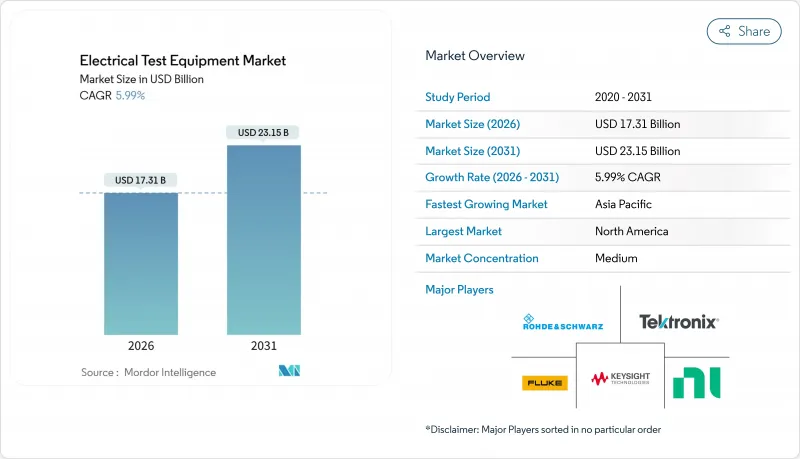
本報告按設備便攜性(固定式、攜帶式)、產品類型(示波器、萬用電錶等)、測試應用(電壓、性能、試運行、預測性維護、合規性、校準)、工業應用(能源、航太、製造、汽車等)和地區進行細分。市場預測以美元計價。
全球電氣測試設備市場趨勢與洞察
全球加強電氣安全法規的收緊
全球監管機構正在提高隔離調整閾值,並將網路安全檢查納入電氣安全協議,迫使製造商和最終用戶更新其儀器設備。 IEC 61010-1 4.0版於2024年1月生效,提高了電壓超過1000V設備的隔離間隙和爬電距離,迫使供應商重新設計機殼,客戶重新校準現有設備。在美國,UL 9540A強制要求對電池能源儲存系統進行多級熱失控檢驗,導致認證期間測試儀的使用率提高了三倍。歐盟修訂了其低電壓指令,強制要求根據IEC 62443對組件進行安全認證,並將隔離測試與網路安全審計聯繫起來。資料中心和製藥廠等場所的停機損失遠超過儀器成本,因此對設備更換的需求極高。由此,配備堅固機殼和安全韌體的可攜式安全分析儀的出貨量實現了兩位數的成長。
擴大可再生能源設施
大規模太陽能、風能和配套儲能設施的建設,正推動電網邊緣測試點數量激增,這些測試點需要諧波、電能品質和絕緣檢驗。美國能源局的電網韌性與創新夥伴關係(GRIP)計畫已撥款34.6億美元用於電網升級,並強制要求使用能夠捕捉高達50次諧波的次週期電壓驟降的分析儀。北海離岸風力發電電場正在部署525千伏高壓直流輸電線路,這需要使用諸如Megger公司的IDAX 350之類的絕緣測試儀來檢測船載換流站的電纜。中國的GB/T 36547-2024標準強制要求對所有容量超過10兆瓦時的電網倉儲設施進行標準化性能測試,從而推動了國內對可再生能源負載的需求成長。這些政策正在推動整個電氣測試設備市場對高壓、高精度攜帶式測試儀器的持續投資。
測量儀器的購置成本很高
售價超過10萬美元的10吉赫示波器對許多實驗室來說仍然難以負擔,阻礙了東南亞和南美地區的現代化。儘管供應商正在試銷低規格型號,例如泰克MSO 2系列(售價1200美元),但其200兆赫茲的頻寬限制了其應用範圍,使其僅限於消費性電子產品維修。目前,艾默生測試測量公司PXI訂單中有34%是透過經營租賃方式取得的,這使得設備過時的風險從買方轉移到了供應商。然而,諸如印度20%的基本關稅等關稅措施,仍使得高階分析儀的採購成本居高不下。因此,預算限制延長了混合設備組合的使用壽命,限制了電氣測試設備市場的短期升級。
細分市場分析
到2025年,攜帶式設備將佔電氣測試設備市場61.73%的佔有率。預計到2031年,該細分市場將以7.12%的複合年成長率成長,因為公共產業公司、承包商和可再生能源安裝商更傾向於使用電池供電的設備,這些設備在試運行中無需中斷電路電源。福祿克(Fluke)的4.2公斤重的Norma 6000功率分析儀是實現現場實驗室級精度的典範,而羅德與施瓦茨(Rohde & Schwarz)的8小時電池供電手持式示波器在汽車維修店中也越來越受歡迎。雖然在環境控制至關重要的半導體製造工廠中,固定式設備仍然非常重要,但由於攜帶式設備機殼堅固耐用且符合IEC 61010-1跌落測試標準,其使用正在不斷擴大。
可攜式波形產生器的配件生態系統包括無線探頭、雲端控制面板和基於邊緣運算的人工智慧安全功能,這些功能可與企業資產管理軟體無縫整合。因此,採購框架越來越重視整體連接性和網路安全,而不僅僅是精確度。由於中國競爭對手的影響,預計2024年平均售價將下降8%,高階品牌正透過捆綁校準券和韌體解鎖碼來保護利潤率,從而維持其在電氣測試設備市場的差異化優勢。
2025年,萬用電錶和鉤錶的銷售額佔比為28.74%,但正面臨來自低成本新參與企業的下行壓力。再生式電子負載雖然絕對值較小,但預計年複合成長率將達到6.33%,在所有類別中成長率最高。一家歐洲電池實驗室借助EA Elektro-Automatik公司一款能源回收高達96%的型號,成功減少了1.2吉瓦時的年耗電量。示波器市場呈現兩極化,售價低於2000美元的型號在教育和維修市場廣受歡迎,而售價高達5萬美元的混合訊號示波器則為航太項目提供技術支援。
隨著碳化矽 (SiC)驅動裝置在暖通空調 (HVAC) 和工業自動化領域的應用日益廣泛,對功率分析儀的需求再次上升。同時,隨著用戶將校準週期延長至 18 個月,安全測試設備也日趨商品化。電動車和網格儲存的電池專用測試設備需求激增,基於 PXI 和 FPGA 平台的軟體定義波形產生器正在取代老舊的類比設備。這些變化表明,效率、模組化和軟體擴充性正在影響電氣測試設備市場的採購趨勢。
區域分析
到2025年,北美將佔全球銷售量的38.73%。這主要得益於聯邦政府斥資34.6億美元升級電網,以及密西根州和加州電動車電池研究實驗室的擴建。此外,加拿大電網級儲能系統部署量激增47%,以及墨西哥斥資10億美元改造電動車工廠,也將進一步推動這項成長動能。
歐洲加速的能源轉型正在推動對電能品質和絕緣診斷工具的投資。德國離岸風力發電的擴張、英國耗資43億美元的變電站維修項目以及法國核能發電廠延壽項目,都增加了對高壓測試設備的需求。歐盟電池法規強制要求進行可追溯的能耗測量,這也促進了校準分析儀的購買。
預計到2031年,亞太地區將以6.65%的複合年成長率實現最高成長,主要得益於台灣地區650億美元的半導體資本投資、韓國的存儲晶片製造工廠以及中國強制性存儲測試政策(有利於國內供應商)。在印度,298億盧比的獎勵措施正吸引更多電子設備工廠採購萬用電錶和功率分析儀。同時,日本的固態電池試點計畫以及製造地向東協的轉移正在擴大該地區的採購需求。儘管南美、中東和非洲等新興市場的絕對銷量落後於其他地區,但憑藉強勁的專案儲備(需要攜帶式安全測試儀和電網規範分析儀),這些市場正在擴大電氣測試設備市場的版圖。
其他好處:
- Excel格式的市場預測(ME)表
- 3個月的分析師支持
目錄
第1章:引言
- 市場分析與定義的前提條件
- 分析範圍
第2章 分析方法
第3章執行摘要
第4章 市場狀況
- 市場概覽
- 市場促進因素
- 全球加強電氣安全法規
- 擴大可再生能源設施
- 5G和高速網路的普及
- 電動車的日益普及和對電池測試日益成長的需求。
- PMaaS(預測性維護即服務)實施現狀
- 對能源再生負荷的需求
- 市場限制因素
- 設備購置成本高
- 技術創新導致快速過時
- 熟練測量技術人員短缺
- 連網型設備的網路安全風險
- 產業價值鏈分析
- 監理情勢
- 技術展望
- 波特五力分析
- 投資分析
第5章:預測市場規模與成長率
- 設備的便攜性
- 固定式
- 攜帶式的
- 產品類型
- 示波器
- 萬用表/鉤錶
- 功率分析儀
- 電氣安全測試設備
- 電池測試設備
- 高壓測試儀
- 電子負載裝置
- 訊號和函數產生器
- 網路協定分析師
- 數據採集系統
- 目的性測試
- 電壓測試
- 功能/性能測試
- 安裝和試運行測試
- 預防性維護和狀態監測
- 合規性和認證測試
- 品質保證和實驗室校準
- 透過工業應用
- 能源與電力
- 航太/國防
- 製造業、工業自動化
- 家用電子設備
- 石油和天然氣
- 汽車和電動旅行
- 通訊和IT基礎設施
- 醫療設備
- 研究與學術
- 按地區
- 北美洲
- 美國
- 加拿大
- 墨西哥
- 南美洲
- 巴西
- 阿根廷
- 其他南美國家
- 歐洲
- 德國
- 英國
- 法國
- 義大利
- 西班牙
- 其他歐洲國家
- 亞太地區
- 中國
- 日本
- 印度
- 韓國
- ASEAN
- 其他亞太國家
- 中東和非洲
- 中東
- 沙烏地阿拉伯
- 阿拉伯聯合大公國
- 其他中東國家
- 非洲
- 南非
- 奈及利亞
- 其他非洲國家
- 中東
- 北美洲
第6章 競爭情勢
- 市場集中度
- 策略趨勢
- 市佔率分析
- 公司簡介
- Keysight Technologies, Inc.
- Rohde and Schwarz GmbH and Co. KG
- Tektronix, Inc.
- Fluke Corporation
- National Instruments Corporation
- Yokogawa Test and Measurement Corporation
- Anritsu Corporation
- Chroma ATE Inc.
- Hioki EE Corporation
- Megger Group Limited
- Chauvin Arnoux SA
- BandK Precision Corporation
- Viavi Solutions Inc.
- Advantest Corporation
- Teledyne LeCroy Inc.
- Good Will Instrument Co., Ltd.
- Rigol Technologies Co., Ltd.
- Mastech Group Limited
- Ideal Industries, Inc.
- Kikusui Electronics Corporation
- EA Elektro-Automatik GmbH and Co. KG
- NH Research, Inc.
- Itech Electronic Co., Ltd.
第7章 市場機會與未來展望
According to Mordor Intelligence, the electrical test equipment market size was USD 17.31 billion in 2026 and is projected to reach USD 23.15 billion by 2031, registering a 5.99% CAGR.
This report is Segmented by Equipment Mobility (Stationary and Portable), Product Category (Oscilloscopes, Multimeters, and More), Testing Application (Voltage, Performance, Commissioning, Maintenance, Compliance, and Calibration), Industry Application (Energy, Aerospace, Manufacturing, Automotive, and More), and Geography. The Market Forecasts are Provided in Terms of Value (USD).
Global Electrical Test Equipment Market Trends and Insights
Stricter Global Electrical-Safety Regulations
Regulators worldwide are increasing insulation-coordination thresholds and incorporating cybersecurity checks into electrical safety protocols, compelling both manufacturers and end-users to update their instrument fleets. IEC 61010-1 Edition 4.0, effective January 2024, increased clearance and creepage distances for equipment above 1 000 V, leading vendors to redesign enclosures and customers to recalibrate installed bases. In the United States, UL 9540A now mandates multi-level thermal-runaway validation for battery-energy storage systems, resulting in a threefold increase in tester utilization rates during certification. The European Union amended the Low Voltage Directive to require IEC 62443 component security attestations, tying dielectric tests to cybersecurity audits. Replacement demand is acute in data-center and pharmaceutical facilities where downtime penalties outweigh instrument cost. Consequently, portable safety analyzers with ruggedized housings and secure firmware record double-digit shipment growth.
Expansion of Renewable-Energy Installations
Utility-scale solar, wind, and co-located battery assets multiply grid-edge test points that need harmonic, power-quality, and insulation verification. The U.S. Department of Energy's Grid Resilience and Innovation Partnerships program earmarked USD 3.46 billion for transmission upgrades that specify analyzers able to capture sub-cycle voltage sags through the 50th harmonic. North Sea offshore wind farms deploy 525 kV HVDC links, requiring insulation testers such as Megger's IDAX 350 for on-board converter-station cables. China's GB/T 36547-2024 forces every grid-storage site above 10 MWh to complete standardized performance tests, boosting bids for domestic regenerative loads. These policies drive sustained investment in high-voltage, high-precision portable instruments across the electrical test equipment market.
High Acquisition Cost of Instruments
Ten-gigahertz oscilloscopes priced above USD 100 000 remain out of reach for many regional labs, slowing modernization in Southeast Asia and South America. Vendors experiment with lower-spec models such as Tektronix's MSO 2 Series at USD 1 200, yet 200 MHz bandwidth confines usage to consumer-electronics repair. Operating leases now constitute 34% of PXI orders at Emerson Test and Measurement, transferring obsolescence risk from buyers to suppliers. Nevertheless, tariffs like India's 20% basic customs duty still inflate landed cost on premium analyzers. Budget constraints therefore lengthen mixed-fleet lifecycles, limiting near-term electrical test equipment market upgrades.
Other drivers and restraints analyzed in the detailed report include:
- Proliferation of 5G and High-Speed Networks
- Rising EV Adoption and Battery-Test Demand
- Rapid Technology-Driven Obsolescence
For complete list of drivers and restraints, kindly check the Table Of Contents.
Segment Analysis
Portable assets represented 61.73% of the electrical test equipment market share in 2025. The segment is projected to deliver a 7.12% CAGR through 2031, as utilities, contractors, and renewable-energy installers prefer battery-powered devices that eliminate the need for de-energizing circuits during commissioning. Fluke's 4.2 kg Norma 6000 power analyzer exemplifies laboratory-grade precision on the job site, while Rohde and Schwarz's eight-hour handheld oscilloscope gains traction in automotive service bays. Stationary gear maintains relevance in semiconductor fabs where environmental control is paramount, but ruggedized housings and IEC 61010-1 drop-test compliance broaden portable use cases.
The portable wave drives accessory ecosystem includes wireless probes, cloud dashboards, and edge-AISafety features that integrate seamlessly with enterprise asset-management software. As a result, procurement frameworks are increasingly assessing total connectivity and cybersecurity, rather than raw accuracy. With average selling prices falling 8% in 2024 due to Chinese competition, premium brands are bundling calibration vouchers and firmware unlock codes to protect their margins, thereby sustaining differentiation in the electrical test equipment market.
Multimeters and clamp meters delivered 28.74% of 2025 revenue but face price erosion from low-cost entrants. Conversely, regenerative electronic loads, though smaller in absolute terms, are projected to register a 6.33% CAGR, the fastest among all categories. EA Elektro-Automatik's 96% energy-recovery models helped one European battery lab cut annual consumption by 1.2 GWh annually. Oscilloscopes polarize, with sub-USD 2 000 instruments winning education and repair markets and USD 50 000 mixed-signal editions anchoring aerospace programs.
Power analyzers see renewed demand as silicon-carbide drives penetrate HVAC and industrial automation, while safety testers commoditize as users stretch calibration to 18-month intervals. Battery-specific testers surge in demand for EVs and grid storage, and software-defined waveform generators based on PXI or FPGA platforms replace aging analog units. These shifts illustrate how efficiency, modularity, and software extensibility shape purchasing in the electrical test equipment market.
Complete Report Scope:
- By Equipment Mobility
- Stationary
- Portable
- By Product Category
- Oscilloscopes
- Multimeters and Clamp Meters
- Power Analyzers
- Electrical Safety Testers
- Battery Testing Equipment
- High-Voltage Testers
- Electronic Loads
- Signal and Function Generators
- Network and Protocol Analyzers
- Data Acquisition Systems
- By Testing Application
- Voltage Testing
- Functionality / Performance Testing
- Installation and Commissioning Testing
- Preventive Maintenance and Condition Monitoring
- Compliance and Certification Testing
- Quality Assurance and Lab Calibration
- By Industry Application
- Energy and Power
- Aerospace and Defense
- Manufacturing and Industrial Automation
- Consumer Electronics
- Oil and Gas
- Automotive and E-Mobility
- Telecommunications and IT Infrastructure
- Healthcare and Medical Devices
- Research and Academics
- By Geography
- North America
- United States
- Canada
- Mexico
- South America
- Brazil
- Argentina
- Rest of South America
- Europe
- Germany
- United Kingdom
- France
- Italy
- Spain
- Rest of Europe
- Asia-Pacific
- China
- Japan
- India
- South Korea
- ASEAN
- Rest of Asia-Pacific
- Middle East and Africa
- Middle East
- Saudi Arabia
- United Arab Emirates
- Rest of Middle East
- Africa
- South Africa
- Nigeria
- Rest of Africa
- Middle East
- North America
Geography Analysis
North America held 38.73% of global revenue in 2025, underpinned by USD 3.46 billion in federal transmission upgrades and expanding EV battery labs in Michigan and California. Canada's 47% surge in grid-scale storage deployments and Mexico's USD 1 billion EV plant conversion sustain additional momentum.
Europe's accelerated energy transition propels investment in power-quality and insulation-diagnostic tools. Germany's offshore wind expansion, the United Kingdom's USD 4.3 billion substation upgrades, and France's nuclear life-extension projects together elevate demand for high-voltage test gear. The European Union's Battery Regulation reinforces traceable energy-consumption metering, compelling purchase of calibrated analyzers.
Asia-Pacific is forecast to post the strongest 6.65% CAGR to 2031, driven by Taiwan's USD 65 billion semiconductor capex, South Korea's memory-chip fab, and China's storage-testing mandate favoring local suppliers. India's INR 29.8 billion incentive payouts attract additional electronics factories that procure multimeters and power analyzers, while Japan's solid-state battery pilots and ASEAN manufacturing relocations amplify regional purchasing. Emerging markets in South America, the Middle East and Africa lag in absolute volumes but register robust project pipelines that require portable safety testers and grid-code analyzers, broadening the electrical test equipment market footprint.
- Keysight Technologies, Inc.
- Rohde and Schwarz GmbH and Co. KG
- Tektronix, Inc.
- Fluke Corporation
- National Instruments Corporation
- Yokogawa Test and Measurement Corporation
- Anritsu Corporation
- Chroma ATE Inc.
- Hioki E.E. Corporation
- Megger Group Limited
- Chauvin Arnoux SA
- BandK Precision Corporation
- Viavi Solutions Inc.
- Advantest Corporation
- Teledyne LeCroy Inc.
- Good Will Instrument Co., Ltd.
- Rigol Technologies Co., Ltd.
- Mastech Group Limited
- Ideal Industries, Inc.
- Kikusui Electronics Corporation
- EA Elektro-Automatik GmbH and Co. KG
- NH Research, Inc.
- Itech Electronic Co., Ltd.
Additional Benefits:
- The market estimate (ME) sheet in Excel format
- 3 months of analyst support
TABLE OF CONTENTS
1 INTRODUCTION
- 1.1 Study Assumptions and Market Definition
- 1.2 Scope of the Study
2 RESEARCH METHODOLOGY
3 EXECUTIVE SUMMARY
4 MARKET LANDSCAPE
- 4.1 Market Overview
- 4.2 Market Drivers
- 4.2.1 Stricter Global Electrical-Safety Regulations
- 4.2.2 Expansion of Renewable-Energy Installations
- 4.2.3 Proliferation of 5G and High-Speed Networks
- 4.2.4 Rising EV Adoption and Battery-Test Demand
- 4.2.5 Predictive-Maintenance-as-a-Service Uptake
- 4.2.6 Demand for Energy-Regenerative Loads
- 4.3 Market Restraints
- 4.3.1 High Acquisition Cost of Instruments
- 4.3.2 Rapid Technology-Driven Obsolescence
- 4.3.3 Shortage of Skilled Metrology Technicians
- 4.3.4 Cybersecurity Risks in Connected Devices
- 4.4 Industry Value Chain Analysis
- 4.5 Regulatory Landscape
- 4.6 Technological Outlook
- 4.7 Porter's Five Forces Analysis
- 4.7.1 Bargaining Power of Suppliers
- 4.7.2 Bargaining Power of Buyers
- 4.7.3 Threat of New Entrants
- 4.7.4 Threat of Substitutes
- 4.7.5 Intensity of Competitive Rivalry
- 4.8 Investment Analysis
5 MARKET SIZE AND GROWTH FORECASTS (VALUE)
- 5.1 By Equipment Mobility
- 5.1.1 Stationary
- 5.1.2 Portable
- 5.2 By Product Category
- 5.2.1 Oscilloscopes
- 5.2.2 Multimeters and Clamp Meters
- 5.2.3 Power Analyzers
- 5.2.4 Electrical Safety Testers
- 5.2.5 Battery Testing Equipment
- 5.2.6 High-Voltage Testers
- 5.2.7 Electronic Loads
- 5.2.8 Signal and Function Generators
- 5.2.9 Network and Protocol Analyzers
- 5.2.10 Data Acquisition Systems
- 5.3 By Testing Application
- 5.3.1 Voltage Testing
- 5.3.2 Functionality / Performance Testing
- 5.3.3 Installation and Commissioning Testing
- 5.3.4 Preventive Maintenance and Condition Monitoring
- 5.3.5 Compliance and Certification Testing
- 5.3.6 Quality Assurance and Lab Calibration
- 5.4 By Industry Application
- 5.4.1 Energy and Power
- 5.4.2 Aerospace and Defense
- 5.4.3 Manufacturing and Industrial Automation
- 5.4.4 Consumer Electronics
- 5.4.5 Oil and Gas
- 5.4.6 Automotive and E-Mobility
- 5.4.7 Telecommunications and IT Infrastructure
- 5.4.8 Healthcare and Medical Devices
- 5.4.9 Research and Academics
- 5.5 By Geography
- 5.5.1 North America
- 5.5.1.1 United States
- 5.5.1.2 Canada
- 5.5.1.3 Mexico
- 5.5.2 South America
- 5.5.2.1 Brazil
- 5.5.2.2 Argentina
- 5.5.2.3 Rest of South America
- 5.5.3 Europe
- 5.5.3.1 Germany
- 5.5.3.2 United Kingdom
- 5.5.3.3 France
- 5.5.3.4 Italy
- 5.5.3.5 Spain
- 5.5.3.6 Rest of Europe
- 5.5.4 Asia-Pacific
- 5.5.4.1 China
- 5.5.4.2 Japan
- 5.5.4.3 India
- 5.5.4.4 South Korea
- 5.5.4.5 ASEAN
- 5.5.4.6 Rest of Asia-Pacific
- 5.5.5 Middle East and Africa
- 5.5.5.1 Middle East
- 5.5.5.1.1 Saudi Arabia
- 5.5.5.1.2 United Arab Emirates
- 5.5.5.1.3 Rest of Middle East
- 5.5.5.2 Africa
- 5.5.5.2.1 South Africa
- 5.5.5.2.2 Nigeria
- 5.5.5.2.3 Rest of Africa
- 5.5.5.1 Middle East
- 5.5.1 North America
6 COMPETITIVE LANDSCAPE
- 6.1 Market Concentration
- 6.2 Strategic Moves
- 6.3 Market Share Analysis
- 6.4 Company Profiles {(includes Global level Overview, Market level overview, Core Segments, Financials as available, Strategic Information, Market Rank/Share for key companies, Products and Services, and Recent Developments)}
- 6.4.1 Keysight Technologies, Inc.
- 6.4.2 Rohde and Schwarz GmbH and Co. KG
- 6.4.3 Tektronix, Inc.
- 6.4.4 Fluke Corporation
- 6.4.5 National Instruments Corporation
- 6.4.6 Yokogawa Test and Measurement Corporation
- 6.4.7 Anritsu Corporation
- 6.4.8 Chroma ATE Inc.
- 6.4.9 Hioki E.E. Corporation
- 6.4.10 Megger Group Limited
- 6.4.11 Chauvin Arnoux SA
- 6.4.12 BandK Precision Corporation
- 6.4.13 Viavi Solutions Inc.
- 6.4.14 Advantest Corporation
- 6.4.15 Teledyne LeCroy Inc.
- 6.4.16 Good Will Instrument Co., Ltd.
- 6.4.17 Rigol Technologies Co., Ltd.
- 6.4.18 Mastech Group Limited
- 6.4.19 Ideal Industries, Inc.
- 6.4.20 Kikusui Electronics Corporation
- 6.4.21 EA Elektro-Automatik GmbH and Co. KG
- 6.4.22 NH Research, Inc.
- 6.4.23 Itech Electronic Co., Ltd.
7 MARKET OPPORTUNITIES AND FUTURE OUTLOOK
- 7.1 White-space and Unmet-Need Assessment

 電磁閥電壓測試儀市場規模、佔有率和成長分析:按產品類型、電壓範圍、應用、工業設備測試、最終用戶和地區分類-2026-2033年產業預測
 電氣和電子測試設備:市場佔有率分析、行業趨勢和統計數據、成長預測(2026-2031)
 全球電力測試系統市場:2026-2036 年電氣和電子測試設備市場:按組件、產品類型、外形規格、應用、最終用戶、國家和地區分類——行業分析、市場規模、市場佔有率和預測(2026-2033 年)
 全球電壓檢測器市場規模、佔有率、趨勢和成長分析報告(2026-2034)
 2026年全球帶電電壓檢測器市場報告
 動態電壓恢復裝置市場:按類型、組件、容量、最終用途和銷售管道分類-2026-2032年全球市場預測2026年全球電壓感測系統市場報告2026年全球電氣測試設備市場報告
 電壓測試器市場 - 全球產業規模、佔有率、趨勢、機會、預測:按產品類型、操作方式、頻率、應用、地區和競爭格局分類,2021-2031年