


 |
市場調查報告書
商品編碼
2120629
可見光通訊:市場佔有率分析、產業趨勢與統計、成長預測(2026-2031)Visible Light Communication - Market Share Analysis, Industry Trends & Statistics, Growth Forecasts (2026 - 2031) |
||||||

※ 本網頁內容可能與最新版本有所差異。詳細情況請與我們聯繫。
根據 Mordor Intelligence 預測,可見光通訊市場規模預計在 2025 年達到 38.8 億美元,2026 年達到 68.6 億美元,到 2031 年達到 385.7 億美元,2026 年至 2031 年的複合年成長率為 41.25%。
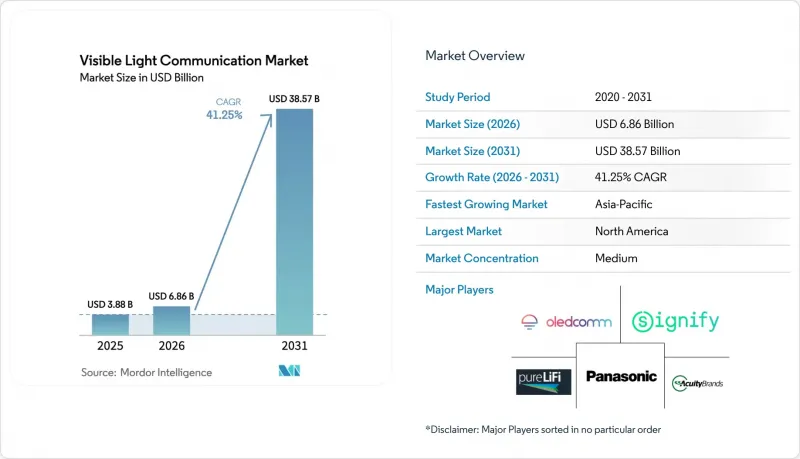
本報告按組件(發光二極體、檢測器、微控制器、軟體和服務)、傳輸方式(單向、雙向)、應用領域(國防安全、交通運輸、公共基礎設施、生命科學等)、終端用戶行業(醫療保健、零售等)和地區進行細分。市場預測以美元計價。
全球可見光通訊市場趨勢及洞察
室內照明基礎設施快速轉向LED
為了滿足能源效率法規要求,建築業主加快了向LED照明的轉型,為部署可低成本升級Li-Fi收發器的照明設備奠定了基礎。例如,在洛杉磯,22萬盞路燈中98%已被LED燈取代,其中3.7萬盞已連網用於遠距離診斷,為部署光無線疊加網路鋪平了道路。目前,市面上已有預先安裝Li-Fi晶片組的商用照明設備,透過規模經濟降低了單位成本。配備光電探測器和微控制器的改造套件使醫院和學校無需進行破壞性的佈線工作,而LED更換週期的縮短則確保了Li-Fi專案的穩定供應。所有這些變化加在一起,將使長期複合年成長率提高8.5個百分點。
醫院和飛機客艙對無射頻干擾的連線需求正在激增。
在加護病房和飛機客艙中,由於電磁干擾的限制,光纖無線鏈路比 Wi-Fi 和藍牙更受歡迎。英國國家醫療服務體系 (NHS England) 於 2024 年在救護車停靠區進行了一項試驗,使用 pureLiFi 設備上傳病患記錄,而不會干擾維生設備。歐盟的「飛機輕型通訊」計畫已在飛機上實現了 1 Gbps 的吞吐量,為航空公司採用該技術提供了切實可行的理由。由於 LiFi 訊號始終處於光照範圍內,醫療專業人員可以確保電子健康記錄的確定性和安全性頻寬,而航空公司則可以避免同軸電纜主幹網帶來的重量負擔。這一趨勢正推動複合年成長率 (CAGR) 達到 7.2%。
缺乏全球互通性標準
IEEE 802.11bb 僅規定了物理層參數,將介質存取規則留給各個廠商自行決定,從而限制了買家只能與單一廠商簽訂合約。由於缺乏類似 Wi-Fi 聯盟的認證體系,企業必須依賴廠商的自我聲明,這增加了風險感知。電磁相容性 (EMC) 法規的區域差異迫使製造商跨洲重新測試產品,導致產品上市時間延長,並使複合年成長率 (CAGR) 下降 2.8%。
細分市場分析
預計2026年至2031年間,微控制器將以42.11%的複合年成長率成長,超過可見光通訊市場的整體成長速度。由於雙向Li-Fi鏈路需要即時通道估計、自適應均衡和前向糾錯,設計人員正從分離式FPGA轉向整合數位訊號處理器的高速系統晶片(SoC)控制器。瑞薩電子、義法半導體和德克薩斯目前均已推出配備專用Li-Fi指令集的200 MHz裝置,從而有效縮小基板面積並降低功耗。高通的專利顯示,行動電話晶片組有望在消費市場廣泛應用。
發光二極體(LED) 兼具照明和傳輸的雙重功能,預計到 2025 年仍將佔據可見光通訊市場 43.78% 的佔有率,但隨著 LED 更新換代週期的成熟,其成長速度正在放緩。檢測器受惠於崩潰式二極體技術的進步,提高了抗環境光干擾的能力;軟體定義的 Li-Fi 協定堆疊透過無線方式提供調變方案升級,延長了硬體的使用壽命。隨著營運商轉向基於結果的合約模式,涵蓋網路管理、預測性維護和分析等服務層也在穩步發展。
到2025年,單向連結(主要用於注重成本的定位服務和指示牌應用)將佔據可見光通訊市場66.83%的佔有率,而雙向系統正以41.47%的複合年成長率迅速縮小差距。雙向Li-Fi通常將可見光下行鏈路與紅外線上行鏈路結合,提供安全、全雙工的連接,適用於遠端醫療和軍事指揮中心。 PureLiFi在2025年世界行動通訊大會上發布的「LINXC Bridge」支援100個同時上線用戶和Gigabit級總吞吐量,使其在會議場所和機場貴賓休息室等應用場景中極具吸引力。 Signify的「Trulifi 6004」於2025年獲得FIPS 140-3認證,滿足美國國防部的採購要求。
儘管單向套件因其價格實惠且易於使用,在注重成本的零售市場中仍佔據主導地位,但企業正擴大選擇雙向套件。這些套件滿足了安全高效運作的關鍵需求,例如身份驗證、延遲保證和加密上行鏈路。此外,全雙工架構支援符合 IEEE 802.11bb 標準的服務品質 (QoS) 標記等進階功能。這種相容性使得光無線吞吐量管理能夠與常用的 Wi-Fi 工具無縫整合,從而提升整體網路效能和可靠性。
區域分析
預計到2025年,北美將佔據可見光通訊市場37.49%的佔有率,主要得益於智慧城市和國防相關合約的早期應用。在洛杉磯,一項路燈改造計畫將22萬盞路燈中的98%更換為LED燈,並將3.7萬個節點聯網,建構了能夠支援Li-Fi網路覆蓋的基礎設施。同樣,華盛頓特區的7.5萬盞LED路燈正在為支援公共Wi-Fi切換奠定基礎。在加拿大,聯邦政府津貼正用於醫院和校園的試點項目,而墨西哥一家購物中心營運商正在實施基於Li-Fi的導航功能,以改善訪客分析。
在中國「十四五」規劃和日本工業自動化措施的支持下,亞太地區預計在2026年至2031年間將維持42.27%的複合年成長率,成為全球成長最快的地區。復旦大學和清華大學都已獲得政府資助,用於開發智慧城市原型。Panasonic和中川綜合研究所已推出用於工廠和高速公路區域的多Gigabit測試平台。印度的「百城智慧計畫」計畫在德里和班加羅爾開展Li-Fi試點項目,韓國電子通訊研究院(ETRI)正在將光纖無線技術納入其6G藍圖。在澳大利亞,人們正在探索在地下礦井中使用Li-Fi通訊,因為無線電火花可能造成爆炸風險。
在歐洲,嚴格的電磁相容性 (EMC) 法規正在推動無線光纖技術在醫院和飛機客艙中的應用。英國已投資 400 萬英鎊(500 萬美元)開展一項試點項目,將 Li-Fi 技術與行人安全分析功能相結合,應用於路燈照明。德國的西門子和寶馬公司正在進行工廠試驗,透過 Li-Fi 技術連接可程式邏輯控制器 (PLC)。在法國,Li-Fi 技術在零售業的應用日益廣泛,家樂福就利用昕諾飛 (Signify) 的照明系統開展門市專屬促銷活動。在中東,高階零售商和飯店正在部署 Li-Fi 技術,而非洲的「零碳 1」舉措正在基礎設施低度開發地區試驗太陽能 LED 燈桿。然而,在南美洲,資金短缺和現有設施維修成本仍然是短期障礙,使得這項技術的應用仍處於觀望狀態。
其他好處:
- Excel格式的市場預測(ME)表
- 3個月的分析師支持
目錄
第1章:引言
- 研究假設和市場定義
- 調查範圍
第2章:調查方法
第3章執行摘要
第4章 市場狀況
- 市場概覽
- 市場促進因素
- 室內照明基礎設施快速轉向LED
- 醫院和飛機客艙對無射頻干擾的連線需求正在激增。
- 政府資助的智慧城市路燈更換項目
- 大型零售連鎖店店內定位服務實施現狀
- 採用 Li-Fi 作為 6G回程傳輸候選技術
- 量子點微型LED的突破性進展,使通訊速度達到10 Gbps或更高。
- 市場限制因素
- 缺乏全球互通性標準
- 維修照明設備的成本很高,因為照明設備的初始成本很高。
- 熱帶地區和戶外作業中的環境光噪音
- 供應鏈對高速驅動積體電路的依賴
- 產業價值鏈分析
- 宏觀經濟因素對市場的影響
- 監理情勢
- 技術展望
- 波特五力分析
第5章 市場規模與成長預測
- 按組件
- 發光二極體
- 檢測器
- 微控制器
- 軟體服務
- 按變速器類型
- 單向
- 雙向
- 透過使用
- 家用電子產品
- 國防與安全
- 運輸
- 公共基礎設施
- 生命科學
- 其他用途
- 按最終用戶行業分類
- 衛生保健
- 零售
- 工業和製造業
- 航太航太
- 教育
- 按地區
- 北美洲
- 美國
- 加拿大
- 墨西哥
- 歐洲
- 德國
- 英國
- 法國
- 俄羅斯
- 其他歐洲國家
- 亞太地區
- 中國
- 日本
- 印度
- 韓國
- 澳洲
- 其他亞太國家
- 中東和非洲
- 中東
- 沙烏地阿拉伯
- 阿拉伯聯合大公國
- 其他中東國家
- 非洲
- 南非
- 埃及
- 其他非洲國家
- 中東
- 南美洲
- 巴西
- 阿根廷
- 其他南美國家
- 北美洲
第6章 競爭情勢
- 市場集中度
- 策略趨勢
- 市佔率分析
- 公司簡介
- Signify NV
- pureLiFi Ltd.
- Oledcomm SAS
- Acuity Brands, Inc.
- Panasonic Corporation
- LVX System Corp.
- Velmenni OU
- VLNComm Inc.
- Lucibel SA
- LightPointe Communications, Inc.
- Renesas Electronics Corporation
- GE Lighting, LLC
- Qualcomm Incorporated
- Fujitsu Limited
- Kyocera SLD Laser, Inc.
- Nakagawa Laboratories Inc.
- Outstanding Technology Co., Ltd.
- Wuxi Axrtek Co., Ltd.
- ByteLight, Inc.
- Zero1 Pte Ltd.
- AeroLiFi GmbH
第7章 市場機會與未來展望
According to Mordor Intelligence, the visible light communication market size is projected to be USD 3.88 billion in 2025, USD 6.86 billion in 2026, and reach USD 38.57 billion by 2031, growing at a CAGR of 41.25% from 2026 to 2031.
This report is Segmented by Component (Light-Emitting Diode, Photodetectors, Microcontrollers, and Software and Services), Transmission Type (Unidirectional, and Bidirectional), Application (Defense and Security, Transportation, Public Infrastructure, Life Sciences, and More), End-User Vertical (Healthcare, Retail, and More), and Geography. The Market Forecasts are Provided in Terms of Value (USD).
Global Visible Light Communication Market Trends and Insights
Rapid LED Replacement in Indoor Lighting Infrastructure
Building owners accelerated LED conversions to meet energy-efficiency mandates, creating an installed base of fixtures that can be upgraded with Li-Fi transceivers at marginal cost. Los Angeles, for example, upgraded 98% of its 220,000 streetlights to LED, with 37,000 nodes already networked for remote diagnostics, paving the way for optical wireless overlays. Factory-integrated Li-Fi chipsets are now appearing in commercial luminaires, reducing per-unit costs by leveraging economies of scale. Retrofit kits equipped with photodetectors and microcontrollers allow hospitals and schools to avoid disruptive cabling work, and shorter LED replacement cycles guarantee a steady pipeline of Li-Fi-ready projects. Collectively, these shifts add 8.5 percentage points to the long-term CAGR impact.
Surging Demand for RF-Free Connectivity in Hospitals and Aircraft Cabins
Electromagnetic interference limits in critical-care zones and aircraft cabins favor optical wireless links over Wi-Fi and Bluetooth. NHS England's 2024 ambulance-bay trial used pureLiFi units to upload patient records without disturbing life-support equipment. The EU Aircraft Light Communication project proved 1 Gbps cabin throughput, showing viable grounds for airline deployment. Because Li-Fi signals stay within illuminated zones, healthcare providers gain deterministic, secure bandwidth for electronic health records, while airlines avoid the weight of coaxial backbones. This dynamic contributes a 7.2% positive swing to CAGR.
Absence of Global Interoperability Standards
IEEE 802.11bb resolves only physical-layer parameters, leaving media-access rules open to proprietary tweaks that trap buyers into single-vendor contracts. Certification regimes equivalent to those of the Wi-Fi Alliance are still missing, so enterprises rely on vendor self-declarations, which raises perceived risk. Regional electromagnetic-compatibility rules diverge, forcing manufacturers to re-test products across continents, which delays time to market and subtracts 2.8% from CAGR momentum.
Other drivers and restraints analyzed in the detailed report include:
- Government-Funded Smart-City Streetlight Retrofits
- Retail Indoor-Positioning Roll-Outs by Big-Box Chains
- High Up-Front Fixture Retrofit Costs
For complete list of drivers and restraints, kindly check the Table Of Contents.
Segment Analysis
Microcontrollers are set to outpace the broader visible light communication market at a 42.11% CAGR between 2026 and 2031. Because bidirectional Li-Fi links require real-time channel estimation, adaptive equalization, and forward-error correction, designers are shifting from discrete FPGAs to high-speed system-on-chip controllers that integrate digital signal processors. Renesas, STMicroelectronics, and Texas Instruments now ship 200 MHz devices with Li-Fi-specific instruction sets, shrinking board space and power draw. Qualcomm patents point to handset-grade chipsets that merge optical and radio transceivers, hinting at mass-market consumer potential.
Light-emitting diodes retained 43.78% of the visible light communication market share in 2025, thanks to their dual illumination-and-transmission role, yet growth moderates as the LED replacement cycle matures. Photodetectors benefit from advances in avalanche diodes that improve immunity to ambient light, and software-defined Li-Fi stacks extend hardware life by pushing modulation upgrades over the air. Service layers spanning network management, predictive maintenance, and analytics grow steadily as operators shift to outcome-based contracting.
Although unidirectional links captured 66.83% of the visible light communication market in 2025 because they serve cost-sensitive positioning and signage jobs, bidirectional systems are closing the gap with a 41.47% CAGR. Bidirectional Li-Fi typically pairs a visible downlink with an infrared uplink, delivering secure, full-duplex connectivity suited to telemedicine or military command rooms. pureLiFi's LINXC Bridge, unveiled at Mobile World Congress 2025, supports 100 concurrent users and gigabit aggregate throughput, making it appealing to conference venues and airport lounges. Signify's Trulifi 6004 gained FIPS 140-3 validation in 2025, clearing procurement paths inside the United States Department of Defense.
While cost-driven retail roll-outs continue to favor unidirectional kits due to their affordability and simplicity, businesses are increasingly opting for bidirectional packages. These packages address critical needs such as authentication, latency guarantees, and encrypted uplinks, which are essential for secure and efficient operations. Additionally, full-duplex architectures enable advanced features like quality-of-service tagging, adhering to IEEE 802.11bb standards. This alignment allows optical wireless throughput management to integrate seamlessly with familiar Wi-Fi tools, enhancing overall network performance and reliability.
Complete Report Scope:
- By Component
- Light-Emitting Diodes
- Photodetectors
- Microcontrollers
- Software and Services
- By Transmission Type
- Unidirectional
- Bidirectional
- By Application
- Consumer Electronics
- Defense and Security
- Transportation
- Public Infrastructure
- Life Sciences
- Other Applications
- By End-User Vertical
- Healthcare
- Retail
- Industrial and Manufacturing
- Aerospace and Aviation
- Education
- By Geography
- North America
- United States
- Canada
- Mexico
- Europe
- Germany
- United Kingdom
- France
- Russia
- Rest of Europe
- Asia-Pacific
- China
- Japan
- India
- South Korea
- Australia
- Rest of Asia-Pacific
- Middle East and Africa
- Middle East
- Saudi Arabia
- United Arab Emirates
- Rest of Middle East
- Africa
- South Africa
- Egypt
- Rest of Africa
- Middle East
- South America
- Brazil
- Argentina
- Rest of South America
- North America
Geography Analysis
North America held 37.49% of the visible light communication market share in 2025, on the back of early smart-city deployments and defense contracts. The Los Angeles streetlight program converted 98% of 220,000 luminaires to LED and networked 37,000 nodes, positioning the grid for Li-Fi overlays. Washington, D.C.'s 75,000 LED poles similarly create a ready backbone for public Wi-Fi handoffs. Canada channels federal grants into hospital and campus pilot sites, while Mexico's mall operators embed Li-Fi wayfinding to lift footfall analytics.
Asia Pacific is projected to record a 42.27% CAGR from 2026-2031, the fastest globally, underpinned by China's 14th Five-Year Plan and Japan's industrial-automation push. Fudan University and Tsinghua University both receive government funding for smart-city prototypes. Panasonic and Nakagawa Laboratories showcase multi-gigabit test beds for factories and highway corridors. India's 100-city smart mission plants Li-Fi pilots in Delhi and Bangalore, and South Korea's ETRI embeds optical wireless within its 6G standards blueprint. Australia probes Li-Fi links in underground mines where radio sparks pose explosion risks.
Europe benefits from strict electromagnetic-compatibility mandates that encourage hospitals and aircraft cabins to adopt optical wireless. The United Kingdom invested GBP 4 million (USD 5 million) in streetlight pilots that combine Li-Fi with pedestrian-safety analytics. Germany's Siemens and BMW are running factory trials that connect programmable logic controllers via Li-Fi. France extends retail deployments, with Carrefour using Signify's lighting grid to deliver aisle-level promotions. The Middle East is rolling out Li-Fi in luxury retail and hotels, and Africa's Zero 1 initiative is experimenting with solar-powered LED poles in underserved regions. South America remains exploratory, citing funding gaps and retrofit costs as near-term hurdles.
- Signify N.V.
- pureLiFi Ltd.
- Oledcomm S.A.S.
- Acuity Brands, Inc.
- Panasonic Corporation
- LVX System Corp.
- Velmenni OU
- VLNComm Inc.
- Lucibel SA
- LightPointe Communications, Inc.
- Renesas Electronics Corporation
- GE Lighting, LLC
- Qualcomm Incorporated
- Fujitsu Limited
- Kyocera SLD Laser, Inc.
- Nakagawa Laboratories Inc.
- Outstanding Technology Co., Ltd.
- Wuxi Axrtek Co., Ltd.
- ByteLight, Inc.
- Zero1 Pte Ltd.
- AeroLiFi GmbH
Additional Benefits:
- The market estimate (ME) sheet in Excel format
- 3 months of analyst support
TABLE OF CONTENTS
1 INTRODUCTION
- 1.1 Study Assumptions and Market Definition
- 1.2 Scope of the Study
2 RESEARCH METHODOLOGY
3 EXECUTIVE SUMMARY
4 MARKET LANDSCAPE
- 4.1 Market Overview
- 4.2 Market Drivers
- 4.2.1 Rapid LED Replacement in Indoor Lighting Infrastructure
- 4.2.2 Surging Demand for RF-Free Connectivity in Hospitals and Aircraft Cabins
- 4.2.3 Government-Funded Smart-City Street-Light Retrofits
- 4.2.4 Retail Indoor-Positioning Roll-Outs by Big-Box Chains
- 4.2.5 Adoption of Li-Fi as a 6G Backhaul Candidate
- 4.2.6 Quantum-Dot Micro-LED Breakthroughs Enabling 10 Gbps+ Links
- 4.3 Market Restraints
- 4.3.1 Absence of Global Interoperability Standards
- 4.3.2 High Up-Front Fixture Retrofit Costs
- 4.3.3 Ambient-Light Noise in Tropical and Outdoor Deployments
- 4.3.4 Supply-Chain Dependency on High-Speed Driver Ics
- 4.4 Industry Value Chain Analysis
- 4.5 Impact of Macroeconomic Factors on the Market
- 4.6 Regulatory Landscape
- 4.7 Technological Outlook
- 4.8 Porter's Five Forces Analysis
- 4.8.1 Bargaining Power of Suppliers
- 4.8.2 Bargaining Power of Buyers
- 4.8.3 Threat of New Entrants
- 4.8.4 Threat of Substitute Products
- 4.8.5 Intensity of Competitive Rivalry
5 MARKET SIZE AND GROWTH FORECASTS (VALUE)
- 5.1 By Component
- 5.1.1 Light-Emitting Diodes
- 5.1.2 Photodetectors
- 5.1.3 Microcontrollers
- 5.1.4 Software and Services
- 5.2 By Transmission Type
- 5.2.1 Unidirectional
- 5.2.2 Bidirectional
- 5.3 By Application
- 5.3.1 Consumer Electronics
- 5.3.2 Defense and Security
- 5.3.3 Transportation
- 5.3.4 Public Infrastructure
- 5.3.5 Life Sciences
- 5.3.6 Other Applications
- 5.4 By End-User Vertical
- 5.4.1 Healthcare
- 5.4.2 Retail
- 5.4.3 Industrial and Manufacturing
- 5.4.4 Aerospace and Aviation
- 5.4.5 Education
- 5.5 By Geography
- 5.5.1 North America
- 5.5.1.1 United States
- 5.5.1.2 Canada
- 5.5.1.3 Mexico
- 5.5.2 Europe
- 5.5.2.1 Germany
- 5.5.2.2 United Kingdom
- 5.5.2.3 France
- 5.5.2.4 Russia
- 5.5.2.5 Rest of Europe
- 5.5.3 Asia-Pacific
- 5.5.3.1 China
- 5.5.3.2 Japan
- 5.5.3.3 India
- 5.5.3.4 South Korea
- 5.5.3.5 Australia
- 5.5.3.6 Rest of Asia-Pacific
- 5.5.4 Middle East and Africa
- 5.5.4.1 Middle East
- 5.5.4.1.1 Saudi Arabia
- 5.5.4.1.2 United Arab Emirates
- 5.5.4.1.3 Rest of Middle East
- 5.5.4.2 Africa
- 5.5.4.2.1 South Africa
- 5.5.4.2.2 Egypt
- 5.5.4.2.3 Rest of Africa
- 5.5.4.1 Middle East
- 5.5.5 South America
- 5.5.5.1 Brazil
- 5.5.5.2 Argentina
- 5.5.5.3 Rest of South America
- 5.5.1 North America
6 COMPETITIVE LANDSCAPE
- 6.1 Market Concentration
- 6.2 Strategic Moves
- 6.3 Market Share Analysis
- 6.4 Company Profiles (includes Global Level Overview, Market Level Overview, Core Segments, Financials as available, Strategic Information, Market Rank/Share for key companies, Products and Services, and Recent Developments)
- 6.4.1 Signify N.V.
- 6.4.2 pureLiFi Ltd.
- 6.4.3 Oledcomm S.A.S.
- 6.4.4 Acuity Brands, Inc.
- 6.4.5 Panasonic Corporation
- 6.4.6 LVX System Corp.
- 6.4.7 Velmenni OU
- 6.4.8 VLNComm Inc.
- 6.4.9 Lucibel SA
- 6.4.10 LightPointe Communications, Inc.
- 6.4.11 Renesas Electronics Corporation
- 6.4.12 GE Lighting, LLC
- 6.4.13 Qualcomm Incorporated
- 6.4.14 Fujitsu Limited
- 6.4.15 Kyocera SLD Laser, Inc.
- 6.4.16 Nakagawa Laboratories Inc.
- 6.4.17 Outstanding Technology Co., Ltd.
- 6.4.18 Wuxi Axrtek Co., Ltd.
- 6.4.19 ByteLight, Inc.
- 6.4.20 Zero1 Pte Ltd.
- 6.4.21 AeroLiFi GmbH
7 MARKET OPPORTUNITIES AND FUTURE OUTLOOK
- 7.1 White-Space and Unmet-Need Assessment

 FSO 與 VLC/Li-Fi 市場-2026 年至 2032 年全球市場預測
 2026年全球可見光通訊市場報告2026年FSO和VLC/Li-Fi全球市場報告可見光定位市場:按組件、技術、部署方式、應用程式和最終用戶分類-2026-2032年全球預測可見光通訊市場:按產品、類型、應用和最終用戶產業分類,全球預測(2026-2032年)
 可見光通訊市場規模、佔有率和成長分析(按組件、應用、傳輸方式和地區分類)—產業預測(2026-2033 年)
 可見光通訊 (Li-Fi) 市場 - 全球產業規模、佔有率、趨勢、機會和預測,按組件類型、垂直整合程度、最終用戶、地區和競爭格局分類,2020-2030 年預測可見光通訊市場-全球產業規模、佔有率、趨勢、機會及預測(按組件、應用、最終用戶、地區和競爭格局分類,2020-2030 年預測)
 可見光LED市場-2025年至2030年預測