


 |
市場調查報告書
商品編碼
2123093
區塊鏈在製造業的應用:市場佔有率分析、產業趨勢與統計及成長預測(2026-2031)Blockchain In Manufacturing - Market Share Analysis, Industry Trends & Statistics, Growth Forecasts (2026 - 2031) |
||||||

※ 本網頁內容可能與最新版本有所差異。詳細情況請與我們聯繫。
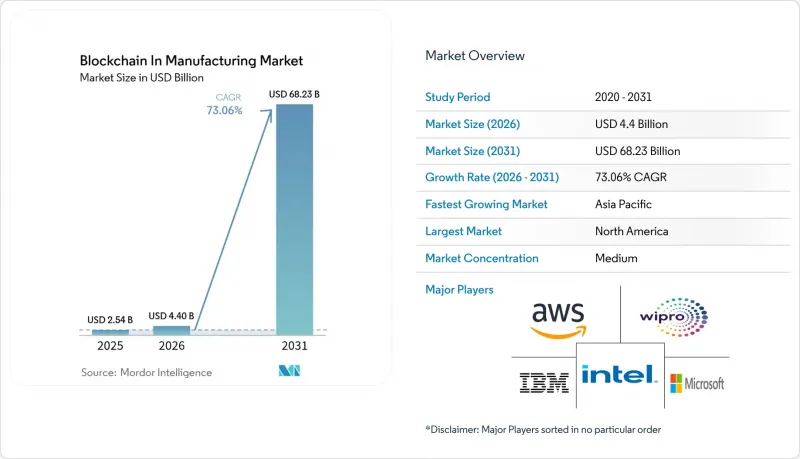
據 Mordor Intelligence 稱,2025 年製造業區塊鏈市場價值為 25.4 億美元,預計到 2031 年將達到 682.3 億美元,高於 2026 年的 44 億美元。
預測期(2026-2031 年)的複合年成長率預計為 73.06%。
本報告按應用(物流和供應鏈管理、仿冒品控制、品管和合規性等)、最終用戶產業(汽車、航太和國防、製藥和生命科學等)、部署模式(本地部署、雲端/區塊鏈即服務、混合/邊緣部署)、區塊鏈類型(公共區塊鏈、私有/許可區塊鏈等)和地區進行分類。
全球區塊鏈市場趨勢及製造業洞察。
擴大BaaS在各製造企業的應用
目前,基於雲端的區塊鏈即服務 (BaaS) 已佔離散型製造商部署選擇的 61.8%,這主要得益於其承包環境,無需專門的節點管理。微軟將區塊鏈遙測技術整合到其 Fabric 分析套件中,使用戶能夠查詢生產線事件以及企業數據,從而將系統整合時間縮短了 35%。成本節約和簡化的 DevOps,以及對快速部署和嚴格運作的需求,正在推動汽車、電子和工業設備製造工廠採用 BaaS。
供應鏈中的強制性原產地和可追溯性
美國食品藥物管理局 (FDA) 延長了食品溯源法規的最後期限,重申了區塊鏈技術滿足其不可篡改的批次級報告要求的適用性。同時,歐盟的「數位產品護照」法規也強調了在產品生命週期的各個階段建立去中心化記錄的必要性。製藥、航太和家用電子電器製造商正在將序列化資料整合到共用帳本中,以實現召回流程的自動化,從而將人工審核成本降低 28%。
標準化的碎片化和互通性差距
由於缺乏通用資料模型,供應商被迫為每個貿易夥伴建造成本高昂的中間件橋接器。 GS1 和 ISO工作小組已起草了通用模式,但其應用速度遠不及快速推進的實施期限。由聯盟主導的汽車和化學工業先導計畫已取得進展,但這些仍屬特例,尚未成為業界標準。
細分市場分析
預計到2031年,品管和合規工具的複合年成長率將達到74.20%,超過物流管理。物流管理預計到2025年將佔據製造業區塊鏈市場佔有率的45.20%。一家正在進行FDA序列化試點計畫的製藥公司報告稱,將批次歷史記錄儲存在分散式帳本上,使不合格項的解決速度提高了30%。能夠自動簽發審計證書的智慧合約工作流程正在取代紙本記錄,從而將合規回應時間縮短了40%。第二波應用情境包括預測性維護日誌和品質保證審計,其中防篡改歷史記錄正在降低爭議率。由於高階化學產品的標籤反映了公共休閒中的真實性雜湊值,因此仿冒品檢測仍然至關重要,這有助於增強消費者信心。隨著應用場景的增加,區塊鏈在製造業的待開發區和棕地中都得到了廣泛應用。
品管系統也正在成為積層製造領域新型智慧財產權保護方案的基礎,它利用零知識證明來驗證設計合規性,同時又不洩漏商業機密。電子元件製造商透過在設備上整合加密簽章和帳本,提高了召回準確率。由此可見,品質、合規性和防偽的整合正在加速企業對互通平台的興趣,並推動區塊鏈在製造業市場的發展。
預計到2025年,汽車工廠將引領市場,佔銷售額的30.60%。這反映了零件可追溯性的廣泛應用以及對成熟的工業4.0的投資。然而,隨著序列化、冷鏈追蹤和患者級溯源追蹤在全球醫療保健法規下成為強制性要求,預計到2031年,生命科學領域的製造商將以75.60%的複合年成長率擴大區塊鏈在製造業市場的規模。與IBM和默克合作的製藥公司報告稱,在模擬審計中,召回回應速度提高了25%。航太和國防領域的系統整合商正在採用安全的零件譜系帳本來管理3D列印零件,以降低篡改風險。消費性電子產品製造商正在產品中嵌入擔保令牌,以簡化售後服務,而食品和飲料加工商正在實施「從農場到餐桌」的追蹤系統,以滿足永續性審計要求。這種跨產業的多元化應用,使得區塊鏈在製造業的應用範圍進一步擴大,不再侷限於早期採用者。
區域分析
2025年,北美地區貢獻了43.80%的收入,這主要得益於FDA的監管、成熟的雲端基礎設施以及創業投資對帳本新創企業的大力支持。藥品序列化和航太零件譜系的要求推動了最初的演示,隨後擴展到多工廠部署。各州的獎勵進一步促進了中小企業的採用。
預計亞太地區在2026年至2031年間將以75.20%的複合年成長率實現最高成長,這反映了該地區廣泛的數位化舉措,例如中國的工業區塊鏈試點項目和日本的「社會5.0」智慧工廠藍圖。亞洲開發銀行(亞銀)的「十三邊形計畫」象徵著該地區為實現與製造業出口信貸流動相關的去中心化銀行間結算所做的努力。印度的電子產業叢集和韓國的電池供應鏈協定正在加速發展,推動二級供應商採用相關技術。
歐洲正崛起為以永續性發展為重點的區塊鏈應用區域,利用「數位產品護照」追蹤碳足跡和循環經濟指標。德國汽車製造商正在使用共享帳本追蹤再生鋼的含量,而法國大型航太公司則正在應用區塊鏈技術來管理積層製造粉末。北歐製造商透過使用水力發電和風力發電為許可型網路運作,從而滿足了環境、社會和治理(ESG)方面的要求。跨境資料空間專案正在促進互通性,這表明隨著區塊鏈在全球製造業市場的成熟,區域性應用將在通用管治下整合。
其他好處:
- Excel格式的市場預測(ME)表
- 3個月的分析師支持
目錄
第1章:引言
- 研究假設和市場定義
- 調查範圍
第2章:調查方法
第3章執行摘要
第4章 市場狀況
- 市場概覽
- 市場促進因素
- 擴大BaaS在各製造企業的應用
- 關於供應鏈來源和可追溯性的規定
- 高價值零件防偽的需求
- 令牌化實現了「設備即服務」模式。
- 結合積層製造技術,可靠地追蹤零件的來源。
- 用於智慧財產權保護的隱私權保護零知識證明試點項目
- 市場限制因素
- 標準碎片化和互通性差距
- OT環境中區塊鏈人才短缺
- 人們越來越關注與鏈上可追溯性相關的能源消耗問題
- 後量子時代安全要求的不確定性
- 價值供應鏈分析
- 監理情勢
- 技術展望
- 波特五力分析
- 宏觀經濟趨勢對市場的影響
第5章 市場規模與成長預測
- 透過使用
- 物流和供應鏈管理
- 打擊仿冒品的對策
- 品管和合規性
- 預測性維護和資產追蹤
- 用於採購的智慧合約
- 其他用途
- 按最終用戶行業分類
- 車
- 航太/國防
- 製藥和生命科學
- 家用電子產品
- 工業機械
- 食品/飲料
- 其他行業
- 部署模式
- 現場
- 雲端/區塊鏈即服務 (BaaS)
- 混合/邊緣
- 按區塊鏈類型
- 民眾
- 私有/基於許可
- 聯盟
- 按地區
- 北美洲
- 美國
- 加拿大
- 墨西哥
- 南美洲
- 巴西
- 阿根廷
- 其他南美國家
- 歐洲
- 德國
- 英國
- 法國
- 義大利
- 西班牙
- 其他歐洲國家
- 亞太地區
- 中國
- 日本
- 印度
- 韓國
- 其他亞太國家
- 中東和非洲
- 中東
- 沙烏地阿拉伯
- 阿拉伯聯合大公國
- 土耳其
- 其他中東國家
- 非洲
- 南非
- 奈及利亞
- 肯亞
- 其他非洲國家
- 中東
- 北美洲
第6章 競爭情勢
- 市場集中度
- 策略舉措和夥伴關係
- 市佔率分析
- 公司簡介
- IBM Corporation
- Microsoft Corporation
- SAP SE
- Oracle Corporation
- Amazon Web Services Inc.
- Accenture PLC
- Wipro Limited
- Infosys Ltd
- Intel Corporation
- Advanced Micro Devices Inc.
- VeChain Technology
- Chronicled Inc.
- SyncFab
- Siemens AG
- Honeywell International Inc.
- General Electric
- R3 LLC
- ConsenSys
- Kaleido
- BlockApps Inc.
第7章 市場機會與未來展望
According to Mordor Intelligence, the blockchain in manufacturing market size was valued at USD 2.54 billion in 2025 and estimated to grow from USD 4.4 billion in 2026 to reach USD 68.23 billion by 2031, at a CAGR of 73.06% during the forecast period (2026-2031).
This report is Segmented by Application (Logistics and Supply Chain Management, Counterfeit Management, Quality Control and Compliance, and More), End-User Vertical (Automotive, Aerospace and Defense, Pharmaceutical and Life Sciences, and More), Deployment Mode (On-Premises, Cloud/Blockchain-as-a-Service, and Hybrid/Edge), Blockchain Type (Public, Private/Permissioned, and More), and Geography.
Global Blockchain In Manufacturing Market Trends and Insights
Escalating Adoption of BaaS Across Discrete Manufacturing
Cloud-delivered BaaS now represents 61.8% of implementation preferences among discrete manufacturers, a share propelled by turnkey environments that eliminate the need for specialized node management. Microsoft's integration of blockchain telemetry into its Fabric analytics suite allows users to query production-line events alongside enterprise data, reducing system-integration time by 35%. Cost savings combine with simplified DevOps to ensure that BaaS gains traction in automotive, electronics, and industrial equipment factories that require rapid onboarding yet stringent uptime.
Supply-Chain Provenance and Traceability Mandates
The FDA extended its Food Traceability Rule deadline yet reaffirmed blockchain's suitability for immutable lot-level reporting requirements. Parallel EU Digital Product Passport rules reinforce the need for distributed records across every product lifecycle phase. Pharmaceutical, aerospace, and consumer electronics producers are embedding serialization data onto shared ledgers to automate recall, thereby trimming manual audit costs by 28%.
Fragmented Standards and Interoperability Gaps
The absence of universal data models forces suppliers to build costly middleware bridges for each trading partner. GS1 and ISO working groups are drafting common schemas, yet adoption lags fast-moving implementation deadlines. Consortium-based pilots in automotive and chemicals signal progress but remain pockets rather than norms.
Other drivers and restraints analyzed in the detailed report include:
- Demand for Counterfeit Mitigation in High-Value Components
- Tokenization Enabling Equipment-as-a-Service Models
- Limited Blockchain Talent in OT Environments
For complete list of drivers and restraints, kindly check the Table Of Contents.
Segment Analysis
Quality control and compliance tools are projected to post a 74.20% CAGR to 2031, outpacing logistics management despite the latter's 45.20% hold on the blockchain in manufacturing market share in 2025. Pharmaceutical firms running FDA serialization pilots report 30% faster deviation resolution when batch histories sit on a distributed ledger. Smart-contract workflows that auto-issue audit certificates replace paper record-keeping, cutting compliance hours by 40%. Second-wave applications include predictive maintenance logs and warranty adjudication, where immutable histories lower dispute rates. Counterfeit detection remains central as luxury-grade chemical tags feed authenticity hashes into public ledgers, enhancing consumer trust. As use cases multiply, the blockchain in the manufacturing market registers significant traction across both greenfield and brownfield plants.
Quality systems also form the backbone for emerging intellectual-property protection schemes in additive manufacturing, where zero-knowledge proofs confirm design compliance without revealing trade secrets. Electronic-component makers integrate on-device cryptographic signatures with the ledger, strengthening recall precision. This convergence of quality, compliance, and anti-counterfeiting accelerates enterprise interest in interoperable platforms, reinforcing the blockchain in the manufacturing market growth narrative.
Automotive factories dominated revenue with 30.60% in 2025, reflecting extensive part traceability obligations and mature Industry 4.0 investments. Nonetheless, life-sciences producers will expand the blockchain in the manufacturing market size for their segment at a 75.60% CAGR through 2031 as serialization, cold-chain tracking, and patient-level provenance become mandatory under global health regulations. Drug makers collaborating with IBM and Merck reported 25% faster recall execution during simulated audits. Aerospace and defense integrators adopt secure part genealogy ledgers for 3D-printed components, mitigating tampering risks. Consumer-electronics brands embed warranty tokens into products to streamline after-sales service, while food and beverage processors deploy farm-to-fork tracking to satisfy sustainability audits. Collectively, vertical diversification broadens the blockchain in the manufacturing industry footprint beyond early movers.
Complete Report Scope:
- By Application
- Logistics and Supply Chain Management
- Counterfeit Management
- Quality Control and Compliance
- Predictive Maintenance and Asset Tracking
- Smart Contracts for Procurement
- Other Applications
- By End-user Vertical
- Automotive
- Aerospace and Defense
- Pharmaceutical and Life Sciences
- Consumer Electronics
- Industrial Machinery
- Food and Beverage
- Other Verticals
- By Deployment Mode
- On-premises
- Cloud/Blockchain-as-a-Service (BaaS)
- Hybrid/Edge
- By Blockchain Type
- Public
- Private/Permissioned
- Consortium
- By Geography
- North America
- United States
- Canada
- Mexico
- South America
- Brazil
- Argentina
- Rest of South America
- Europe
- Germany
- United Kingdom
- France
- Italy
- Spain
- Rest of Europe
- Asia-Pacific
- China
- Japan
- India
- South Korea
- Rest of Asia-Pacific
- Middle East and Africa
- Middle East
- Saudi Arabia
- United Arab Emirates
- Turkey
- Rest of Middle East
- Africa
- South Africa
- Nigeria
- Kenya
- Rest of Africa
- Middle East
- North America
Geography Analysis
North America held 43.80% of 2025 revenue owing to FDA mandates, established cloud infrastructure, and strong venture capital backing for ledger startups. Pharmaceutical serialization and aerospace part pedigree requirements drove early proofs that have since scaled to multi-plant deployments. State-level incentives further supported SME adoption.
Asia Pacific registers the highest 75.20% CAGR forecast between 2026 and 2031, reflecting sweeping digitization initiatives such as China's industrial blockchain pilots and Japan's Society 5.0 smart-factory roadmap. The Asian Development Bank's Project Tridecagon showcases regional commitment to inter-bank distributed settlements that align with manufacturing export-credit flows. India's electronics clusters and South Korea's battery-supply chain agreements add momentum, catalyzing adoption by Tier-2 suppliers.
Europe emerges as a sustainability-centric adopter, leveraging Digital Product Passports to document carbon footprints and circular-economy metrics. Germany's automotive OEMs employ joint ledgers to track recycled steel content, while France's aerospace primes adopt blockchain to manage additive-manufacturing powders. Nordic manufacturers power permissioned networks with hydro and wind energy, addressing ESG expectations. Cross-border data-spaces projects promote interoperability, suggesting that regional implementations will converge under common governance as the blockchain in the manufacturing market matures globally.
- IBM Corporation
- Microsoft Corporation
- SAP SE
- Oracle Corporation
- Amazon Web Services Inc.
- Accenture PLC
- Wipro Limited
- Infosys Ltd
- Intel Corporation
- Advanced Micro Devices Inc.
- VeChain Technology
- Chronicled Inc.
- SyncFab
- Siemens AG
- Honeywell International Inc.
- General Electric
- R3 LLC
- ConsenSys
- Kaleido
- BlockApps Inc.
Additional Benefits:
- The market estimate (ME) sheet in Excel format
- 3 months of analyst support
TABLE OF CONTENTS
1 INTRODUCTION
- 1.1 Study Assumptions and Market Definition
- 1.2 Scope of the Study
2 RESEARCH METHODOLOGY
3 EXECUTIVE SUMMARY
4 MARKET LANDSCAPE
- 4.1 Market Overview
- 4.2 Market Drivers
- 4.2.1 Escalating adoption of BaaS across discrete manufacturing
- 4.2.2 Supply-chain provenance and traceability mandates
- 4.2.3 Demand for counterfeit mitigation in high-value components
- 4.2.4 Tokenisation enabling equipment-as-a-service models
- 4.2.5 Integration with additive manufacturing for secure part genealogy
- 4.2.6 Privacy-preserving zero-knowledge-proof pilots for IP protection
- 4.3 Market Restraints
- 4.3.1 Fragmented standards and interoperability gaps
- 4.3.2 Limited blockchain talent in OT environments
- 4.3.3 Rising energy-use concerns for on-chain traceability
- 4.3.4 Uncertainty around post-quantum security requirements
- 4.4 Value/Supply-Chain Analysis
- 4.5 Regulatory Landscape
- 4.6 Technological Outlook
- 4.7 Porter's Five Forces Analysis
- 4.7.1 Bargaining Power of Suppliers
- 4.7.2 Bargaining Power of Buyers
- 4.7.3 Threat of New Entrants
- 4.7.4 Threat of Substitutes
- 4.7.5 Intensity of Competitive Rivalry
- 4.8 Impact of Macroeconomic Trends on the Market
5 MARKET SIZE AND GROWTH FORECASTS (VALUE)
- 5.1 By Application
- 5.1.1 Logistics and Supply Chain Management
- 5.1.2 Counterfeit Management
- 5.1.3 Quality Control and Compliance
- 5.1.4 Predictive Maintenance and Asset Tracking
- 5.1.5 Smart Contracts for Procurement
- 5.1.6 Other Applications
- 5.2 By End-user Vertical
- 5.2.1 Automotive
- 5.2.2 Aerospace and Defense
- 5.2.3 Pharmaceutical and Life Sciences
- 5.2.4 Consumer Electronics
- 5.2.5 Industrial Machinery
- 5.2.6 Food and Beverage
- 5.2.7 Other Verticals
- 5.3 By Deployment Mode
- 5.3.1 On-premises
- 5.3.2 Cloud/Blockchain-as-a-Service (BaaS)
- 5.3.3 Hybrid/Edge
- 5.4 By Blockchain Type
- 5.4.1 Public
- 5.4.2 Private/Permissioned
- 5.4.3 Consortium
- 5.5 By Geography
- 5.5.1 North America
- 5.5.1.1 United States
- 5.5.1.2 Canada
- 5.5.1.3 Mexico
- 5.5.2 South America
- 5.5.2.1 Brazil
- 5.5.2.2 Argentina
- 5.5.2.3 Rest of South America
- 5.5.3 Europe
- 5.5.3.1 Germany
- 5.5.3.2 United Kingdom
- 5.5.3.3 France
- 5.5.3.4 Italy
- 5.5.3.5 Spain
- 5.5.3.6 Rest of Europe
- 5.5.4 Asia-Pacific
- 5.5.4.1 China
- 5.5.4.2 Japan
- 5.5.4.3 India
- 5.5.4.4 South Korea
- 5.5.4.5 Rest of Asia-Pacific
- 5.5.5 Middle East and Africa
- 5.5.5.1 Middle East
- 5.5.5.1.1 Saudi Arabia
- 5.5.5.1.2 United Arab Emirates
- 5.5.5.1.3 Turkey
- 5.5.5.1.4 Rest of Middle East
- 5.5.5.2 Africa
- 5.5.5.2.1 South Africa
- 5.5.5.2.2 Nigeria
- 5.5.5.2.3 Kenya
- 5.5.5.2.4 Rest of Africa
- 5.5.5.1 Middle East
- 5.5.1 North America
6 COMPETITIVE LANDSCAPE
- 6.1 Market Concentration
- 6.2 Strategic Moves and Partnerships
- 6.3 Market Share Analysis
- 6.4 Company Profiles (includes Global level Overview, Market level overview, Core Segments, Financials as available, Strategic Information, Market Rank/Share for key companies, Products and Services, Recent Developments)
- 6.4.1 IBM Corporation
- 6.4.2 Microsoft Corporation
- 6.4.3 SAP SE
- 6.4.4 Oracle Corporation
- 6.4.5 Amazon Web Services Inc.
- 6.4.6 Accenture PLC
- 6.4.7 Wipro Limited
- 6.4.8 Infosys Ltd
- 6.4.9 Intel Corporation
- 6.4.10 Advanced Micro Devices Inc.
- 6.4.11 VeChain Technology
- 6.4.12 Chronicled Inc.
- 6.4.13 SyncFab
- 6.4.14 Siemens AG
- 6.4.15 Honeywell International Inc.
- 6.4.16 General Electric
- 6.4.17 R3 LLC
- 6.4.18 ConsenSys
- 6.4.19 Kaleido
- 6.4.20 BlockApps Inc.
7 MARKET OPPORTUNITIES AND FUTURE OUTLOOK
- 7.1 White-space and Unmet-need Assessment

 製造業區塊鏈市場規模、佔有率、趨勢和預測:按供應商、應用、最終用戶和地區分類,2026-2034 年
 製造業區塊鏈市場:按類型、組件、產業和應用分類-2026-2032年全球預測
 2026年全球製造業區塊鏈市場報告