

 |
市場調查報告書
商品編碼
2124083
顯示促進因素:市場佔有率分析、行業趨勢和統計數據、成長預測(2026-2031 年)Display Driver - Market Share Analysis, Industry Trends & Statistics, Growth Forecasts (2026 - 2031) |
||||||

※ 本網頁內容可能與最新版本有所差異。詳細情況請與我們聯繫。
據 Mordor Intelligence 稱,顯示驅動器市場預計到 2026 年價值 96.9 億美元,高於 2025 年的 89.1 億美元,預計到 2031 年將達到 147.2 億美元。
預計從 2026 年到 2031 年,其複合年成長率將達到 8.73%。
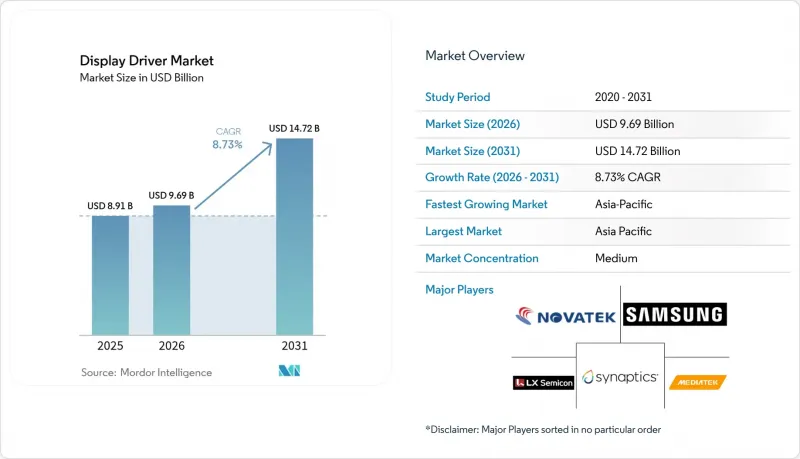
本報告外形規格(大面積DDIC、中小面積DDIC、軟性/折疊式DDIC)、顯示技術(LCD、OLED、MicroLED、電子紙)、應用領域(電視、智慧型手機、平板電腦、筆記型電腦、車載顯示器等)、終端用戶產業(家用電子電器、汽車、工業等)和地區進行細分。市場預測以美元計價。
全球顯示驅動單元市場趨勢及洞察
在北美和亞太地區,旗艦智慧型手機採用OLED顯示器的趨勢正在迅速擴大。
預計OLED將在2024年超越LCD,成為智慧型手機出貨量最大的螢幕,並且隨著各大品牌將120Hz自我調整刷新率和屏下相機作為標準配置,OLED的市場佔有率將持續擴大。三星顯示器計畫於2026年發布的0.6毫米厚面板,在降低30%功耗的同時,需要能夠實現1Hz至120Hz無閃爍頻率調節的驅動器。同樣計畫於2026年發表的蘋果首款折疊式iPhone,將進一步提升高階軟性顯示器的價值,並推動對具有增強型走線設計的抗彎曲驅動IC的需求。 LTPO背板自Apple Watch系列開始量產以來,由於其可節省5-15%的功耗,正逐漸成為智慧型手機的標配,預計到2029年,其累計出貨量將超過LTPS。這些變化,加上OEM廠商對更複雜的閘極補償和觸控功能整合的需求,正為顯示驅動器市場帶來持續的利多。
歐洲汽車數位駕駛座顯示器的普及推動了對多通道驅動積體電路的需求。
歐洲汽車製造商正加速從類比儀表向軟體定義駕駛座的轉型,將儀錶板、資訊娛樂系統和乘員顯示器整合到單一SoC晶片上。 2024年,高階車型的平均每輛車面板數量將增加至4.3個,多通道驅動晶片的搭載率也呈現類似趨勢。 Himax的汽車TDDI銷量首次超過傳統DDIC銷量,累計出貨量達7000萬顆。 Microchip於2025年收購了連接技術專家VSI,這將使DisplayPort 2.1的汽車網路頻寬擴展至80Gbps,滿足無壓縮8K儀錶板的需求。這些發展趨勢使得顯示驅動晶片市場與ADAS和駕駛座的成長緊密相連。
40 奈米以下晶圓代工廠產能長期短缺,限制了 DDIC 的供應。
生產驅動晶片的晶圓廠也生產人工智慧加速器。台積電預計2025年第二季營收將達到314.2億美元,主要得益於高效能運算客戶的推動,這些客戶持有台積電大部分的5奈米和7奈米晶圓訂單。成熟的28奈米和40奈米等製程節點正面臨來自消費級SoC的競爭,訂單驅動晶片的訂單也已分配完畢。預計到2030年,美國工程師短缺人數將達到6.7萬人,可能會進一步減緩待開發區工廠產能擴張的速度。
細分市場分析
到2025年,中小面積積體電路將佔據大部分銷售額,達到顯示驅動晶片市場佔有率的56.65%。這些元件廣泛應用於智慧型手機、平板電腦以及各種物聯網顯示器,在這些應用中,低漏電流和緊湊的晶片尺寸至關重要。雖然平均單價仍低於0.90美元,但銷量足以彌補微薄的利潤,使這一細分市場成為顯示驅動晶片市場的基礎。隨著行動電話製造商朝120Hz可變更新率發展,市場需求依然強勁,平均售價(ASP)也略有上漲。
軟性/折疊式驅動晶片雖然目前的出貨量遠低於其他晶片,但其成長速度最快,複合年成長率高達11.45%。三星的「Z系列」在2024年第二季出貨量達到925萬顆,印證了折疊式裝置的主流化趨勢,並促使其他品牌紛紛效仿。華為同期折疊式設備的出貨量也幾乎加倍,顯示其客戶群正在不斷擴大。此類驅動晶片需要能夠承受半徑小於2毫米的反覆彎曲,整合校正演算法以減少摺痕,並整合觸控功能以節省基板面積。 LG Innotek的雙金屬COF基板支援雙面佈線,並進一步縮小了邊框。蘋果預計將於2026年推出可折疊產品,這將進一步推高市場需求,幾乎所有無廠半導體公司都已將此目標納入其藍圖。
憑藉成熟的生產規模,液晶顯示器(LCD)在2025年仍將佔據顯示器驅動器市場62.70%的佔有率,但價值趨勢正在改變。 Mini LED背光技術的應用需要時序控制器中擁有更多通道,這使得高階電視的單面板附加價值加倍。同時,OLED在平板電腦和筆記型電腦領域正迅速崛起,預計到2028年,平板電腦的滲透率將從5.7%成長到18%,這將極大地推動低功耗驅動器的發展。
然而,微型LED(microLED)表現突出,預計到2031年將以12.25%的複合年成長率成長。直發光面板在原型微型顯示器中已實現20,000尼特的峰值亮度,不僅超越了OLED,而且解決了人們對其使用壽命的擔憂。應用材料公司的量子點顏色轉換技術降低了成本門檻,並提高了良率均勻性。驅動IC現在需要適應小於5µm的像素間距,並實現二極體等級電流匹配。這些規格對擁有類比電路專業知識的公司來說極具優勢。電子紙仍然是一個小眾市場,但對貨架標籤和閱讀器所需的低頻閘極驅動器的需求仍然穩定。
區域分析
到2025年,中國將佔據顯示驅動晶片市場的主導地位,市佔率將達到44.25%。憑藉政府的大規模支持和麵板產業的持續投資,中國未來將成為驅動晶片的最大買家和最有發展潛力的供應商。國內晶圓廠正從55nm製程向實用的28nm節點演進,為本土客戶提供台灣代工廠之外的另一種選擇,從而重塑採購格局。 TCL的噴墨列印OLED中試生產線正在加速這項自給自足的進程。面板自給自足的實現使得本土政策與驅動晶片需求之間形成緊密的連結。
韓國正經歷最快的成長,預計到2031年複合年成長率將達到9.85%。三星和LG Display在OLED沉澱技術和層均勻性方面進一步擴大了領先優勢。政府支持的4,710億美元半導體走廊計畫包括運作16座新晶圓廠,並將系統級產能提高一倍以上。其大部分晶圓庫存將用於生產採用22奈米及更精細製程製造的顯示驅動晶圓。
台灣仍是全球無廠半導體公司不可或缺的代工夥伴。光是台積電一家就力爭實現季度314.2億美元的銷售額,即便人工智慧晶片佔據了其先進產能的很大一部分,該公司仍保持著顯示驅動晶片的流片。在美國,《晶片製造和創新法案》(CHIPS Act)的激勵措施正促使部分驅動晶片的生產轉向國內,例如台積電在亞利桑那州投資1650億美元的擴建計劃,該計劃整合了邏輯晶片和先進封裝生產線。歐洲正憑藉對汽車顯示器的需求開闢出自己的利基市場。歐洲原始設備製造商(OEM)傾向於在地採購關鍵的高級駕駛輔助系統(ADAS)叢集,這刺激了規模較小但具有重要戰略意義的驅動晶片設計公司的發展。
其他好處:
- Excel格式的市場預測(ME)表
- 3個月的分析師支持
目錄
第1章:引言
- 研究假設和市場定義
- 調查範圍
第2章:調查方法
第3章執行摘要
第4章 市場狀況
- 市場概覽
- 市場促進因素
- 在北美和亞太地區,旗艦智慧型手機採用 OLED 和 AMOLED 面板的趨勢正在迅速擴大。
- 汽車數位駕駛座顯示器的快速普及推動了歐洲對多通道數位數位座艙顯示器的需求。
- 中國大螢幕 8K LCD 電視面板的快速普及推高了驅動 IC 的平均售價 (ASP)。
- 穿戴式裝置中 LTPO 背板和整合式觸控驅動器的普及,推動了高利潤 SDDI 的銷售。
- 台灣和韓國政府主導的半導體自給自足計畫正在增強當地的晶圓代工生產能力。
- 對於電動車資訊娛樂顯示器的高效 OLED 驅動器而言,朝向小於 28 奈米的製程節點的轉變正在加速。
- 市場限制因素
- 代工廠長期產能不足,限制了40奈米以下DDIC的供應。
- ESD 和 T-Con 的智慧財產權 (IP) 高額專利費阻礙了輕型晶圓廠競爭對手的進入。
- 超薄邊框顯示器的 COF 封裝良率挑戰正在推高筆記型電腦 ODM 的物料清單成本。
- 面板製造商日益成長的垂直整合正在縮小第三方驅動 IC 的終端位址 (TAM)。
- 產業價值鏈分析
- 監管和技術展望
- 波特五力分析
- 技術藍圖和進展
- 投資分析
第5章 市場規模與成長預測
- 按外形規格
- 大面積DDIC
- 中小面積DDIC
- 軟性/折疊式DDIC
- 顯示技術
- LCD
- OLED
- MicroLED
- E-Paper
- 透過使用
- 電視機
- 智慧型手機
- 藥片
- 筆記型電腦
- 桌面顯示器
- 汽車顯示器
- 穿戴式裝置
- 工業和人機介面
- AR/ VR頭戴裝置
- 按最終用途行業分類
- 家用電子產品
- 車
- 產業
- 衛生保健
- 航太/國防
- 按地區
- 中國
- 台灣
- 韓國
- 北美洲、中美洲和南美洲
- 世界其他地區
第6章 競爭情勢
- 市場集中度
- 策略趨勢
- 市佔率分析
- 公司簡介
- Novatek Microelectronics Corp.
- Synaptics Incorporated
- Samsung Electronics Co., Ltd.(System LSI)
- Silicon Works Co., Ltd.
- MediaTek Inc.
- LX Semicon Co., Ltd.
- Magnachip Semiconductor Corp.
- Fitipower Integrated Technology Inc.
- Raydium Semiconductor Corp.
- Sitronix Technology Corp.
- Himax Technologies, Inc.
- FocalTech Systems Co., Ltd.
- Parade Technologies, Ltd.
- Solomon Systech Ltd.
- Pixelworks, Inc.
- Alpha and Omega Semiconductor Ltd.
- Chipone Technology(Beijing)Co., Ltd.
- Rockchip Electronics Co., Ltd.
- Ilitek(I-LITEK)Corp.
- Silan Microelectronics Co., Ltd.
- Apple Inc.(Internal Display Driver Group)
- BOE Varitronix Ltd.
- Shenzhen Goodix Technology Co., Ltd.
- Arm Technology(Display HW IP)
- Texas Instruments Incorporated
第7章 市場機會與未來展望
According to Mordor Intelligence, the display driver market size in 2026 is estimated at USD 9.69 billion, growing from 2025 value of USD 8.91 billion with 2031 projections showing USD 14.72 billion, growing at 8.73% CAGR over 2026-2031.
This report is Segmented by Form Factor (Large-Area DDIC, Small and Medium-Area DDIC, and Flexible/Foldable DDIC), Display Technology (LCD, OLED, Microled, and E-Paper), Application (Television, Smartphone, Tablet, Notebook PC, Automotive Displays, and More), End-Use Industry (Consumer Electronics, Automotive, Industrial, and More), and Geography. The Market Forecasts are Provided in Terms of Value (USD).
Global Display Driver Market Trends and Insights
Exponential OLED adoption in flagship smartphones across North America and Asia-Pacific
OLED overtook LCD in smartphone unit share during 2024 and is still gaining ground as brands standardize on 120 Hz adaptive refresh and under-panel cameras. Samsung Display's 0.6 mm-thin panels scheduled for 2026 will cut power draw by 30% and require drivers able to throttle from 1 Hz to 120 Hz without flicker. Apple's first foldable iPhone, slated for 2026, further validates the premium flexible format and boosts demand for bend-tolerant driver ICs with reinforced trace routing. LTPO backplanes, which ship in volume starting with Apple Watch models, are becoming a smartphone default thanks to their 5-15% power savings and will surpass LTPS in cumulative units before 2029. Together these shifts add steady tailwinds to the display driver market as OEMs need more complex gate compensation and touch integration.
Surge in automotive display adoption for digital cockpits fueling multi-channel driver IC demand in Europe
European vehicle makers are accelerating the transition from analog gauges to software-defined cockpit domains that blend instrument, infotainment, and passenger screens on a single SoC pipeline. Average panel count per vehicle climbed to 4.3 in premium models during 2024, and multi-channel driver IC attach rates followed the same arc. Himax recorded its first quarter in which automotive TDDI revenue surpassed classic DDIC income after shipping 70 million units cumulatively. Microchip's 2025 acquisition of connectivity specialist VSI expands in-vehicle networking bandwidth to DisplayPort 2.1's 80 Gbps, a prerequisite for uncompressed 8K dashboards. These moves keep the display driver market firmly tethered to ADAS and cockpit growth.
Chronic foundry capacity tightness below 40 nm limiting DDIC supply
The same fabs that print driver ICs also run AI accelerators. TSMC projects USD 31.42 billion in Q2 2025 revenue, fueled mainly by high-performance compute customers that lock in the bulk of 5 nm and 7 nm wafers. Mature nodes at 28 nm and 40 nm face competing demand from consumer SOCs, leaving display driver orders on allocation. The engineer shortage in the United States, pegged at 67,000 by 2030, may further delay greenfield capacity ramps.
Other drivers and restraints analyzed in the detailed report include:
- Rapid proliferation of large-area 8K LCD TV panels in China elevating driver IC ASPs
- Migration toward LTPO backplane and integrated touch drivers in wearables boosting high-margin SDDI sales
- Intensifying panel-maker vertical integration curtailing third-party driver IC TAM
For complete list of drivers and restraints, kindly check the Table Of Contents.
Segment Analysis
Small- and medium-area ICs dominated sales, holding 56.65% of display driver market share in 2025. These parts serve smartphones, tablets, and a broad range of IoT screens that prize low leakage and compact die sizes. Average unit price remains under USD 0.90, yet volume offsets the thin margins, making the segment a foundation of the display driver market. Demand stays resilient as handset OEMs migrate to 120 Hz variable refresh, prompting a subtle uplift in ASP.
Flexible / foldable driver ICs generate far lower unit volume today but post the fastest expansion at an 11.45% CAGR. Samsung's Z series hit 9.25 million panels shipped in Q2 2024, validating mainstream foldables and pushing competing brands to follow. Huawei nearly doubled its foldable shipments within the same window, signaling a widened field of buyers. Drivers in this category must tolerate repetitive bending at radii below 2 mm, pack in compensation algorithms for crease mitigation, and integrate touch to save board area. LG Innotek's two-metal COF substrate offers dual-side routing, shrinking bezels even further. Apple's anticipated 2026 entrance is a demand kicker that nearly every fabless roadmap is already targeting.
LCD retained 62.70% revenue share of the display driver market in 2025 thanks to entrenched manufacturing scale, but the value story is shifting. Mini LED backlights force far higher channel counts into timing controllers, doubling the attachment value per panel in premium TVs. Meanwhile OLED adoption grows in tablets and laptops, scaling from 5.7% to 18% penetration in tablets by 2028, a windfall for power-efficient drivers.
MicroLED, however, stands out with a 12.25% CAGR to 2031. Direct-emission panels achieve peak brightness of 20,000 nits in prototype microdisplays, surpassing OLED while cutting lifetime concerns. Applied Materials' quantum-dot color-conversion technique lowers cost hurdles and raises yield uniformity. Driver ICs must now handle sub-5 µm pixel pitches and deliver diode-level current matching, a spec set that favors firms with analog circuit heritage. E-paper remains niche, but it preserves a steady stream of low-frequency gate drivers for shelf labels and readers.
Complete Report Scope:
- By Form Factor
- Large-Area DDIC
- Small and Medium-Area DDIC
- Flexible/Foldable DDIC
- By Display Technology
- LCD
- OLED
- MicroLED
- E-Paper
- By Application
- Television
- Smartphone
- Tablet
- Notebook PC
- Desktop Monitor
- Automotive Displays
- Wearables
- Industrial and HMI
- AR/VR Headsets
- By End-use Industry
- Consumer Electronics
- Automotive
- Industrial
- Healthcare
- Aerospace and Defense
- By Geography
- China
- Taiwan
- South Korea
- Americas
- Rest of the World
Geography Analysis
China sat atop the leaderboard with 44.25% of display driver market revenue in 2025. Massive government incentives and on-going panel investments make the nation both the largest buyer and the most formidable future supplier of driver ICs. Domestic fabs advance from 55 nm riverbeds to viable 28 nm nodes, giving local customers an alternative to Taiwan foundries and thus reshaping the procurement map. TCL's inkjet-printed OLED pilot lines strengthen this self-reliance push. Panel self-sufficiency translates into a tight correlation between local policy and driver demand.
South Korea records the fastest growth, posting a projected 9.85% CAGR through 2031. Samsung and LG Display extend their lead in OLED evaporation know-how and layer uniformity. The government-backed USD 471 billion semiconductor corridor plans to bring sixteen new fabs online and more than double system-level capacity. A high share of that wafer inventory will roll into display driver wafers printed at 22 nm and finer.
Taiwan remains the indispensable foundry partner for global fabless players. TSMC alone aims for USD 31.42 billion in quarterly revenue, keeping display driver tape-outs alive even as AI chips claim the lion's share of leading-edge capacity. In the Americas, CHIPS Act incentives pull limited driver volumes onshore, illustrated by TSMC's USD 165 billion Arizona build-out that pairs logic with advanced packaging lines. Europe carves its niche through automotive display demand: continental OEMs prefer local supply for mission-critical ADAS clusters, spurring small but strategic driver IC design houses.
List of Companies Covered in this Report:
- Novatek Microelectronics Corp.
- Synaptics Incorporated
- Samsung Electronics Co., Ltd. (System LSI)
- Silicon Works Co., Ltd.
- MediaTek Inc.
- LX Semicon Co., Ltd.
- Magnachip Semiconductor Corp.
- Fitipower Integrated Technology Inc.
- Raydium Semiconductor Corp.
- Sitronix Technology Corp.
- Himax Technologies, Inc.
- FocalTech Systems Co., Ltd.
- Parade Technologies, Ltd.
- Solomon Systech Ltd.
- Pixelworks, Inc.
- Alpha and Omega Semiconductor Ltd.
- Chipone Technology (Beijing) Co., Ltd.
- Rockchip Electronics Co., Ltd.
- Ilitek (I-LITEK) Corp.
- Silan Microelectronics Co., Ltd.
- Apple Inc. (Internal Display Driver Group)
- BOE Varitronix Ltd.
- Shenzhen Goodix Technology Co., Ltd.
- Arm Technology (Display HW IP)
- Texas Instruments Incorporated
Additional Benefits:
- The market estimate (ME) sheet in Excel format
- 3 months of analyst support
TABLE OF CONTENTS
1 INTRODUCTION
- 1.1 Study Assumptions and Market Definition
- 1.2 Scope of the Study
2 RESEARCH METHODOLOGY
3 EXECUTIVE SUMMARY
4 MARKET LANDSCAPE
- 4.1 Market Overview
- 4.2 Market Drivers
- 4.2.1 Exponential Adoption of OLED and AMOLED Panels in Flagship Smartphones across North America and Asia-Pacific
- 4.2.2 Surge in Automotive Display Adoption for Digital Cockpits Fueling Multi-Channel DDIC Demand in Europe
- 4.2.3 Rapid Proliferation of Large-Area 8K LCD TV Panels in China Elevating Driver IC ASPs
- 4.2.4 Migration Toward LTPO Backplane and Integrated Touch Drivers in Wearables Boosting High-Margin SDDI Sales
- 4.2.5 Government-Backed Semiconductor Self-Sufficiency Programs in Taiwan and South Korea Bolstering Local Foundry capacity
- 4.2.6 Accelerated Shift toLess than 28 nm Process Nodes for Power-Efficient OLED Drivers in EV Infotainment Displays
- 4.3 Market Restraints
- 4.3.1 Chronic Foundry capacity TightnessLess than 40 nm Limiting DDIC Supply Fulfilment
- 4.3.2 High Royalty Costs of ESD and T-Con IP Stifling Entry of Fab-Lite Competitors
- 4.3.3 Yield Challenges in COF Packaging for Ultra-Thin Bezel Displays Inflating BOM for Notebook ODMs
- 4.3.4 Intensifying Panel-Maker Vertical Integration Curtailing Third-Party Driver IC TAM
- 4.4 Industry Value Chain Analysis
- 4.5 Regulatory or Technological Outlook
- 4.6 Porter's Five Forces Analysis
- 4.6.1 Threat of New Entrants
- 4.6.2 Bargaining Power of Suppliers
- 4.6.3 Bargaining Power of Buyers
- 4.6.4 Threat of Substitute Products
- 4.6.5 Intensity of Competitive Rivalry
- 4.7 Technological Roadmap and Advances
- 4.8 Investment Analysis
5 MARKET SIZE AND GROWTH FORECASTS (VALUES)
- 5.1 By Form Factor
- 5.1.1 Large-Area DDIC
- 5.1.2 Small and Medium-Area DDIC
- 5.1.3 Flexible/Foldable DDIC
- 5.2 By Display Technology
- 5.2.1 LCD
- 5.2.2 OLED
- 5.2.3 MicroLED
- 5.2.4 E-Paper
- 5.3 By Application
- 5.3.1 Television
- 5.3.2 Smartphone
- 5.3.3 Tablet
- 5.3.4 Notebook PC
- 5.3.5 Desktop Monitor
- 5.3.6 Automotive Displays
- 5.3.7 Wearables
- 5.3.8 Industrial and HMI
- 5.3.9 AR/VR Headsets
- 5.4 By End-use Industry
- 5.4.1 Consumer Electronics
- 5.4.2 Automotive
- 5.4.3 Industrial
- 5.4.4 Healthcare
- 5.4.5 Aerospace and Defense
- 5.5 By Geography
- 5.5.1 China
- 5.5.2 Taiwan
- 5.5.3 South Korea
- 5.5.4 Americas
- 5.5.5 Rest of the World
6 COMPETITIVE LANDSCAPE
- 6.1 Market Concentration
- 6.2 Strategic Moves
- 6.3 Market Share Analysis
- 6.4 Company Profiles (includes Global level Overview, Market level overview, Core Segments, Financials as available, Strategic Information, Market Rank/Share for key companies, Products and Services, and Recent Developments)
- 6.4.1 Novatek Microelectronics Corp.
- 6.4.2 Synaptics Incorporated
- 6.4.3 Samsung Electronics Co., Ltd. (System LSI)
- 6.4.4 Silicon Works Co., Ltd.
- 6.4.5 MediaTek Inc.
- 6.4.6 LX Semicon Co., Ltd.
- 6.4.7 Magnachip Semiconductor Corp.
- 6.4.8 Fitipower Integrated Technology Inc.
- 6.4.9 Raydium Semiconductor Corp.
- 6.4.10 Sitronix Technology Corp.
- 6.4.11 Himax Technologies, Inc.
- 6.4.12 FocalTech Systems Co., Ltd.
- 6.4.13 Parade Technologies, Ltd.
- 6.4.14 Solomon Systech Ltd.
- 6.4.15 Pixelworks, Inc.
- 6.4.16 Alpha and Omega Semiconductor Ltd.
- 6.4.17 Chipone Technology (Beijing) Co., Ltd.
- 6.4.18 Rockchip Electronics Co., Ltd.
- 6.4.19 Ilitek (I-LITEK) Corp.
- 6.4.20 Silan Microelectronics Co., Ltd.
- 6.4.21 Apple Inc. (Internal Display Driver Group)
- 6.4.22 BOE Varitronix Ltd.
- 6.4.23 Shenzhen Goodix Technology Co., Ltd.
- 6.4.24 Arm Technology (Display HW IP)
- 6.4.25 Texas Instruments Incorporated
7 MARKET OPPORTUNITIES AND FUTURE OUTLOOK
- 7.1 White-Space and Unmet-Need Assessment

 顯示驅動IC市場:預測至2034年-按顯示技術、驅動類型、IC封裝類型、應用、最終用戶和地區分類的全球分析
 顯示驅動IC市場:2026-2032年全球市場預測(依顯示器、IC封裝、驅動技術、應用及最終用戶分類)
 顯示器驅動器市場:全球產業分析、市場規模、市場佔有率及預測(按驅動器類型、封裝類型、裝置、顯示技術、顯示器尺寸、國家和地區分類)-2026年至2033年
 2026年全球金屬氧化物半導體(MOS)顯示驅動器市場報告顯示驅動IC創新市場預測至2034年:按架構、顯示技術、應用和區域分類的全球分析2026年全球顯示驅動器市場報告顯示驅動單元市場:按面板技術、解析度、螢幕大小、應用、分銷管道分類,全球預測(2026-2032年)
 顯示驅動器市場分析及預測(至 2035 年):按類型、產品類型、技術、組件、應用、設備、最終用戶、功能、安裝類型、解決方案分類
 全球顯示器驅動器市場規模、佔有率、趨勢和成長分析報告(2026-2034)
 顯示器驅動器市場 - 全球產業規模、佔有率、趨勢、機會及預測(按類型、技術、最終用戶、地區和競爭格局分類,2021-2031年)