


 |
市場調查報告書
商品編碼
2124820
數位訊號處理器:市場佔有率分析、產業趨勢與統計、成長預測(2026-2031)Digital Signal Processor - Market Share Analysis, Industry Trends & Statistics, Growth Forecasts (2026 - 2031) |
||||||

※ 本網頁內容可能與最新版本有所差異。詳細情況請與我們聯繫。
根據 Mordor Intelligence 預測,數位訊號處理器 (DSP) 市場規模將從 2025 年的 26.9 億美元成長到 2026 年的 27.7 億美元,然後在 2031 年達到 32.3 億美元,2026 年至 2031 年的複合年成長率為 3.10%。
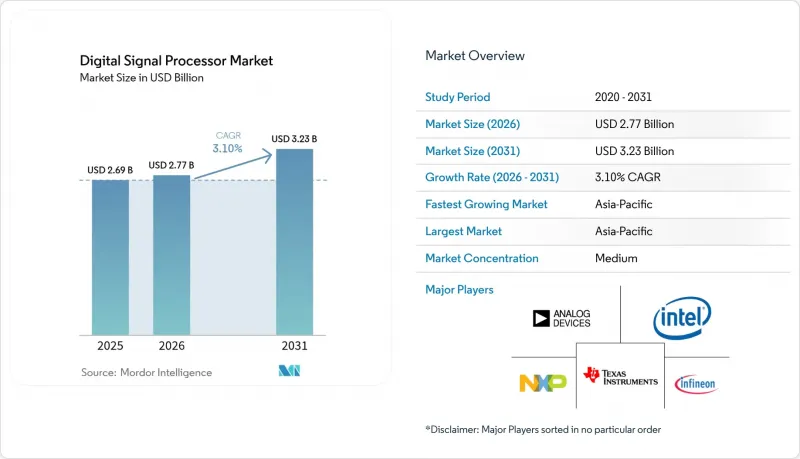
本報告以核心數(例如,單核心)、產品類型(例如,通用獨立DSP)、架構(例如,SIMD、VLIX)、數值格式(例如,定點)、最終用戶產業(例如,電信、汽車、家用電子電器)和地區進行細分。市場預測以美元(USD)計價。
全球數位訊號處理器市場趨勢與洞察
亞洲5G OpenRAN部署擴充
開放式無線接取網路(Open RAN)架構將硬體和軟體功能分離,以可程式化的DSP平台取代了專有基頻卡,並透過軟體進行重新定向。中國、日本和韓國的電信業者正在採用這些開放式協定棧,以減少廠商鎖定並加速功能更新。一個結合了NVIDIA ARC GPU和高效能DSP核心的測試平台,在多用戶負載下實現了超過500 Mbps的下行鏈路速度。這項效能展示引發了對多核心、支援浮點運算的DSP的採購熱潮,這些DSP能夠即時執行波束成形、通道估計和去程傳輸壓縮等功能。由此產生的連鎖反應正在增加亞太地區對商用晶片和可授權DSP IP的訂單,北美地區也正在逐步採用這項技術。
汽車ADAS一級設計正從MCU轉向以DSP為中心的SoC。
隨著每輛車上的攝影機、雷達和LiDAR數量的增加,微控制器的吞吐量不足以進行即時感測器融合。因此,一級供應商正轉向異質SoC,將多核心DSP引擎和AI加速器整合在一起。 AMD的Zynq UltraScale+XA MPSoC展示如何在一個經過安全認證的封裝內,實現高效協同的DSP架構處理雷達啁啾訊號,同時相鄰的AI引擎執行目標分類。到2027年,歐洲和東亞的汽車供應鏈將穩定提高這種設計的採用率,即使平均售價趨於下降,也能支撐兩位數的銷售成長。
先進節點(7奈米及以下)代工廠的供應鏈波動
台灣和韓國數量有限的先進晶圓廠面臨週期性的地緣政治因素和物流中斷的挑戰。當產能緊張時,DSP前置作業時間可能超過40週,迫使設計人員在無法滿足功耗和性能目標的成熟製程上重新流片。相較之下,那些採用多方晶圓廠合作策略和高度靈活的實體設計套件的半導體製造商受到的影響較小,而那些依賴單一供應商的競爭對手則不然。
細分市場分析
預計到2025年,多核心裝置將佔數位訊號處理器銷售額的64.30%,市場規模將達到17.3億美元,凸顯了其在5G基頻、汽車雷達和工業視覺等領域的關鍵作用。這些組件之所以在數位訊號處理器市場備受青睞,是因為任務級並行處理能夠自然地跨多個同構核心進行,即使在即時性要求下也能實現確定性延遲。德克薩斯(TI)的C66x系列展示了一種利用統一的「多核心導航器」架構(包含八個定點/浮點核心)消除複製開銷的機制。其柔軟性的配置支援涵蓋醫療成像、馬達控制和衛星通訊終端等多個產品線的各種應用。
儘管在智慧電錶等深度嵌入式、價格敏感的終端節點中,單核心和雙核心處理器仍然可用,但融合了DSP、CPU和AI加速器的異構多核心SoC正迅速崛起。到2031年,多核心數位訊號處理器市場的年複合成長率(CAGR)將持續維持在3.64%,其成長速度將持續超過整個產業的營收成長。隨著開放原始碼工具鏈的日趨成熟,多核心程式設計的負擔正在減輕,這促使供應商將可擴展的基於分塊的架構、暫存記憶體藍圖結構和核間訊息傳遞作為優先發展方向。
到2025年,專用數位訊號處理器(DSP)將佔數位訊號處理器市場銷售額的47.60%,即12.8億美元。這是因為高度專業化的指令集和加速器模組在智慧型手機、基地台和車載資訊娛樂系統等應用中實現了高能源效率性能。這種成長符合原始設備製造商(OEM)降低物料清單(BOM)成本和減少基板空間的需求。高通的數據機整合DSP模組和ADI的射頻最佳化核心正是這種以應用為導向的典型例子。
然而,預計成長最快的市場將是可授權的嵌入式DSP IP,這些IP將整合到更廣泛的SoC專案中。這一趨勢正以4.02%的複合年成長率成長,擴大了EDA供應商和軟IP供應商的潛在市場規模。通用分立式DSP目前正轉向軍事、航太和實驗儀器等細分市場,這些市場對產品生命週期長短要求很高。基於FPGA的混合產品正在填補客製化空白,滿足中等規模生產客戶對可重構性的需求,同時避免ASIC的風險。
區域分析
到2025年,亞太地區將佔全球銷售額的48.20%,並佔據全球數位訊號處理器市場近一半的佔有率。光是中國就將佔晶圓需求的四分之一以上,這主要得益於電信業者建設超高密度5G網路以及電動車製造商為車輛配備雷達和資訊娛樂處理器。韓國和日本憑藉其先進的記憶體、感測器和汽車供應鏈,也正在推動進一步的需求成長。亞太地區以3.74%的複合年成長率保持領先地位,其晶圓產能確保了即使在先進製程節點供應緊張的情況下,也能保持供應優勢。
北美在銷售額和研發實力方面均位居第二。矽谷的新創公司和奧斯汀的成熟公司正在推動尖端多核心架構和神經DSP混合技術的發展,而美國的國防計畫則確保了抗輻射浮點組件的穩定市場。 《晶片與科學法案》下的聯邦獎勵正在推動國內晶圓廠的擴張,這些晶圓廠計劃於2027年投入運作,預計將緩解本地DSP製造商面臨的節點短缺問題。
歐洲憑藉德國和法國汽車製造商的強勁需求以及日益增多的機器視覺整合商,完善了這一三方格局。諸如IPCEI微電子等區域性舉措正在支持12吋晶圓的試點生產線,縮小與亞洲的生產差距。同時,南美洲以及中東和非洲作為新興市場也做出了貢獻,這主要得益於電信基礎設施和衛星寬頻閘道的部署,而這些基礎設施和閘道器則依賴高吞吐量的DSP為基礎的調變解調器。
其他好處:
- Excel格式的市場預測(ME)表
- 3個月的分析師支持
目錄
第1章:引言
- 研究假設和市場定義
- 調查範圍
第2章:調查方法
第3章執行摘要
第4章 市場狀況
- 市場概覽
- 市場促進因素
- 亞洲5G開放式無線接取網路部署擴展
- 汽車ADAS一級設計正從MCU轉向以DSP為中心的SoC。
- 穿戴式音訊設備和智慧音箱中的人工智慧語音處理技術
- 在航太和國防領域引入軟體定義雷達
- 歐洲「品質4.0」邊緣型工業機器視覺
- 需要高吞吐量基頻DSP的雲端原生無線接取網路
- 市場限制因素
- 先進節點(7奈米及以下)代工廠的供應鏈波動
- 在電池供電設備中整合定點和浮點精度權衡
- 可授權DSP IP核的專利費不斷上漲
- 全球網路出口限制正在限制DSP向某些地區的出口。
- 產業生態系分析
- 技術展望
- 波特五力分析
第5章 市場規模與成長預測
- 核心特定
- 單核
- 雙核心
- 多核心
- 依產品類型
- 通用型獨立DSP
- 特定應用的DSP(ASSP/ASIP)
- 嵌入式DSP IP核
- 基於FPGA/SoC的混合DSP
- 以建築學為例
- SIMD(單指令多資料流)
- VLIW(Very-long-instruction-word)
- SIMT/向量DSP
- MLIW 與新型異質設計
- 數字表示法格式
- 不動點
- 浮點數
- 混合/自適應精度
- 按最終用戶行業分類
- 溝通
- 蜂窩基礎設施(4G/5G、開放式無線接入網)
- 資料中心和雲端邊緣
- VoIP 和 IP 影片
- 車
- ADAS和自動駕駛
- 車載資訊娛樂系統
- 家用電子產品
- 智慧型手機和平板電腦
- 穿戴式音訊設備/穿戴式裝置
- 智慧電視和機上盒
- 產業
- 馬達控制和驅動裝置
- 機器視覺與機器人技術
- 智慧電網和能源
- 航太/國防
- 雷達和電子戰系統
- 衛星和空間電子
- 衛生保健
- 醫學影像診斷
- 病患監測和診斷
- 溝通
- 按地區
- 北美洲
- 美國
- 加拿大
- 墨西哥
- 歐洲
- 德國
- 英國
- 法國
- 義大利
- 西班牙
- 其他歐洲國家
- 亞太地區
- 中國
- 日本
- 韓國
- 印度
- 東南亞
- 澳洲
- 其他亞太國家
- 南美洲
- 巴西
- 其他南美國家
- 中東和非洲
- 中東
- 阿拉伯聯合大公國
- 沙烏地阿拉伯
- 其他中東國家
- 非洲
- 南非
- 其他非洲國家
- 中東
- 北美洲
第6章 競爭情勢
- 市場集中度
- 策略趨勢
- 市佔率分析
- 公司簡介
- Texas Instruments Inc.
- Analog Devices Inc.
- Qualcomm Technologies Inc.
- Intel Corporation
- NXP Semiconductors NV
- STMicroelectronics NV
- Infineon Technologies AG
- Renesas Electronics Corp.
- Xilinx Inc.(AMD)
- Broadcom Inc.
- Samsung Electronics Co. Ltd.
- Toshiba Corp.
- Cirrus Logic Inc.
- MediaTek Inc.
- HiSilicon Technologies Co. Ltd.
- Marvell Technology Inc.
- ARM Ltd.(DSP IP)
- CEVA Inc.
- Cadence Design Systems(Tensilica DSP)
- Synopsys Inc.(ARC DSP)
- ON Semiconductor Corp.
- Silicon Labs Inc.
- Realtek Semiconductor Corp.
第7章 市場機會與未來展望
According to Mordor Intelligence, the digital signal processor market size is expected to grow from USD 2.69 billion in 2025 to USD 2.77 billion in 2026 and is forecast to reach USD 3.23 billion by 2031 at 3.10% CAGR over 2026-2031.
This report is Segmented by Core (Single-Core, and More), Product Type (General-Purpose Stand-Alone DSPs, and More), Architecture (Single Instruction Multiple Data, Very-Long-Instruction-Word, and More), Numeric Format (Fixed-Point, and More), End-User Industry (Communication, Automotive, Consumer Electronics, and More), and Geography. The Market Forecasts are Provided in Terms of Value (USD).
Global Digital Signal Processor Market Trends and Insights
Proliferation of 5G Open-RAN Deployments in Asia
Open RAN architectures separate hardware and software functions, replacing proprietary baseband cards with programmable DSP platforms that can be retargeted in software. Operators in China, Japan, and South Korea are using these open stacks to trim vendor lock-in and speed feature updates. Testbeds combining NVIDIA ARC GPUs with high-performance DSP cores have exceeded 500 Mbps downlink under multi-user loads. This performance proof drives a procurement wave for multicore, floating-point-capable DSPs that execute beam-forming, channel estimation, and fronthaul compression in real time. The resulting pull-through effect is lifting orders for both merchant silicon and licensable DSP IP in Asia-Pacific and secondary deployments in North America.
Automotive ADAS Tier-1 Designs Migrating from MCU to DSP-centric SoCs
As camera, radar, and LiDAR counts rise per vehicle, microcontrollers lack the throughput to perform real-time sensor fusion. Tier-1 suppliers are therefore shifting to heterogeneous SoCs combining multi-core DSP engines with AI accelerators. AMD's Zynq UltraScale+ XA MPSoC shows how a tightly coupled DSP fabric processes radar chirps while adjacent AI engines classify objects, all inside a single safety-certified package. The automotive supply chain in Europe and East Asia is committing design wins through 2027, anchoring double-digit unit growth even as average selling prices drift lower.
Supply-chain Volatility in Advanced Node (<= 7 nm) Foundries
A limited pool of ultra-modern fabs in Taiwan and South Korea faces periodic geopolitical and logistics disruptions. When capacity tightens, DSP lead-times stretch beyond 40 weeks, pushing designers to retape-out on mature processes that meet neither power nor performance targets. Chipmakers with multi-foundry strategies and adaptable physical-design kits remain better insulated than rivals locked to single-source partnerships.
Other drivers and restraints analyzed in the detailed report include:
- AI-enhanced Audio & Voice Processing in Hearables and Smart Speakers
- Adoption of Software-Defined Radar in Aerospace & Defense
- Integration Trade-offs Between Fixed- and Floating-Point Precision in Battery-Powered Devices
For complete list of drivers and restraints, kindly check the Table Of Contents.
Segment Analysis
Multi-core devices generated 64.30% of 2025 revenue, equivalent to a USD 1.73 billion slice of the digital signal processor market size, underscoring their essential role in 5G baseband, automotive radar, and industrial vision. The digital signal processor market favors these parts because task-level parallelism maps naturally to multiple homogeneous cores, allowing deterministic latency under real-time constraints. Texas Instruments' C66x family demonstrates how eight fixed-/floating-point cores harness a unified Multicore Navigator fabric to eliminate copy overhead. The configuration headroom supports product-line variants spanning medical imaging, motor control, and SATCOM terminals.
Single-core and dual-core options survive in deeply embedded, price-sensitive end-nodes such as smart meters, while heterogeneous multi-core SoCs that blend DSP, CPU, and AI accelerators are gaining traction. Sustained 3.64% CAGR through 2031 keeps the multi-core slice of the digital signal processor market expanding faster than overall industry revenue. As open-source toolchains mature, multicore programming burdens fall, reinforcing supplier roadmaps that prioritize scalable tile-based fabrics, scratchpad memory hierarchies, and inter-core message passing.
Application-specific DSPs captured 47.60% of revenue in 2025, or USD 1.28 billion of the digital signal processor market size, because tightly focused instruction sets and accelerator blocks deliver watt-efficient performance in smartphones, base stations, and infotainment head units. Their growth aligns with OEM demands for BOM savings and board-space reductions. Qualcomm's modem-integrated DSP blocks and Analog Devices' RF-optimized cores exemplify this fit-for-purpose approach.
The fastest expansion, however, comes from licensable embedded DSP IP inserted into wider SoC projects. At a 4.02% CAGR, this vector raises the total addressable slice for EDA vendors and soft-IP houses. General-purpose discrete DSPs now orient toward military, aerospace, and laboratory instrumentation niches that value long product lifecycles. FPGA-based hybrids fill customization gaps where mid-volume customers need reconfigurability without ASIC risk.
Complete Report Scope:
- By Core
- Single-core
- Dual-core
- Multi-core
- By Product Type
- General-purpose Stand-alone DSPs
- Application-specific DSP (ASSP/ASIP)
- Embedded DSP IP Cores
- FPGA/SoC-based Hybrid DSPs
- By Architecture
- SIMD (Single Instruction Multiple Data)
- VLIW (Very-long-instruction-word)
- SIMT/Vector DSPs
- MLIW and Novel Heterogeneous Designs
- By Numeric Format
- Fixed-point
- Floating-point
- Mixed/Adaptive Precision
- By End-user Industry
- Communication
- Cellular Infrastructure (4G/5G, Open-RAN)
- Data Center and Cloud Edge
- VoIP and IP Video
- Automotive
- ADAS and Autonomous Driving
- In-vehicle Infotainment
- Consumer Electronics
- Smartphones and Tablets
- Hearables/Wearables
- Smart TVs and STBs
- Industrial
- Motor Control and Drives
- Machine Vision and Robotics
- Smart Grid and Energy
- Aerospace and Defense
- Radar and EW Systems
- Satellite and Space Electronics
- Healthcare
- Medical Imaging
- Patient Monitoring and Diagnostics
- Communication
- By Geography
- North America
- United States
- Canada
- Mexico
- Europe
- Germany
- United Kingdom
- France
- Italy
- Spain
- Rest of Europe
- Asia-Pacific
- China
- Japan
- South Korea
- India
- South East Asia
- Australia
- Rest of Asia-Pacific
- South America
- Brazil
- Rest of South America
- Middle East and Africa
- Middle East
- United Arab Emirates
- Saudi Arabia
- Rest of Middle East
- Africa
- South Africa
- Rest of Africa
- Middle East
- North America
Geography Analysis
Asia-Pacific generated 48.20% of worldwide revenue in 2025, just under half of the global digital signal processor market. China alone drives more than one quarter of wafer demand as its telecom operators build ultra-dense 5G grids and EV makers load vehicles with radar and infotainment processors. South Korea and Japan add further pull through their advanced memory, sensor, and automotive supply chains. A 3.74% CAGR keeps the region at the top of the growth league, and its installed fab capacity secures a supply advantage when advanced-node allocations tighten.
North America ranks second in both revenue and R&D depth. Silicon Valley start-ups and Austin-based incumbents push leading-edge multicore architectures and neural-DSP hybrids, while US defense projects guarantee a steady market for rad-hard floating-point parts. Federal incentives under the CHIPS and Science Act catalyze domestic fab expansions scheduled to come online by 2027, promising to ease node scarcity for local DSP houses.
Europe completes the triad with robust demand from German and French automakers and a growing cohort of machine-vision integrators. Regional initiatives such as IPCEI Micro-electronics support pilot lines for 12-in wafers, narrowing the production gap with Asia. Meanwhile, South America plus the Middle East & Africa contribute an emerging tail, largely tied to telecom infrastructure roll-outs and satellite broadband gateways that rely on high-throughput DSP-based modems.
- Texas Instruments Inc.
- Analog Devices Inc.
- Qualcomm Technologies Inc.
- Intel Corporation
- NXP Semiconductors N.V.
- STMicroelectronics N.V.
- Infineon Technologies AG
- Renesas Electronics Corp.
- Xilinx Inc. (AMD)
- Broadcom Inc.
- Samsung Electronics Co. Ltd.
- Toshiba Corp.
- Cirrus Logic Inc.
- MediaTek Inc.
- HiSilicon Technologies Co. Ltd.
- Marvell Technology Inc.
- ARM Ltd. (DSP IP)
- CEVA Inc.
- Cadence Design Systems (Tensilica DSP)
- Synopsys Inc. (ARC DSP)
- ON Semiconductor Corp.
- Silicon Labs Inc.
- Realtek Semiconductor Corp.
Additional Benefits:
- The market estimate (ME) sheet in Excel format
- 3 months of analyst support
TABLE OF CONTENTS
1 INTRODUCTION
- 1.1 Study Assumptions and Market Definition
- 1.2 Scope of the Study
2 RESEARCH METHODOLOGY
3 EXECUTIVE SUMMARY
4 MARKET LANDSCAPE
- 4.1 Market Overview
- 4.2 Market Drivers
- 4.2.1 Proliferation of 5G Open-RAN Deployments in Asia
- 4.2.2 Automotive ADAS Tier-1 Designs Migrating from MCU to DSP-centric SoCs
- 4.2.3 AI-enhanced Audio and Voice Processing in Hearables and Smart Speakers
- 4.2.4 Adoption of Software-Defined Radar in Aerospace and Defense
- 4.2.5 Edge-based Industrial Machine Vision for Quality 4.0 in Europe
- 4.2.6 Cloud-native Radio Access Networks Requiring High-throughput Baseband DSPs
- 4.3 Market Restraints
- 4.3.1 Supply-chain Volatility in Advanced Node (?7 nm) Foundries
- 4.3.2 Integration Trade-offs Between Fixed- and Floating-Point Precision in Battery-Powered Devices
- 4.3.3 Escalating Royalty Costs for Licensable DSP IP Cores
- 4.3.4 Global Cyber-export Controls Limiting DSP Shipments to Select Regions
- 4.4 Industry Ecosystem Analysis
- 4.5 Technological Outlook
- 4.6 Porter's Five Forces Analysis
- 4.6.1 Bargaining Power of Suppliers
- 4.6.2 Bargaining Power of Buyers
- 4.6.3 Threat of New Entrants
- 4.6.4 Threat of Substitutes
- 4.6.5 Intensity of Competitive Rivalry
5 MARKET SIZE AND GROWTH FORECASTS (VALUES)
- 5.1 By Core
- 5.1.1 Single-core
- 5.1.2 Dual-core
- 5.1.3 Multi-core
- 5.2 By Product Type
- 5.2.1 General-purpose Stand-alone DSPs
- 5.2.2 Application-specific DSP (ASSP/ASIP)
- 5.2.3 Embedded DSP IP Cores
- 5.2.4 FPGA/SoC-based Hybrid DSPs
- 5.3 By Architecture
- 5.3.1 SIMD (Single Instruction Multiple Data)
- 5.3.2 VLIW (Very-long-instruction-word)
- 5.3.3 SIMT/Vector DSPs
- 5.3.4 MLIW and Novel Heterogeneous Designs
- 5.4 By Numeric Format
- 5.4.1 Fixed-point
- 5.4.2 Floating-point
- 5.4.3 Mixed/Adaptive Precision
- 5.5 By End-user Industry
- 5.5.1 Communication
- 5.5.1.1 Cellular Infrastructure (4G/5G, Open-RAN)
- 5.5.1.2 Data Center and Cloud Edge
- 5.5.1.3 VoIP and IP Video
- 5.5.2 Automotive
- 5.5.2.1 ADAS and Autonomous Driving
- 5.5.2.2 In-vehicle Infotainment
- 5.5.3 Consumer Electronics
- 5.5.3.1 Smartphones and Tablets
- 5.5.3.2 Hearables/Wearables
- 5.5.3.3 Smart TVs and STBs
- 5.5.4 Industrial
- 5.5.4.1 Motor Control and Drives
- 5.5.4.2 Machine Vision and Robotics
- 5.5.4.3 Smart Grid and Energy
- 5.5.5 Aerospace and Defense
- 5.5.5.1 Radar and EW Systems
- 5.5.5.2 Satellite and Space Electronics
- 5.5.6 Healthcare
- 5.5.6.1 Medical Imaging
- 5.5.6.2 Patient Monitoring and Diagnostics
- 5.5.1 Communication
- 5.6 By Geography
- 5.6.1 North America
- 5.6.1.1 United States
- 5.6.1.2 Canada
- 5.6.1.3 Mexico
- 5.6.2 Europe
- 5.6.2.1 Germany
- 5.6.2.2 United Kingdom
- 5.6.2.3 France
- 5.6.2.4 Italy
- 5.6.2.5 Spain
- 5.6.2.6 Rest of Europe
- 5.6.3 Asia-Pacific
- 5.6.3.1 China
- 5.6.3.2 Japan
- 5.6.3.3 South Korea
- 5.6.3.4 India
- 5.6.3.5 South East Asia
- 5.6.3.6 Australia
- 5.6.3.7 Rest of Asia-Pacific
- 5.6.4 South America
- 5.6.4.1 Brazil
- 5.6.4.2 Rest of South America
- 5.6.5 Middle East and Africa
- 5.6.5.1 Middle East
- 5.6.5.1.1 United Arab Emirates
- 5.6.5.1.2 Saudi Arabia
- 5.6.5.1.3 Rest of Middle East
- 5.6.5.2 Africa
- 5.6.5.2.1 South Africa
- 5.6.5.2.2 Rest of Africa
- 5.6.5.1 Middle East
- 5.6.1 North America
6 COMPETITIVE LANDSCAPE
- 6.1 Market Concentration
- 6.2 Strategic Moves
- 6.3 Market Share Analysis
- 6.4 Company Profiles {(includes Global level Overview, Market level overview, Core Segments, Financials as available, Strategic Information, Market Rank/Share for key companies, Products and Services, and Recent Developments)}
- 6.4.1 Texas Instruments Inc.
- 6.4.2 Analog Devices Inc.
- 6.4.3 Qualcomm Technologies Inc.
- 6.4.4 Intel Corporation
- 6.4.5 NXP Semiconductors N.V.
- 6.4.6 STMicroelectronics N.V.
- 6.4.7 Infineon Technologies AG
- 6.4.8 Renesas Electronics Corp.
- 6.4.9 Xilinx Inc. (AMD)
- 6.4.10 Broadcom Inc.
- 6.4.11 Samsung Electronics Co. Ltd.
- 6.4.12 Toshiba Corp.
- 6.4.13 Cirrus Logic Inc.
- 6.4.14 MediaTek Inc.
- 6.4.15 HiSilicon Technologies Co. Ltd.
- 6.4.16 Marvell Technology Inc.
- 6.4.17 ARM Ltd. (DSP IP)
- 6.4.18 CEVA Inc.
- 6.4.19 Cadence Design Systems (Tensilica DSP)
- 6.4.20 Synopsys Inc. (ARC DSP)
- 6.4.21 ON Semiconductor Corp.
- 6.4.22 Silicon Labs Inc.
- 6.4.23 Realtek Semiconductor Corp.
7 MARKET OPPORTUNITIES AND FUTURE OUTLOOK
- 7.1 White-space and Unmet-need Assessment

 數位訊號處理器 (DSP) 市場預測至 2034 年—按處理器類型、架構、功能、分銷管道、應用和地區分類的全球分析數位訊號處理器市場預測至2034年—按類型、架構、應用、最終用戶和地區分類的全球分析
 音頻DSP市場規模(按類型、最終用途和地區分類)(2026-2034年)
 VPX訊號處理平台全球市場報告(2026年)
 音訊DSP市場:2026-2032年全球市場預測(依產品類型、應用程式、部署方式、銷售管道及最終用戶分類)2026年全球軟判決前向糾錯連貫數位訊號處理單元(SD-FEC連貫DSP)市場報告數位訊號處理器市場:按處理器類型、處理速度、核心數、最終用戶產業和應用分類-2026-2032年全球市場預測2026年全球播客音訊處理設備市場報告
 數位訊號處理器市場-全球產業規模、佔有率、趨勢、機會、預測:按核心類型、按類型、按最終用戶、按地區和競爭對手分類,2021-2031年USB數位音訊晶片市場:按通道數、封裝、介面、位元深度、取樣率、應用和分銷管道分類-全球預測,2026-2032年