


 |
市場調查報告書
商品編碼
2120418
資料中心服務:市場佔有率分析、產業趨勢與統計、成長預測(2026-2032)Data Center Services - Market Share Analysis, Industry Trends & Statistics, Growth Forecasts (2026 - 2032) |
||||||

※ 本網頁內容可能與最新版本有所差異。詳細情況請與我們聯繫。
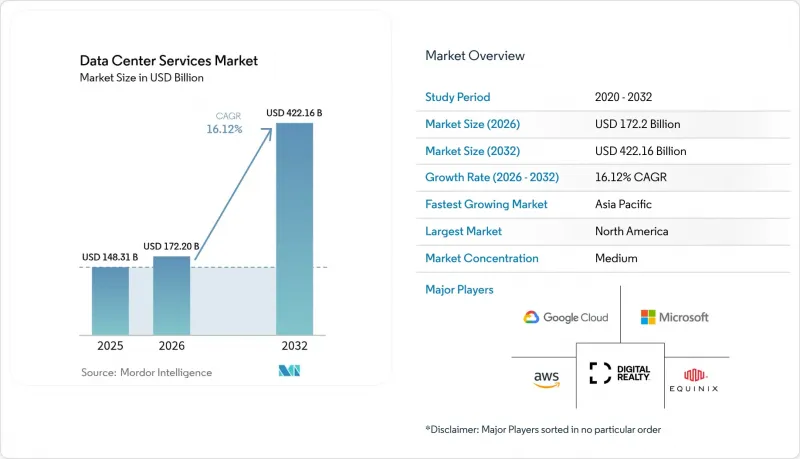
根據 Mordor Intelligence 預測,資料中心服務市場規模將從 2025 年的 1,483.1 億美元成長到 2026 年的 1,722 億美元,然後在 2032 年達到 4,221.6 億美元,2026 年至 2032 年的複合年成長率為 16.12%。
本報告按服務類型(託管服務、主機託管服務等)、服務等級(一級、二級、四級等)、最終用戶行業(銀行、金融服務和保險、醫療保健等)、部署模式(本地資料中心、超大規模等)和地區(北美、亞太等)進行細分。市場預測以美元計價。
全球資料中心服務市場趨勢與洞察
增加對資料中心技術的投入
目前,企業不再僅僅將基礎設施支出視為成本中心,而是將其視為競爭優勢,並為能夠實現即時擴展的外包模式分配更多預算。微軟宣布與貝萊德合作投資300億美元用於人工智慧基礎設施建設後,這一趨勢尤為明顯,凸顯了超大規模資料中心業者如何利用外部資本加速部署。不斷成長的支出水準正在加速邊緣節點和人工智慧推理引擎的部署,而這些部署以往往往受到傳統採購週期的限制。對於服務供應商,這具有優勢,因為客戶更傾向於託管環境,以便他們能夠使用最新技術並縮短部署時間。因此,資料中心服務市場對託管和託管服務的需求持續成長,這些服務整合了最先進的GPU叢集和先進的冷卻系統。
雲端運算的激增和超大規模公司的擴張
雲端服務供應商正在建構區域性資料中心,以滿足延遲預期和主權資料法規的要求,從而產生額外的需求,而本地服務合作夥伴可以從中獲利。 Oracle 在日本投資 80 億美元,象徵其致力於提供符合法規且涵蓋全球的主權雲端容量。此次擴張將容量分散到多個城市,而不是集中在大型資料中心,使企業能夠建立多區域、容錯的策略。對於供應商而言,與超大規模資料中心業者的合作正在釋放交叉連接的收入來源,並推動資料中心服務市場向整合混合服務轉型,將雲端存取與本地互連相結合。
資料隱私和安全問題
高調的資料外洩事件讓企業在外包高度敏感的工作負載時更加謹慎,尤其是在金融和醫療保健等處罰嚴厲的行業。服務提供者必須投資零信任架構和透明的事件回應流程,這可能導致營運成本增加和利潤率下降。小規模的營運商難以維持與全球同行相當的安全水平,這促使一些客戶選擇整合到提供認證環境的知名品牌中。雖然這個問題減緩了轉型進程,但也推動著資料中心服務市場向整合到基礎設施訂閱中的高價值保全服務。
細分市場分析
到2025年,託管服務將佔資料中心服務市場的44.72%,這反映出市場對提供直接雲端連接和廣泛互通性的營運商中立站點的需求。同時,在優先考慮營運支出(OPEX)並尋求彈性擴展的企業的推動下,雲端和虛擬資料中心服務預計將以16.94%的複合年成長率成長。託管服務對於延遲敏感型工作負載和合規性主導型部署仍然具有吸引力,即使在雲端採用加速的情況下,也能保持合約的穩定性。隨著中型企業將日常基礎設施營運外包,託管服務市場趨於穩定,而災害復原和備份服務則由於日益嚴格的資料保護條例而呈現利基成長。
資料中心基礎設施管理工具能夠即時洞察電力、冷卻和資產利用率,已成為所有服務類型不可或缺的一部分。專業服務諮詢服務透過提供遷移藍圖指導和監管審計服務,加深了與客戶的關係。因此,服務組合已從單一機架租賃發展為包含實體安裝空間、虛擬機器和諮詢支援的整合套件。這種多元化的方法提高了客戶留存率,並推動資料中心服務市場在未來幾年保持成長動能。
到2025年,三級資料中心將佔據資料中心服務市場54.73%的佔有率,在成本效益和容錯能力之間取得切實可行的平衡。這些資料中心承載著主流企業工作負載,最大限度地減少停機時間,同時避免了四級資料中心的額外成本。四級資料中心主要面向金融交易和關鍵醫療系統,隨著零中斷架構的普及,預計其複合年成長率將達到16.02%。一級和二級資料中心的市場佔有率正在下降,測試實驗室和歸檔儲存除外。
供應商將園區分類為不同層級,使客戶能夠根據預算調整應用容錯能力。液冷技術正被引入三級機房,以支援人工智慧叢集的部署,而無需將整個園區升級到四級。這種模組化的層級分類最大限度地提高了資源利用率,並增強了混合層級園區的吸引力。這既豐富了市場多樣性,也為客戶提供了更具成本績效的選擇。
區域分析
北美在2025年仍將維持在資料中心服務市場的最大佔有率,這得益於微軟和貝萊德等公司斥資300億美元用於人工智慧基礎設施建設等超大規模投資。完善的連接樞紐、充裕的資金和成熟的法規結構鞏固了該地區的主導地位。美國西南部的用水限制是一項挑戰,促使人們採用液冷和乾式冷卻解決方案。加拿大透過提供可再生能源替代方案,吸引那些需要持續兆瓦級電力負荷的人工智慧訓練叢集。
亞太地區成長最快,這主要得益於廣泛的數位化和主權數據政策。Oracle在日本投資80億美元建設主權雲,以及NTT在印度投資15億美元進行擴張,都清楚展現了該地區的強勁發展勢頭。出於安全考慮,中國優先考慮國內數據處理,並傾向選擇本地供應商。印度受益於政府支付系統和生物識別項目,這些項目需要大規模的運算能力。東南亞則已成為連結全球企業和本地消費者的橋樑。
歐洲的發展趨勢正受到GDPR和日益嚴格的永續性法規的影響。營運商必須在應對各國分散的法規的同時,滿足可再生能源配額目標,這催生了對合規性託管服務的需求。中東和非洲正在崛起為新的前沿市場,阿拉伯聯合大公國、沙烏地阿拉伯和肯亞已宣布啟動多個大型項目,例如耗資5.44億美元的微軟Du資料中心和地熱發電園區。這些市場橫跨各大洲的戰略位置使其能夠發揮區域樞紐的作用,進一步擴大資料中心服務市場的地理覆蓋範圍。
其他好處:
- Excel格式的市場預測(ME)表
- 3個月的分析師支持
目錄
第1章:引言
- 研究假設和市場定義
- 調查範圍
第2章:調查方法
第3章執行摘要
第4章 市場狀況
- 市場概覽
- 市場促進因素
- 增加對資料中心技術的投入
- 由於可擴展性問題,資料中心的複雜性日益增加。
- 雲端運算的激增和超可擴展性的擴展
- 數據主權相關法規正在推動該地區的基礎設施建設。
- 液冷技術的引進使得提高機架密度成為可能。
- 人工智慧驅動的工作負載編配與最佳化
- 市場限制因素
- 資料隱私和安全問題
- 高度複雜任務中熟練勞動力短缺
- 冷卻水使用限制
- 高功率元件供應鏈瓶頸
- 價值供應鏈分析
- 監理情勢
- 投資和資金籌措趨勢
- 波特五力分析
第5章 市場規模與成長預測
- 按服務類型
- 託管服務
- 託管服務
- 雲端/虛擬資料中心服務
- 災害復原和備份服務
- 資料中心基礎設施管理 (DCIM) 服務
- 專業服務及諮詢服務
- 基於層級的標準
- 一級和二級
- Tier III
- Tier IV
- 按最終用戶行業分類
- BFSI
- 衛生保健
- 零售與電子商務
- 製造業
- IT/通訊
- 政府/公共部門
- 媒體與娛樂
- 其他
- 按部署模式
- 現場設施
- 託管設施
- 超大規模/公司自建設施
- 按地區
- 北美洲
- 美國
- 加拿大
- 墨西哥
- 南美洲
- 巴西
- 阿根廷
- 其他南美國家
- 歐洲
- 英國
- 德國
- 法國
- 義大利
- 西班牙
- 俄羅斯
- 其他歐洲國家
- 亞太地區
- 中國
- 日本
- 印度
- 韓國
- 澳洲和紐西蘭
- 亞太其他地區
- 中東和非洲
- 中東
- 沙烏地阿拉伯
- 阿拉伯聯合大公國
- 土耳其
- 其他中東國家
- 非洲
- 南非
- 奈及利亞
- 肯亞
- 其他非洲國家
- 中東
- 北美洲
第6章 競爭情勢
- 市佔率分析
- 公司簡介
- Equinix Inc.
- Digital Realty Trust Inc.
- Amazon Web Services(AWS)
- Microsoft Corporation(Azure)
- Google LLC(Google Cloud)
- Alibaba Cloud
- Tencent Cloud
- IBM Corporation
- Fujitsu Limited
- NTT Communications
- Hewlett Packard Enterprise Company
- Dell Inc.
- Cisco Systems Inc.
- Vertiv Co.
- Singapore Telecommunications Limited(Singtel)
- Iron Mountain Inc.
- Cyxtera Technologies
- CoreSite Realty Corporation
- Capgemini SE
- Kyndryl Holdings Inc.
- Rackspace Technology
- OVHcloud
- ATandT Inc.
- Switch Inc.
- EdgeConneX
第7章 市場機會與未來展望
According to Mordor Intelligence, the data center service market size is expected to grow from USD 148.31 billion in 2025 to USD 172.2 billion in 2026 and is forecast to reach USD 422.16 billion by 2032 at 16.12% CAGR over 2026-2032.
This report is Segmented Type of Service (Managed Hosting Service, Colocation Service and More), Tier Standard (Tier I and II, Tier IV and More), End-User Industry (BFSI, Healthcare and More), Deployment Model (On-Premise Data Centers, Hyperscale and More), and Geography (North America, Asia-Pacific and More). Market Forecasts are Provided in Terms of Value (USD).
Global Data Center Services Market Trends and Insights
Increase in Expenditure on Data Center Technology
Organizations now view infrastructure spending as a competitive differentiator rather than a pure cost center, allocating larger budgets to outsourced models that unlock instant scalability. The trend gained prominence after Microsoft committed USD 30 billion to AI infrastructure in partnership with BlackRock, underscoring how hyperscalers leverage external capital to accelerate deployments. Higher spending levels accelerate adoption of edge nodes and AI inference engines that would otherwise be constrained by traditional procurement cycles. Service providers benefit because clients prefer managed environments that reduce deployment time while ensuring technology currency. Consequently, the data center service market experiences sustained demand for colocation and managed hosting that integrate cutting-edge GPU clusters with advanced cooling.
Surge in Cloud and Hyperscale Expansion
Cloud providers are building regional zones to satisfy latency expectations and sovereign data rules, creating overflow demand that local service partners can monetize. Oracle's USD 8 billion investment in Japan exemplifies the push toward sovereign cloud capacity that meets compliance while maintaining global reach. The expansion diffuses capacity across multiple cities rather than concentrating it in mega-farms, allowing enterprises to architect multi-region resiliency strategies. For service vendors, partnering with hyperscalers opens cross-connect revenue streams and drives the data center service market toward integrated hybrid offerings that bundle cloud on-ramps with local interconnection.
Data Privacy and Security Concerns
High-profile breaches make enterprises cautious about outsourcing sensitive workloads, particularly in finance and healthcare where penalties are severe. Providers must invest in zero-trust architectures and transparent incident-response processes, raising operating costs that can erode margins. Smaller operators struggle to match the security depth of global peers, leading some customers to consolidate with larger brands that offer certified environments. The issue slows migrations yet also pushes the data center service market toward higher-value security services embedded within infrastructure subscriptions.
Other drivers and restraints analyzed in the detailed report include:
- AI-Driven Workload Orchestration and Optimization
- Data-Sovereignty Regulations Driving Local Facilities
- Skilled Workforce Shortage in Advanced Operations
For complete list of drivers and restraints, kindly check the Table Of Contents.
Segment Analysis
Colocation services generated 44.72% of the data center service market size in 2025, reflecting demand for carrier-neutral sites that offer direct cloud on-ramps and rich interconnection. Cloud and virtual data center services, however, are forecast to expand at a 16.94% CAGR, supported by organizations that prefer operational expenditure and elastic scaling. Colocation retains appeal for latency-sensitive workloads and compliance-driven deployments, sustaining steady contracts even as cloud uptake accelerates. Managed hosting stabilizes as mid-market enterprises offload routine infrastructure tasks, while disaster recovery and backup enjoy niche growth amid stricter data-protection mandates.
Data center infrastructure management tools have become essential across all service types, providing real-time insight into power, cooling, and asset utilization. Professional and consulting services deepen client relationships by guiding migration roadmaps and regulatory audits. Service portfolios therefore evolve from single-rack leasing to integrated suites that blend physical footprint, virtual machines, and advisory support. This composite approach anchors customer stickiness and keeps the data center service market positioned for multi-year expansion.
Tier III facilities accounted for 54.73% of the data center service market share in 2025, striking a pragmatic middle ground between cost efficiency and fault tolerance. They host mainstream corporate workloads that tolerate minimal downtime yet avoid Tier IV premiums. Tier IV sites, targeting financial trading and critical healthcare systems, are expected to post a 16.02% CAGR as zero-interrupt architectures gain favor. Tier I and Tier II facilities lose share except for test labs and archival storage.
Operators are segmenting campuses by tier, enabling clients to align application resilience with budget. Liquid cooling is filtering into Tier III halls to accommodate AI clusters without upgrading the entire site to Tier IV. This modular tiering maximizes utilization and broadens the appeal of mixed-tier campuses, reinforcing market diversity while offering customers granular cost-performance trade-offs.
Complete Report Scope:
- By Type of Service
- Managed Hosting Service
- Colocation Service
- Cloud / Virtual Data Center Services
- Disaster Recovery and Backup Services
- Data Center Infrastructure Management (DCIM) Services
- Professional and Consulting Services
- By Tier Standard
- Tier I and II
- Tier III
- Tier IV
- By End-User Industry
- BFSI
- Healthcare
- Retail and E-commerce
- Manufacturing
- IT and Telecom
- Government and Public Sector
- Media and Entertainment
- Others
- By Deployment Model
- On-Premise Facilities
- Colocation Facilities
- Hyperscale/Self-built Facilities
- By Geography
- North America
- United States
- Canada
- Mexico
- South America
- Brazil
- Argentina
- Rest of South America
- Europe
- United Kingdom
- Germany
- France
- Italy
- Spain
- Russia
- Rest of Europe
- Asia-Pacifc
- China
- Japan
- India
- South Korea
- Australia and New Zealand
- Rest of Asia-Pacifc
- Middle East and Africa
- Middle East
- Saudi Arabia
- United Arab Emirates
- Turkey
- Rest of Middle East
- Africa
- South Africa
- Nigeria
- Kenya
- Rest of Africa
- Middle East
- North America
Geography Analysis
North America retained the largest portion of the data center service market in 2025, buoyed by hyperscale investments like Microsoft and BlackRock's USD 30 billion AI-infrastructure program. Established connectivity hubs, abundant capital, and mature regulatory frameworks sustain regional leadership. Challenges arise from water-use restrictions in the southwest, spurring adoption of liquid or dry-cooling solutions. Canada offers renewably powered alternatives, attracting AI training clusters that demand continuous megawatt loads.
Asia-Pacific recorded the fastest growth, driven by widespread digitization and sovereign data policies. Oracle's USD 8 billion sovereign cloud build in Japan and NTT's USD 1.5 billion expansion in India underscore the region's momentum. China emphasizes domestic processing for security reasons, favoring local providers. India benefits from government payment systems and biometric identity programs that necessitate compute at scale, while Southeast Asia positions itself as a bridge between global enterprises and local consumers.
Europe's trajectory is influenced by GDPR and escalating sustainability mandates. Operators must navigate fragmented national regulations while meeting renewable-energy quotas, creating scope for specialized compliance hosting. Middle East and Africa emerge as new frontiers, with the UAE, Saudi Arabia, and Kenya unveiling large-scale projects like the USD 544 million Microsoft-du facility and geothermal-powered campuses. Strategic positioning between continents enables these markets to serve as inter-regional hubs, further broadening the geographical footprint of the data center service market.
- Equinix Inc.
- Digital Realty Trust Inc.
- Amazon Web Services (AWS)
- Microsoft Corporation (Azure)
- Google LLC (Google Cloud)
- Alibaba Cloud
- Tencent Cloud
- IBM Corporation
- Fujitsu Limited
- NTT Communications
- Hewlett Packard Enterprise Company
- Dell Inc.
- Cisco Systems Inc.
- Vertiv Co.
- Singapore Telecommunications Limited (Singtel)
- Iron Mountain Inc.
- Cyxtera Technologies
- CoreSite Realty Corporation
- Capgemini SE
- Kyndryl Holdings Inc.
- Rackspace Technology
- OVHcloud
- ATandT Inc.
- Switch Inc.
- EdgeConneX
Additional Benefits:
- The market estimate (ME) sheet in Excel format
- 3 months of analyst support
TABLE OF CONTENTS
1 INTRODUCTION
- 1.1 Study Assumptions and Market Definition
- 1.2 Scope of the Study
2 RESEARCH METHODOLOGY
3 EXECUTIVE SUMMARY
4 MARKET LANDSCAPE
- 4.1 Market Overview
- 4.2 Market Drivers
- 4.2.1 Increase in Expenditure on Data Center Technology
- 4.2.2 Rising Data Center Complexities Due to Scalability
- 4.2.3 Surge in Cloud and Hyperscale Expansion
- 4.2.4 Data-Sovereignty Regulations Driving Local Facilities
- 4.2.5 Liquid Cooling Adoption Enabling Higher Rack Densities
- 4.2.6 AI-Driven Workload Orchestration and Optimization
- 4.3 Market Restraints
- 4.3.1 Data Privacy and Security Concerns
- 4.3.2 Skilled Workforce Shortage in Advanced Operations
- 4.3.3 Water-Usage Restrictions for Cooling
- 4.3.4 Supply-Chain Bottlenecks for High-Power Components
- 4.4 Value / Supply-Chain Analysis
- 4.5 Regulatory Landscape
- 4.6 Investment and Fund-Raising Trends
- 4.7 Porter's Five Forces Analysis
- 4.7.1 Bargaining Power of Suppliers
- 4.7.2 Bargaining Power of Consumers
- 4.7.3 Threat of New Entrants
- 4.7.4 Intensity of Competitive Rivalry
- 4.7.5 Threat of Substitute Products
5 MARKET SIZE AND GROWTH FORECASTS
- 5.1 By Type of Service
- 5.1.1 Managed Hosting Service
- 5.1.2 Colocation Service
- 5.1.3 Cloud / Virtual Data Center Services
- 5.1.4 Disaster Recovery and Backup Services
- 5.1.5 Data Center Infrastructure Management (DCIM) Services
- 5.1.6 Professional and Consulting Services
- 5.2 By Tier Standard
- 5.2.1 Tier I and II
- 5.2.2 Tier III
- 5.2.3 Tier IV
- 5.3 By End-User Industry
- 5.3.1 BFSI
- 5.3.2 Healthcare
- 5.3.3 Retail and E-commerce
- 5.3.4 Manufacturing
- 5.3.5 IT and Telecom
- 5.3.6 Government and Public Sector
- 5.3.7 Media and Entertainment
- 5.3.8 Others
- 5.4 By Deployment Model
- 5.4.1 On-Premise Facilities
- 5.4.2 Colocation Facilities
- 5.4.3 Hyperscale/Self-built Facilities
- 5.5 By Geography
- 5.5.1 North America
- 5.5.1.1 United States
- 5.5.1.2 Canada
- 5.5.1.3 Mexico
- 5.5.2 South America
- 5.5.2.1 Brazil
- 5.5.2.2 Argentina
- 5.5.2.3 Rest of South America
- 5.5.3 Europe
- 5.5.3.1 United Kingdom
- 5.5.3.2 Germany
- 5.5.3.3 France
- 5.5.3.4 Italy
- 5.5.3.5 Spain
- 5.5.3.6 Russia
- 5.5.3.7 Rest of Europe
- 5.5.4 Asia-Pacifc
- 5.5.4.1 China
- 5.5.4.2 Japan
- 5.5.4.3 India
- 5.5.4.4 South Korea
- 5.5.4.5 Australia and New Zealand
- 5.5.4.6 Rest of Asia-Pacifc
- 5.5.5 Middle East and Africa
- 5.5.5.1 Middle East
- 5.5.5.1.1 Saudi Arabia
- 5.5.5.1.2 United Arab Emirates
- 5.5.5.1.3 Turkey
- 5.5.5.1.4 Rest of Middle East
- 5.5.5.2 Africa
- 5.5.5.2.1 South Africa
- 5.5.5.2.2 Nigeria
- 5.5.5.2.3 Kenya
- 5.5.5.2.4 Rest of Africa
- 5.5.5.1 Middle East
- 5.5.1 North America
6 COMPETITIVE LANDSCAPE
- 6.1 Market Share Analysis
- 6.2 Company Profiles (includes Global level Overview, Market level overview, Core Segments, Financials as available, Strategic Information, Market Rank/Share for key companies, Products and Services, and Recent Developments)
- 6.2.1 Equinix Inc.
- 6.2.2 Digital Realty Trust Inc.
- 6.2.3 Amazon Web Services (AWS)
- 6.2.4 Microsoft Corporation (Azure)
- 6.2.5 Google LLC (Google Cloud)
- 6.2.6 Alibaba Cloud
- 6.2.7 Tencent Cloud
- 6.2.8 IBM Corporation
- 6.2.9 Fujitsu Limited
- 6.2.10 NTT Communications
- 6.2.11 Hewlett Packard Enterprise Company
- 6.2.12 Dell Inc.
- 6.2.13 Cisco Systems Inc.
- 6.2.14 Vertiv Co.
- 6.2.15 Singapore Telecommunications Limited (Singtel)
- 6.2.16 Iron Mountain Inc.
- 6.2.17 Cyxtera Technologies
- 6.2.18 CoreSite Realty Corporation
- 6.2.19 Capgemini SE
- 6.2.20 Kyndryl Holdings Inc.
- 6.2.21 Rackspace Technology
- 6.2.22 OVHcloud
- 6.2.23 ATandT Inc.
- 6.2.24 Switch Inc.
- 6.2.25 EdgeConneX
7 MARKET OPPORTUNITIES AND FUTURE OUTLOOK
- 7.1 White-space and Unmet-Need Assessment

 2026年全球資料中心網格服務市場報告
 資料中心服務市場報告:趨勢、預測與競爭分析(至2035年)
 2026 年資料中心服務領域十大成長機會
 資料中心認證世界(截至 2032 年):按認證類型(設施與可靠性、營運、永續性與能源)、基礎設施(IT、電力、冷卻)和最終用戶(雲端服務供應商、銀行、金融服務和保險、製造業)分類2026年全球伺服器服務市場報告2026年全球資料中心設計服務市場報告
 資料中心即服務 (DCaaS) 市場:按基礎設施、組織規模、產業和地區分類
 資料中心即服務 (DCaaS) 市場:按服務類型、最終用戶、企業規模和部署模式分類的全球市場預測,2026-2032 年全球資料中心服務市場規模、佔有率、趨勢和成長分析報告(2026-2034)
 資料中心服務市場分析及預測(至2035年):類型、產品、服務、技術、組件、應用、部署、最終用戶、解決方案、模式