


 |
市場調查報告書
商品編碼
2120423
歐洲紙包裝:市場佔有率分析、產業趨勢與統計及成長預測(2026-2031)Europe Paper Packaging - Market Share Analysis, Industry Trends & Statistics, Growth Forecasts (2026 - 2031) |
||||||

※ 本網頁內容可能與最新版本有所差異。詳細情況請與我們聯繫。
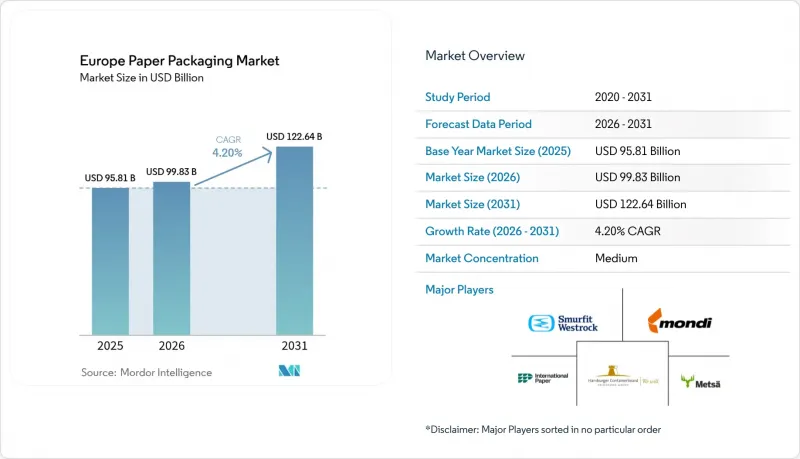
根據 Mordor Intelligence 預測,歐洲紙包裝市場規模將從 2025 年的 958.1 億美元成長到 2026 年的 998.3 億美元,然後在 2031 年達到 1226.4 億美元,2026 年至 2031 年的複合年成長率為 4.20%。
本報告按產品類型(折疊紙盒、瓦楞紙箱、紙袋等)、材料類型(原生紙漿等)、終端用戶行業(醫療保健/製藥、個人護理/家居用品等)、包裝形式(初級包裝、二級包裝、三級包裝)和地區進行細分。市場預測以價值(美元)表示。
歐洲紙包裝市場趨勢與洞察
食品飲料行業對永續和可回收包裝的需求日益成長。
歐洲食品飲料品牌已公開宣布其目標是到2030年實現100%包裝可回收,並據此推出了優先選擇纖維而非多層塑膠的採購標準。大型食品零售商正在推行「貨架即用」標準,鼓勵使用調理食品材料纖維托盤,例如瑪莎百貨(Marks & Spencer)於2025年5月推出的紙纖維即食餐托盤。烈酒和啤酒生產商透過推出旗艦產品,例如採用90%紙質材料製成的蘇格蘭威士忌酒瓶,來增強消費者對紙張低環境影響的認知。一項針對巧克力棒包裝紙的生命週期研究證實,在所有中間評估類別中,紙張的溫室氣體排放量均低於拉伸聚丙烯。包裝製造商正加強與塗層技術供應商的合作,並根據品牌所有者發布的永續性藍圖重新設計產品,以符合將於2026年8月生效的25 ppb PFAS法規。隨著跨境集中採購競標中ISO 14040標準的合規性成為強制性要求,擁有經檢驗的「從搖籃到大門」資料集的紙質解決方案正逐漸成為跨國食品飲料集團的首選供應商。
電子商務小包裹量激增
歐洲線上零售額持續維持兩位數成長,導致履約中心使用的紙箱及配套緩衝材料數量激增。在英國,全通路雜貨店和專賣店不斷擴張的配送網路,使得2010年至2024年間紙板消耗量成長了12.6%。亞馬遜宣布,到2025年1月,其歐洲業務將全面採用100%可回收紙袋和紙板信封,自2018年以來,一次性塑膠郵寄袋的使用量已減少超過10億個。自動化、尺寸最佳化的包裝系統,例如Mondoy和CMC Packaging Automation共同開發的解決方案,可按需產生紙箱尺寸,在提高卡車裝載效率的同時,最多可減少40%的紙張用量。都市區生鮮速賣市場預計將從2021年的250億歐元快速成長至2025年的720億歐元,這需要尺寸最佳化的二級包裝,以確保產品在10分鐘配送時限內保持品質。因此,加工商正優先採用高速模切、客製化數位印刷和線上品管感測器等技術,以滿足電商企業對大規模生產能力和品牌柔軟性的需求。
對森林砍伐和原料供應波動的擔憂
歐盟將於2025年生效的森林砍伐法規強制要求可追溯性,以便追溯到地理位置明確的林地。隨著加工商實施衛星檢驗和區塊鏈帳本技術,採購成本將增加3-5%。電費上漲、北歐鋸木廠因間歇性停工導致產能停滯以及小直徑原生紙漿供不應求,迫使買家以高價依賴現貨市場。 Birelud的生產力提升計畫凸顯了整個產業應對紙漿價格飆升和原料短缺造成的利潤率壓力的緊迫性。小麥秸稈和芒草等替代纖維作為模塑纖維食品碗正受到關注,但纖維長度和白度的差異阻礙了它們在高清印刷包裝中的應用。將原物料產地擴展到伊比利亞半島和波羅的海國家的森林可以降低集中風險,但會延長物流鏈,部分抵消減少碳足跡的益處。從中長期來看,造紙公司正在加快推進封閉回路型水系統和植樹造林,以安撫相關人員並遵守日益嚴格的實質審查調查審計。
細分市場分析
2025年,瓦楞紙箱將佔總銷售額的37.92%,凸顯其在履約、工業和食品分銷通路的領先地位。歐洲紙質包裝市場預計將穩步成長,這主要得益於電子商務小包裹的增加、定製印刷批量需求的成長以及輕量化包裝技術的不斷進步,這些技術在減少貨運過程中浪費的同時,又不影響紙箱的抗壓強度。液體紙盒預計將以5.12%的複合年成長率實現最高增速,直至2031年,這主要得益於乳製品替代品、常溫果汁產品以及品牌主導為減少多層塑膠使用而採取的舉措。
折疊紙盒等二次產品在藥品吸塑包裝的重疊部分以及高階個人保健產品包裝中仍然發揮著至關重要的作用,其精準的摺痕和光澤的清漆處理能夠提升產品的展示效果。隨著各國逐步禁止使用一次性塑膠購物袋,紙袋和零售袋的需求正在回升,雜貨店也開始轉向使用添加了濕強劑的牛皮紙製品,以提高其耐用性,以便於重複使用。雖然抗撕裂冷凍袋、模塑纖維托盤和模塑紙漿緩衝材料等專業細分市場正在擴大其目標市場規模,但瓦楞紙板仍然是支撐加工廠產運轉率的核心產品,並全部區域的資本投資提供了依據。
到2025年,再生紙將佔市場佔有率的55.98%。這得益於嚴格的報廢回收率目標以及為國內造紙廠提供原料的完善回收系統。碳邊境調節機制(CBAM)將使進口原生紙的成本高於低碳再生紙,因此預計再生紙在歐洲紙包裝市場的佔有率將擴大。高品質的白色頂測試襯紙在需要可印刷表面的展示櫃中越來越受歡迎,而棕色測試襯紙則在標準運輸瓦楞紙箱中佔據主導地位。
對於高階化妝品禮盒、醫療設備說明書和需要極高印刷精度和優異剛性的折疊紙盒而言,原生纖維基材仍然至關重要。具有分散或擠出阻隔性能的複合紙板在對水蒸氣和油污的阻隔性要求較高的領域佔據中間位置,但由於逐步淘汰 PFAS 的風險,其短期擴張受到限制。在供應鏈中,將斯堪地那維亞針葉牛皮紙與伊比利亞桉木硬木相結合的雙源採購策略正逐漸成為主流,以平衡強度和光滑度。造紙商正與夥伴關係建立循環合作關係,從物流中心回收廢棄紙板 (OCC),以縮短循環時間並確保食品級再生材料所需的原料純度。
其他好處:
- Excel格式的市場預測(ME)表
- 3個月的分析師支持
目錄
第1章:引言
- 研究假設和市場定義
- 調查範圍
第2章:調查方法
第3章執行摘要
第4章 市場狀況
- 市場概覽
- 市場促進因素
- 食品飲料產業對永續和可回收包裝材料的需求日益成長。
- 電子商務小包裹量激增
- 歐盟的一次性塑膠指令正在加速向紡織品的轉變。
- 輕質高強度瓦楞紙板技術的進步
- 隨著食材自煮包和快速商業的發展,對合適尺寸的包裝產生了需求。
- 歐盟的碳邊境調節機制正在推動再生紙產業的發展。
- 市場限制因素
- 對森林砍伐和原料供應波動的擔憂
- 由於可回收性的提高,軟質塑膠的優勢正在減弱。
- 能源價格的急劇上漲推高了造紙廠的營運成本。
- 阻隔塗佈紙中 PFAS 的逐步淘汰仍存在不確定性
- 產業價值鏈分析
- 監理情勢
- 技術展望
- 宏觀經濟因素對市場的影響
- 波特五力分析
第5章 市場規模與成長預測
- 依產品類型
- 折疊紙箱
- 瓦楞紙箱
- 紙袋和紙袋
- 液體紙盒
- 其他紙包裝
- 依材料類型
- 原生纖維紙
- 再生紙
- 複合紙板
- 按最終用戶行業分類
- 食物
- 飲料
- 醫療和藥品
- 個人護理和家居用品
- 電子商務與零售
- 菸草
- 其他終端用戶產業
- 按包裝類型
- 初級包裝
- 二級包裝
- 三級包裝
- 國家
- 德國
- 英國
- 法國
- 義大利
- 西班牙
- 荷蘭
- 其他歐洲國家
第6章 競爭情勢
- 市場集中度
- 策略趨勢
- 市佔率分析
- 公司簡介
- Smurfit WestRock
- Mondi plc
- International Paper Company
- Stora Enso Oyj
- Svenska Cellulosa Aktiebolaget SCA
- Metsa Board Oyj
- Mayr-Melnhof Karton AG
- Prinzhorn Holding GmbH
- Progroup AG
- Schumacher Packaging GmbH
- Klingele Papierwerke GmbH & Co. KG
- Graphic Packaging Holding Company
- RAJA Groupe
- VPK Packaging Group NV
- RDM Group(Reno De Medici SpA)
- Lucart SpA
- Essity AB
- Palm GmbH & Co. KG
第7章 市場機會與未來展望
According to Mordor Intelligence, the Europe paper packaging market size is expected to grow from USD 95.81 billion in 2025 to USD 99.83 billion in 2026 and is forecast to reach USD 122.64 billion by 2031 at 4.20% CAGR over 2026-2031.
This report is Segmented by Product Type (Folding Cartons, Corrugated Boxes, Paper Bags and Sacks, and More), Material Type (Virgin Fiber Paper, and More), End-User Industry ( Healthcare and Pharmaceutical, Personal Care and Household, and More), Packaging Format (Primary Packaging, Secondary Packaging, and Tertiary Packaging), and Geography. The Market Forecasts are Provided in Terms of Value (USD).
Europe Paper Packaging Market Trends and Insights
Rising demand for sustainable and recyclable packaging in Food and Beverage
European food and beverage brands publicly commit to 100% recyclable packaging targets for 2030, prompting procurement scorecards that prioritize fiber over multilayer plastics. Leading grocers impose shelf-readiness criteria that reward mono-material fiber trays, as shown by Marks & Spencer's rollout of paper-fiber ready-meal trays in May 2025. Distillers and brewers showcase flagship launches such as a 90% paper bottle for Scotch whisky, reinforcing consumer perception that paper embodies lower environmental impact. Life-cycle studies covering chocolate bar wrappers confirm lower greenhouse-gas footprints for paper against oriented polypropylene in every midpoint category. Packaging converters intensify collaboration with coating-technology suppliers to meet upcoming 25 ppb PFAS limits in August 2026, aligning product reformulations with brand owners' public sustainability roadmaps. As ISO 14040 compliance becomes mandatory for cross-border central procurement tenders, paper solutions with verified cradle-to-gate data sets gain preferred-supplier status across multinational F&B groups.
Rapid surge in e-commerce parcel volumes
European online retail purchases maintain double-digit growth, fueling a steep rise in box counts and ancillary cushioning across fulfillment centers. Corrugated consumption in the United Kingdom increased 12.6% between 2010 and 2024 as omnichannel grocers and specialty retailers upgraded distribution networks. Amazon reports the elimination of more than 1 billion single-use plastic mailers since 2018 by converting its European operations to 100% recyclable paper pouches and board envelopes in January 2025. Automated right-size packaging equipment, such as solutions codeveloped by Mondi and CMC Packaging Automation, generates on-demand box dimensions that cut paper use up to 40% while improving truck-cubic-utilization metrics. Urban grocery quick-commerce, projected to jump from EUR 25 billion in 2021 to EUR 72 billion by 2025, requires dimensionally optimized secondary packs that preserve product integrity in 10-minute delivery windows. Consequently, converters prioritize high-speed die-cutting, digital print customization, and inline quality-control sensors to meet both volume scale and branding agility demanded by e-commerce merchants.
Deforestation concerns and raw-material supply volatility
The EU Deforestation Regulation, effective 2025, mandates traceability back to geolocated forest plots, adding 3-5% to procurement overhead as converters implement satellite verification and blockchain ledgers. Nordic sawmill capacity interruptions, stemming from electricity-cost surges and periodic labor stoppages, and thin virgin-fiber availability, are forcing buyers to tap spot markets at premium prices. Billerud's productivity program underscores industry-wide urgency to offset margin compression arising from pulp price spikes and raw-material scarcity. Alternative fibers such as wheat straw and miscanthus attract attention for molded-fiber food bowls, yet inconsistent fiber length and brightness curtail adoption for high-definition print packs. Geographic diversification toward Iberian and Baltic forests mitigates concentration risk but extends logistics chains, partially reversing carbon-footprint gains. Over the medium term, mills expedite closed-loop water systems and reforestation commitments to reassure stakeholders and comply with tightening due diligence audits.
Other drivers and restraints analyzed in the detailed report include:
- EU Single-Use Plastics Directive accelerating fiber substitution
- Advancements in lightweight, high-strength corrugated technology
- Improving recyclability of flexible plastics narrowing advantage
For complete list of drivers and restraints, kindly check the Table Of Contents.
Segment Analysis
Corrugated boxes held 37.92% of 2025 revenue, underscoring their status as the workhorse format across fulfillment, industrial, and grocery distribution channels. Europe's paper packaging market size for corrugated boxes is projected to compound steadily, given e-commerce parcel proliferation, customized print runs, and continuous lightweighting gains that lower freight emissions without forfeiting crush strength. Liquid cartons post the fastest 5.12% CAGR through 2031, propelled by dairy-alternative beverages, shelf-stable juice lines, and brand-led commitments to curb multilayer plastics usage.
Secondary products such as folding cartons maintain relevance for pharmaceutical blister overwraps and high-graphic personal-care packs where precise creasing and glossy varnishes create shelf appeal. Paper sacks and retail bags regain momentum as national bans phase out single-use plastic carriers, with grocers switching to kraft options featuring wet-strength additives for reuse durability. Specialty niches-tear-resistant freezer bags, shaped formed-fiber trays, and molded-pulp void-fill expand addressable volumes, yet corrugated remains the anchor that underpins converter plant utilization rates and capex justification across the region.
Recycled grades captured 55.98% share in 2025, an outcome of stringent post-consumer content targets and robust collection systems that feed domestic mills. Europe paper packaging market share for recycled liner is expected to widen as CBAM makes imports of virgin grades more expensive relative to low-carbon recycled sheet. High-quality white-top testliner gains favor in display-ready cases requiring printable surfaces, while brown testliner dominates standard shipping cartons.
Virgin-fiber substrates remain indispensable for premium cosmetics gift boxes, medical device manuals, and folding cartons demanding pristine print fidelity and superior stiffness. Composite paperboard featuring dispersion or extrusion barriers occupies a middle ground where water-vapor and fat resistance are critical, yet PFAS-phase-out risk tempers near-term expansion. Supply chains gravitate toward dual-sourcing strategies, combining Scandinavian softwood kraft with Iberian eucalyptus hardwood to balance strength and smoothness. Mills engage in circularity partnerships with retailers to backhaul OCC (old corrugated containers) from distribution centers, shortening loop time and securing feedstock purity levels imperative for food-grade recycled content.
Complete Report Scope:
- By Product Type
- Folding Cartons
- Corrugated Boxes
- Paper Bags and Sacks
- Liquid Cartons
- Other Paper Packaging
- By Material Type
- Virgin Fiber Paper
- Recycled Paper
- Composite Paperboard
- By End-user Industry
- Food
- Beverage
- Healthcare and Pharmaceutical
- Personal Care and Household
- E-commerce and Retail
- Tobacco
- Other End-user Industries
- By Packaging Format
- Primary Packaging
- Secondary Packaging
- Tertiary Packaging
- By Country
- Germany
- United Kingdom
- France
- Italy
- Spain
- Netherlands
- Rest of Europe
List of Companies Covered in this Report:
- Smurfit WestRock
- Mondi plc
- International Paper Company
- Stora Enso Oyj
- Svenska Cellulosa Aktiebolaget SCA
- Metsa Board Oyj
- Mayr-Melnhof Karton AG
- Prinzhorn Holding GmbH
- Progroup AG
- Schumacher Packaging GmbH
- Klingele Papierwerke GmbH & Co. KG
- Graphic Packaging Holding Company
- RAJA Groupe
- VPK Packaging Group NV
- RDM Group (Reno De Medici S.p.A.)
- Lucart S.p.A.
- Essity AB
- Palm GmbH & Co. KG
Additional Benefits:
- The market estimate (ME) sheet in Excel format
- 3 months of analyst support
TABLE OF CONTENTS
1 INTRODUCTION
- 1.1 Study Assumptions and Market Definition
- 1.2 Scope of the Study
2 RESEARCH METHODOLOGY
3 EXECUTIVE SUMMARY
4 MARKET LANDSCAPE
- 4.1 Market Overview
- 4.2 Market Drivers
- 4.2.1 Rising demand for sustainable and recyclable packaging in FandB
- 4.2.2 Rapid surge in e-commerce parcel volumes
- 4.2.3 EU Single-Use Plastics Directive accelerating fiber substitution
- 4.2.4 Advancements in lightweight, high-strength corrugated technology
- 4.2.5 Growth of meal-kit and quick-commerce requiring right-sized packs
- 4.2.6 EU Carbon Border Adjustment Mechanism driving recycled mills
- 4.3 Market Restraints
- 4.3.1 Deforestation concerns and raw material supply volatility
- 4.3.2 Improving recyclability of flexible plastics narrowing advantage
- 4.3.3 Energy-price shocks raising mill operating costs
- 4.3.4 PFAS-phase-out uncertainty in barrier-coated papers
- 4.4 Industry Value Chain Analysis
- 4.5 Regulatory Landscape
- 4.6 Technological Outlook
- 4.7 Impact of Macroeconomic Factors on the Market
- 4.8 Porter's Five Forces Analysis
- 4.8.1 Bargaining Power of Suppliers
- 4.8.2 Bargaining Power of Buyers
- 4.8.3 Threat of New Entrants
- 4.8.4 Threat of Substitutes
- 4.8.5 Intensity of Competitive Rivalry
5 MARKET SIZE AND GROWTH FORECAST (VALUE)
- 5.1 By Product Type
- 5.1.1 Folding Cartons
- 5.1.2 Corrugated Boxes
- 5.1.3 Paper Bags and Sacks
- 5.1.4 Liquid Cartons
- 5.1.5 Other Paper Packaging
- 5.2 By Material Type
- 5.2.1 Virgin Fiber Paper
- 5.2.2 Recycled Paper
- 5.2.3 Composite Paperboard
- 5.3 By End-user Industry
- 5.3.1 Food
- 5.3.2 Beverage
- 5.3.3 Healthcare and Pharmaceutical
- 5.3.4 Personal Care and Household
- 5.3.5 E-commerce and Retail
- 5.3.6 Tobacco
- 5.3.7 Other End-user Industries
- 5.4 By Packaging Format
- 5.4.1 Primary Packaging
- 5.4.2 Secondary Packaging
- 5.4.3 Tertiary Packaging
- 5.5 By Country
- 5.5.1 Germany
- 5.5.2 United Kingdom
- 5.5.3 France
- 5.5.4 Italy
- 5.5.5 Spain
- 5.5.6 Netherlands
- 5.5.7 Rest of Europe
6 COMPETITIVE LANDSCAPE
- 6.1 Market Concentration
- 6.2 Strategic Moves
- 6.3 Market Share Analysis
- 6.4 Company Profiles (includes Global level Overview, Market level overview, Core Segments, Financials as available, Strategic Information, Market Rank/Share for key companies, Products and Services, and Recent Developments)
- 6.4.1 Smurfit WestRock
- 6.4.2 Mondi plc
- 6.4.3 International Paper Company
- 6.4.4 Stora Enso Oyj
- 6.4.5 Svenska Cellulosa Aktiebolaget SCA
- 6.4.6 Metsa Board Oyj
- 6.4.7 Mayr-Melnhof Karton AG
- 6.4.8 Prinzhorn Holding GmbH
- 6.4.9 Progroup AG
- 6.4.10 Schumacher Packaging GmbH
- 6.4.11 Klingele Papierwerke GmbH & Co. KG
- 6.4.12 Graphic Packaging Holding Company
- 6.4.13 RAJA Groupe
- 6.4.14 VPK Packaging Group NV
- 6.4.15 RDM Group (Reno De Medici S.p.A.)
- 6.4.16 Lucart S.p.A.
- 6.4.17 Essity AB
- 6.4.18 Palm GmbH & Co. KG
7 MARKET OPPORTUNITIES AND FUTURE OUTLOOK
- 7.1 White-space and Unmet-need Assessment

 2026-2034年全球再生紙包裝中礦物油烴(MOSH/MOAH)轉型市場規模、佔有率、趨勢和成長分析報告
 越南紙包裝市場:市場佔有率分析、產業趨勢與統計及成長預測(2026-2031年)
 原生紙包裝市場預測至2034年-全球產品類型、紙張類型、材料類型、包裝形式、應用、最終用戶和地區分析紙包裝:市場佔有率分析、產業趨勢與統計、成長預測(2026-2031)中東和非洲紙包裝市場:市場佔有率分析、行業趨勢和統計數據以及成長預測(2026-2031 年)印尼紙包裝:市場佔有率分析、產業趨勢與統計及成長預測(2026-2031)義大利紙包裝市場:市場佔有率分析、產業趨勢與統計、成長預測(2026-2031)亞太地區紙包裝市場:市佔率分析、產業趨勢與統計及成長預測(2026-2031年)印度紙包裝市場:市場佔有率分析、產業趨勢與統計及成長預測(2026-2031)日本紙包裝市場:市場佔有率分析、產業趨勢與統計及成長預測(2026-2031)