


 |
市場調查報告書
商品編碼
1637809
實驗室機械臂-市場佔有率分析、產業趨勢/統計、成長預測(2025-2030)Robotic Arms In Laboratories - Market Share Analysis, Industry Trends & Statistics, Growth Forecasts (2025 - 2030) |
||||||

※ 本網頁內容可能與最新版本有所差異。詳細情況請與我們聯繫。
實驗室機械臂市場預計在預測期內複合年成長率為 11.5%。
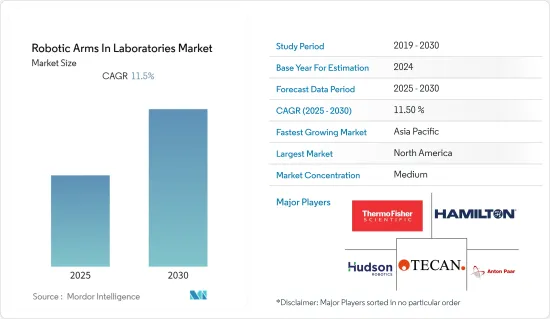
機械臂正在迅速應用於研究實驗室,用於需要靈活性、有效空間利用和周邊設備無縫整合的應用。這款手臂易於編程,因此得到越來越多的採用。樣品製備、分析儀器操作和樣品處理是這些機器人執行的典型業務。因此,實驗室自動化已成為實驗室機械臂使用的主要驅動力。
主要亮點
- 機械臂廣泛應用於檢測開發、細胞生物學、生物檢測驗證、DNA 定量、PCR 設定、淨化等。它們針對處理標準實驗室設備(例如微孔盤、儲液槽和一次性吸頭架)進行了最佳化。它們還可用於裝載和卸載基於微孔盤的實驗室設備,例如讀取器、清洗和試劑分配器。
- 此外,在生物醫學研究中,機械臂主要用於樣本處理。機器人在藥物發現過程中的影響力有限,這就是為什麼開發、測試和商業化過程平均需要15至20年的時間。實驗室自動化和機器人技術(尤其是人工智慧和機器學習)的最新改進為生命科學和製藥領域創造了新的前沿。我們現在可以以超出人類能力的速度和準確性完成任務。
- 例如,FDA 藥物評估與研究中心 (CDER) 最近核准了50 種全新藥物和生技藥品。在核准的50種新藥和生技藥品中,有33種是小分子,17種是單株抗體等大分子藥物。然而,近年來生技藥品的核准數量一直在穩步增加。如此龐大的藥物核准數量可能是研究目標市場背後的驅動力。
- 此外,由於協作機械臂具有穩定性、高精度、重複性、多自由度、移動性、遠端控制等明顯優勢,在醫學影像和手術中的應用已經有一段時間了。機器人手術現在已成為許多外科手術的現實。根據英國國家衛生服務局的數據,2021 年 4 月至 2022 年 3 月期間,英國報告了 4,330 萬次影像檢查。預計 2022 年 3 月進行了 367 萬次影像檢查。 2022 年 3 月,最常見的診斷影像類型是平片(X 光),有 182 萬例,其次是診斷超音波(85 萬例)、電腦斷層掃描(電腦斷層掃描)和磁振造影(56 萬例) 。
- 此外,由於患者數量的增加以及可檢測的檢測項目的增加,送往實驗室的檢測項目的數量也在增加。然而,需要更多的人員來處理這些樣本,醫療設施也需要人力。根據勞工統計局的數據,對實驗室技術人員的需求正在增加。例如,美國醫學院協會 (AAMC) 預測,到 2030 年,臨床醫生短缺 42,600 名,到年終,臨床醫生短缺 121,300 名。預計這將推動研究市場的需求。
- 此外,俄羅斯和烏克蘭之間的戰爭正在影響電子元件供應鏈。衝突可能會擾亂供應鏈,導致原料短缺和價格上漲,影響機械臂製造商並導致最終用戶的成本更高。
實驗室機械臂市場趨勢
基因組學和蛋白質組學應用預計將佔據主要市場佔有率
- 基因組學是指生物體整個基因組的研究,同時結合遺傳學的元素。科學家不斷尋求提高先進基因序列測定的準確性、增加通量並降低成本。自動化通常使這一切成為可能,而這是大多數實驗室無法實現的。
- 近年來技術的進步、臨床研究投資的增加以及計算能力的提高導致了資料分析的進步,揭示了以前未知的相關性、隱藏的模式和其他見解,特別是在測試大型資料集時。顯著提高。此外,新的醫學進步正在迅速發生,這主要歸功於基因組分析的最新趨勢。 DNA 序列分析可以讓我們更清楚地了解遺傳變異如何導致疾病,進而帶來新的治療方法。據 NIH 稱,美國國立衛生研究院的臨床研究經費為 180 億美元。
- 此外,實驗室自動化為更大的靈活性、更高的通量和經濟實惠的解決方案創造了空間。它提供更快的處理速度,讓您可以加快流程,而不必擔心缺乏可靠性和準確性。基因型鑒定和 DNA定序已經變得負擔得起,而且成長速度穩定。自動化大規模定序過程中的幾乎每一步,包括分離 DNA、克隆或擴增 DNA、準備酶促定序反應、精製DNA,以及透過分離 DNA 片段並用螢光標記檢測來獲得 DNA 序列。
- 基因組學具有提高醫療效果和加速精準醫療的潛力,但最有前景的領域之一是將基因檢測引入臨床檢測。隨著科學的突飛猛進以及人們對基因組學影響的認知不斷增強,有必要也有機會最大限度地發揮所收集樣本及其生成的資料的價值。因此,臨床開發和研究的各個階段都廣泛需要基因樣本收集。
- 2022 年 4 月,由印度 38 個基因組序列測定機構組成的 INSACOG(印度 SARS-CoV-2 基因組學聯盟)報告稱,估計 1 月至 4 月印度已對 89,860 個樣本進行了序列測定。目前總合240,570 個樣本已完成定序。印度所有病例中只有 0.397% 得到了定序。這是根據全球最廣泛的新型冠狀病毒基因組序列資料庫GISAID(全球禽流感資料共享計劃)的最新資料得出的。基因組學可用於識別病毒模式並預防未來的突變。對基因組學和蛋白質組學不斷成長的需求預計將為所研究市場的成長提供有利可圖的機會。
- 此外,核酸分離、RNAi篩檢、CRISPR 分析、PCR 和基因表現分析只是使用自動化的基因組學應用的一部分。實驗室自動化參與企業/供應商正在開發工具來滿足這些應用要求。例如,Tecan集團最近宣布推出新的「Fluent自動化工作站」平台。該平台包含多種功能,可簡化日常實驗室自動化並提高工作流程生產力。該技術在執行過程中動態反應,根據實際時間進行調整,以持續保持最佳吞吐量,透過易於理解的甘特圖即時可見。
預計北美將佔據主要市場佔有率
- 美國長期以來一直是臨床研究的先驅。該國是輝瑞、葛蘭素史克、強生和諾華等主要製藥公司的所在地。政府也擁有最集中的委外研發機構(CRO)。該國重要的 CRO 包括 Laboratory Corp. of America Holdings、IQVIA、SyneosHealth 和 Parexel International Corp.。
- 由於主要行業參與者的存在和嚴格的 FDA 法規,該國的市場競爭非常激烈。國內公司擴大在實驗室中實施機器人和自動化技術,以獲得相對於競爭對手的優勢。
- 2022 年 2 月,Auris Health 和 Kinova 同意續約五年合約。透過這項協議,Kinova 將繼續支援 Auris 發展機器人輔助手術的 Monarch 平台。該協議還包括將合作關係再延長三年的選項。 Auris 團隊與加拿大機械臂專家 Kinova 合作開發了機械臂,將支援外科手術的重大進步。 Monarch 平台適用於治療性和診斷性支氣管鏡手術。
- 此外,杜克大學的工程師和眼科醫生最近開發了一種機器人成像設備,可以自動識別患者的眼睛並掃描其是否有各種眼部疾病的徵兆。新設備結合了機械臂和影像掃描儀,可以在不到一分鐘的時間內自動追蹤患者的眼睛並對其進行成像,從而產生與專業眼科診所使用的傳統掃描儀相當的清晰影像。此類創新產品在該國的擴張可能會進一步推動所研究市場的成長。
- 此外,該國擁有數量最多的合約研究組織(CRO)。 Syneos Health、IQVIA、Laboratory Corp. of America Holdings 和 Parexel International Corp. 是美國最大的 CRO。由於所有主要競爭對手的存在以及 FDA 的嚴格監管,該國的市場競爭非常激烈。這裡的公司正在實驗室中迅速利用機器人和自動化,以獲得相對於競爭對手的競爭優勢。
- 據 ClinicalTrials.gov 稱,機器人和自動化的實施是支持臨床研究領域發展的關鍵因素,美國最近提交了超過 129,005 份臨床試驗申請。此外,由於機器人和自動化的採用增加,近年來 FDA 的核准顯著增加。
實驗室機械臂行業概況
Thermo Fisher Scientific、Hamilton、 Hudson Robotics、Tecan Group 和 Anton Paar 等主要企業已製造出半固體實驗室機械臂。市場參與企業正在採取聯盟和收購等策略來加強其產品供應並獲得永續的競爭優勢。
- 2024 年 1 月,SRI 的 XRGo 機器人平台將透過確保無塵室無菌並在大批量生產線和其他危險環境的維護期間保護工人來徹底改變製藥業。直覺的遠端操作軟體使操作員能夠對機械臂進行精細控制,並在不干擾環境的情況下促進遠端干預。
- 2023年12月,ABB機器人與晶泰科技將達成策略夥伴關係關係,在中國開發一系列自動化實驗室工作站。這些最先進的實驗室顯著提高了生物製藥、化學工程、化學和新能源材料研發過程的生產力。
其他好處
- Excel 格式的市場預測 (ME) 表
- 3 個月分析師支持
目錄
第1章簡介
- 研究假設和市場定義
- 調查範圍
第2章調查方法
第3章執行摘要
第4章市場洞察
- 市場概況
- 價值鏈分析
- 產業吸引力-波特五力分析
- 新進入者的威脅
- 買方議價能力
- 供應商的議價能力
- 替代品的威脅
- 競爭公司之間敵對關係的強度
- 評估宏觀經濟趨勢對市場的影響
第5章市場動態
- 市場促進因素
- 實驗室自動化的上升趨勢
- 人們對實驗室工作安全的興趣日益濃厚
- 市場限制因素
- 昂貴的初始設置
第6章 市場細分
- 按類型
- 多關節臂
- 雙臂
- 平行連桿臂
- 其他
- 按用途
- 藥物發現
- 數位影像
- 基因組學和蛋白質組學
- 臨床診斷
- 系統生物學
- 其他
- 按地區
- 北美洲
- 歐洲
- 亞洲
- 澳洲/紐西蘭
- 拉丁美洲
- 中東/非洲
第7章 競爭格局
- 公司簡介
- Thermo Fisher Scientific Inc.
- Hamilton Company
- Hudson Robotics, Inc.
- Tecan Group
- Anton Paar GmbH
- Biomrieux SA
- Siemens Healthineers AG
- Beckman Coulter Inc.
- Perkinelmer Inc.
- QIAGEN NV
- Abbott Laboratories
第8章投資分析
第9章市場的未來
The Robotic Arms In Laboratories Market is expected to register a CAGR of 11.5% during the forecast period.
Robotic arms are rapidly being used in research laboratories for applications that need flexibility, effective space use, and seamless integration of lab peripherals. With the simplicity with which the arms may be programmed, the adoption has expanded over time. Preparing samples, running analytical equipment, and handling sample material are typical duties these robots do. As a result, lab automation is the primary driver of laboratory robotic arm use.
Key Highlights
- Robotic arms are widely used in assay development, cell biology, bioassay validation, DNA quantification, PCR setup, and cleanup. These are optimized for handling standard labware, like microplates, reservoirs, and disposable tip racks. These are also helpful for loading and unloading microplate-based lab instruments, such as readers, washers, and reagent dispensers.
- Further, biomedical research has employed robotic arms primarily to process samples. Their influence in the drug discovery process remained limited, which explains why the development, testing, and commercialization process takes 15 to 20 years on average. Recent improvements in laboratory automation and robotics, particularly in AI and ML, have created a new frontier in life science and pharmaceutical. Tasks can now be completed at rates and precision that exceed human competence.
- For instance, the FDA's Center for Drug Evaluation and Research (CDER) recently approved 50 brand-new pharmaceutical and biological products. 33 of the 50 novel medications and biological products approved for usage had tiny molecules, while 17 were monoclonal antibodies and other large molecules. However, the number of biological approvals has constantly risen during the past few years. Such huge approvals for drugs will drive the studied market.
- Furthermore, due to its apparent benefits, including stability, high precision, repeatability, many degrees of freedom, mobility, and remote control, collaborative robotic arms have been used with medical imaging and operations for a while. In many surgical procedures, robotic surgery is now a reality. According to National Health Service (United Kingdom), 43.3 million imaging tests were reported between April 2021 and March 2022 in England. 3.67 million imaging tests were said to have been performed in March 2022. The most prevalent type of imaging in March 2022 was plain radiography (X-rays), with 1.82 million cases, followed by diagnostic ultrasound (0.85 million), computerized axial tomography (CT-scan), and magnetic resonance imaging (0.56 million).
- Moreover, more tests are being sent to the lab due to a higher number of patients and an increasing number of tests available. However, the need for more staff to process these samples leaves medical facilities needing help. According to the Bureau of Labor Statistics, the demand for lab workers is growing. For instance, the American Association of Medical Colleges (AAMC) predicted that by 2030 there would be a shortage of 42,600 and 121,300 clinicians by the end of the following decade. This would drive the demand for the studied market.
- Furthermore, the Russia-Ukraine war is impacting the supply chain of electronic components. The dispute has disrupted the supply chain, causing shortages and price increases for raw materials, affecting robotic arms manufacturers and potentially leading to higher costs for end-users.
Laboratory Robotic Arm Market Trends
Genomics and Proteomics Application is Expected to Hold Significant Market Share
- Genomics refers to the study of whole genomes of organisms while incorporating elements from genetics. Scientists always look for improved accuracy, higher throughput, and reduced cost during advanced gene sequencing. Though most labs lack access, automation has often delivered all these.
- With the technological advancements, increasing investments in clinical research, and computational capacities over the past few years, there has been significant improvement in knowledge of genome sequencing in terms of data analytics advances that show unknown correlations, hidden patterns, and other insights, specifically when testing data sets on a large scale. Moreover, novel medical advances are being made rapidly, mainly due to recent developments in genome analysis. DNA sequence analysis provides a clearer understanding of how genetic variation leads to disease and, thus, will lead to new cures. According to NIH, clinical research funding by the National Institute of Health was USD 18 billion.
- Furthermore, laboratory automation has made room for great flexibility, higher throughputs, and affordable solutions. It offers faster handling, and the process can be expedited without worrying about a lack of reliability and precision. Genotyping and DNA sequencing have been affordable, and the growth rate is robust. Some instruments can automate nearly every step of the large-scale sequencing process: isolating DNA, cloning or amplifying DNA, preparing enzymatic sequencing reactions, purifying DNA, and separating and detecting DNA fragments with fluorescent labels to obtain DNA sequences.
- Although genomics has the potential to increase medicine efficacy and speed up precision healthcare, one of the most promising areas is the introduction of genetic testing into clinical trials. With breakthroughs in science and growing awareness of the effect of genomics, there is a need and an opportunity to maximize the value of the gathered samples and the data generated from them. As a result, obtaining genetic samples is extensively urged at all phases and studies of clinical development.
- In April 2022, INSACOG (Indian SARS-CoV-2 Consortium on Genomics), a group of 38 genome sequencing institutes in India, published a report in which it was estimated that India sequenced 89,860 samples between January and April. There are now 240,570 sequenced samples in total. Only 0.397 percent of India's total cases have been sequenced. According to the most recent data from the Global Initiative on Sharing Avian Influenza Data (GISAID), the world's most extensive database of new coronavirus genome sequences, this is the case. Using genomics will enable the identification of the pattern of the virus and prevent future mutation spread. The increasing need for Genomics & Proteomics is anticipated to be a lucrative opportunity for the studied market's growth.
- Furthermore, nucleic acid isolation, RNAi screening, CRISPR analysis, PCR, and gene expression analysis are just a few of the genomics applications that use automation. Laboratory automation players/vendors are developing tools to meet these application requirements. Tecan Group, for example, recently introduced their new "Fluent Automation Workstation" platform, which incorporates various capabilities to simplify day-to-day laboratory automation and increase workflow productivity. The technique reacts dynamically during a run, making adjustments based on actual times to maintain continuous optimal throughput, visible in real time via an easy-to-understand Gantt chart.
North America is Expected to Hold the Significant Market Share
- The United States has been a pioneer in clinical research for years. This country is home to major pharmaceutical companies, like Pfizer, Novartis, GlaxoSmithKline, J&J, and Novartis. The government also has the highest concentration of contract research organizations (CROs). Some of the significant CROs in the country are Laboratory Corp. of America Holdings, IQVIA, SyneosHealth, and Parexel International Corp.
- Owing to the presence of all the major players in the industry and stringent FDA regulations, the market is very competitive in the country. Companies in the country are increasingly adopting robotics and automation in labs to gain an advantage over competitors.
- In February 2022, Auris Health and Kinova agreed to a five-year contract extension. In accordance with the deal, Kinovawould keep assisting Auris in growing its Monarch Platform, which is intended for robotic-assisted surgery. An option to prolong the relationship for a further three years is part of the agreement. To define and create a purpose-built robotic arm to support substantial advancement in surgery, the team at Auris collaborated with Kinova, a Canadian business specializing in robotic arms. The Monarch Platform is intended for therapeutic and diagnostic bronchoscopic operations.
- In addition, Duke University engineers and ophthalmologists recently created robotic imaging equipment that can automatically identify and scan a patient's eyes for signs of various eye illnesses. The new device, which combines a robotic arm and an imaging scanner, can automatically track and picture a patient's eyes in less than a minute and generate images as clear as those from conventional scanners used in specialized eye clinics. Such expansion of innovative products in the country may further drive the studied market growth.
- In addition, the country has the most significant number of contract research organizations (CROs). Syneos Health, IQVIA, Laboratory Corp. of America Holdings, and Parexel International Corp. are among the country's largest CROs. The market in the nation is exceptionally competitive, thanks to the presence of all of the main competitors in the business and strict FDA rules. Companies in the country are rapidly using robots and automation in labs to get a competitive advantage over competitors.
- According to ClinicalTrials.gov, incorporating robots and automation has been a critical component assisting the development of the clinical research sector, with more than 129,005 clinical trials filed in the United States recently. Furthermore, due to the growing adoption of robots and automation, there has been a considerable increase in FDA approvals in recent years.
Laboratory Robotic Arm Industry Overview
The Robotic Arms in Laboratories is semi-consolidated with the presence of major players like Thermo Fisher Scientific Inc., Hamilton Company, Hudson Robotics, Inc., Tecan Group, and Anton Paar GmbH. Players in the market are adopting strategies such as partnerships and acquisitions to enhance their product offerings and gain sustainable competitive advantage.
- January 2024: SRI's XRGo robotic platform is set to revolutionize the pharmaceutical industry by ensuring cleanrooms remain sterile and safeguarding workers during maintenance on high-volume production lines and in other hazardous environments. With its intuitive telemanipulation software, operators can exert fine control over a robotic arm, facilitating remote interventions without disturbing the environment.
- December 2023: ABB Robotics and XtalPi have established a strategic partnership to develop a series of automated laboratory workstations in China. These cutting-edge laboratories will significantly enhance the productivity of R&D processes in biopharmaceuticals, chemical engineering, chemistry, and new energy materials.
Additional Benefits:
- The market estimate (ME) sheet in Excel format
- 3 months of analyst support
TABLE OF CONTENTS
1 INTRODUCTION
- 1.1 Study Assumptions and Market Definition
- 1.2 Scope of the Study
2 RESEARCH METHODOLOGY
3 EXECUTIVE SUMMARY
4 MARKET INSIGHTS
- 4.1 Market Overview
- 4.2 Value Chain Analysis
- 4.3 Industry Attractiveness - Porter's Five Forces Analysis
- 4.3.1 Threat of New Entrants
- 4.3.2 Bargaining Power of Buyers
- 4.3.3 Bargaining Power of Suppliers
- 4.3.4 Threat of Substitute Products
- 4.3.5 Intensity of Competitive Rivalry
- 4.4 Assessment of Impact of Macroeconomic Trends on the Market
5 MARKET DYNAMICS
- 5.1 Market Drivers
- 5.1.1 Growing Trend of Lab automation
- 5.1.2 Increasing Focus Towards Work-safety in Laboratories
- 5.2 Market Restraints
- 5.2.1 Expensive Initial Setup
6 MARKET SEGMENTATION
- 6.1 By Type
- 6.1.1 Articulated Arm
- 6.1.2 Dual Arm
- 6.1.3 Parallel Link Arm
- 6.1.4 Others
- 6.2 By Application
- 6.2.1 Drug Discovery
- 6.2.2 Digital Imaging
- 6.2.3 Genomics & Proteomics
- 6.2.4 Clinical Diagnostics,
- 6.2.5 System Biology
- 6.2.6 Others
- 6.3 By Geography
- 6.3.1 North America
- 6.3.2 Europe
- 6.3.3 Asia
- 6.3.4 Australia and New Zealand
- 6.3.5 Latin America
- 6.3.6 Middle East and Africa
7 COMPETITIVE LANDSCAPE
- 7.1 Company Profiles
- 7.1.1 Thermo Fisher Scientific Inc.
- 7.1.2 Hamilton Company
- 7.1.3 Hudson Robotics, Inc.
- 7.1.4 Tecan Group
- 7.1.5 Anton Paar GmbH
- 7.1.6 Biomrieux SA
- 7.1.7 Siemens Healthineers AG
- 7.1.8 Beckman Coulter Inc.
- 7.1.9 Perkinelmer Inc.
- 7.1.10 QIAGEN NV
- 7.1.11 Abbott Laboratories
8 INVESTMENT ANALYSIS
9 FUTURE OF THE MARKET

 2026年重型機械臂市場報告2026年全球機械臂市場報告
 旋轉機械手臂市場按類型、有效載荷能力、驅動類型、控制模式、自由度和最終用途行業分類-全球預測,2026-2032年智慧六軸機械臂市場:按行業、功能、有效載荷能力、組件和安裝類型分類 - 全球預測(2026-2032 年)
 機器人包裝系統市場機會、成長促進因素、產業趨勢分析及預測(2025-2034年)工業機械臂市場(按機器人類型、應用和最終用戶產業分類)—2025-2032年全球預測重型搬運機械臂市場:2025-2032年全球預測(依終端用戶產業、應用、驅動系統、酬載能力及控制系統分類)
 2025-2033 年重型負載機械手臂市場報告(按類型、有效負載能力、最終用戶和地區)
 全球機械臂市場
 2024-2028年全球義肢機械臂市場