


 |
市場調查報告書
商品編碼
2122175
會計軟體:市佔率分析、產業趨勢與統計、成長預測(2026-2031)Accounting Software - Market Share Analysis, Industry Trends & Statistics, Growth Forecasts (2026 - 2031) |
||||||

※ 本網頁內容可能與最新版本有所差異。詳細情況請與我們聯繫。
據 Mordor Intelligence 稱,2025 年會計軟體市值為 215.6 億美元,預計到 2031 年將達到 358.6 億美元,而 2026 年為 234.7 億美元,預測期(2026-2031 年)的複合年成長率為 8.85%。
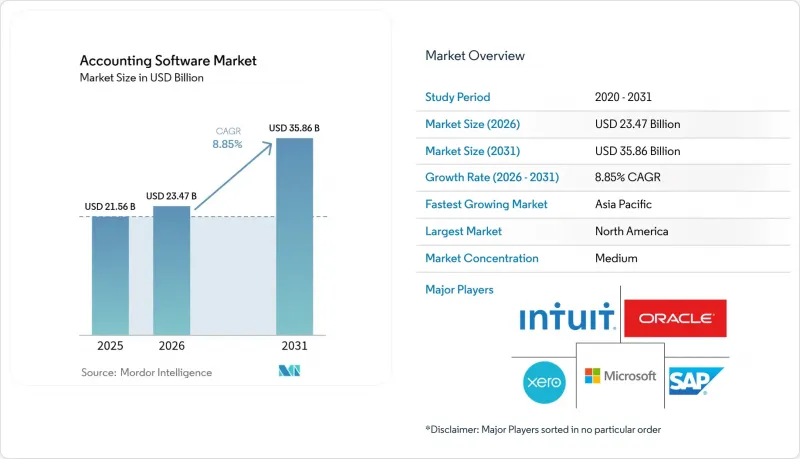
本報告按部署類型(本地部署和雲端部署)、組織規模(大型企業和中小企業)、最終用戶行業(金融、保險和證券 (BFSI)、製造業、零售和電子商務、專業服務、IT 和電信、醫療保健)、應用(薪資管理、計費和發票等)以及地區進行細分。市場預測以美元 (USD) 為單位。
全球會計軟體市場趨勢與洞察
實施雲端優先的金融堆疊
企業正從本地系統遷移到雲端架構,實現會計、財務和營運資料的即時同步,從而降低基礎設施成本並提高現金流量可見度。這種遷移還實現了與金融科技功能的無縫整合,例如支付、費用卡和短期流動性管理,而這些在傳統系統中是無法實現的。
簿記工作流程的超自動化
基於機器學習的資料提取和機器人流程自動化 (RPA) 技術,使得交易分類、銀行帳戶對帳和發票處理的準確率高達 98%,從而使會計事務所能夠在不相應增加員工的情況下承接更多客戶。由此帶來的生產力提升,降低了中小企業的整體擁有成本,並有助於緩解整個產業的人才短缺問題。
資料主權和隱私法規
GDPR等法規強制要求本地資料存儲,迫使供應商維護多區域雲端環境,增加了部署成本。企業往往不願意遷移高度敏感的會計數據,除非合約條款能夠保證加密、存取控制和本地儲存選項,這導致專案進度延誤。
細分市場分析
預計到2025年,雲端解決方案將佔總營收的68.08%,複合年成長率(CAGR)為10.15%,這意味著本地部署的市場佔有率將持續下降。這種「收費付費」模式無需資本投資,並包含自動更新功能以增強安全性。與銀行和薪資核算服務提供者的無縫API整合進一步鞏固了雲端解決方案的普及。雖然依賴傳統ERP系統的大型企業仍傾向於採用混合策略來處理對延遲敏感的工作流程,但其子公司正在試行部署雲端解決方案以縮短結算週期。資料儲存選項和區域資料中心的日益增多正在緩解傳統的合規性問題,這表明到本十年末,雲端在會計軟體市場的佔有率將接近飽和。
在高度監管的行業中,離線處理是強制性的,或者系統需要透過客製化來固定,因此本地部署平台仍然佔據著重要的地位。然而,維護負擔和大型主機工程師的短缺迫使財務長們不得不為現代化改造分配預算。供應商正利用這波遷移浪潮,提供能夠將歷史帳簿資料映射到多租戶架構的遷移工具包,將系統切換週期縮短至短短幾週。因此,即使整個行業都在擴張,與本地部署相關的會計軟體市場規模預計仍將萎縮。
大型企業透過採用能夠產生多幣種和多實體報告的全球合併會計套件,預計到2025年,其收入的54.10%將來自這些套件。同時,中小企業(SME)憑藉直覺的雲端模組和人工智慧驅動的數據收集,減少了對專職IT人員的依賴,從而以10.85%的複合年成長率(CAGR)實現了最高的成長。訂閱計劃即使在企業發展的早期階段也能提供經濟實惠的訪問權限,因為費用會根據交易量進行調整。
隨著強制性電子帳單推動數位化進程,亞太和拉丁美洲的創業生態系統正經歷中小企業需求的進一步加速成長。供應商推出整合聊天機器人功能的入門級軟體包,降低了准入門檻,並將手動使用電子表格的用戶轉換為用戶。因此,中小企業在會計軟體市場佔有率中佔比穩步提升,預計與大型企業在會計軟體普及率方面的歷史差距將進一步縮小。
區域分析
預計到2025年,北美將佔全球收入的38.35%,這主要得益於其對雲端運算的高度接受度、成熟的支付基礎設施以及充足的技術預算。美國企業在員工人均財務應用的支出高於全球平均水平,從而推動了供應商創新和夥伴關係系統的快速發展。加拿大也呈現類似的趨勢,這得益於其協調的稅收框架,該框架簡化了跨境應用。
在歐洲,遵守GDPR和強制性永續發展報告正在推動平台創新。多語言介面和歐洲電子帳單標準(例如Peppol)正在推動產品在地化。然而,與亞太地區相比,較慢的決策週期導致其成長速度放緩。
亞太地區以10.45%的複合年成長率領跑,主要得益於印度和印尼強制推行的電子帳單發票制度,以及日本強制要求使用電子記錄保存軟體。中小企業正從桌面軟體轉向「行動優先」的雲端平台,這些平台整合了本地電子錢包和QR碼支付功能。全球供應商對本地資料中心的投資,有助於緩解資料主權的擔憂,並促進公共部門的採購。
在拉丁美洲,巴西和墨西哥的發展勢頭強勁。由於這些國家長期以來一直實施即時發票結算,企業正在將自動化範圍從稅務申報擴展到完整的ERP和財務雲端解決方案。在中東和非洲,由於經濟多元化努力和金融科技生態系統的擴張,市場呈現穩定成長,但由於通訊基礎設施和勞動力短缺,普及速度正在放緩。
其他好處:
- Excel格式的市場預測(ME)表
- 3個月的分析師支持
目錄
第1章:引言
- 研究假設和市場定義
- 調查範圍
第2章:調查方法
第3章執行摘要
第4章 市場洞察
- 市場概覽
- 市場促進因素
- 實施雲端優先的金融堆疊
- 核算流程的超自動化
- 人工智慧驅動的異常檢測和合規性
- 對「行動優先」會計體驗的需求
- 利用開放銀行基礎設施實現即時應收帳款和應付帳款融資
- 符合ESG標準的審計追蹤正在推動軟體更新。
- 市場限制因素
- 關於資料主權和隱私的法規
- 舊有系統遷移成本
- 能夠駕馭人工智慧的會計專業人員短缺。
- 跨國強制電子帳單和不一致的系統
- 價值鏈分析
- 監理情勢
- 技術展望
- 波特五力分析
- 產業生態系分析
- 主要用例和案例研究
- 宏觀經濟趨勢評估
- 投資分析
第5章 市場規模與成長預測
- 依部署類型
- 現場
- 基於雲端的(SaaS)
- 按組織規模
- 大公司
- 中小企業
- 按最終用戶行業分類
- BFSI
- 製造業
- 零售與電子商務
- 專業服務
- 資訊科技/通訊
- 衛生保健
- 透過使用
- 薪資管理
- 發票開立和發票編制
- 費用管理
- 稅務管理
- 按地區
- 北美洲
- 美國
- 加拿大
- 墨西哥
- 南美洲
- 巴西
- 阿根廷
- 哥倫比亞
- 其他南美國家
- 歐洲
- 德國
- 英國
- 法國
- 義大利
- 西班牙
- 俄羅斯
- 荷蘭
- 其他歐洲國家
- 亞太地區
- 中國
- 日本
- 韓國
- 印度
- 澳洲
- 新加坡
- 其他亞太國家
- 中東和非洲
- 中東
- 沙烏地阿拉伯
- 阿拉伯聯合大公國
- 其他中東國家
- 非洲
- 南非
- 埃及
- 其他非洲國家
- 中東
- 北美洲
第6章 競爭情勢
- 市場集中度
- 策略趨勢
- 市佔率分析
- 公司簡介
- Intuit Inc.
- The Sage Group plc
- SAP SE
- Oracle Corporation(subsidiary:NetSuite Inc.)
- Microsoft Corporation
- Xero Limited
- Infor, Inc.(aka Infor Global Solutions, Inc.)
- Epicor Software Corporation
- Unit4 NV(parent Unit4 Holding BV)
- Zoho Corporation Private Limited
- MYOB Group Pty Ltd
- 2ndSite Inc.(doing business as FreshBooks)
- Wave Financial Inc.
- KashFlow Software Limited
- FreeAgent Holdings plc(operating entity:FreeAgent Central Ltd)
- Patriot Software Company, LLC
- Odoo SA
- Saasu Pty Ltd
- Red Wing Software, Inc.
- Reckon Limited
第7章 市場機會與未來展望
According to Mordor Intelligence, the accounting software market size was valued at USD 21.56 billion in 2025 and estimated to grow from USD 23.47 billion in 2026 to reach USD 35.86 billion by 2031, at a CAGR of 8.85% during the forecast period (2026-2031).
This report is Segmented by Deployment Type (On-Premise, and Cloud-Based), Organization Size (Large Enterprises, and Small and Medium Enterprises (SMEs)), End-User Industry (BFSI, Manufacturing, Retail and E-Commerce, Professional Services, IT and Telecom, and Healthcare), Application (Payroll Management, Billing and Invoicing, and More), and Geography. The Market Forecasts are Provided in Terms of Value (USD).
Global Accounting Software Market Trends and Insights
Cloud-First Finance-Stack Adoption
Organizations are abandoning on-premise installations in favor of cloud architectures that synchronize accounting, treasury and operational data in real time, cutting infrastructure costs and improving cash-flow visibility. The shift also unlocks seamless fintech integrations-payments, expense cards and short-term liquidity-once unattainable on legacy systems.
Hyper-Automation of Bookkeeping Workflows
Machine-learning extraction and robotic process automation now classify transactions, reconcile banks and process invoices with 98% accuracy, allowing accounting firms to absorb more clients without proportional head-count increases. The resulting productivity gains lower total ownership costs for small businesses and offset the industry-wide talent deficit.
Data-Sovereignty and Privacy Regulations
Rules such as GDPR compel local data residency, forcing vendors to maintain multi-region clouds and inflating implementation budgets. Enterprises hesitate to migrate sensitive ledgers until contractual clauses guarantee encryption, access controls and in-country storage options, delaying project timelines .
Other drivers and restraints analyzed in the detailed report include:
- AI-Led Anomaly Detection and Compliance
- Mobile-First Accounting Experience Demand
- Scarcity of AI-Ready Accounting Talent
For complete list of drivers and restraints, kindly check the Table Of Contents.
Segment Analysis
Cloud solutions generated 68.08% revenue in 2025, and their 10.15% CAGR signals that the on-premise share will continue to erode. The model's pay-as-you-grow pricing eliminates capital expenditure and embeds automatic updates that strengthen security posture. Seamless API connectivity with banks and payroll providers further cements adoption. Large enterprises wedded to legacy ERPs still favor hybrid strategies for latency-sensitive workflows, yet even they pilot cloud subsidiaries to reduce close cycles. Growing data-residency options and regional datacenters mitigate prior compliance objections, suggesting that the cloud slice of the accounting software market will near saturation by decade-end.
On-premise platforms retain niche relevance in highly regulated sectors where offline processing is mandatory or where bespoke customizations lock systems in place. However, maintenance overhead and scarce mainframe skills push CFOs to earmark modernization budgets. Vendors exploit this transition by offering migration toolkits that map historical ledgers into multi-tenant architectures, shortening cut-over periods to weeks. As a result, the accounting software market size tied to on-premise deployments is projected to contract despite overall industry expansion.
Large organizations captured 54.10% of 2025 revenue by deploying global-consolidation suites capable of multi-currency and multi-entity reporting. Yet SMEs drive the fastest 10.85% CAGR because intuitive cloud modules and AI-driven data capture reduce the need for dedicated IT staff. Subscription tiers align costs with transaction volume, ensuring affordability even during early growth stages.
Entrepreneurial ecosystems in Asia-Pacific and Latin America further catalyze SME demand as mandatory e-invoicing forces digital upgrades. Vendors releasing starter packages with embedded chatbot support lower adoption barriers and convert manual spreadsheet users into subscribers. Consequently, the accounting software market share commanded by SMEs will steadily rise, narrowing the historic gap with enterprise deployments.
Complete Report Scope:
- By Deployment Type
- On-premise
- Cloud-based (SaaS)
- By Organization Size
- Large Enterprises
- Small and Medium Enterprises (SMEs)
- By End-user Industry
- BFSI
- Manufacturing
- Retail and E-commerce
- Professional Services
- IT and Telecom
- Healthcare
- By Application
- Payroll Management
- Billing and Invoicing
- Expense Tracking
- Tax Management
- By Geography
- North America
- United States
- Canada
- Mexico
- South America
- Brazil
- Argentina
- Colombia
- Rest of South America
- Europe
- Germany
- United Kingdom
- France
- Italy
- Spain
- Russia
- Netherlands
- Rest of Europe
- Asia-Pacific
- China
- Japan
- South Korea
- India
- Australia
- Singapore
- Rest of Asia-Pacific
- Middle East and Africa
- Middle East
- Saudi Arabia
- United Arab Emirates
- Rest of Middle East
- Africa
- South Africa
- Egypt
- Rest of Africa
- Middle East
- North America
Geography Analysis
North America contributed 38.35% revenue in 2025 on the back of high cloud readiness, mature payments rails and well-funded technology budgets. United States enterprises allocate larger per-employee spend on finance applications compared with global averages, spurring rapid vendor innovation and partnering ecosystems. Canada mirrors this trend, supported by harmonized taxation frameworks that simplify cross-border deployment.
Europe follows, where GDPR compliance and sustainability-reporting mandates stimulate platform refreshes. Multi-lingual interfaces and European e-invoicing standards such as Peppol drive product localization. However, slower decision cycles temper growth relative to Asia-Pacific.
Asia-Pacific charts the fastest 10.45% CAGR, propelled by India's and Indonesia's compulsory e-invoicing rollouts and by Japan's soft-mandate for electronic preservation of ledgers. SMEs leapfrog desktop software, adopting mobile-first cloud suites that integrate domestic e-wallets and QR code payments. Local datacenter investments by global vendors mitigate data-sovereignty hesitance and unlock public-sector procurements.
Latin America sees momentum in Brazil and Mexico, where real-time invoice clearance has existed for years, leading businesses to extend automation beyond tax reporting to full ERP-finance clouds. Middle East and Africa post steady gains aligned to economic diversification drives and expanding fintech ecosystems, though connectivity and talent shortages moderate adoption pace.
- Intuit Inc.
- The Sage Group plc
- SAP SE
- Oracle Corporation (subsidiary: NetSuite Inc.)
- Microsoft Corporation
- Xero Limited
- Infor, Inc. (a.k.a. Infor Global Solutions, Inc.)
- Epicor Software Corporation
- Unit4 N.V. (parent Unit4 Holding B.V.)
- Zoho Corporation Private Limited
- MYOB Group Pty Ltd
- 2ndSite Inc. (doing business as FreshBooks)
- Wave Financial Inc.
- KashFlow Software Limited
- FreeAgent Holdings plc (operating entity: FreeAgent Central Ltd)
- Patriot Software Company, LLC
- Odoo SA
- Saasu Pty Ltd
- Red Wing Software, Inc.
- Reckon Limited
Additional Benefits:
- The market estimate (ME) sheet in Excel format
- 3 months of analyst support
TABLE OF CONTENTS
1 INTRODUCTION
- 1.1 Study Assumptions and Market Definition
- 1.2 Scope of the Study
2 RESEARCH METHODOLOGY
3 EXECUTIVE SUMMARY
4 MARKET INSIGHTS
- 4.1 Market Overview
- 4.2 Market Drivers
- 4.2.1 Cloud-first finance-stack adoption
- 4.2.2 Hyper-automation of book-keeping workflows
- 4.2.3 AI-led anomaly detection and compliance
- 4.2.4 Mobile-first accounting experience demand
- 4.2.5 Real-time A/R-A/P financing via open-banking rails
- 4.2.6 ESG-grade audit trails driving software refresh
- 4.3 Market Restraints
- 4.3.1 Data-sovereignty and privacy regulations
- 4.3.2 Legacy-system switching costs
- 4.3.3 Scarcity of AI-ready accounting talent
- 4.3.4 Fragmented e-invoicing mandates across borders
- 4.4 Value Chain Analysis
- 4.5 Regulatory Landscape
- 4.6 Technological Outlook
- 4.7 Porter's Five Forces Analysis
- 4.7.1 Bargaining Power of Suppliers
- 4.7.2 Bargaining Power of Buyers
- 4.7.3 Threat of New Entrants
- 4.7.4 Threat of Substitutes
- 4.7.5 Competitive Rivalry
- 4.8 Industry Ecosystem Analysis
- 4.9 Key Use Cases and Case Studies
- 4.10 Assessment of Macroeconomic Trends
- 4.11 Investment Analysis
5 MARKET SIZE AND GROWTH FORECASTS (VALUE)
- 5.1 By Deployment Type
- 5.1.1 On-premise
- 5.1.2 Cloud-based (SaaS)
- 5.2 By Organization Size
- 5.2.1 Large Enterprises
- 5.2.2 Small and Medium Enterprises (SMEs)
- 5.3 By End-user Industry
- 5.3.1 BFSI
- 5.3.2 Manufacturing
- 5.3.3 Retail and E-commerce
- 5.3.4 Professional Services
- 5.3.5 IT and Telecom
- 5.3.6 Healthcare
- 5.4 By Application
- 5.4.1 Payroll Management
- 5.4.2 Billing and Invoicing
- 5.4.3 Expense Tracking
- 5.4.4 Tax Management
- 5.5 By Geography
- 5.5.1 North America
- 5.5.1.1 United States
- 5.5.1.2 Canada
- 5.5.1.3 Mexico
- 5.5.2 South America
- 5.5.2.1 Brazil
- 5.5.2.2 Argentina
- 5.5.2.3 Colombia
- 5.5.2.4 Rest of South America
- 5.5.3 Europe
- 5.5.3.1 Germany
- 5.5.3.2 United Kingdom
- 5.5.3.3 France
- 5.5.3.4 Italy
- 5.5.3.5 Spain
- 5.5.3.6 Russia
- 5.5.3.7 Netherlands
- 5.5.3.8 Rest of Europe
- 5.5.4 Asia-Pacific
- 5.5.4.1 China
- 5.5.4.2 Japan
- 5.5.4.3 South Korea
- 5.5.4.4 India
- 5.5.4.5 Australia
- 5.5.4.6 Singapore
- 5.5.4.7 Rest of Asia-Pacific
- 5.5.5 Middle East and Africa
- 5.5.5.1 Middle East
- 5.5.5.1.1 Saudi Arabia
- 5.5.5.1.2 United Arab Emirates
- 5.5.5.1.3 Rest of Middle East
- 5.5.5.2 Africa
- 5.5.5.2.1 South Africa
- 5.5.5.2.2 Egypt
- 5.5.5.2.3 Rest of Africa
- 5.5.5.1 Middle East
- 5.5.1 North America
6 COMPETITIVE LANDSCAPE
- 6.1 Market Concentration
- 6.2 Strategic Moves
- 6.3 Market Share Analysis
- 6.4 Company Profiles (includes Global level Overview, Market level overview, Core Segments, Financials as available, Strategic Information, Market Rank/Share for key companies, Products and Services, and Recent Developments)
- 6.4.1 Intuit Inc.
- 6.4.2 The Sage Group plc
- 6.4.3 SAP SE
- 6.4.4 Oracle Corporation (subsidiary: NetSuite Inc.)
- 6.4.5 Microsoft Corporation
- 6.4.6 Xero Limited
- 6.4.7 Infor, Inc. (a.k.a. Infor Global Solutions, Inc.)
- 6.4.8 Epicor Software Corporation
- 6.4.9 Unit4 N.V. (parent Unit4 Holding B.V.)
- 6.4.10 Zoho Corporation Private Limited
- 6.4.11 MYOB Group Pty Ltd
- 6.4.12 2ndSite Inc. (doing business as FreshBooks)
- 6.4.13 Wave Financial Inc.
- 6.4.14 KashFlow Software Limited
- 6.4.15 FreeAgent Holdings plc (operating entity: FreeAgent Central Ltd)
- 6.4.16 Patriot Software Company, LLC
- 6.4.17 Odoo SA
- 6.4.18 Saasu Pty Ltd
- 6.4.19 Red Wing Software, Inc.
- 6.4.20 Reckon Limited
7 MARKET OPPORTUNITIES AND FUTURE OUTLOOK
- 7.1 White-space and Unmet-Need Assessment

 2026-2030年全球會計軟體市場
 2026-2030年全球非營利組織軟體市場
 會計軟體市場:2026-2032年全球市場預測(依軟體、定價模式、應用程式、部署類型、企業規模、最終用戶和產業分類)
 2026-2030年全球商業會計軟體市場
 薪資稅合規自動化:市佔率分析、產業趨勢與統計及成長預測(2026-2031 年)薪資和人力資源合規軟體:市場佔有率分析、行業趨勢和統計數據以及成長預測(2026-2031 年)
 2026年全球稅務和會計軟體市場報告
 人力資源和薪資管理軟體市場:按部署類型、行業和地區分類
 全球基金會計軟體市場規模、佔有率、趨勢和成長分析報告(2026-2034)全球會計軟體市場規模、佔有率、趨勢和成長分析報告(2026-2034)