


 |
市場調查報告書
商品編碼
2122281
IP多媒體子系統(IMS)服務:市場佔有率分析、產業趨勢與統計數據以及成長預測(2026-2031年)IP Multimedia Subsystem (IMS) Services - Market Share Analysis, Industry Trends & Statistics, Growth Forecasts (2026 - 2031) |
||||||

※ 本網頁內容可能與最新版本有所差異。詳細情況請與我們聯繫。
根據 Mordor Intelligence 預測,IP 多媒體子系統 (IMS) 服務市場將從 2025 年的 34.6 億美元成長到 2026 年的 39.2 億美元,然後在 2031 年達到 72.9 億美元,2026 年至 2031 年的複合年成長率為 13.24%。
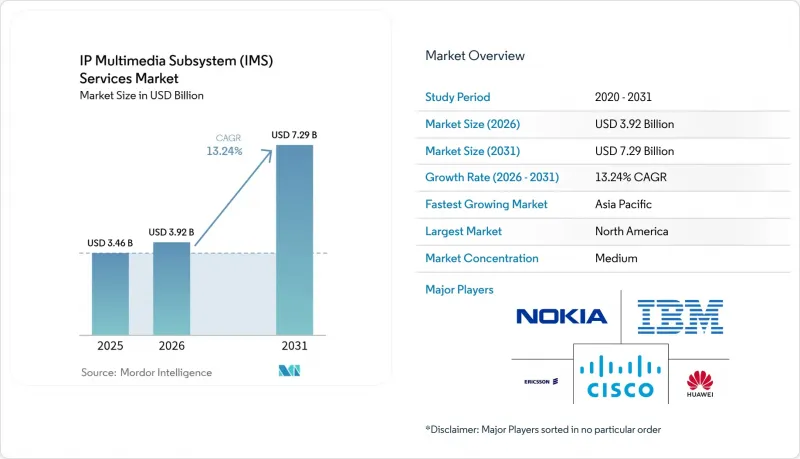
本報告按服務(即時通訊、VoIP、VoLTE、VoWiFi 及其他)、組件(產品和服務)、部署模式(本地部署和雲端部署)、運營商類型(行動通訊業者)、最終用戶(運營商、企業及其他)和地區進行細分。市場預測以美元計價。
全球IP多媒體子系統(IMS)服務市場趨勢與洞察
LTE和VoLTE的興起以及5G的出現
獨立組網的5G部署將語音通訊與傳統的LTE網路分離,迫使營運商採用VoNR(語音自動應答),VoNR利用IMS會話控制進行呼叫建立、轉碼器協商和服務品質(QoS)管理。法國Free Mobile、越南Viettel和英國O2的商用服務推出表明,VoNR已不再處於實驗階段,而是已投入實際運作。隨著基於IMS的核心網路支援網路切片和低延遲應用場景,營運商從中獲得了更多收益,使他們能夠將5G的商業價值擴展到連接之外。 2024年9月,愛立信與12家領先的營運商成立了一家網路API合資企業,並發布了符合CAMARA標準的API。這使得開發人員能夠啟動按需頻寬和定位服務,將IMS轉變為可供第三方使用的可程式設計資產。這項轉變使得語音成為IMS眾多收入來源之一。
企業通訊對進階通訊服務(RCS) 的需求正在激增。
預計到 2025 年,RCS 流量將達到 500 億條訊息,到 2029 年收入將達到 42 億美元,基於 IMS 的通訊正鞏固其作為傳統簡訊 (SMS) 極具吸引力的替代方案的地位。蘋果決定在 iOS 18 中加入 RCS,消除了 Android 和 iPhone 生態系統之間最後一個主要的互通性障礙。已讀回執、寄件者身分驗證和富媒體功能使企業能夠發起面向所有裝置使用者的互動宣傳活動,從而建立 OTT 應用程式無法企及的使用者參與度和可信任身分。營運商正在推出與客戶關係管理 (CRM) 套件整合的 RCS 即服務 (RCSaaS) 平台,在彌補簡訊收入下滑的同時,創造穩定的經常性收入。隨著 RCS 的不斷普及,IMS 的狀態、通訊和安全功能的使用率不斷提高,市場也從語音管道擴展到資料管道。
熟練的IMS專家短缺
雲端原生IMS需要微服務編配、CI/CD管線和多廠商API整合的專業知識,但大多數電信工程師的經驗主要集中在單體或虛擬化核心環境,導致缺乏Kubernetes的實際營運經驗。由於人才短缺,電信業者往往會延後遷移或過度依賴廠商提供的服務,增加成本和風險。儘管TM Forum的認證課程和廠商贊助的訓練營正在不斷擴展,但培訓速度跟不上部署進度,尤其是在印度和沙烏地阿拉伯等高成長市場。廠商正在將AI驅動的配置和自動修復功能整合到產品中,以使更少的工程師能夠管理大規模的網路,但人力專業知識仍然是瓶頸。
細分市場分析
VoLTE 服務業務是目前最大的單一收入來源,預計到 2025 年將佔 IP 多媒體子系統 (IMS) 服務市場佔有率的 37.95%。隨著 4G 網路覆蓋的成熟和普及,VoLTE 仍是確保語音服務連續性的基礎,因為行動電話裝置正朝著普遍相容的方向發展。然而,企業行銷部門和顧客關懷團隊正將重心轉向支援 RCS 的即時通訊,預計到 2031 年,該業務板塊的年均成長率將達到 14.41%。蘋果公司採用 RCS 消除了碎片化,使品牌能夠開展針對所有智慧型手機用戶的單一宣傳活動,並利用已讀回執和富媒體等功能。在用戶參與度提升的推動下,業者正推出直接惠及企業即時通訊的營收分成模式。
通訊的成長正在影響IP多媒體子系統(IMS)服務市場的流量模式。由於RCS基於IMS資料通道運行,每個企業客戶都在增加對狀態顯示、群組聊天和檔案傳輸功能的使用。隨著業者透過API實現認證寄件者ID和富媒體卡的獲利,價值正從簡單的通話時間轉向協調的多媒體會話。雖然VoNR和VoWiFi也在成長,但由於成熟市場的終端滲透率接近飽和,它們的成長率有所下降。因此,服務產品正在多元化,從而避免了營運商語音收入停滯不前的風險。
即使到了2025年,IMS核心設備仍將佔總收入的71.88%,這反映了電信業採購中硬體和永久授權的傳統模式。會話控制功能、媒體閘道器和訊號防火牆將佔據資本支出的大部分,尤其是在亞洲和中東新建的5G核心網路中。然而,成長最快的領域是託管服務和專業服務,預計年成長率將達到14.93%,因為電信業者將從設計到營運的整個生命週期外包出去。德國電信(Telefonica Germany)與Mavenir簽署的五年雲端原生協定清晰地體現了這一轉變。該協議將營運商轉變為訂閱模式,供應商承擔升級風險,同時確保效能。
在工程團隊小規模的市場中,電信業者更傾向於選擇包含 Kubernetes 叢集、持續整合 (CI) 管線和內聯安全功能的承包雲端解決方案。這種需求擴大了系統整合商和軟體專家的收入佔有率,同時壓縮了硬體利潤率。未來,與活躍用戶數量掛鉤的軟體即服務 (SaaS) 合約可能會使服務領域的收入結構更接近產品領域,從而進一步重塑 IP 多媒體子系統 (IMS) 服務市場的收入結構。
區域分析
預計到2025年,北美仍將維持最大的收入佔有率,達到41.26%。 AT&T正投資210億至220億美元用於網路建設,並計畫部署中頻段5G,力爭在2026年實現全國3億人口覆蓋,同年實現70%的Open RAN流量。 T-Mobile的六載波聚合速度已達到3.6 Gbps,Verizon已部署13萬台支援Open RAN的無線設備。所有這些方案都需要IMS監控來確保語音和影像同步。美國聯邦通訊委員會(FCC)關於「空間補充覆蓋」的決定使得透過衛星直接向設備提供語音通訊成為可能,營運商與低地球軌道(LEO)衛星星系的合作正在為農村地區基於IMS的呼叫服務創造新的收入來源。
在亞太地區,5G的快速部署預計將以14.37%的複合年成長率推動市場成長。中國移動擁有8.1億5G連接,並正在利用IMS數據通道測試擴增實境(AR)賦能的「新通話」功能。在印度,Reliance Jio的5G基地台數量已超過100萬,並正在測試用於遊戲和企業寬頻的網路切片技術。 Bharti Airtel已加入網路API合資企業,以實現按需品質的商業化。 Telstra已透過獨立組網(SA)5G實現了340Mbps的上行速度,並與Starlink簽署了衛星語音通訊合約。這些措施正在擴大亞太地區IP多媒體子系統(IMS)服務市場的規模,因為每增加一個5G用戶就需要一個IMS終端。
在歐洲,核心網路正透過雲端專案進行現代化改造。德國電信(Telefonica Germany)於2025年2月與Mavenir簽署了一項為期五年的雲端原生協議,而德國電信(Deutsche Telekom)已於一年前完成了1700萬條線路的遷移。 Free Mobile於2024年9月推出了其首個商用VoNR網路,而英國O2公司於2024年2月在14個支援獨立組網(SA)的城市推出了服務。歐盟的「數位十年」目標需要1,480億歐元的新型連接基礎設施投資,其中大部分將用於建造可擴展的全IP核心網,以處理5G獨立組網的通訊流量。 Orange的「Sylva」專案正在製定電信雲端的標準化藍圖,使營運商能夠在無需大規模重新整合的情況下,跨國遷移IMS工作負載。
中東和非洲正在經歷快速的雲端運算普及。沙烏地電信已將其74%的語音用戶遷移到雲端IMS,並在8993個地點實現了54.7%的5G覆蓋率。阿拉伯聯合大公國展示了「新通話」功能,可將語音視覺化,並實現了5.1 Gbps的室內速度,凸顯了人們對利用IMS數據通道的體驗式服務日益成長的興趣。 GSMA預測,該地區的行動收入將從2023年的660億美元成長到2030年的880億美元,將帶動IMS支出的穩定成長。
南美洲在資本支出方面落後其他地區,但正透過雲端原生方法縮小差距。 2024年8月,Mavenir和Whitestack為一家大型電信營運商(名稱未公開)部署了IMS核心網,這表明採用多廠商、最佳組合堆疊可以降低部署成本並加快產品上市速度。隨著巴西、智利和哥倫比亞的頻譜競標進入最後階段,營運商正從開發銀行獲得資金籌措,以支援VoLTE和後續VoNR的部署,加速IP多媒體子系統(IMS)服務的逐步普及。
其他好處
- Excel格式的市場預測(ME)表
- 3個月的分析師支持
目錄
第1章:引言
- 研究假設和市場定義
- 調查範圍
第2章:調查方法
第3章執行摘要
第4章 市場狀況
- 市場概覽
- 市場促進因素
- LTE和VoLTE的興起以及5G的出現
- 企業通訊對進階通訊服務(RCS) 的需求正在激增。
- 電信業者對雲端原生IMS架構的投資激增
- 在獨立組網的 5G 網路中快速過渡到基於新無線電的語音 (VoNR)
- 基於衛星的、設備直連語音服務的出現。
- 透過政府主導的頻率重新分配工作加快IMS升級
- 市場限制因素
- 熟練的IMS專家短缺
- 將IMS與傳統電路交換網路整合所帶來的複雜性。
- 網路安全訊號詐騙的風險正在增加。
- 新興市場資本密集型初始部署成本
- 產業價值鏈分析
- 監理情勢
- 技術展望
- 波特五力分析
- 宏觀經濟因素對市場的影響
第5章 市場規模與成長預測
- 按服務
- 即時通訊
- VoIP
- VoLTE
- VoWiFi
- 其他
- 按組件
- 產品
- 服務
- 按部署模式
- 現場
- 基於雲端的
- 按業務類型分類
- 行動通訊業者
- 固定線路電信業者
- 最終用戶
- 電信營運商
- 公司
- 緊急服務
- 按地區
- 北美洲
- 美國
- 加拿大
- 墨西哥
- 南美洲
- 巴西
- 墨西哥
- 其他南美國家
- 歐洲
- 德國
- 英國
- 法國
- 西班牙
- 義大利
- 其他歐洲國家
- 亞太地區
- 中國
- 印度
- 日本
- 澳洲
- 韓國
- 其他亞太國家
- 中東和非洲
- 中東
- 沙烏地阿拉伯
- 阿拉伯聯合大公國
- 卡達
- 土耳其
- 其他中東國家
- 非洲
- 南非
- 奈及利亞
- 其他非洲地區
- 中東
- 北美洲
第6章 競爭情勢
- 市場集中度
- 策略趨勢
- 市佔率分析
- 公司簡介
- Telefonaktiebolaget LM Ericsson
- Cisco Systems, Inc.
- Nokia Corporation
- Huawei Technologies Co., Ltd.
- International Business Machines Corporation
- ZTE Corporation
- Ribbon Communications Inc.
- 三星電子有限公司(網路事業部)
- Oracle Corporation
- NEC Corporation
- Mavenir Systems, Inc.
- Metaswitch Networks Ltd.(Microsoft Corp.)
- Athonet SpA
- Cirpack SAS
- Italtel SpA
- Mitel Networks Corporation
- Amdocs Ltd.
- Juniper Networks, Inc.
- Hewlett Packard Enterprise Company
- Fujitsu Ltd.
- Dialogic Corporation
- Enghouse Systems Ltd.
第7章 市場機會與未來展望
According to Mordor Intelligence, the IP multimedia subsystem (IMS) services market size is expected to grow from USD 3.46 billion in 2025 to USD 3.92 billion in 2026 and is forecast to reach USD 7.29 billion by 2031 at 13.24% CAGR over 2026-2031.
This report is Segmented by Service (Instant Messaging, Voip, Volte, Vowifi, and Other Services), Component (Products, and Services), Deployment Model (On-Premises, and Cloud-Based), Operator Type (Mobile Network Operators, and Fixed Network Operators), End User (Telecommunication Operators, Enterprises, and More), and Geography. The Market Forecasts are Provided in Terms of Value (USD).
Global IP Multimedia Subsystem (IMS) Services Market Trends and Insights
Increasing Popularity of LTE and VoLTE and Emergence of 5G
Standalone 5G deployments detach voice from legacy LTE anchors, prompting carriers to adopt VoNR, which relies on IMS session control for call setup, codec negotiation, and quality-of-service enforcement. Commercial launches by Free Mobile in France, Viettel in Vietnam, and O2 UK demonstrate that VoNR is production-ready rather than experimental. Operators see additional upside because an IMS-anchored core supports network slicing and low-latency use cases that monetize 5G beyond connectivity. A September 2024 network-API venture formed by Ericsson and 12 leading carriers exposes CAMARA-compliant APIs, allowing developers to trigger bandwidth on demand or location services, thereby turning IMS into a programmable asset for third-party applications. This shift positions voice as only one of many revenue-bearing IMS functions.
Soaring Demand for Rich Communication Services in Business Messaging
RCS traffic reached 50 billion messages in 2025, and revenue is on track to reach USD 4.2 billion by 2029, solidifying IMS-based messaging as a compelling alternative to legacy SMS. Apple's decision to add RCS to iOS 18 removed the last major interoperability barrier between Android and iPhone ecosystems. With read receipts, verified sender IDs, and rich media, enterprises can now push interactive campaigns across the entire handset base, generating higher engagement and trusted identities that over-the-top apps cannot match. Carriers are launching RCS-as-a-service platforms that integrate with customer relationship management suites, generating sticky recurring fees while offsetting SMS revenue erosion. Each new RCS tenant increases attachment rates for IMS presence, messaging, and security functions, and extends the market from voice into data channels.
Shortage of Skilled IMS Professionals
Cloud-native IMS requires expertise in microservices orchestration, CI/CD pipelines, and multi-vendor API integration, yet most telecom engineers grew up on monolithic or virtualized cores and lack hands-on Kubernetes experience. Operators facing talent gaps often delay migrations or over-rely on vendor-managed services, which drives up costs and risk. Certification programs from the TM Forum and vendor-sponsored boot camps are expanding, but the pace of training still lags behind deployment timelines, particularly in high-growth markets such as India and Saudi Arabia. Vendors are incorporating AI-assisted configuration and auto-healing into their products, enabling fewer engineers to manage larger networks; however, human expertise remains the bottleneck.
Other drivers and restraints analyzed in the detailed report include:
- Surging Operator Investments in Cloud-Native IMS Architectures
- Rapid Transition to Voice over New Radio in Standalone 5G Networks
- Complexity Integrating IMS with Legacy Circuit-Switched Networks
For complete list of drivers and restraints, kindly check the Table Of Contents.
Segment Analysis
The service segment generated the largest single-stream revenue from VoLTE, capturing 37.95% of the IP Multimedia Subsystem (IMS) Services market share in 2025. Adoption rose when 4G coverage matured, and VoLTE remains foundational for voice continuity because handsets universally support it. However, enterprise marketing and customer-care teams are pivoting to RCS-enabled Instant Messaging, projected to grow at a 14.41% annual rate through 2031. Apple's RCS adoption eliminates fragmentation, enabling brands to create a single campaign for the entire smartphone universe, complemented by read receipts and rich media. The higher engagement rate is prompting carriers to launch revenue-sharing models that give them a direct stake in business messaging.
Messaging growth influences traffic patterns on the IP Multimedia Subsystem (IMS) Services market. Because RCS runs over IMS data channels, each enterprise customer lifts the utilization of presence, group chat, and file-transfer functions. As carriers monetize APIs for verified sender IDs or rich cards, value migrates from simple voice minutes to orchestrated multimedia sessions. VoNR and VoWiFi also gain, but their incremental growth is lower because penetration already nears handset saturation in mature markets. The result is a diversified service mix that buffers operators against flat voice revenue.
IMS core equipment still accounted for 71.88% of overall revenue in 2025, reflecting the hardware and perpetual license heritage of telecom procurement. Session control functions, media gateways, and signaling firewalls dominate capital layouts, especially for greenfield 5G cores in Asia and the Middle East. Yet the fastest expansion is in managed and professional services, set to climb 14.93% annually as carriers outsource the entire lifecycle from design to operations. Telefonica Germany's five-year cloud-native agreement with Mavenir illustrates the pivot: the operator shifts to a subscription model where the vendor absorbs upgrade risk while guaranteeing performance.
In markets with lean engineering teams, operators prefer turnkey cloud stacks that bundle Kubernetes clusters, continuous-integration pipelines, and in-line security. This demand gives system integrators and software specialists a larger revenue slice while compressing hardware margins. Over time, software-as-a-service contracts linked to active subscriber counts could bring the services slice approach closer to parity with products, further reshaping the revenue mix within the IP Multimedia Subsystem (IMS) Services market.
Complete Report Scope:
- By Service
- Instant Messaging
- VoIP
- VoLTE
- VoWiFi
- Other Services
- By Component
- Products
- Services
- By Deployment Model
- On-Premises
- Cloud-Based
- By Operator Type
- Mobile Network Operators
- Fixed Network Operators
- By End User
- Telecommunication Operators
- Enterprises
- Emergency Services
- By Geography
- North America
- United States
- Canada
- Mexico
- South America
- Brazil
- Mexico
- Rest of South America
- Europe
- Germany
- United Kingdom
- France
- Spain
- Italy
- Rest of Europe
- Asia Pacific
- China
- India
- Japan
- Australia
- South Korea
- Rest of Asia Pacific
- Middle East and Africa
- Middle East
- Saudi Arabia
- United Arab Emirates
- Qatar
- Turkey
- Rest of Middle East
- Africa
- South Africa
- Nigeria
- Rest of Africa
- Middle East
- North America
Geography Analysis
North America retained the leading 41.26% revenue share in 2025. AT&T invested USD 21 billion to USD 22 billion in its network, plans nationwide mid-band 5G reaching 300 million POPs by 2026, and targets 70% Open RAN traffic the same year. T-Mobile's six-carrier aggregation reached 3.6 Gbps, while Verizon installed 130,000 Open RAN-ready radios, all of which require IMS supervision to ensure synchronized voice and video. The FCC's Supplemental Coverage from Space ruling enables satellite direct-to-device voice, with partnerships between operators and LEO constellations creating new revenue pools for IMS-anchored calling in rural areas.
The Asia Pacific is forecast to expand at a 14.37% CAGR due to massive 5G adoption. China Mobile counts 810 million 5G connections and is piloting augmented-reality New Calling features using IMS data channels. In India, Reliance Jio has surpassed 1 million 5G sites and is testing network slicing for gaming and enterprise broadband. Bharti Airtel has joined the network-API venture to monetize quality-on-demand. Telstra achieved 340 Mbps uplink on standalone 5G and signed with Starlink for satellite voice coverage. These initiatives enhance the IP Multimedia Subsystem (IMS) Services market size in the Asia Pacific, as every incremental 5G user requires an IMS endpoint.
Europe is modernizing its core through cloud projects. Telefonica Germany signed a five-year cloud-native contract with Mavenir in February 2025, and Deutsche Telekom completed a 17 million-line migration one year prior. Free Mobile launched the first commercial VoNR network in September 2024, while O2 UK lit 14 standalone cities in February 2024. The EU's Digital Decade targets require EUR 148 billion in new connectivity spending, with a significant portion earmarked for all-IP cores that can scale to support 5G standalone traffic. Orange's Sylva project standardizes telco-cloud blueprints, allowing operators to port IMS workloads across countries without extensive reintegration.
The Middle East and Africa show rapid cloudification. Saudi Telecom Company migrated 74% of voice subscribers to cloud IMS and achieved 54.7% 5G coverage across 8,993 sites. e& UAE demonstrated New Calling with visualized voice, while du UAE reached 5.1 Gbps indoor speeds, highlighting experiential services that rely on IMS data channels. GSMA expects mobile revenues in the region to rise from USD 66 billion in 2023 to USD 88 billion by 2030, resulting in a steady increase in IMS spend.
South America lags in capex but is catching up via cloud-native approaches. Mavenir and Whitestack rolled out an IMS core for an unnamed tier-one carrier in August 2024, demonstrating that multi-vendor best-of-breed stacks can reduce acquisition costs and shorten the time to market. As spectrum auctions finalize in Brazil, Chile, and Colombia, carriers are lining up funding from development banks to underwrite VoLTE and later VoNR, supporting the gradual penetration of IP Multimedia Subsystem (IMS) services.
- Telefonaktiebolaget LM Ericsson
- Cisco Systems, Inc.
- Nokia Corporation
- Huawei Technologies Co., Ltd.
- International Business Machines Corporation
- ZTE Corporation
- Ribbon Communications Inc.
- Samsung Electronics Co., Ltd. (Networks Division)
- Oracle Corporation
- NEC Corporation
- Mavenir Systems, Inc.
- Metaswitch Networks Ltd. (Microsoft Corp.)
- Athonet S.p.A.
- Cirpack SAS
- Italtel S.p.A.
- Mitel Networks Corporation
- Amdocs Ltd.
- Juniper Networks, Inc.
- Hewlett Packard Enterprise Company
- Fujitsu Ltd.
- Dialogic Corporation
- Enghouse Systems Ltd.
Additional Benefits:
- The market estimate (ME) sheet in Excel format
- 3 months of analyst support
TABLE OF CONTENTS
1 INTRODUCTION
- 1.1 Study Assumptions and Market Definition
- 1.2 Scope of the Study
2 RESEARCH METHODOLOGY
3 EXECUTIVE SUMMARY
4 MARKET LANDSCAPE
- 4.1 Market Overview
- 4.2 Market Drivers
- 4.2.1 Increasing Popularity of LTE and VoLTE and Emergence of 5G
- 4.2.2 Soaring Demand for Rich Communication Services (RCS) in Business Messaging
- 4.2.3 Surging Operator Investments in Cloud-Native IMS Architectures
- 4.2.4 Rapid Transition to Voice over New Radio (VoNR) in Stand-Alone 5G Networks
- 4.2.5 Emergence of Satellite Direct-to-Device Voice Services
- 4.2.6 Government-Backed Spectrum Refarming Initiatives Accelerating IMS Upgrades
- 4.3 Market Restraints
- 4.3.1 Shortage of Skilled IMS Professionals
- 4.3.2 Complexity Integrating IMS with Legacy Circuit-Switched Networks
- 4.3.3 Heightened Cyber-Security and Signalling Fraud Risks
- 4.3.4 Capital-Intensive Upfront Deployment Costs in Emerging Markets
- 4.4 Industry Value Chain Analysis
- 4.5 Regulatory Landscape
- 4.6 Technological Outlook
- 4.7 Porter's Five Forces Analysis
- 4.7.1 Bargaining Power of Buyers
- 4.7.2 Bargaining Power of Suppliers
- 4.7.3 Threat of New Entrants
- 4.7.4 Threat of Substitutes
- 4.7.5 Intensity of Competitive Rivalry
- 4.8 Impact of Macroeconomic Factors on the Market
5 MARKET SIZE AND GROWTH FORECASTS (VALUE)
- 5.1 By Service
- 5.1.1 Instant Messaging
- 5.1.2 VoIP
- 5.1.3 VoLTE
- 5.1.4 VoWiFi
- 5.1.5 Other Services
- 5.2 By Component
- 5.2.1 Products
- 5.2.2 Services
- 5.3 By Deployment Model
- 5.3.1 On-Premises
- 5.3.2 Cloud-Based
- 5.4 By Operator Type
- 5.4.1 Mobile Network Operators
- 5.4.2 Fixed Network Operators
- 5.5 By End User
- 5.5.1 Telecommunication Operators
- 5.5.2 Enterprises
- 5.5.3 Emergency Services
- 5.6 By Geography
- 5.6.1 North America
- 5.6.1.1 United States
- 5.6.1.2 Canada
- 5.6.1.3 Mexico
- 5.6.2 South America
- 5.6.2.1 Brazil
- 5.6.2.2 Mexico
- 5.6.2.3 Rest of South America
- 5.6.3 Europe
- 5.6.3.1 Germany
- 5.6.3.2 United Kingdom
- 5.6.3.3 France
- 5.6.3.4 Spain
- 5.6.3.5 Italy
- 5.6.3.6 Rest of Europe
- 5.6.4 Asia Pacific
- 5.6.4.1 China
- 5.6.4.2 India
- 5.6.4.3 Japan
- 5.6.4.4 Australia
- 5.6.4.5 South Korea
- 5.6.4.6 Rest of Asia Pacific
- 5.6.5 Middle East and Africa
- 5.6.5.1 Middle East
- 5.6.5.1.1 Saudi Arabia
- 5.6.5.1.2 United Arab Emirates
- 5.6.5.1.3 Qatar
- 5.6.5.1.4 Turkey
- 5.6.5.1.5 Rest of Middle East
- 5.6.5.2 Africa
- 5.6.5.2.1 South Africa
- 5.6.5.2.2 Nigeria
- 5.6.5.2.3 Rest of Africa
- 5.6.5.1 Middle East
- 5.6.1 North America
6 COMPETITIVE LANDSCAPE
- 6.1 Market Concentration
- 6.2 Strategic Moves
- 6.3 Market Share Analysis
- 6.4 Company Profiles (includes Global Level Overview, Market Level Overview, Core Segments, Financials as available, Strategic Information, Market Rank/Share for key companies, Products and Services, and Recent Developments)
- 6.4.1 Telefonaktiebolaget LM Ericsson
- 6.4.2 Cisco Systems, Inc.
- 6.4.3 Nokia Corporation
- 6.4.4 Huawei Technologies Co., Ltd.
- 6.4.5 International Business Machines Corporation
- 6.4.6 ZTE Corporation
- 6.4.7 Ribbon Communications Inc.
- 6.4.8 Samsung Electronics Co., Ltd. (Networks Division)
- 6.4.9 Oracle Corporation
- 6.4.10 NEC Corporation
- 6.4.11 Mavenir Systems, Inc.
- 6.4.12 Metaswitch Networks Ltd. (Microsoft Corp.)
- 6.4.13 Athonet S.p.A.
- 6.4.14 Cirpack SAS
- 6.4.15 Italtel S.p.A.
- 6.4.16 Mitel Networks Corporation
- 6.4.17 Amdocs Ltd.
- 6.4.18 Juniper Networks, Inc.
- 6.4.19 Hewlett Packard Enterprise Company
- 6.4.20 Fujitsu Ltd.
- 6.4.21 Dialogic Corporation
- 6.4.22 Enghouse Systems Ltd.
7 MARKET OPPORTUNITIES AND FUTURE OUTLOOK
- 7.1 White-Space and Unmet-Need Assessment

 IP多媒體子系統市場:按通訊方式、最終用戶、應用程式和地區分類
 IP多媒體子系統市場預測至2034年-按組件、網路類型、部署模式、應用、最終用戶和地區分類的全球分析
 2026年全球IP多媒體子系統市場報告2026年全球IP多媒體子系統(IMS)服務市場報告
 IP多媒體子系統市場-全球產業規模、佔有率、趨勢、機會及預測(按組件、通訊業者、地區及競爭格局分類),2021-2031年
 IP多媒體子系統市場規模、佔有率和成長分析(按部署類型、組件、服務、最終用戶和地區分類)-產業預測(2026-2033年)
 IP多媒體子系統(IMS)的全球市場的預測,供應商的佔有率(2024年~2030年)