


 |
市場調查報告書
商品編碼
2122309
住宅路由器:市場佔有率分析、產業趨勢與統計、成長預測(2026-2031)Residential Routers - Market Share Analysis, Industry Trends & Statistics, Growth Forecasts (2026 - 2031) |
||||||

※ 本網頁內容可能與最新版本有所差異。詳細情況請與我們聯繫。
據 Mordor Intelligence 稱,2025 年住宅路由器市值為 132.1 億美元,2026 年為 145.8 億美元,預計到 2031 年將達到 226.2 億美元,2026 年至 2031 年期間的複合年成長率為 9.18%。
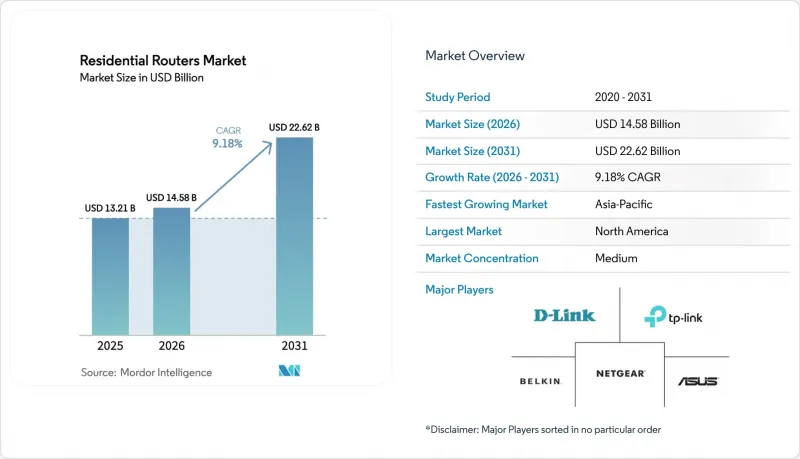
本報告按連接類型(有線、無線)、Wi-Fi 標準代數(Wi-Fi 4、Wi-Fi 5 及其他)、產品外形規格(獨立路由器、網狀 Wi-Fi 系統及其他)、分銷管道(零售、線上/電商及其他)、最終用戶家庭類型(獨棟住宅、多用戶住宅及其他)和地區進行細分。市場預測以美元計價。
全球住宅路由器市場趨勢及洞察
智慧家庭和物聯網設備的普及
2025年,北美家庭平均連網設備數量將達到17台,歐洲將達到12台。這種飽和狀態使得原本設計用於10個或更少並發連接的舊式路由器過時。對於那些同時進行影片串流、智慧恆溫器輪詢和監視器上傳等操作且面臨延遲問題的家庭來說,三頻和網狀網路系統不再是奢侈品,而是必需品。為了應對這項挑戰,網路服務供應商(ISP)正在將支援Wi-Fi 6E和Wi-Fi 7的閘道器與新的光纖網路捆綁銷售,每月花費10-15美元將用戶鎖定在託管的Wi-Fi生態系統中。基於Matter的互通性現在已成為標準,迫使製造商整合支援Thread的邊界路由器功能。這進一步細分了以平台為中心的新興參與企業和傳統硬體品牌之間的競爭。
全球IP流量激增和高速寬頻的普及
預計到2024年,全球IP流量將達到4.8澤字節(ZB),到2028年將超過7.5澤字節。到2025年,中國的光纖普及率將超過52%,韓國將超過48%,這將推動對配備2.5Gbps或10Gbps廣域網路連接埠的路由器的需求。為此,北美有線電視營運商正在將Wi-Fi 7無線功能整合到其DOCSIS 4.0閘道器中,並將收入來源從硬體轉向持續的管理服務費用。在印度,BharatNet已將骨幹網路覆蓋範圍擴展至25萬個村莊,但售價低於25美元的路由器缺乏韌體更新的基礎設施,使得農村用戶容易受到殭屍網路的威脅。這些趨勢導致住宅路由器市場出現兩極化,一邊是ISP管理的閘道器,另一邊是高階發燒設備。
網路安全和隱私風險日益惡化
2024年,75%的物聯網殭屍網路攻擊成功案例都以路由器為目標。歐盟的《網路彈性法案》強制要求每五年進行一次安全更新,這將使組件成本增加3-5美元,令低利潤品牌處境艱難。在美國,由於許多消費者不了解技術認證標誌,聯邦通訊委員會(FCC)的自願網路安全標籤仍未充分利用。一些網路服務供應商(ISP)閘道被曝收集瀏覽元元資料用於廣告定向後,隱私計劃活動愈演愈烈,迫使服務提供者實施選擇加入機制。由於家庭用戶仍在等待監管機構的明確指示,設備升級週期正在放緩,原始設備製造商(OEM)也將預算從功能創新轉向合規性。
細分市場分析
預計到2025年,無線路由器將佔據住宅路由器市場78.46%的佔有率,年複合成長率達10.17%。這反映了無線路由器能夠處理並發視訊串流並應對遠端辦公的負載。同時使用三個或更多影片會話的家庭用戶更傾向於選擇三頻機械式路由器,而不是需要昂貴結構化佈線的有線路由器。網路服務供應商(ISP)透過捆綁支援網狀網路的閘道來消除訊號盲區,從而加速無線路由器的普及,推動住宅路由器市場轉型為訂閱模式。有線路由器在對延遲敏感的細分市場(例如高頻交易)中仍然佔有一席之地,但隨著Wi-Fi 7的效能接近有線路由器,其市場佔有率預計將持續下降。
目前,無線產品的價值提案主要體現在網狀網路生態系統和人工智慧輔助漫遊。歐盟無線電設備指令中對USB-C充電器的標準化,降低了人們對電子廢棄物的擔憂,並縮短了路由器更換的考慮週期。即使在德國和日本幾乎每個房間都配備乙太網路介面的市場,為了確保柔軟性, Wi-Fi會話終止仍發生在Wi-Fi終端。因此,隨著物聯網滲透率的提高,住宅路由器市場很可能仍將以無線路由器為主導。
儘管Wi-Fi 6和6E在2025年佔出貨量的47.82%,但Wi-Fi 7預計將以10.88%的複合年成長率實現最快成長。多鏈路操作整合了2.4GHz、5GHz和6GHz頻寬,為雲端遊戲和擴增實境(AR)提供確定性延遲。網路服務供應商(ISP)在服務啟動時分發支援802.11be的閘道器,消除了先前阻礙新標準廣泛應用的部署延遲。在中國,6GHz頻段僅限於室內使用,因此需要雙SKU策略,但預計到2027年,基於銷售量的定價模式將趨於正常化。
售價超過 400 美元的 Wi-Fi 7 路由器面向業餘愛好者,是各大品牌的旗艦產品,但其銷售量僅佔總銷售量的不到 8%。隨著用戶端裝置的出現,效能差距預計將促使 Wi-Fi 5 裝置更換,從而進一步擴大住宅路由器市場。
區域分析
預計到2025年,北美將佔住宅路由器銷量的41.58%,這主要得益於網路服務供應商(ISP)將Wi-Fi 7配套服務捆綁到光纖和有線電視套餐中。康卡斯特(Comcast)的xFi平台服務於3,200萬戶家庭,其人工智慧驅動的最佳化功能每月收費14美元。 AT&T和Verizon也採用了類似的策略,透過遠端診斷將上門服務成本降低了28%。網狀網路系統的平均售價仍然很高,在140美元到200美元之間。諸如美國聯邦通訊委員會(FCC)的網路安全標籤等監管措施增加了合規負擔,但並未顯著改變消費者的選擇。
亞太地區預計將成為成長最快的地區,到2031年複合年成長率將達到10.62%。中國5.8億光纖家庭需要多千兆路由器,而印度BharatNet骨幹網路中低成本硬體的安全漏洞也日益凸顯。東協地區對價格的敏感度依然很高,72%的路由器售價低於35美元。日本和韓國在Wi-Fi 7的普及方面處於領先,營運商紛紛推出10Gbps服務。
預計到2025年,歐洲將佔全球銷售額的22%,這主要受到歐盟《網路彈性法案》和《生態設計指令》的影響,這兩項法案都有利於擁有完善認證流程的品牌。 BeFibre和EE已將其人工智慧驅動的Wi-Fi 7套餐定價為每月15美元,並將解約率降低了18%。儘管由於德國的結構化佈線標準,網狀網路的普及速度有所放緩,但預計到2025年,光纖普及率將達到48%,這將為多千兆路由器創造潛在需求。南美、中東和非洲總合佔銷售額的18%,但由於進口關稅和外匯波動,成長一直較為緩慢。
其他好處
- Excel格式的市場預測(ME)表
- 3個月的分析師支持
目錄
第1章:引言
- 研究假設和市場定義
- 調查範圍
第2章:調查方法
第3章執行摘要
第4章 市場狀況
- 市場概覽
- 市場促進因素
- 智慧家庭和物聯網設備的普及
- 全球IP流量激增和高速寬頻的普及
- 向 Wi-Fi 6/6E/7 標準的過渡將加快更換週期。
- 網路服務供應商正在提供大規模Wi-Fi 7 閘道器,並將其與光纖網路部署結合。
- 人工智慧驅動的託管式 Wi-Fi 訂閱服務正在推動對高階路由器的需求成長。
- 節能法規鼓勵升級到低功耗路由器。
- 市場限制因素
- 網路安全和隱私風險日益惡化
- 新興市場的價格敏感性
- 使用者技能不足會導致功能利用率低和升級延遲。
- 由於晶片組供應鏈波動,導致產品短缺和價格上漲。
- 產業價值鏈分析
- 監理情勢
- 技術展望
- 波特五力分析
第5章 市場規模與成長預測
- 按連線類型
- 有線
- 無線的
- Wi-Fi 標準按代分類
- Wi-Fi 4(802.11n)
- Wi-Fi 5(802.11ac)
- Wi-Fi 6/6E(802.11ax)
- Wi-Fi 7(802.11be)
- 按產品外形規格
- 獨立路由器
- 網狀Wi-Fi系統
- 數據機、路由器、閘道器(IAD)
- 5G/FWA 家庭閘道器
- 透過分銷管道
- 零售(店內)
- 線上/電子商務
- ISP捆綁租賃
- D2C品牌
- 按最終用戶家庭類型分類
- 獨立式住宅
- 多用戶住宅(MDU)
- 小規模辦公室/家庭辦公室 (SOHO)
- 按地區
- 北美洲
- 美國
- 加拿大
- 墨西哥
- 南美洲
- 巴西
- 阿根廷
- 其他南美國家
- 歐洲
- 德國
- 英國
- 法國
- 義大利
- 西班牙
- 其他歐洲國家
- 亞太地區
- 中國
- 日本
- 印度
- 韓國
- ASEAN
- 其他亞太國家
- 中東
- 沙烏地阿拉伯
- 阿拉伯聯合大公國
- 其他中東國家
- 非洲
- 南非
- 奈及利亞
- 其他非洲地區
- 北美洲
第6章 競爭情勢
- 市場集中度
- 策略趨勢
- 市佔率分析
- 公司簡介
- NETGEAR Inc.
- TP-LINK Technologies Co., Ltd.
- D-Link Corporation
- Belkin International, Inc.(Linksys)
- ASUSTeK Computer Inc.
- Google LLC(Nest Wi-Fi, eero)
- Cisco Systems, Inc.
- Huawei Technologies Co., Ltd.
- Xiaomi Inc.
- Synology Inc.
- TRENDnet, Inc.
- Buffalo Inc.
- Ubiquiti Inc.
- CommScope Holding Company, Inc.(ARRIS)
- Zyxel Communications Corp.
- Amazon.com, Inc.(eero LLC)
- Sercomm Corporation
- Qualcomm Incorporated(Networking Pro platforms)
- Tenda Technology Co., Ltd.
- Mercusys Technologies Co., Ltd.
- Amped Wireless(Newo Corporation)
- Nokia Corporation(Fixed Networks CPE)
第7章 市場機會與未來展望
According to Mordor Intelligence, the residential routers market size was valued at USD 13.21 billion in 2025, USD 14.58 billion in 2026, and is projected to attain USD 22.62 billion by 2031, translating into a 9.18% CAGR during the 2026-2031 period.
This report is Segmented by Connectivity Type (Wired, and Wireless), Wi-Fi Standard Generation (Wi-Fi 4, Wi-Fi 5, and More), Product Form Factor (Stand-Alone Routers, Mesh Wi-Fi Systems, and More), Distribution Channel (Retail, Online/E-commerce, and More), End-User Household Type (Single-Family Homes, Multi-Dwelling Units, and More), and Geography. The Market Forecasts are Provided in Terms of Value (USD).
Global Residential Routers Market Trends and Insights
Proliferation of Smart-Home and IoT Devices
Connected-device density climbed to 17 units per household in North America and 12 in Europe by 2025. This saturation forces legacy routers, originally designed for fewer than 10 concurrent links, into obsolescence. Households facing latency during simultaneous 4K streaming, smart-thermostat polling, and security-camera uploads now view tri-band or mesh systems as utilities rather than luxuries. ISPs exploit the pain point by bundling Wi-Fi 6E and Wi-Fi 7 gateways with new fiber installations, locking subscribers into managed Wi-Fi ecosystems at USD 10-15 per month. Matter interoperability has become baseline, compelling manufacturers to embed Thread border-router functionality that fragments competition between platform-centric entrants and traditional hardware brands.
Surging Global IP Traffic and High-Speed Broadband Uptake
Global IP traffic reached 4.8 zettabytes in 2024 and will exceed 7.5 zettabytes by 2028. Fiber penetration surpassed 52% in China and 48% in South Korea during 2025, creating pull for routers with 2.5 Gbps or 10 Gbps WAN ports. North American cable operators responded by integrating Wi-Fi 7 radios into DOCSIS 4.0 gateways, shifting profit pools from hardware to recurring managed-service fees. In India, BharatNet extended backbone capacity to 250,000 villages, but the absence of firmware-update infrastructure in sub-USD 25 routers leaves rural users exposed to botnets. These dynamics polarize the residential routers market between ISP-controlled gateways and premium enthusiast gear.
Escalating Cybersecurity and Privacy Risks
Routers represented 75% of successful IoT botnet compromises in 2024. The EU Cyber Resilience Act now mandates five-year security-update commitments, adding USD 3-5 to bill of materials and squeezing low-margin brands. In the United States, a voluntary FCC cybersecurity label remains underused because most consumers cannot interpret technical badges. Privacy advocacy intensified after revelations that some ISP gateways harvest browsing metadata for ad targeting, pressuring operators to adopt opt-in frameworks. As households wait for regulatory clarity, upgrade cycles slow and OEMs divert budgets from feature innovation to compliance.
Other drivers and restraints analyzed in the detailed report include:
- Migration to Wi-Fi 6/6E/7 Standards Fueling Replacement Cycles
- ISP Fiber Roll-Outs Bundling Wi-Fi 7 Gateways at Scale
- Price Sensitivity in Emerging Markets
For complete list of drivers and restraints, kindly check the Table Of Contents.
Segment Analysis
Wireless routers held 78.46% residential routers market share in 2025 and are set to grow at a 10.17% CAGR, reflecting their ability to manage simultaneous streams and remote-work loads. Households that host three or more concurrent video sessions favor tri-band units over wired alternatives that require costly structured cabling. ISPs accelerate wireless adoption by bundling mesh-capable gateways that erase dead zones, moving the residential routers market toward subscription models. The wired segment persists in latency-sensitive niches such as high-frequency trading, yet its contraction will continue as Wi-Fi 7 delivers near-wired performance.
Mesh ecosystems and AI-assisted roaming now define the wireless value proposition. The EU Radio Equipment Directive's standardization on USB-C chargers lowers e-waste objections and shortens router replacement deliberations. Markets like Germany and Japan, which integrate Ethernet jacks in every room, still end sessions on Wi-Fi endpoints for flexibility. The residential routers market will therefore remain decisively wireless as IoT density rises.
Wi-Fi 6 and 6E accounted for 47.82% of shipments in 2025, yet Wi-Fi 7 is poised for the fastest growth at 10.88% CAGR. Multi-link operation aggregates 2.4 GHz, 5 GHz, and 6 GHz bands to deliver deterministic latency for cloud gaming and augmented reality. ISPs distribute 802.11be gateways during service activation, cutting the adoption lag that historically separates new standards from mass uptake. China's restriction of 6 GHz to indoor use forces dual-SKU strategies, but volume pricing will normalize by 2027.
Enthusiast-grade Wi-Fi 7 routers priced above USD 400 serve as brand halo products and constitute less than 8% of unit volume. As client devices arrive, the performance gulf will motivate replacements of Wi-Fi 5 units, further propelling the residential routers market size.
Complete Report Scope:
- By Connectivity Type
- Wired
- Wireless
- By WiFi Standard Generation
- Wi-Fi 4 (802.11n)
- Wi-Fi 5 (802.11ac)
- Wi-Fi 6 / 6E (802.11ax)
- Wi-Fi 7 (802.11be)
- By Product Form Factor
- Stand-alone Routers
- Mesh Wi-Fi Systems
- Modem- Router Gateways (IADs)
- 5G/ FWA Home Gateways
- By Distribution Channel
- Retail (In-store)
- Online/ E-commerce
- ISP Bundled/ Leased
- Direct-to-Consumer Brands
- By End-User Household Type
- Single- Family Homes
- Multi- Dwelling Units (MDUs)
- Small Office/ Home Office (SOHO)
- By Geography
- North America
- United States
- Canada
- Mexico
- South America
- Brazil
- Argentina
- Rest of South America
- Europe
- Germany
- United Kingdom
- France
- Italy
- Spain
- Rest of Europe
- Asia-Pacific
- China
- Japan
- India
- South Korea
- ASEAN
- Rest of Asia-Pacific
- Middle East
- Saudi Arabia
- United Arab Emirates
- Rest of Middle East
- Africa
- South Africa
- Nigeria
- Rest of Africa
- North America
Geography Analysis
North America generated 41.58% of residential router revenue in 2025, propelled by ISP bundling that embeds Wi-Fi 7 gateways into fiber and cable tiers. Comcast's xFi platform serves 32 million households and monetizes AI-driven optimization at USD 14 per month. AT&T and Verizon adopted similar tactics, cutting truck-roll costs by 28% through remote diagnostics. Average selling prices remain high at USD 140-200 for mesh systems. Regulatory moves such as the FCC cybersecurity label add compliance overhead without visibly shifting consumer choices.
Asia-Pacific is forecast to deliver the fastest regional expansion at a 10.62% CAGR through 2031. China's 580 million fiber households require multi-gig routers, while India's BharatNet backbone highlights security gaps in low-cost hardware. ASEAN nations remain price sensitive, with 72% of routers priced below USD 35. Japan and South Korea lead Wi-Fi 7 adoption as operators bundle 10 Gbps services.
Europe held 22% of global revenue in 2025, shaped by the EU Cyber Resilience Act and Ecodesign mandates that favor brands with established certification pipelines. BeFibre and EE priced AI-powered Wi-Fi 7 tiers at USD 15 per month, trimming churn by 18%. Germany's structured wiring norms slow mesh proliferation, yet fiber penetration reached 48% in 2025, creating latent demand for multi-gig routers. South America, the Middle East, and Africa combined for 18% of revenue, constrained by import tariffs and currency volatility.
- NETGEAR Inc.
- TP-LINK Technologies Co., Ltd.
- D-Link Corporation
- Belkin International, Inc. (Linksys)
- ASUSTeK Computer Inc.
- Google LLC (Nest Wi-Fi, eero)
- Cisco Systems, Inc.
- Huawei Technologies Co., Ltd.
- Xiaomi Inc.
- Synology Inc.
- TRENDnet, Inc.
- Buffalo Inc.
- Ubiquiti Inc.
- CommScope Holding Company, Inc. (ARRIS)
- Zyxel Communications Corp.
- Amazon.com, Inc. (eero LLC)
- Sercomm Corporation
- Qualcomm Incorporated (Networking Pro platforms)
- Tenda Technology Co., Ltd.
- Mercusys Technologies Co., Ltd.
- Amped Wireless (Newo Corporation)
- Nokia Corporation (Fixed Networks CPE)
Additional Benefits:
- The market estimate (ME) sheet in Excel format
- 3 months of analyst support
TABLE OF CONTENTS
1 INTRODUCTION
- 1.1 Study Assumptions and Market Definition
- 1.2 Scope of the Study
2 RESEARCH METHODOLOGY
3 EXECUTIVE SUMMARY
4 MARKET LANDSCAPE
- 4.1 Market Overview
- 4.2 Market Drivers
- 4.2.1 Proliferation of Smart-Home and IoT Devices
- 4.2.2 Surging Global IP Traffic and High-speed Broadband Uptake
- 4.2.3 Migration to Wi-Fi 6/6E/7 Standards Fueling Replacement Cycles
- 4.2.4 ISP Fiber Roll-outs Bundling Wi-Fi 7 Gateways at Scale
- 4.2.5 AI-driven Managed-Wi-Fi Subscriptions Boosting Premium Router Demand
- 4.2.6 Energy-efficiency Mandates Prompting Low-power Router Upgrades
- 4.3 Market Restraints
- 4.3.1 Escalating Cybersecurity and Privacy Risks
- 4.3.2 Price Sensitivity in Emerging Markets
- 4.3.3 User Skill Gaps Causing Feature Under-Utilization, Delaying Upgrades
- 4.3.4 Chipset Supply-chain Volatility Creating Product Shortages and Price Spikes
- 4.4 Industry Value Chain Analysis
- 4.5 Regulatory Landscape
- 4.6 Technological Outlook
- 4.7 Porter's Five Forces Analysis
- 4.7.1 Bargaining Power of Suppliers
- 4.7.2 Bargaining Power of Buyers
- 4.7.3 Threat of New Entrants
- 4.7.4 Threat of Substitutes
- 4.7.5 Intensity of Competitive Rivalry
5 MARKET SIZE AND GROWTH FORECASTS (VALUE)
- 5.1 By Connectivity Type
- 5.1.1 Wired
- 5.1.2 Wireless
- 5.2 By WiFi Standard Generation
- 5.2.1 Wi-Fi 4 (802.11n)
- 5.2.2 Wi-Fi 5 (802.11ac)
- 5.2.3 Wi-Fi 6 / 6E (802.11ax)
- 5.2.4 Wi-Fi 7 (802.11be)
- 5.3 By Product Form Factor
- 5.3.1 Stand-alone Routers
- 5.3.2 Mesh Wi-Fi Systems
- 5.3.3 Modem- Router Gateways (IADs)
- 5.3.4 5G/ FWA Home Gateways
- 5.4 By Distribution Channel
- 5.4.1 Retail (In-store)
- 5.4.2 Online/ E-commerce
- 5.4.3 ISP Bundled/ Leased
- 5.4.4 Direct-to-Consumer Brands
- 5.5 By End-User Household Type
- 5.5.1 Single- Family Homes
- 5.5.2 Multi- Dwelling Units (MDUs)
- 5.5.3 Small Office/ Home Office (SOHO)
- 5.6 By Geography
- 5.6.1 North America
- 5.6.1.1 United States
- 5.6.1.2 Canada
- 5.6.1.3 Mexico
- 5.6.2 South America
- 5.6.2.1 Brazil
- 5.6.2.2 Argentina
- 5.6.2.3 Rest of South America
- 5.6.3 Europe
- 5.6.3.1 Germany
- 5.6.3.2 United Kingdom
- 5.6.3.3 France
- 5.6.3.4 Italy
- 5.6.3.5 Spain
- 5.6.3.6 Rest of Europe
- 5.6.4 Asia-Pacific
- 5.6.4.1 China
- 5.6.4.2 Japan
- 5.6.4.3 India
- 5.6.4.4 South Korea
- 5.6.4.5 ASEAN
- 5.6.4.6 Rest of Asia-Pacific
- 5.6.5 Middle East
- 5.6.5.1 Saudi Arabia
- 5.6.5.2 United Arab Emirates
- 5.6.5.3 Rest of Middle East
- 5.6.6 Africa
- 5.6.6.1 South Africa
- 5.6.6.2 Nigeria
- 5.6.6.3 Rest of Africa
- 5.6.1 North America
6 COMPETITIVE LANDSCAPE
- 6.1 Market Concentration
- 6.2 Strategic Moves
- 6.3 Market Share Analysis
- 6.4 Company Profiles (includes Global level Overview, Market Level Overview, Core Segments, Financials as Available, Strategic Information, Market Rank/Share for Key Companies, Products and Services, and Recent Developments)
- 6.4.1 NETGEAR Inc.
- 6.4.2 TP-LINK Technologies Co., Ltd.
- 6.4.3 D-Link Corporation
- 6.4.4 Belkin International, Inc. (Linksys)
- 6.4.5 ASUSTeK Computer Inc.
- 6.4.6 Google LLC (Nest Wi-Fi, eero)
- 6.4.7 Cisco Systems, Inc.
- 6.4.8 Huawei Technologies Co., Ltd.
- 6.4.9 Xiaomi Inc.
- 6.4.10 Synology Inc.
- 6.4.11 TRENDnet, Inc.
- 6.4.12 Buffalo Inc.
- 6.4.13 Ubiquiti Inc.
- 6.4.14 CommScope Holding Company, Inc. (ARRIS)
- 6.4.15 Zyxel Communications Corp.
- 6.4.16 Amazon.com, Inc. (eero LLC)
- 6.4.17 Sercomm Corporation
- 6.4.18 Qualcomm Incorporated (Networking Pro platforms)
- 6.4.19 Tenda Technology Co., Ltd.
- 6.4.20 Mercusys Technologies Co., Ltd.
- 6.4.21 Amped Wireless (Newo Corporation)
- 6.4.22 Nokia Corporation (Fixed Networks CPE)
7 MARKET OPPORTUNITIES AND FUTURE OUTLOOK
- 7.1 White-space and Unmet-Need Assessment

 企業級路由器:市場佔有率分析、產業趨勢與統計、成長預測(2026-2031)
 CNC雕刻機市場-2026-2032年全球市場預測智慧路由器市場:依路由器類型、技術標準、應用、通路和最終用戶分類-2026-2032年全球市場預測中小企業路由器:市場佔有率分析、產業趨勢與統計及成長預測(2026-2031 年)分支路由器:市場佔有率分析、行業趨勢和統計數據、成長預測(2026-2031 年)工業路由器市場:2026-2032年全球市場預測(依產品類型、連接技術、部署環境、最終用戶產業及銷售管道)核心路由器:市場佔有率分析、行業趨勢和統計數據、成長預測(2026-2031 年)網路路由器:市場佔有率分析、產業趨勢與統計、成長預測(2026-2031)路由器:市場佔有率分析、行業趨勢和統計數據、成長預測(2026-2031 年)
 2026年全球電信級路由市場報告