


 |
市場調查報告書
商品編碼
2123118
區塊鏈在媒體、廣告和娛樂領域的應用:市場佔有率分析、行業趨勢與統計數據以及成長預測(2026-2031 年)Blockchain In Media, Advertising, And Entertainment - Market Share Analysis, Industry Trends & Statistics, Growth Forecasts (2026 - 2031) |
||||||

※ 本網頁內容可能與最新版本有所差異。詳細情況請與我們聯繫。
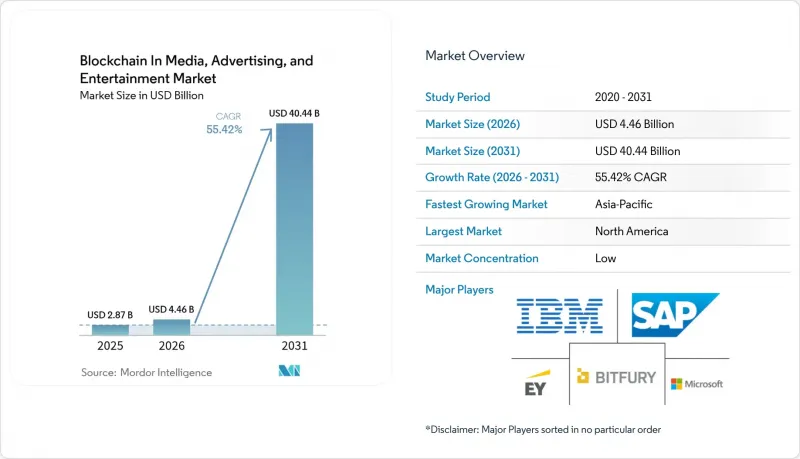
根據 Mordor Intelligence 預測,到 2026 年,媒體、廣告和娛樂領域的區塊鏈市場規模預計將達到 44.6 億美元。
這比 2025 年的 28.7 億美元有所成長,預計到 2031 年將達到 404.4 億美元,2026 年至 2031 年的複合年成長率為 55.42%。
本報告按區塊鏈類型(公有鏈、私有鏈、聯盟鏈/混合鏈)、公司規模(中小企業、大型企業)、應用領域(許可和版權管理、數位廣告等)、媒體行業(音樂、電影和電視、廣告內容等)以及地區進行分類。市場預測以美元計價。
全球區塊鏈市場在媒體、廣告和娛樂領域的趨勢與洞察。
版稅收入代幣化
透過將版稅代幣化,支付邏輯被整合到智慧合約中,在內容播放或觀看時立即執行,將結算週期從近兩年縮短至近乎即時。獨立音樂人可以獲得 85% 至 95% 的串流媒體收入,這與傳統的分配比例相比發生了巨大變化。另一方面,粉絲們獲得了音樂庫的股份,從而增加了他們的版稅收益和流動性。 2024 年,用於將音樂庫資產持分所有權的新創公司的創業融資達到了 5,500 萬美元,這表明投資者對媒體、廣告和娛樂領域的區塊鏈市場充滿信心。電影製片廠也在試行類似的模式,使用鏈上票房Oracle來觸發剩餘收入支付並解決會計糾紛。這些合約消除了匹配摩擦,有助於提高區塊鏈在媒體、廣告和娛樂產業的應用,並擴大其在音樂和影像媒體領域的滲透率。
消除創作者與觀眾的中間環節
區塊鏈影片網路使創作者能夠直接向觀眾提供內容,無需支付30-50%的平台費用,從而提高利潤率並縮短投資回報週期。 Theta的邊緣節點獎勵可將分發成本降低約60%,而NFT預售則允許獨立電影在開拍前就資金籌措。使用穩定幣的跨境微支付繞過了外匯限制,並將分散在全球各地的粉絲群體轉化為即時資助者。 2024年的試點數據顯示,超過40個項目透過NFT銷售成功資金籌措,這表明區塊鏈在媒體、廣告和娛樂領域擁有強勁的發展勢頭。即使在銀行基礎設施不完善的地區,創作者也能在幾分鐘內而非幾週內收回資金,凸顯了區塊鏈超越現有仲介業者的能力。
缺乏標準化和互通性
在以太坊上鑄造的數位資產很少能與Polygon版權協議原生互通,迫使版權持有者並行管理其資產。僅有五分之一的媒體項目採用了新的代幣分類框架,限制了資產的可移植性和流動性。 CCIP和LayerZero等橋接協議雖然能夠促進傳輸,但會產生gas費用並擴大攻擊面。這是由於缺乏用於通用和機械許可的通用元資料模式,以及自動化版稅聚合的停滯不前所致。因此,在標準統一之前,企業可能會推遲投資,並阻礙區塊鏈在媒體、廣告和娛樂領域的應用。
細分市場分析
預計到2025年,公有鏈將佔媒體、廣告和娛樂區塊鏈市場46.85%的佔有率,但聯盟混合網路預計將以60.02%的複合年成長率快速成長,遠超公有鏈的成長勢頭。許可型管治支援選擇性資料揭露,這對於保護預發佈內容的製片公司至關重要。在混合模式中,合約指紋在以太坊上進行哈希處理,既能保證交易條款的隱私性,又能維持公開可審計性,從而降低資訊外洩的風險。在好萊塢的先導計畫中,一個私有的Hyperledger實例實現了5000 TPS(每秒交易量),再次印證了其在後製工作流程中的效能優勢。儘管如此,對於尋求全球NFT流動性的創作者而言,公有鏈的價值仍然存在,這表明媒體、廣告和娛樂區塊鏈市場的未來將是雙堆疊模式。
混合模式的採用也得益於鏈上隱私工具,例如零知識證明,這些工具允許公開驗證版稅分配情況,同時隱藏高度敏感資訊。工作室聯盟現在可以檢驗款項是否已支付,而無需向競爭對手透露特定金額。隨著開放原始碼框架的成熟,整合摩擦減少,鼓勵更多中型廣播公司進行遷移。在預測期內,混合架構預計將佔新增採用量的 40%,鞏固其作為媒體、廣告和娛樂產業區塊鏈市場預設企業模式的地位。
儘管預計到2025年大型企業將佔交易總量的63.10%,但中小企業(SME)正在迅速追趕,預計到2031年將以59.85%的複合年成長率成長。 Thirdweb和Alchemy提供的現成合約範本將開發週期從數月縮短至數週。 AWS和Azure上的託管節點服務進一步降低了成本,使工作室能夠以不到5萬美元的價格建造環境,而先前客製化開發的成本高達六位數。一項針對藝術家的調查預測,到2024年,區塊鏈的採用率將成長兩倍,達到38%,凸顯了區塊鏈在媒體、廣告和娛樂領域的市場發展勢頭強勁。
尤其是在南美和東南亞,創作者雖然缺乏成熟的發行合作夥伴,卻擁有大規模正迅速採用區塊鏈技術。巴西一場基於代幣的線上音樂會,在六個月內吸引了5000名藝術家參與。這表明,即使是小規模企業,只要擁有Web3基礎設施,也能取得超越自身規模的成果。隨著無程式碼工具的普及,到2028年,中小企業的新計畫數量可望超過大型企業,進而改變媒體、廣告和娛樂產業區塊鏈領域的競爭格局。
區域分析
預計到2025年,北美將佔全球收入的38.40%,其中加州工作室的支出佔該地區總支出的60%以上,這得益於強勁的創業投資資金。雖然由於加拿大的稅收優惠政策,區塊鏈遊戲在多倫多和溫哥華正迅速發展,但在墨西哥,區塊鏈遊戲的普及速度較慢,不過由於匯款帶來的穩定幣湧入,其發展勢頭也正在增強。墨西哥在早期階段處於領先地位,目前專注於解決擴展性問題、跨鏈連接以及監管合規平台。然而,其成長速度目前落後於新興地區,反映出區塊鏈產業在媒體、廣告和娛樂領域的市場成熟度尚不成熟。
亞太地區預計將以60.35%的複合年成長率快速成長,成為全球成長最快的地區。中國官方的區塊鏈服務網路(BSSN)正在推動創建受監管的、類似NFT的“數位收藏品”,同時規避加密貨幣交易禁令。日本的Web3藍圖包含稅收優惠政策,這促進了SONY和萬代南夢宮等公司發布區塊鏈遊戲。印度的寶萊塢NFT瞄準了龐大的海外僑民群體,而韓國的K-POP代幣瞬間售罄,為粉絲主導的資金籌措樹立了典範。澳洲和東南亞目前市佔率較小,但它們正透過將區塊鏈技術融入連接媒體、廣告和娛樂市場的區域內容出口策略,利用不斷完善的支付基礎設施來發展區塊鏈業務。
其餘地區包括歐洲、南美洲以及中東和非洲。加密貨幣市場監管局 (MiCA) 提供法律確定性,並正在加速德國和英國權利註冊機構的發展。法國奢侈品牌正將高級時裝與電影 NFT 相結合,以增強體驗式行銷。在巴西和阿根廷,穩定幣正被用於緩解通貨膨脹的負面影響,但由於基礎設施不足,其普及速度緩慢。杜拜和利雅德正利用自由區激勵措施吸引 Web3 工作室,而奈及利亞正在試行基於區塊鏈的音樂串流服務,旨在吸引海外居民下載。這些多元化的舉措清楚地展現了區塊鏈在媒體、廣告和娛樂產業的國際化發展。
其他好處:
- Excel格式的市場預測(ME)表
- 3個月的分析師支持
目錄
第1章:引言
- 市場分析與定義的前提條件
- 分析範圍
第2章 分析方法
第3章執行摘要
第4章 市場狀況
- 市場概覽
- 市場促進因素
- 內容商品化與盜版問題
- 消除創作者與觀眾之間的中介功能
- 安全快速交易的需求
- 遏制欺詐性程序化廣告的必要性
- 去中心化自主製作工作室
- 版稅收入代幣化
- 市場限制因素
- 缺乏標準化和互通性
- 實施成本高且耗時。
- 代幣化收入方面的監管不確定性
- 人們擔憂能源密集產業鏈的碳足跡
- 產業價值鏈分析
- 宏觀經濟因素的影響
- 監理情勢
- 技術展望
- 波特五力分析
- 投資分析
第5章:預測市場規模與成長率
- 按區塊鏈類型
- 民眾
- 私人的
- 聯盟/混合
- 按公司規模
- 小型企業
- 大公司
- 透過使用
- 授權和版權管理
- 數位廣告
- 智慧合約
- 沉澱
- 網路遊戲
- 直播
- 其他用途
- 媒體帆船
- 音樂
- 電影和電視
- 廣告內容
- 遊戲
- 運動的
- 新聞與出版物
- 其他媒體片段
- 按地區
- 北美洲
- 美國
- 加拿大
- 墨西哥
- 南美洲
- 巴西
- 阿根廷
- 其他南美國家
- 歐洲
- 德國
- 英國
- 法國
- 義大利
- 西班牙
- 其他歐洲國家
- 亞太地區
- 中國
- 日本
- 印度
- 韓國
- 澳洲
- 其他亞太國家
- 中東和非洲
- 中東
- 沙烏地阿拉伯
- 阿拉伯聯合大公國
- 土耳其
- 其他中東國家
- 非洲
- 南非
- 奈及利亞
- 埃及
- 其他非洲國家
- 中東
- 北美洲
第6章 競爭情勢
- 市場集中度
- 策略趨勢
- 市佔率分析
- 公司簡介
- IBM Corporation
- Microsoft Corporation
- Ernst and Young Global Limited
- The Bitfury Group Limited
- SAP SE
- Accenture plc
- Amazon Web Services Inc.
- Oracle Corporation
- Infosys Limited
- ConsenSys Software Inc.
- R3 HoldCo LLC
- Dapper Labs Inc.
- Livepeer Inc.
- Theta Labs Inc.
- VeChain Foundation
- Animoca Brands Corporation Limited
- Chainalysis Inc.
- Mattereum Limited
- Rally Network PBC
- Braintrust Holdings LLC
第7章 市場機會與未來展望
According to Mordor Intelligence, the blockchain in media, advertising, and entertainment market size in 2026 is estimated at USD 4.46 billion, growing from 2025 value of USD 2.87 billion with 2031 projections showing USD 40.44 billion, growing at 55.42% CAGR over 2026-2031.
This report is Segmented by Type of Blockchain (Public, Private, and Consortium/Hybrid), Enterprise Size (Small and Medium Enterprises and Large Enterprises), Application (Licensing and Rights Management, Digital Advertising, and More), Media Segment (Music, Film and TV, Advertising Content, and More), and Geography. The Market Forecasts are Provided in Terms of Value (USD).
Global Blockchain In Media, Advertising, And Entertainment Market Trends and Insights
Tokenization of Royalty Streams
Tokenizing royalties embeds payout logic into smart contracts that execute instantly when content is streamed or screened, compressing settlement cycles from close to two years to near real-time. Independent musicians receive 85-95% of streaming income, a sharp reversal of legacy splits, while fans obtain fractional ownership in song catalogs, deepening loyalty and liquidity. Venture funding reached USD 55 million in 2024 for startups that fractionalize back-catalog assets, signalling strong investor confidence in the blockchain in the media, advertising, and entertainment market. Film studios are piloting similar models, using on-chain box-office oracles to trigger residuals and eliminate accounting disputes. As these contracts eliminate reconciliation friction, they help expand blockchain adoption in the media, advertising, and entertainment markets, with increased penetration across music and visual media.
Disintermediation between Creators and Audience
Blockchain video networks enable creators to stream content directly to viewers without surrendering 30-50% of their platform fees, thereby securing higher margins and reducing cash-collection cycles. Theta's edge-node incentives drop delivery costs by roughly 60%, while NFT pre-sales now bankroll independent films before cameras roll. Cross-border micro-payments in stablecoins circumvent currency controls, turning globally scattered fan communities into instant financiers. Pilot data from 2024 indicate that over 40 projects have been funded through NFT sales, demonstrating tangible momentum behind the blockchain in the media, advertising, and entertainment sectors. In regions with patchy banking rails, creators collect funds in minutes rather than weeks, underscoring blockchain's ability to undercut entrenched intermediaries.
Lack of Standardization and Interoperability
Digital assets minted on Ethereum seldom interoperate natively with rights contracts on Polygon, forcing right-holders to juggle parallel inventories. Only a fifth of media projects have implemented emerging token-taxonomy frameworks, limiting asset portability and liquidity. Bridge protocols like CCIP and LayerZero facilitate transfers while incurring gas costs and introducing additional attack surfaces, as they lack shared metadata schemas for sync and mechanical licenses, and automated royalty aggregation stalls. Consequently, enterprises may delay investment, tempering their adoption of blockchain in media, advertising, and entertainment markets until standards converge.
Other drivers and restraints analyzed in the detailed report include:
- Need to Curb Programmatic Advertising Fraud
- Demand for Secure and Faster Transactions
- Regulatory Uncertainty for Tokenized Revenue
For complete list of drivers and restraints, kindly check the Table Of Contents.
Segment Analysis
Consortium and hybrid networks are projected to grow at a rapid 60.02% CAGR, far outstripping public-chain momentum, despite public blockchains holding 46.85% of the blockchain in media, advertising, and entertainment market in 2025. Permissioned governance offers selective data disclosure, a must for studios guarding prerelease content. Hybrid models hash contract fingerprints onto Ethereum, preserving public auditability while keeping deal terms private, thereby mitigating the risk of leaks. Private Hyperledger instances reached 5,000 TPS during a Hollywood pilot, reaffirming the performance edge for post-production workflows. Yet, public chains retain value for creators chasing global NFT liquidity, underscoring a dual-stack future across the blockchain in the media, advertising, and entertainment market.
Hybrid adoption also benefits from on-chain privacy tools, such as zero-knowledge proofs, which mask sensitive fields while allowing public confirmation of royalty splits. Studio consortia can now validate that payments occurred without exposing exact amounts to rivals. As open-source frameworks mature, integration friction falls, encouraging more mid-tier broadcasters to migrate. Over the forecast horizon, hybrid architectures are expected to anchor 40% of new deployments, solidifying their status as the default enterprise pattern for the blockchain in the media, advertising, and entertainment market.
Although large enterprises controlled 63.10% of transactional value in 2025, SMEs are closing fast with a 59.85% CAGR through 2031. Ready-made contract templates from Thirdweb and Alchemy shrink development cycles from months to weeks. Managed node services on AWS and Azure, further lower cost, letting studios spin up environments for under USD 50,000, compared with six-figure custom builds earlier. An artist survey revealed that blockchain usage is expected to triple to 38% by 2024, highlighting grassroots momentum across the blockchain in media, advertising, and entertainment market.
SME traction is especially acute in South America and Southeast Asia, where creators lack entrenched distribution partners yet boast large online audiences. Token-gated streaming concerts in Brazil attracted 5,000 artists within six months, demonstrating that small players can punch above their weight when equipped with Web3 infrastructure. As no-code tooling proliferates, SMEs could surpass large enterprises in new project count by 2028, tilting the competitive balance within the blockchain in the media, advertising, and entertainment market.
Complete Report Scope:
- By Type of Blockchain
- Public
- Private
- Consortium / Hybrid
- By Enterprise Size
- Small and Medium Enterprises
- Large Enterprises
- By Appliaction
- Licensing and Rights Management
- Digital Advertising
- Smart Contracts
- Payments
- Online Gaming
- Live Streaming
- Other Applications
- By Media Segment
- Music
- Film and TV
- Advertising Content
- Gaming
- Sports
- News and Publishing
- Other Media Segments
- By Geography
- North America
- United States
- Canada
- Mexico
- South America
- Brazil
- Argentina
- Rest of South America
- Europe
- Germany
- United Kingdom
- France
- Italy
- Spain
- Rest of Europe
- Asia-Pacific
- China
- Japan
- India
- South Korea
- Australia
- Rest of Asia-Pacific
- Middle East and Africa
- Middle East
- Saudi Arabia
- United Arab Emirates
- Turkey
- Rest of Middle East
- Africa
- South Africa
- Nigeria
- Egypt
- Rest of Africa
- Middle East
- North America
Geography Analysis
North America contributed 38.40% of the revenue in 2025, with California studios accounting for over 60% of the regional spend amid robust venture backing. Canada's tax incentives anchor blockchain gaming in Toronto and Vancouver, whereas Mexico's adoption lags but gains impetus from remittance-driven stablecoin flows. The region's early lead shifts focus toward scaling concerns, cross-chain orchestration, and regulatory compliance platforms; yet, its growth rate now trails emerging hotspots, reflecting market maturity within the blockchain industry in media, advertising, and entertainment.
Asia-Pacific is forecast to soar at 60.35% CAGR, the fastest worldwide. China's state-run Blockchain-based Service Network enables compliant NFT-like "digital collectibles," circumventing crypto trading bans. Japan's Web3 roadmap supplies tax carve-outs that spur Sony and Bandai Namco to launch blockchain games. India's Bollywood NFTs target a vast diaspora, and South Korea's K-pop tokens sell out instantly, generating templates for fan-sourced financing. Australia and Southeast Asia contribute modest shares today but capitalize on improved payment rails by integrating blockchain technology into regional content-export strategies that stitch together the media, advertising, and entertainment market.
Europe, South America, the Middle East, and Africa fill the remainder. MiCA provides legal certainty that accelerates the development of German and U.K. rights registries. France's luxury houses merge couture with film NFTs, enhancing experiential marketing. Brazil and Argentina utilize stablecoins to mitigate the drag of inflation, although infrastructure deficits slow their adoption. Dubai and Riyadh leverage free-zone perks to magnetize Web3 studios, while Nigeria pilots blockchain music streams targeting diaspora downloads. Collectively, these diverse initiatives underscore the global reach of blockchain in the media, advertising, and entertainment sectors.
- IBM Corporation
- Microsoft Corporation
- Ernst and Young Global Limited
- The Bitfury Group Limited
- SAP SE
- Accenture plc
- Amazon Web Services Inc.
- Oracle Corporation
- Infosys Limited
- ConsenSys Software Inc.
- R3 HoldCo LLC
- Dapper Labs Inc.
- Livepeer Inc.
- Theta Labs Inc.
- VeChain Foundation
- Animoca Brands Corporation Limited
- Chainalysis Inc.
- Mattereum Limited
- Rally Network PBC
- Braintrust Holdings LLC
Additional Benefits:
- The market estimate (ME) sheet in Excel format
- 3 months of analyst support
TABLE OF CONTENTS
1 INTRODUCTION
- 1.1 Study Assumptions and Market Definition
- 1.2 Scope of the Study
2 RESEARCH METHODOLOGY
3 EXECUTIVE SUMMARY
4 MARKET LANDSCAPE
- 4.1 Market Overview
- 4.2 Market Drivers
- 4.2.1 Commoditization of Content and Piracy
- 4.2.2 Disintermediation between Creators and Audience
- 4.2.3 Demand for Secure and Faster Transactions
- 4.2.4 Need to Curb Programmatic Advertising Fraud
- 4.2.5 Decentralized Autonomous Production Studios
- 4.2.6 Tokenization of Royalty Streams
- 4.3 Market Restraints
- 4.3.1 Lack of Standardization and Interoperability
- 4.3.2 Expensive and Time-Consuming Deployment
- 4.3.3 Regulatory Uncertainty for Tokenized Revenue
- 4.3.4 Carbon Footprint Concerns of Energy-Intensive Chains
- 4.4 Industry Value Chain Analysis
- 4.5 Impact of Macroeconomic Factors
- 4.6 Regulatory Landscape
- 4.7 Technological Outlook
- 4.8 Porter's Five Forces Analysis
- 4.8.1 Bargaining Power of Suppliers
- 4.8.2 Bargaining Power of Buyers
- 4.8.3 Threat of New Entrants
- 4.8.4 Threat of Substitute Products
- 4.8.5 Intensity of Competitive Rivalry
- 4.9 Investment Analysis
5 MARKET SIZE AND GROWTH FORECASTS (VALUE)
- 5.1 By Type of Blockchain
- 5.1.1 Public
- 5.1.2 Private
- 5.1.3 Consortium / Hybrid
- 5.2 By Enterprise Size
- 5.2.1 Small and Medium Enterprises
- 5.2.2 Large Enterprises
- 5.3 By Appliaction
- 5.3.1 Licensing and Rights Management
- 5.3.2 Digital Advertising
- 5.3.3 Smart Contracts
- 5.3.4 Payments
- 5.3.5 Online Gaming
- 5.3.6 Live Streaming
- 5.3.7 Other Applications
- 5.4 By Media Segment
- 5.4.1 Music
- 5.4.2 Film and TV
- 5.4.3 Advertising Content
- 5.4.4 Gaming
- 5.4.5 Sports
- 5.4.6 News and Publishing
- 5.4.7 Other Media Segments
- 5.5 By Geography
- 5.5.1 North America
- 5.5.1.1 United States
- 5.5.1.2 Canada
- 5.5.1.3 Mexico
- 5.5.2 South America
- 5.5.2.1 Brazil
- 5.5.2.2 Argentina
- 5.5.2.3 Rest of South America
- 5.5.3 Europe
- 5.5.3.1 Germany
- 5.5.3.2 United Kingdom
- 5.5.3.3 France
- 5.5.3.4 Italy
- 5.5.3.5 Spain
- 5.5.3.6 Rest of Europe
- 5.5.4 Asia-Pacific
- 5.5.4.1 China
- 5.5.4.2 Japan
- 5.5.4.3 India
- 5.5.4.4 South Korea
- 5.5.4.5 Australia
- 5.5.4.6 Rest of Asia-Pacific
- 5.5.5 Middle East and Africa
- 5.5.5.1 Middle East
- 5.5.5.1.1 Saudi Arabia
- 5.5.5.1.2 United Arab Emirates
- 5.5.5.1.3 Turkey
- 5.5.5.1.4 Rest of Middle East
- 5.5.5.2 Africa
- 5.5.5.2.1 South Africa
- 5.5.5.2.2 Nigeria
- 5.5.5.2.3 Egypt
- 5.5.5.2.4 Rest of Africa
- 5.5.5.1 Middle East
- 5.5.1 North America
6 COMPETITIVE LANDSCAPE
- 6.1 Market Concentration
- 6.2 Strategic Moves
- 6.3 Market Share Analysis
- 6.4 Company Profiles (includes Global level Overview, Market level overview, Core Segments, Financials as available, Strategic Information, Market Rank/Share for key companies, Products and Services, and Recent Developments)
- 6.4.1 IBM Corporation
- 6.4.2 Microsoft Corporation
- 6.4.3 Ernst and Young Global Limited
- 6.4.4 The Bitfury Group Limited
- 6.4.5 SAP SE
- 6.4.6 Accenture plc
- 6.4.7 Amazon Web Services Inc.
- 6.4.8 Oracle Corporation
- 6.4.9 Infosys Limited
- 6.4.10 ConsenSys Software Inc.
- 6.4.11 R3 HoldCo LLC
- 6.4.12 Dapper Labs Inc.
- 6.4.13 Livepeer Inc.
- 6.4.14 Theta Labs Inc.
- 6.4.15 VeChain Foundation
- 6.4.16 Animoca Brands Corporation Limited
- 6.4.17 Chainalysis Inc.
- 6.4.18 Mattereum Limited
- 6.4.19 Rally Network PBC
- 6.4.20 Braintrust Holdings LLC
7 MARKET OPPORTUNITIES AND FUTURE OUTLOOK
- 7.1 White-Space and Unmet-Need Assessment


