


 |
市場調查報告書
商品編碼
2124160
內容情報:市場佔有率分析、產業趨勢與統計、成長預測(2026-2031)Content Intelligence - Market Share Analysis, Industry Trends & Statistics, Growth Forecasts (2026 - 2031) |
||||||

※ 本網頁內容可能與最新版本有所差異。詳細情況請與我們聯繫。
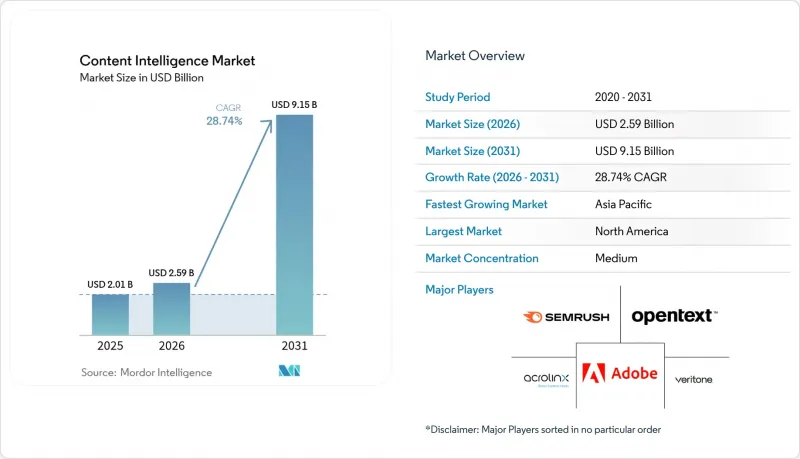
根據 Mordor Intelligence 預測,內容情報市場規模將從 2025 年的 20.1 億美元成長到 2026 年的 25.9 億美元,然後在 2031 年達到 91.5 億美元,2026 年至 2031 年的複合年成長率為 28.74%。
本報告按組件(解決方案、服務)、部署模式(雲端、本地部署、混合部署)、組織規模(中小企業、大型企業)、最終用戶產業(媒體娛樂、政府及公共部門等)和地區進行細分。市場規模和預測均以美元計價。
全球內容智慧市場趨勢與洞察
對大規模個人化、數據驅動型內容的需求
如今,企業已意識到,千篇一律的通訊已無法有效突破消費者複雜的篩選機制。 Adobe 的客戶體驗編排平台 (Customer Experience 編配 platform) 顯示,到 2024 年,不同橫幅廣告變體之間的互動率最高可提升 30%。向第一方資料策略的轉變,為企業建構前所未有的精準個人化模型提供了獨特的動力。使用內容智慧市場平台的企業報告稱,內容創建週期縮短了 40% 至 70%,相關性評分也得到了提升,這證實了規模和品質不再是相互矛盾的。金融服務、醫療保健和零售業也獲得了類似的收益,因為人工智慧能夠最佳化內容,使其更符合監管和客戶需求。隨著績效衡量變得日益重要,用於量化互動率提升的分析模組的投資也加速成長。這些趨勢鞏固了內容智慧市場的中期成長前景。
將人工智慧/機器學習整合到整個行銷技術(MarTech)堆疊中
生成式人工智慧已從單純的附加元件發展成為核心基礎設施。 Adobe 的 GenStudio 將製作、品牌管治和分析整合到單一工作流程中,展示了人工智慧如何消除以往導致製作延誤的人工交接環節。 OpenText 的 Titanium X 結合了 15 個人工智慧飛行員和 100 多個代理,承諾在 10 年內為流程密集型客戶節省 10 億美元的成本。隨著市場整合,傳統供應商被迫升級,否則將面臨市場佔有率被人工智慧新興企業蠶食的風險。如今,企業不再將預算用於一次性授權購買,而是將資金投入持續的模型調優、代理編配和資料營運 (Data-Ops) 中。早期採用整合技術堆疊的企業正受益於人工智慧在即時 A/B 測試和全自動宣傳活動迭代中的編配。這種整合將推動內容智慧市場在 2030 年前持續成長。
資料隱私和 GDPR/DMA 合規成本
OpenAI 於 2025 年被處以 1500 萬歐元的罰款,這鮮明地凸顯了數據濫用帶來的財務風險。歐洲資料保護委員會 (EDPB) 的新指南強制要求企業必須證明其在訓練、監控和推理中使用個人資料的合理性。因此,進入內容智慧市場的公司必須投資於隱私保護架構、本地部署和合成資料管道。合規性審計會使總體擁有成本 (TCO) 增加 25% 至 40%,導致在高度監管領域採購週期延長。儘管面臨這些負擔,企業仍願意承擔更高的成本以維持在歐盟市場的進入。
細分市場分析
儘管解決方案在2025年佔總營收的63.10%,但服務領域仍經歷了快速成長,到2031年年複合成長率(CAGR)將達到33.02%。隨著企業除了工具實施外,還需要諮詢、工作流程重組和變革管理,服務領域的內容智慧市場規模預計將迅速擴張。大規模受監管企業往往依賴專業整合商來確保人工智慧輸出符合合規要求。 Adobe和普華永道(PwC)的合作就是一個典型的例子,該合作旨在為高度監管的產業整合平台、資料管治和領域專業知識。雖然解決方案收入仍然可觀,但由於基礎人工智慧功能的商品化,其成長速度正在放緩。供應商正透過整合特定產業模型和低程式碼編配來實現差異化,但買家仍依賴服務合作夥伴將這些功能轉化為商業價值。這種依賴性是服務領域在整個內容智慧市場持續成長的基礎。
實施的成功指標清晰地反映了這一轉變。與僅實施工具的組織相比,將軟體和託管服務結合的組織報告稱,其採用率高出 20-30%,且價值實現時間更短。目前,Veritone 的客戶合約中,訂閱服務佔比高達 76%,這表明合約模式正朝著以結果為導向的方向發展。在整個預測期內,隨著人工智慧從試點階段過渡到生產階段,成熟的公司會將預算重新分配到諮詢服務、模型微調和持續最佳化方面。
儘管預計到 2025 年雲端運算仍將保持其主導地位,市佔率高達 76.20%,但混合雲配置的成長速度最快,複合年成長率 (CAGR) 達到 35.95%。隨著企業將敏感資料分區儲存在本地叢集上,同時在公共雲端上維持突發工作負載,混合雲配置在內容智慧市場佔有率方面正不斷成長。混合雲部署能夠降低即時個人化的延遲,並在不犧牲彈性擴展性的前提下滿足特定司法管轄區的資料監管要求。與全雲環境相比,早期採用者在處理大量多媒體資產時,營運成本可節省 30% 至 50%。供應商正積極回應,提供可在不同環境之間輕鬆遷移的容器化微服務,使用戶能夠充分利用這些服務,而無需承擔基礎設施複雜性的負擔。
本地部署環境為國防和監管嚴格的醫療保健行業的客戶提供獨特的價值。小型、領域特定語言模型的出現,使得在 CPU 核心上也能高效運行,進一步降低了對 GPU 密集型資料中心的依賴,從而使本地推理成為可行的選擇。未來,能夠抽象策略、模型版本控制和使用指標的多重雲端控制平面將成為標準配置。這種柔軟性將鞏固混合環境在整個內容智慧市場的主流地位。
區域分析
北美地區在2025年佔據了37.40%的收入佔有率,這主要得益於企業人工智慧的早期應用和強大的雲端基礎設施。儘管該地區保持著明顯的領先地位,但隨著大型企業從實驗階段過渡到最佳化階段,成長正在趨於穩定。北美內容智慧市場正穩步擴張,這主要得益於日益嚴格的無障礙法規和零方資料策略的興起。供應商生態系統圍繞著成熟的技術中心聚集,創業投資資金不斷增加,與系統整合商的夥伴關係也不斷發展。
亞太地區以33.84%的複合年成長率呈現最快成長勢頭,這主要得益於蓬勃發展的內容創作經濟,而人工智慧專案在各國的普及以及對多語言、多平台內容的需求,推動了該地區的快速發展。本地新創公司正在發布針對本地語言最佳化的輕量級模型,幫助品牌進行大規模在地化。混合雲端在該地區的應用也在不斷成長,但資料居住法規和成本壓力仍然存在。儘管這些因素正在逐漸削弱北美的主導地位,但這兩個地區仍然佔據內容智慧市場的大部分佔有率。
在歐洲,隨著GDPR和即將推出的歐盟人工智慧法案迫使企業實施內容管治和可解釋性工具,市場呈現強勁成長態勢。許多公司選擇混合部署或本地部署,以滿足嚴格的資料主權要求。南美洲以及中東和非洲地區仍在發展中,但也是極具吸引力的市場。寬頻基礎設施的改善和政府數位化計畫正在為SaaS供應商創造新的商機。全球採用率表明,人工智慧驅動的內容智慧正從早期採用者的特權轉變為主流的必需品。
其他好處:
- Excel格式的市場預測(ME)表
- 3個月的分析師支持
目錄
第1章:引言
- 研究假設和市場定義
- 調查範圍
第2章:調查方法
第3章執行摘要
第4章 市場狀況
- 市場概覽
- 市場促進因素
- 對大規模個人化、數據驅動型內容的需求
- 將人工智慧/機器學習整合到整個行銷技術堆疊中
- 影片和社交平臺。
- 無障礙規範(WCAG 3.0)的採用正在加速。
- 引入小型內部語言模型可降低整體擁有成本。
- 利用合成受眾數據實現零方定向
- 市場限制因素
- 資料隱私和 GDPR/DMA 合規成本
- 內容人工智慧人才短缺及轉型管理挑戰
- GPU/ASIC供應鏈的瓶頸正在推高推理成本。
- 幻覺引發的品牌責任風險
- 價值供應鏈分析
- 監理情勢
- 技術展望
- 波特五力分析
第5章 市場規模與成長預測
- 按組件
- 解決方案
- 服務
- 不同的發展
- 雲
- 現場
- 混合
- 按組織規模
- 中小企業
- 大公司
- 按最終用戶行業分類
- 媒體與娛樂
- 政府/公共部門
- 銀行、金融服務和保險(BFSI)
- IT/通訊
- 製造業
- 醫療保健和生命科學
- 零售與電子商務
- 其他
- 按地區
- 北美洲
- 美國
- 加拿大
- 歐洲
- 德國
- 英國
- 法國
- 其他歐洲國家
- 亞太地區
- 印度
- 中國
- 日本
- 其他亞太國家
- 南美洲
- 巴西
- 阿根廷
- 其他南美國家
- 中東和非洲
- 沙烏地阿拉伯
- 南非
- 阿拉伯聯合大公國
- 其他中東和非洲國家
- 北美洲
第6章 競爭情勢
- 市場集中度
- 策略趨勢
- 市佔率分析
- 公司簡介
- Adobe Inc.
- OpenText Corporation
- Semrush Holdings Inc.
- Acrolinx GmbH
- Veritone Inc.
- M-Files Corporation
- Smartlogic Holdings Ltd.
- Curata Inc.
- Scoop.it SAS
- Socialbakers as(now Emplifi)
- Concured Ltd.
- Atomic Reach Inc.
- OneSpot Inc.
- Vennli Inc.
- Sitecore Holding II A/S
- BrightEdge Technologies Inc.
- StoryChief NV
- Sprinklr Inc.
- Vyond Inc.
- ChapsVision Group
- Degreed Inc.
第7章 市場機會與未來展望
According to Mordor Intelligence, the content intelligence market size is expected to grow from USD 2.01 billion in 2025 to USD 2.59 billion in 2026 and is forecast to reach USD 9.15 billion by 2031 at 28.74% CAGR over 2026-2031.
This report is Segmented by Component (Solution, Service), Deployment (Cloud, On-Premise, Hybrid), Organization Size (SMEs, Large Enterprises), End-User Vertical (Media and Entertainment, Government and Public Sector, and More), and Geography. The Market Size and Forecasts are Provided in Terms of Value (USD).
Global Content Intelligence Market Trends and Insights
Demand for personalised, data-driven content at scale
Enterprises now recognize that generic messaging struggles to cut through sophisticated consumer filters. Adobe's Customer Experience Orchestration platform demonstrated engagement gains of up to 30% for banner variants in 2024. The move toward first-party data strategies gives firms proprietary fuel for ever-more-accurate personalization models. Organizations using content intelligence market platforms report 40-70% faster creation cycles and higher relevance scores, confirming that scale and quality are no longer trade-offs. Financial services, healthcare, and retail all cite similar benefits as AI tailors content to regulatory or customer nuances. The emphasis on performance measurement accelerates spending on analytics modules that quantify engagement lifts. These dynamics strengthen the content intelligence market outlook for mid-term growth.
AI/ML integration across martech stacks
Generative AI has shifted from bolt-on feature to core infrastructure. Adobe's GenStudio unifies creation, brand governance, and analytics in one workflow, showing how AI removes hand-offs that slowed production. OpenText's Titanium X combines 15 AI aviators and more than 100 agents, promising USD 1 billion in savings over a decade for process-heavy clients. Consolidation pressures legacy vendors to upgrade or risk displacement by AI-native entrants. Firms now budget for continuous model tuning, agent orchestration, and data-ops rather than one-time licenses. Early adopters of integrated stacks credit AI orchestration for real-time A/B testing and fully automated campaign iteration. This integration drives a sustained uplift across the content intelligence market through 2030.
Data-privacy and GDPR / DMA compliance costs
OpenAI's EUR 15 million fine in 2025 illustrates the financial exposure tied to data misuse. New European Data Protection Board guidance obliges firms to justify every personal-data use in training, monitoring, and inference. Enterprises adopting the content intelligence market must therefore invest in privacy-preserving architectures, on-premise deployments, and synthetic data pipelines. Compliance audits add 25-40% to total cost of ownership, slowing buying cycles in heavily regulated sectors. Despite the drag, firms accept higher costs to retain EU market access.
Other drivers and restraints analyzed in the detailed report include:
- Omnichannel content explosion on video and social platforms
- Accessibility regulations (WCAG 3.0) accelerating adoption
- Shortage of content-AI talent and change-management gaps
For complete list of drivers and restraints, kindly check the Table Of Contents.
Segment Analysis
Services captured rapid growth with a 33.02% CAGR through 2031 even though Solutions retained 63.10% of 2025 revenue. The Content intelligence market size for services is projected to climb sharply as companies need consulting, workflow redesign, and change management alongside tooling. Larger regulated enterprises turn to specialized integrators that align AI output with compliance obligations. Case in point, Adobe's collaboration with PwC targets heavily regulated verticals to bundle platform, data governance, and domain expertise. Solutions revenue remains sizable, yet commoditization of basic AI features tempers its pace. Vendors differentiate by embedding industry-specific models and low-code orchestration, yet buyers still lean on service partners to translate capability into business value. That dependence underpins sustained Services acceleration across the content intelligence market.
Implementation success metrics underscore the shift: organizations pairing software and managed services report 20-30% higher adoption rates and quicker time-to-value than tool-only deployments. Subscription-based services now account for 76% of Veritone's customer contracts, signaling a pivot toward outcome-centric engagements. Over the forecast horizon, mature enterprises will rebalance budgets toward advisory, model fine-tuning, and continuous optimization as AI moves from pilot to production.
Cloud remained dominant at a 76.20% share in 2025, but hybrid configurations now post the fastest trajectory at 35.95% CAGR. The Content intelligence market share for hybrid setups rises as firms split sensitive data onto local clusters while keeping burst workloads in public clouds. Hybrid rollouts lower latency for real-time personalization and meet jurisdictional data mandates without forgoing elastic scaling. Early adopters have measured 30-50% operating-expense savings compared with all-cloud when processing heavy multimedia assets. Vendors respond with containerized micro-services that slide easily between environments, shielding users from infrastructure complexity.
On-premise instances hold niche value for defense and highly regulated healthcare customers. The release of small, domain-tuned language models that perform well on CPU cores further reduces reliance on GPU-rich data centers, making local inference practical. Over time, multi-cloud control planes that abstract policy, model versioning, and usage metering will become standard. This flexibility cements hybrid as a mainstream choice across the content intelligence market.
Complete Report Scope:
- By Component
- Solution
- Service
- By Deployment
- Cloud
- On-premise
- Hybrid
- By Organisation Size
- Small and Medium-sized Enterprises (SMEs)
- Large Enterprises
- By End-user Vertical
- Media and Entertainment
- Government and Public Sector
- Banking, Financial Services and Insurance (BFSI)
- IT and Telecommunications
- Manufacturing
- Healthcare and Life-sciences
- Retail and e-Commerce
- Others
- By Geography
- North America
- United States
- Canada
- Europe
- Germany
- United Kingdom
- France
- Rest of Europe
- Asia-Pacific
- India
- China
- Japan
- Rest of Asia-Pacific
- South America
- Brazil
- Argentina
- Rest of South America
- Middle East and Africa
- Saudi Arabia
- South Africa
- United Arab Emirates
- Rest of Middle East and Africa
- North America
Geography Analysis
North America generated 37.40% of 2025 revenue thanks to early enterprise AI rollouts and deep cloud infrastructure. The region maintains clear leadership, yet growth stabilizes as large enterprises shift from experimentation to optimization. The Content intelligence market size in North America climbs steadily, supported by regulatory pushes for accessibility and rising zero-party data strategies. Vendor ecosystems cluster around established tech hubs, securing venture funding and fostering partnerships with system integrators.
Asia-Pacific exhibits the fastest pace at 33.84% CAGR, driven by national AI programs and a flourishing creator economy that fuels demand for multilingual, multi-platform content. Local start-ups launch lightweight models fine-tuned for regional languages, helping brands localize at scale. Hybrid cloud adoption also rises where data-residency rules coexist with cost pressures. These forces gradually chip away at North American dominance, although the two regions together still command most of the content intelligence market.
Europe shows resilient expansion as GDPR and the forthcoming EU AI Act compel enterprises to adopt content governance and explainability tooling. Many firms choose hybrid or on-premise deployments to align with stringent data-sovereignty mandates. South America and the Middle East and Africa remain nascent but attractive; improved broadband and government digitization plans create green-field opportunities for SaaS providers. Global penetration confirms that AI-enabled content intelligence is trending from early adopter privilege toward mainstream necessity.
- Adobe Inc.
- OpenText Corporation
- Semrush Holdings Inc.
- Acrolinx GmbH
- Veritone Inc.
- M-Files Corporation
- Smartlogic Holdings Ltd.
- Curata Inc.
- Scoop.it SAS
- Socialbakers a.s. (now Emplifi)
- Concured Ltd.
- Atomic Reach Inc.
- OneSpot Inc.
- Vennli Inc.
- Sitecore Holding II A/S
- BrightEdge Technologies Inc.
- StoryChief NV
- Sprinklr Inc.
- Vyond Inc.
- ChapsVision Group
- Degreed Inc.
Additional Benefits:
- The market estimate (ME) sheet in Excel format
- 3 months of analyst support
TABLE OF CONTENTS
1 INTRODUCTION
- 1.1 Study Assumptions and Market Definition
- 1.2 Scope of the Study
2 RESEARCH METHODOLOGY
3 EXECUTIVE SUMMARY
4 MARKET LANDSCAPE
- 4.1 Market Overview
- 4.2 Market Drivers
- 4.2.1 Demand for personalised, data-driven content at scale
- 4.2.2 AI/ML integration across martech stacks
- 4.2.3 Omnichannel content explosion on video and social platforms
- 4.2.4 Accessibility regulations (WCAG 3.0) accelerating adoption
- 4.2.5 Deployment of in-house small language models lowering TCO
- 4.2.6 Synthetic audience data unlocking zero-party targeting
- 4.3 Market Restraints
- 4.3.1 Data-privacy and GDPR / DMA compliance costs
- 4.3.2 Shortage of content-AI talent and change-management gaps
- 4.3.3 GPU/ASIC supply-chain bottlenecks inflating inference costs
- 4.3.4 Hallucination-driven brand-liability risks
- 4.4 Value / Supply-Chain Analysis
- 4.5 Regulatory Landscape
- 4.6 Technological Outlook
- 4.7 Porter's Five Forces Analysis
- 4.7.1 Bargaining Power of Buyers/Consumers
- 4.7.2 Bargaining Power of Suppliers
- 4.7.3 Threat of New Entrants
- 4.7.4 Threat of Substitutes
- 4.7.5 Intensity of Competitive Rivalry
5 MARKET SIZE AND GROWTH FORECASTS (VALUE)
- 5.1 By Component
- 5.1.1 Solution
- 5.1.2 Service
- 5.2 By Deployment
- 5.2.1 Cloud
- 5.2.2 On-premise
- 5.2.3 Hybrid
- 5.3 By Organisation Size
- 5.3.1 Small and Medium-sized Enterprises (SMEs)
- 5.3.2 Large Enterprises
- 5.4 By End-user Vertical
- 5.4.1 Media and Entertainment
- 5.4.2 Government and Public Sector
- 5.4.3 Banking, Financial Services and Insurance (BFSI)
- 5.4.4 IT and Telecommunications
- 5.4.5 Manufacturing
- 5.4.6 Healthcare and Life-sciences
- 5.4.7 Retail and e-Commerce
- 5.4.8 Others
- 5.5 By Geography
- 5.5.1 North America
- 5.5.1.1 United States
- 5.5.1.2 Canada
- 5.5.2 Europe
- 5.5.2.1 Germany
- 5.5.2.2 United Kingdom
- 5.5.2.3 France
- 5.5.2.4 Rest of Europe
- 5.5.3 Asia-Pacific
- 5.5.3.1 India
- 5.5.3.2 China
- 5.5.3.3 Japan
- 5.5.3.4 Rest of Asia-Pacific
- 5.5.4 South America
- 5.5.4.1 Brazil
- 5.5.4.2 Argentina
- 5.5.4.3 Rest of South America
- 5.5.5 Middle East and Africa
- 5.5.5.1 Saudi Arabia
- 5.5.5.2 South Africa
- 5.5.5.3 United Arab Emirates
- 5.5.5.4 Rest of Middle East and Africa
- 5.5.1 North America
6 COMPETITIVE LANDSCAPE
- 6.1 Market Concentration
- 6.2 Strategic Moves
- 6.3 Market Share Analysis
- 6.4 Company Profiles (includes Global-level Overview, Market-level Overview, Core Segments, Financials as available, Strategic Information, Market Rank/Share, Products and Services, Recent Developments)
- 6.4.1 Adobe Inc.
- 6.4.2 OpenText Corporation
- 6.4.3 Semrush Holdings Inc.
- 6.4.4 Acrolinx GmbH
- 6.4.5 Veritone Inc.
- 6.4.6 M-Files Corporation
- 6.4.7 Smartlogic Holdings Ltd.
- 6.4.8 Curata Inc.
- 6.4.9 Scoop.it SAS
- 6.4.10 Socialbakers a.s. (now Emplifi)
- 6.4.11 Concured Ltd.
- 6.4.12 Atomic Reach Inc.
- 6.4.13 OneSpot Inc.
- 6.4.14 Vennli Inc.
- 6.4.15 Sitecore Holding II A/S
- 6.4.16 BrightEdge Technologies Inc.
- 6.4.17 StoryChief NV
- 6.4.18 Sprinklr Inc.
- 6.4.19 Vyond Inc.
- 6.4.20 ChapsVision Group
- 6.4.21 Degreed Inc.
7 MARKET OPPORTUNITIES AND FUTURE OUTLOOK
- 7.1 White-space and Unmet-need Assessment

 內容智慧市場:按組件、部署模式、應用和產業分類-2026-2032年全球市場預測
 2026年全球內容智慧市場報告
 內容智慧市場分析及預測(至2035年):依類型、產品、服務、技術、元件、應用、最終使用者、功能及部署模式分類
 內容智慧市場-2026-2031年預測內容智慧市場規模、佔有率、成長及全球產業分析:按類型、應用和地區劃分的洞察與預測(2026-2034)
 內容智慧市場規模、佔有率和成長分析(按組件、部署類型、公司規模、最終用途和地區分類)-2026-2033年產業預測2026 年至 2032 年內容智慧市場(按部署模式、應用程式、元件和地區分類)