


 |
市場調查報告書
商品編碼
2124374
銀行維護支援與服務:市場佔有率分析、產業趨勢與統計、成長預測(2026-2031 年)Banking Maintenance Support And Services - Market Share Analysis, Industry Trends & Statistics, Growth Forecasts (2026 - 2031) |
||||||

※ 本網頁內容可能與最新版本有所差異。詳細情況請與我們聯繫。
根據 Mordor Intelligence 預測,銀行維護支援和服務市場規模將從 2025 年的 110.2 億美元成長到 2026 年的 116.9 億美元,然後在 2031 年達到 156.8 億美元,2026 年至 2031 年的複合年成長率為 6.05%。
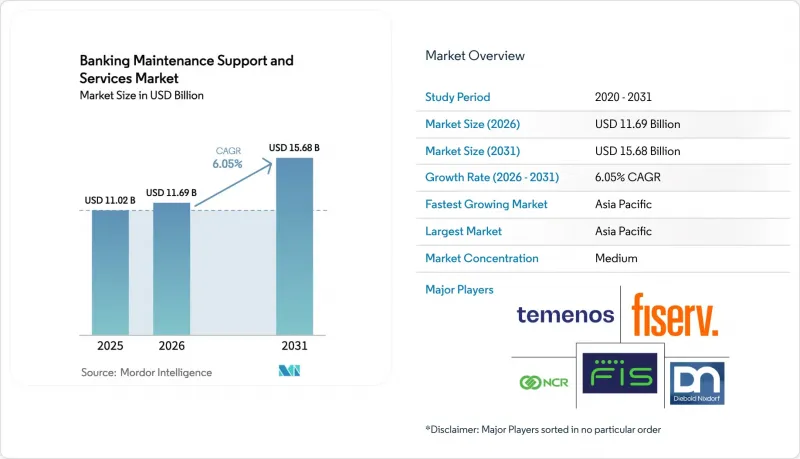
本報告按服務類型(預防性保養、ATM管理服務及其他)、部署模式(雲端、本地部署、混合部署)、銀行類型(零售/商業銀行、合作銀行和互助銀行、投資銀行、純數位銀行/新銀行)、組件(核心銀行平台、通路及其他)和地區進行細分。市場預測以美元計價。
全球銀行維護支援及服務市場趨勢及洞察
核心銀行系統的快速過時
大型主機作業系統停止支援通知的發布正在加速系統更新進程。 IBM 於 2024 年 9 月終止了對 z/OS 2.4 的擴展支持,迫使 340 家銀行要么遷移其系統,要么接受高達 40% 的維護成本上漲。根據 Temenos 統計,2024 年新增許可證訂單中有 58% 是由於替換超過 15 年歷史的系統所致,而採用平行運作模式的遷移平均耗時 18 個月。 FIS 發現,與核心系統現代化相關的諮詢項目增加了 29%,因為銀行要求在 2025 年 11 月的最後期限前獲得符合 ISO 20022 標準的平台。為了確保分階段過渡期間的資料完整性,結合大型主機 JCL 專家和 Kubernetes 工程師的混合支援模式正在興起。因此,市場對同時具備傳統平台和雲端原生平台技能,並能同時管理兩者的維修團隊的需求十分旺盛。
網路威脅情勢日益惡化
2024年,針對核心銀行環境的勒索軟體攻擊事件共記錄127起,平均每次攻擊的贖金高達420萬美元。由於開放銀行API的開放,安全漏洞增加,監理機關在監理審查中發現了2,300起認證不足的案例。零信任架構的採用率年增一倍,達到41%,推動了安全營運中心(SOC)綜合固定價格合約的普及。據Cognizant公司稱,其68%的銀行客戶目前已將基礎設施和網路安全支援整合到單一服務等級協定(SLA)下,模糊了維護和防禦之間的界線。因此,持續的配置審計和快速的補丁更新周期正成為標準的合約條款。
由於廠商鎖定,轉換成本高。
根據Oracle披露的信息,提前終止合約將產生相當於剩餘合約金額18%至22%的取消費用,這阻礙了客戶遷移到其他供應商。一家歐洲中型銀行花了380萬歐元(約442萬美元)提取18年的數據,迫使其將雲端遷移計畫延長了14個月。儘管FIS在2024年仍保留了前100大客戶中的94%,但該公司認為其合約續約的成功並非源自於功能性,而是得益於高昂的遷移門檻。專有資料格式和智慧財產權限制意味著在平台遷移過程中重新開發客製化模組成本高昂。因此,儘管開放原始碼替代方案日益增多,現有供應商仍保持著定價權。
細分市場分析
糾正措施和事件管理合約將成為最大的收入來源,到2025年將佔銀行維護支援和服務市場規模的34.58%。銀行面臨傳統單體系統和微服務同時出現故障的雙重挑戰,導致大量人員被分配到事件回應和工單優先排序。同時,預計到2031年,基於雲端的託管服務將以6.58%的複合年成長率成長,反映出服務模式正向整合了監控、修補程式和回應功能的訂閱套餐轉變。
預防性保養正逐漸被預測分析所取代,從而減少了計劃內停機時間。 Infosys 的一位客戶在實施故障預測模型後,將維護視窗期縮短了 34%。 ATM 服務合約現在也包含了現金最佳化演算法。 NCR 透過在硬體合約中加入軟體更新,將現金補充次數減少了 28%。 PCI DSS 4.0 的發布增加了對合規性主導的修補程式管理的需求。這使得可接受的補丁週期縮短了一半,為以自動化為中心的供應商創造了新的商機。
儘管到2025年,本地部署環境將佔總支出的59.10%,但雲端合約預計將以7.12%的複合年成長率實現最高成長,這主要得益於可擴展的使用模式和資本支出(CAPEX)的降低。隨著審計人員對主權雲端的控制結構越來越有信心,本地部署模式在銀行維護支援和服務市場中的佔有率預計將會下降。
混合模式正逐漸成為新計畫的主流。 Fiserv 三分之二的客戶在大型主機上維護大量結算,同時將其客戶管道分散部署在 AWS 和 Azure 上。 IBM 的大型主機支援現已包含遷移藍圖,旨在儘早將供應商納入「直接遷移」流程。市場對同時擁有 z/OS 和 Kubernetes 認證的工程師需求旺盛,而歐洲央行允許銀行將非關鍵工作負載部署在公共雲端的雲端指南,進一步凸顯了混合支援的必要性。
區域分析
亞太地區成長最為迅猛,主要得益於印度統一支付介面(UPI)和中國數位貨幣試點計畫帶來的交易量激增。印度各銀行正在就與交易處理能力掛鉤的績效基本契約進行談判,要求供應商保證在異質技術堆疊上實現亞秒響應時間。隨著電子人民幣錢包的部署,中國金融機構需要同時支援區塊鏈節點和傳統核心平台,這導致對雙技能人才的需求激增。包括新加坡金融管理局(MAS)在內的東南亞監管機構要求通路可用性達到99.95%,這促使新獲牌照的數位銀行推出高級支援服務。
隨著 FedNow即時結算從隔夜結算轉向即時結算,北美仍然是技術領域的領導者。美國一級銀行正在加速淘汰 COBOL 語言,早期採用者在遷移到雲端原生核心系統後,營運成本降低了 12%。符合 OSFI 彈性框架的加拿大銀行正在尋求在大型主機和公共雲端之間實現統一的可觀測性。隨著超大規模超大規模資料中心業者與專注於金融級合規的合作夥伴合作,銷售一系列託管服務,供應商之間的競爭日益激烈。
歐洲面臨的挑戰主要集中在DORA的實施和ISO 20022標準的標準化。銀行在GDPR、PSD2和巴塞爾協議III下承擔著相互重疊的義務,這導致審計追蹤記錄錯綜複雜,監管機構必須在兩小時內完成維護。託管服務供應商正在根據服務等級協定(SLA)將合規模板、自動化事件報告和第三方風險登記系統整合到其服務中。北歐銀行利用其豐富的水力資源,並將ESG指標與維護KPI掛鉤,引領著向綠色資料中心的轉型。
其他好處
- Excel格式的市場預測(ME)表
- 3個月的分析師支持
目錄
第1章:引言
- 研究假設和市場定義
- 調查範圍
第2章:調查方法
第3章執行摘要
第4章 市場狀況
- 市場概覽
- 核心銀行系統的快速過時
- 網路威脅情勢日益惡化
- 關於全天候 (24/7/365)運轉率的監管要求
- 向「X即服務」類型的經營模式轉型
- 雲端原生可觀測性工具鏈
- ESG驅動的傳統硬體逐步淘汰
- 產業價值鏈分析
- 監理情勢
- 技術展望
- 宏觀經濟因素對市場的影響
- 新冠疫情對學校企業資源規劃(ERP)市場的影響
- 波特五力分析
第5章 市場動態
- 市場促進因素
- 核心銀行系統的快速過時
- 網路威脅情勢日益惡化
- 關於全天候 (24/7/365)運轉率的監管要求
- 向「X即服務」類型的經營模式轉型
- 雲端原生可觀測性工具鏈
- ESG驅動的傳統硬體逐步淘汰
- 市場限制因素
- 由於廠商鎖定,轉換成本高。
- COBOL和大型主機技術棧三級人才短缺
- 凍結對二、三線銀行的資本投資
- 開放原始碼社群支持力道的增加導致付費合約的減少。
第6章 市場規模與成長預測
- 按服務類型
- 預防性保養
- 糾正措施和事件管理
- ATM管理服務
- 軟體升級和修補程式管理
- 監管合規和審計支持
- IT基礎設施支援
- 按部署模式
- 雲
- 現場
- 混合
- 按銀行類型
- 零售/商業銀行
- 合作銀行和互助銀行
- 投資銀行
- 專注於數位領域的新銀行
- 按組件
- 核心銀行平台
- 頻道(ATM/POS/線上/行動)
- 支付處理系統
- 風險與合規系統
- 輔助系統(CRM、財務、人力資源)
- 按地區
- 北美洲
- 美國
- 加拿大
- 墨西哥
- 南美洲
- 巴西
- 阿根廷
- 其他南美國家
- 歐洲
- 德國
- 英國
- 法國
- 義大利
- 西班牙
- 其他歐洲國家
- 亞太地區
- 中國
- 日本
- 印度
- 韓國
- 其他亞太國家
- 中東和非洲
- 中東
- 沙烏地阿拉伯
- 阿拉伯聯合大公國
- 土耳其
- 其他中東國家
- 非洲
- 南非
- 奈及利亞
- 其他非洲地區
- 中東
- 北美洲
第7章 競爭情勢
- 市場集中度
- 策略趨勢
- 市佔率分析
- 公司簡介
- NCR Corporation
- Diebold Nixdorf, Incorporated
- Fidelity National Information Services, Inc.(FIS)
- Fiserv, Inc.
- Temenos AG
- Infosys Limited
- Tata Consultancy Services Limited
- Wipro Limited
- Hewlett-Packard Enterprise Company
- IBM Corporation
- DXC Technology Company
- Oracle Financial Services Software Limited
- Sopra Steria Group SA
- Jack Henry & Associates, Inc.
- Cognizant Technology Solutions Corporation
- Capgemini SE
- Atos SE
- Finastra
- Intellect Design Arena Limited
- Backbase
第8章 市場機會與未來展望
- 評估閒置頻段和未滿足的需求
According to Mordor Intelligence, the banking maintenance support and Services market size is expected to grow from USD 11.02 billion in 2025 to USD 11.69 billion in 2026 and is forecast to reach USD 15.68 billion by 2031 at 6.05% CAGR over 2026-2031.
This report is Segmented by Service Type (Preventive Maintenance, ATM Managed Services, and More), Deployment Model (Cloud, On-Premises, and Hybrid), Bank Type (Retail/Commercial, Cooperative and Mutual, Investment, and Digital-only/Neo-banks), Component Supported (Core Banking Platforms, Channels, and More), and Geography. The Market Forecasts are Provided in Terms of Value (USD).
Global Banking Maintenance Support And Services Market Trends and Insights
Rapid Core-Banking System Obsolescence
End-of-life notices for mainframe operating systems are bringing forward refresh timelines. IBM ended extended support for z/OS 2.4 in September 2024, prompting 340 banks to migrate or accept 40% higher maintenance costs. Temenos stated that 58% of its new-license bookings in 2024 originated from replacements of systems older than 15 years, with migrations averaging 18 months in parallel-run mode. FIS logged a 29% jump in core-modernization consulting engagements as banks seek ISO 20022-compliant platforms ahead of the November 2025 deadline. Hybrid support models are emerging, pairing mainframe JCL specialists with Kubernetes engineers to ensure data integrity during staged cut-overs. The result is steady demand for dual-skilled maintenance teams able to manage legacy and cloud-native platforms in tandem.
Intensifying Cyber-Threat Landscape
Ransomware assaults on core-banking environments reached 127 recorded events in 2024, with average demands of USD 4.2 million per incident. API exposure for open-banking has heightened vulnerability, as regulators flagged 2,300 inadequate-authentication cases during supervisory reviews. Zero-trust architecture adoption doubled year-over-year to 41%, fueling growth in bundled security-operations-center retainers. Cognizant noted that 68% of its banking clients now combine infrastructure and cybersecurity support under a single SLA, blurring maintenance and defense boundaries. Continuous configuration audits and rapid patch cycles have consequently become baseline contract inclusions.
High Vendor-Lock-In Switching Costs
Oracle disclosures show exit fees of 18-22% of remaining contract value for early termination, dissuading migrations. A mid-tier European bank spent EUR 3.8 million(USD 4.42 million) extracting 18 years of data, extending its cloud timeline by 14 months. FIS retained 94% of top-100 clients in 2024, crediting renewal success to elevated switching friction rather than functionality. Proprietary data formats and IP restrictions force costly redevelopment of customized modules during platform shifts. Consequently, incumbent vendors maintain pricing power despite rising open-source alternatives.
Other drivers and restraints analyzed in the detailed report include:
- Regulatory Mandates for 24/7 Uptime
- Shift to X-as-a-Service Operating Models
- Capital Spending Freeze in Tier-2/3 Banks
For complete list of drivers and restraints, kindly check the Table Of Contents.
Segment Analysis
Corrective and incident-management contracts produced the largest stream of revenue, accounting for 34.58% of Banking Maintenance Support and Services market size in 2025. Banks confront concurrent failures across legacy monoliths and microservices, resulting in high headcounts for break-fix and ticket-triage. Cloud-based managed services, however, are expected to grow at a 6.58% CAGR to 2031, reflecting the migration to subscription bundles that combine monitoring, patching, and response capabilities.
Preventive maintenance is being replaced by predictive analytics, which curtails scheduled downtime. Infosys clients trimmed maintenance windows by 34% after deploying failure-forecast models. ATM service contracts now integrate cash-optimization algorithms; NCR cut replenishment runs by 28%, adding software renewals to hardware deals. Compliance-driven patch management demand intensified with the release of PCI DSS 4.0, which halves the permissible patch windows, creating new revenue opportunities for automation-centric vendors.
On-premises setups commanded 59.10% of 2025 spending, but cloud contracts will log the fastest 7.12% CAGR, aided by scalable consumption and freed capex. The Banking Maintenance Support and Services market share for on-premises models will erode as auditors gain comfort with sovereign-cloud controls.
Hybrid models dominate new projects. Two-thirds of Fiserv's clients split customer-facing channels between AWS and Azure, while retaining batch settlement on mainframes. IBM's mainframe support now includes migration road maps, embedding vendors early in lift-and-shift journeys. Dual-skilled engineers certified in z/OS and Kubernetes are in high demand, and ECB cloud guidelines clarify hybrid-support needs by allowing banks to park non-critical workloads in public clouds.
Complete Report Scope:
- By Service Type
- Preventive Maintenance
- Corrective and Incident Management
- ATM Managed Services
- Software Upgrade and Patch Management
- Regulatory Compliance and Audit Support
- IT Infrastructure Support
- By Deployment Model
- Cloud
- On-Premises
- Hybrid
- By Bank Type
- Retail / Commercial Banks
- Cooperative and Mutual Banks
- Investment Banks
- Digital-only / Neo-banks
- By Component
- Supported Core Banking Platforms
- Channels (ATM / POS / Online / Mobile)
- Payment Processing Systems
- Risk and Compliance Systems
- Ancillary Systems (CRM, Treasury, HR)
- By Geography
- North America
- United States
- Canada
- Mexico
- South America
- Brazil
- Argentina
- Rest of South America
- Europe
- Germany
- United Kingdom
- France
- Italy
- Spain
- Rest of Europe
- Asia Pacific
- China
- Japan
- India
- South Korea
- Rest of Asia Pacific
- Middle East and Africa
- Middle East
- Saudi Arabia
- United Arab Emirates
- Turkey
- Rest of the Middle East
- Africa
- South Africa
- Nigeria
- Rest of Africa
- Middle East
- North America
Geography Analysis
Asia-Pacific posted the highest growth trajectory, reflecting transaction-volume surges from India's UPI and China's digital-currency pilots. Banks in India are negotiating outcome-based contracts tied to transaction throughput, compelling vendors to guarantee sub-second response across heterogeneous stacks. Chinese institutions, as they roll out e-CNY wallets, require simultaneous support for blockchain nodes and legacy core platforms, resulting in dual-skill hiring waves. Southeast Asian regulators, including Singapore's MAS, mandate 99.95% channel availability, driving the uptake of premium support tiers among newly licensed digital banks.
North America remains a technology bellwether as FedNow instant payments migrate from overnight settlement to real-time. U.S. Tier-1 banks are accelerating the retirement of COBOL; early adopters report 12% operational cost savings after shifting to cloud-native cores. Canadian banks, governed by OSFI resilience frameworks, request unified observability across mainframes and public clouds. Vendor competition intensifies as hyperscalers co-sell managed-services bundles with partners specializing in financial-grade compliance.
Europe's agenda centers on DORA enforcement and ISO 20022 standardization. Banks face overlapping GDPR, PSD2 and Basel III obligations, creating a labyrinth of audit trails that must be maintained within two hours for regulators. Managed-services providers bundle compliance templates, automated incident-reports and third-party risk registers into SLA-backed offerings. Nordic banks pioneer green-data-center migrations, aided by abundant hydroelectric power, linking ESG metrics to maintenance KPIs.
- NCR Corporation
- Diebold Nixdorf, Incorporated
- Fidelity National Information Services, Inc. (FIS)
- Fiserv, Inc.
- Temenos AG
- Infosys Limited
- Tata Consultancy Services Limited
- Wipro Limited
- Hewlett-Packard Enterprise Company
- IBM Corporation
- DXC Technology Company
- Oracle Financial Services Software Limited
- Sopra Steria Group SA
- Jack Henry & Associates, Inc.
- Cognizant Technology Solutions Corporation
- Capgemini SE
- Atos SE
- Finastra
- Intellect Design Arena Limited
- Backbase
Additional Benefits:
- The market estimate (ME) sheet in Excel format
- 3 months of analyst support
TABLE OF CONTENTS
1 INTRODUCTION
- 1.1 Study Assumptions and Market Definition
- 1.2 Scope of the Study
2 RESEARCH METHODOLOGY
3 EXECUTIVE SUMMARY
4 MARKET LANDSCAPE
- 4.1 Market Overview
- 4.1.1 Rapid Core-Banking System Obsolescence
- 4.1.2 Intensifying Cyber-Threat Landscape
- 4.1.3 Regulatory Mandates for 24/7 Uptime
- 4.1.4 Shift to X-as-a-Service Operating Models
- 4.1.5 Cloud-Native Observability Toolchains
- 4.1.6 ESG-Driven Decommissioning of Legacy Hardware
- 4.2 Industry Value Chain Analysis
- 4.3 Regulatory Landscape
- 4.4 Technological Outlook
- 4.5 Impact of Macroeconomic Factors on the Market
- 4.6 Impact of COVID-19 on the Enterprise Resource Planning for Schools Market
- 4.7 Porter's Five Forces Analysis
- 4.7.1 Bargaining Power of Suppliers
- 4.7.2 Bargaining Power of Buyers/Consumers
- 4.7.3 Threat of New Entrants
- 4.7.4 Threat of Substitute Products
- 4.7.5 Intensity of Competitive Rivalry
5 MARKET DYNAMICS
- 5.1 Market Drivers
- 5.1.1 Rapid Core-Banking System Obsolescence
- 5.1.2 Intensifying Cyber-Threat Landscape
- 5.1.3 Regulatory Mandates for 24/7 Uptime
- 5.1.4 Shift to X-as-a-Service Operating Models
- 5.1.5 Cloud-Native Observability Toolchains
- 5.1.6 ESG-Driven Decommissioning of Legacy Hardware
- 5.2 Market Restraints
- 5.2.1 High Vendor Lock-In Switching Costs
- 5.2.2 Scarcity of L3 Talent for COBOL and Mainframe Stacks
- 5.2.3 Capital Spending Freeze in Tier-2/3 Banks
- 5.2.4 Rising Open-Source Community Support Lowering Paid Contracts
6 MARKET SIZE AND GROWTH FORECASTS (VALUE)
- 6.1 By Service Type
- 6.1.1 Preventive Maintenance
- 6.1.2 Corrective and Incident Management
- 6.1.3 ATM Managed Services
- 6.1.4 Software Upgrade and Patch Management
- 6.1.5 Regulatory Compliance and Audit Support
- 6.1.6 IT Infrastructure Support
- 6.2 By Deployment Model
- 6.2.1 Cloud
- 6.2.2 On-Premises
- 6.2.3 Hybrid
- 6.3 By Bank Type
- 6.3.1 Retail / Commercial Banks
- 6.3.2 Cooperative and Mutual Banks
- 6.3.3 Investment Banks
- 6.3.4 Digital-only / Neo-banks
- 6.4 By Component
- 6.4.1 Supported Core Banking Platforms
- 6.4.2 Channels (ATM / POS / Online / Mobile)
- 6.4.3 Payment Processing Systems
- 6.4.4 Risk and Compliance Systems
- 6.4.5 Ancillary Systems (CRM, Treasury, HR)
- 6.5 By Geography
- 6.5.1 North America
- 6.5.1.1 United States
- 6.5.1.2 Canada
- 6.5.1.3 Mexico
- 6.5.2 South America
- 6.5.2.1 Brazil
- 6.5.2.2 Argentina
- 6.5.2.3 Rest of South America
- 6.5.3 Europe
- 6.5.3.1 Germany
- 6.5.3.2 United Kingdom
- 6.5.3.3 France
- 6.5.3.4 Italy
- 6.5.3.5 Spain
- 6.5.3.6 Rest of Europe
- 6.5.4 Asia Pacific
- 6.5.4.1 China
- 6.5.4.2 Japan
- 6.5.4.3 India
- 6.5.4.4 South Korea
- 6.5.4.5 Rest of Asia Pacific
- 6.5.5 Middle East and Africa
- 6.5.5.1 Middle East
- 6.5.5.1.1 Saudi Arabia
- 6.5.5.1.2 United Arab Emirates
- 6.5.5.1.3 Turkey
- 6.5.5.1.4 Rest of the Middle East
- 6.5.5.2 Africa
- 6.5.5.2.1 South Africa
- 6.5.5.2.2 Nigeria
- 6.5.5.2.3 Rest of Africa
- 6.5.5.1 Middle East
- 6.5.1 North America
7 COMPETITIVE LANDSCAPE
- 7.1 Market Concentration
- 7.2 Strategic Moves
- 7.3 Market Share Analysis
- 7.4 Company Profiles (includes Global level Overview, Market level overview, Core Segments, Financials as available, Strategic Information, Market Rank/Share for key companies, Products and Services, and Recent Developments)
- 7.4.1 NCR Corporation
- 7.4.2 Diebold Nixdorf, Incorporated
- 7.4.3 Fidelity National Information Services, Inc. (FIS)
- 7.4.4 Fiserv, Inc.
- 7.4.5 Temenos AG
- 7.4.6 Infosys Limited
- 7.4.7 Tata Consultancy Services Limited
- 7.4.8 Wipro Limited
- 7.4.9 Hewlett-Packard Enterprise Company
- 7.4.10 IBM Corporation
- 7.4.11 DXC Technology Company
- 7.4.12 Oracle Financial Services Software Limited
- 7.4.13 Sopra Steria Group SA
- 7.4.14 Jack Henry & Associates, Inc.
- 7.4.15 Cognizant Technology Solutions Corporation
- 7.4.16 Capgemini SE
- 7.4.17 Atos SE
- 7.4.18 Finastra
- 7.4.19 Intellect Design Arena Limited
- 7.4.20 Backbase
8 MARKET OPPORTUNITIES AND FUTURE OUTLOOK
- 8.1 White-Space and Unmet-Need Assessment

 電腦化維護管理系統 (CMMS) 軟體市場:2026-2032 年全球市場預測(按軟體、定價模式、組織規模、支援的設備和平台、部署類型和產業分類)
 銀行全方位支援服務市場規模、佔有率及成長分析:依服務類型、部署模式、銀行類型、服務模式、企業規模、最終用戶及地區分類-2026-2033年產業預測
 全球電腦化維護管理系統市場:依產品/服務、企業規模、應用、產業和地區分類-預測至2032年
 2026-2030年全球資料中心及網路第三方硬體維護服務市場
 電腦化維護管理系統市場:按部署類型、最終用戶產業、應用程式和地區分類
 2026-2030年全球電腦化維護管理系統(CMMS)市場
 2026年全球電腦化維護管理系統市場報告2026年全球銀行硬體維護、軟體支援與幫助台支援服務市場報告電腦化維護管理系統市場:按解決方案類型、資產類別、企業規模、部署類型、最終用戶和定價模式分類 - 2026-2032 年全球預測
 CMMS軟體市場規模、佔有率和成長分析:按組件、功能、部署類型、組織規模、整合、產業和地區分類-2026-2033年產業預測