


 |
市場調查報告書
商品編碼
2124378
學生資訊系統:市場佔有率分析、產業趨勢與統計、成長預測(2026-2031)Student Information System - Market Share Analysis, Industry Trends & Statistics, Growth Forecasts (2026 - 2031) |
||||||

※ 本網頁內容可能與最新版本有所差異。詳細情況請與我們聯繫。
據 Mordor Intelligence 稱,2025 年學生資訊系統市值為 154.4 億美元,預計到 2031 年將達到 349.7 億美元,而 2026 年為 177 億美元,預測期(2026-2031 年)的複合年成長率為 14.62%。
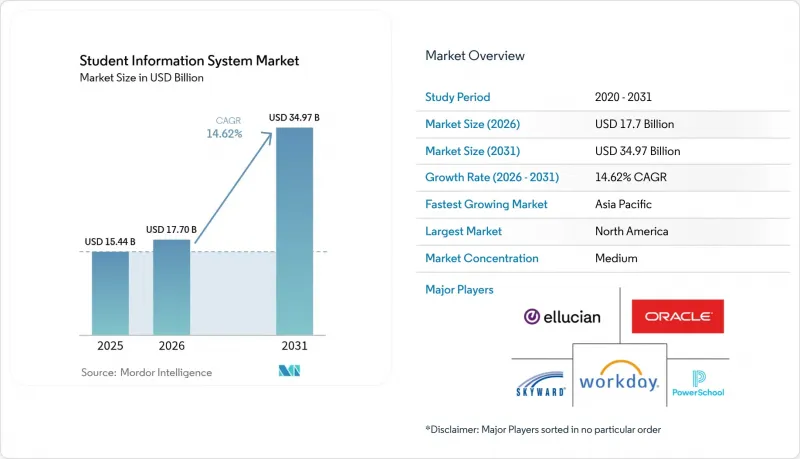
本報告按類型(解決方案和服務)、最終用戶(K-12教育和高等教育)、部署模式(本地部署和雲端部署)、機構規模(小規模,學生人數少於5000人;中型,學生人數在5001至20000人之間;大型,學生人數超過20000人)和地區進行細分。市場預測以美元計價。
全球學生資訊系統市場趨勢與洞察
擴大「雲端優先」數位轉型的推廣
為了實現整合的資料基礎設施、即時分析和無縫協作,教育機構正在全面遷移到雲端原生學生資訊系統 (SIS) 平台。西悉尼大學將多個應用程式整合到 Ellucian Banner 系統中,為分佈在 10 個校區的 45,000 名學生提供支持,用單一的雲端環境取代了分散的本地系統。隨後,拉文大學透過在同一雲端架構中引入人工智慧,將資料下載速度提高了 50%。隨著雲端採用率已達到 72.6%,許多教育機構現在認為混合模式是不必要的複雜性。雲端架構也為預測分析奠定了基礎,而舊有系統在這領域根本無法與之匹敵。因此,供應商正在轉向訂閱模式,以支持持續創新,而客戶則受益於自動更新和更強大的安全保障。
需要進行全面、數據驅動的學生成功分析
大學正從被動式的學生支持轉向透過預測建模進行主動式互動。喬治亞州立大學利用預測預警提高了畢業率,肯塔基大學則利用其學生資訊系統(SIS)的洞察來識別和幫助有輟學風險的學生。為了充分發揮這一價值,杜克大學推出了線上數據分析培訓課程,使教職員能夠有效解讀數據看板。現代平台整合了學業成績、行為徵兆和財務數據,從而提供每位學生的全方位資訊。這種轉變正在將學生資訊系統市場轉變為策略分析的基礎,指南院校進行資源分配、助學金選擇和課程設計。
教育人員技能和變革管理的差距
平台快速發展對資料素養和流程重構能力提出了更高的要求,而許多教育機構恰恰缺乏這些能力。杜克大學的員工培訓課程清晰地展現了彌合這項知識鴻溝所需的投入。習慣手動操作的員工,尤其是專業發展預算有限的小規模院校的員工,對自動化工作流程仍有抵觸情緒。缺乏技能提升,教育機構將無法充分利用高階功能,導致投資報酬率降低,並長期依賴過時的流程。這種限制因素正在減緩整個學生資訊系統市場向雲端遷移和新功能應用的速度,尤其是在人力資源有限的環境中。
細分市場分析
到2025年,隨著教育機構逐步採用全端平台,解決方案板塊的收入將佔總收入的67.80%。 PowerSchool在90天內為4萬名學生完成部署,這清楚地表明供應商正在不斷完善部署工具包並縮短部署週期。雖然服務板塊的支出僅佔總支出的32.20%,但其複合年成長率高達16.1%,因為每個校區都需要在設置、培訓和分析方面獲得專業知識,才能充分利用高級功能。承包解決方案的持續吸引力正在推動產業重組,領先的平台廠商紛紛收購專注於特定區域的專家,以增強垂直領域能力並擴展支援團隊。同時,服務板塊也從基礎部署向持續最佳化、資料科學諮詢和人工智慧模型調優等方向發展。這種互惠互利的關係正在建構供應商與客戶之間的長期夥伴關係,創造除許可費之外的收入來源,並拓展學生資訊系統市場。
由於高等教育領域功能需求複雜且平均合約規模較大,預計到2025年,該領域將維持58.20%的市場佔有率。然而,疫情後的數位化津貼推動了K-12(幼兒園至高中)領域的需求激增,預計到2031年,該領域的複合年成長率將達到16.8%。隨著學區聯合採購聯盟協商有利條款,高階功能的普及程度正不斷提高。 「Infinite Campus」目前服務於46個州的1000萬學生,展現了K-12領域的規模經濟效益。同時,大學面臨入學人數下降和舊有系統遺留問題等挑戰,這些挑戰正在減緩轉型進程。隨著K-12領域的普及,供應商正在最佳化使用者體驗和合規性模組,以適應低齡學生的特定工作流程,從而進一步加速學生資訊系統市場這一細分領域的成長。
區域分析
北美地區擁有雄厚的IT預算和密集的供應商生態系統,預計2025年將貢獻37.60%的收入。然而,隨著各大學傾向於最佳化現有系統而非進行全面升級,支出成長正在放緩。教育援助救濟法案(ESSER)資金的終止加劇了K-12教育預算的壓力,同時大學也面臨招生人數的波動。儘管如此,該地區仍然是創新中心,正在試點人工智慧驅動的學生留存模組,這些模組隨後將在全球推廣。亞太地區是成長最快的地區,預計到2031年將實現16.4%的複合年成長率,這得益於待開發區的雲端部署,避免了舊有系統的負擔。 PowerSchool計劃在五年內將其在印度的員工人數擴大到2000人,以滿足區域需求。 Tribal Group與英國越南大學簽訂了一份價值300萬美元的契約,凸顯了其在新興市場日益成長的投資意願。在歐洲,受《一般資料保護規則》(GDPR) 的推動,隱私納入設計平台正穩步普及,提升了此類平台的價值。 Ellucian 與 Interuniversity Services Inc. 就加拿大大西洋地區達成的五年合作協議,便是跨境合作模式的典範,可供歐洲其他企業效仿。儘管中東和非洲在規模上尚有差距,但隨著電信基礎設施建設項目和旨在提升勞動力素質的教育計畫的推進,預計這些地區將實現長期成長。這些趨勢共同支撐著學生資訊系統市場主要參與企業所採取的跨區域擴大策略。
其他好處
- Excel格式的市場預測(ME)表
- 3個月的分析師支持
目錄
第1章:引言
- 研究假設和市場定義
- 調查範圍
第2章:調查方法
第3章執行摘要
第4章 市場狀況
- 市場概覽
- 市場促進因素
- 擴大「雲端優先」數位轉型的推廣
- 需要進行全面、數據驅動的學生成功分析
- 教育機構面臨的合規和報告義務負擔日益加重
- 對整合式教育技術堆疊和支援 API 的學生資訊系統平台的需求
- 微證書/終身學習模式的興起
- 整合到SIS中的AI驅動型客戶維繫預測解決方案
- 市場限制因素
- 教育人員技能和變革管理的差距
- 低收入地區資本投資的限制
- 加強資料隱私和資料居住的監管
- 供應商鎖定以及遷移舊有系統的複雜性
- 產業價值鏈分析
- 監理情勢
- 技術展望
- 產業吸引力—五力分析
- 供應商的議價能力
- 消費者議價能力
- 新進入者的威脅
- 替代品的威脅
- 競爭公司之間的競爭
- 宏觀經濟因素對市場的影響
第5章 市場規模與成長預測
- 按類型
- 解決方案
- 服務
- 最終用戶
- K-12教育
- 高等教育
- 部署模式
- 現場
- 雲
- 按機構規模
- 學生人數5000人或以下(小規模)
- 學生人數:5,001 至 20,000(中等規模)
- 超過20000名學生(大規模)
- 按地區
- 北美洲
- 美國
- 加拿大
- 墨西哥
- 南美洲
- 巴西
- 阿根廷
- 智利
- 其他南美國家
- 歐洲
- 德國
- 英國
- 法國
- 義大利
- 西班牙
- 俄羅斯
- 其他歐洲國家
- 亞太地區
- 中國
- 印度
- 日本
- 韓國
- 新加坡
- 馬來西亞
- 澳洲
- 其他亞太國家
- 中東和非洲
- 中東
- 阿拉伯聯合大公國
- 沙烏地阿拉伯
- 土耳其
- 其他中東國家
- 非洲
- 南非
- 奈及利亞
- 其他非洲地區
- 中東
- 北美洲
第6章 競爭情勢
- 市場集中度
- 策略趨勢
- 市佔率分析
- 公司簡介
- PowerSchool Holdings Inc.
- Ellucian Company LP
- Oracle Corporation(Student Cloud)
- Workday Inc.
- Skyward Inc.
- Infinite Campus Inc.
- Jenzabar Inc.
- Tribal Group plc
- Unit4 NV
- Instructure Holdings Inc.(Canvas SIS)
- Blackbaud Inc.
- FACTS Management(Nelnet)
- Edupoint Educational Systems
- Senior Systems(Community Brands)
- Rediker Software Inc.
- Gradelink Corporation
- Classe365 Pty Ltd
- OpenEduCat Inc.
- Foradian Technologies
- Octoze Technologies(MyClassCampus)
- Serosoft Solutions(PARENTSALERT)
- Populi Inc.
- Anthology Inc.(CampusNexus Student)
- Alma SIS
- Illuminate Education Inc.
- Hero K12
第7章 市場機會與未來趨勢
- 評估閒置頻段和未滿足的需求
According to Mordor Intelligence, the student information system market size was valued at USD 15.44 billion in 2025 and estimated to grow from USD 17.7 billion in 2026 to reach USD 34.97 billion by 2031, at a CAGR of 14.62% during the forecast period (2026-2031).
This report is Segmented by Type (Solutions and Services), End-User (K-12 Education and Higher Education), Deployment Mode (On-Premise and Cloud), Institution Size (<=5, 000 Students (Small), 5, 001-20, 000 Students (Medium), and >20, 000 Students (Large)), and Geography. The Market Forecasts are Provided in Terms of Value (USD).
Global Student Information System Market Trends and Insights
Growing Cloud-First Digital-Transformation Mandates
Institutions are shifting wholesale to cloud-native SIS platforms to gain unified data backbones, real-time analytics, and frictionless integrations. Western Sydney University consolidated multiple applications onto Ellucian Banner to support 45,000 students across 10 campuses, replacing disparate on-premises systems with a single cloud environment. The University of La Verne later increased data-download speed by 50% after layering AI on the same cloud stack. With cloud penetration already at 72.6%, many institutions now deem hybrid models an unnecessary complication. Cloud architectures also lay the groundwork for predictive analytics, an area where legacy systems cannot compete. As a result, vendors are pivoting to subscription models that fund continuous innovation while customers benefit from automatic updates and stronger security postures.
Mandate for Holistic Data-Driven Student-Success Analytics
Universities are migrating from reactive student support toward proactive engagement informed by predictive modelling. Georgia State University improved graduation rates using predictive alerts, and the University of Kentucky used SIS-generated insights to flag and support at-risk learners. To unlock such value, Duke University launched online data-training courses so staff can interpret dashboards effectively. Modern platforms now merge academic records, behavioural signals, and financial data, delivering a 360-degree view of each learner. This shift is transforming the student information system market into a strategic analytics cornerstone that informs institutional resource allocation, financial aid targeting, and curriculum design.
Skills and Change-Management Gaps Among Education Staff
Rapid platform evolution demands data literacy and process redesign skills that many institutions lack. Duke University's staff training programme illustrates the investment needed to close knowledge gaps. Resistance to automated workflows persists among employees accustomed to manual procedures, especially in small schools with limited professional-development budgets. Without upskilling, institutions under-utilise advanced features, diminishing return on investment, and prolonging reliance on obsolete processes. This restraint slows cloud migrations and feature adoption across the student information system market, particularly where staffing resources are thin.
Other drivers and restraints analyzed in the detailed report include:
- Heightened Compliance and Reporting Burdens on Institutions
- Demand for Unified EdTech Stacks and API-Ready SIS Platforms
- Capital-Expenditure Constraints in Low-Income Regions
For complete list of drivers and restraints, kindly check the Table Of Contents.
Segment Analysis
Solutions captured 67.80% revenue in 2025 as institutions standardised on full-stack platforms. PowerSchool's 90-day deployment for 40,000 students underscores how vendors refine implementation toolkits to compress timelines. Services, although only 32.20% of spend, are compounding at 16.1% CAGR as campuses need configuration, training, and analytics expertise to unlock advanced features.The lasting appeal of turnkey solutions drives consolidation: platform leaders acquire regional specialists to deepen vertical functionality and scale support teams. Simultaneously, services arms are evolving from basic deployment to continuous optimisation, data-science consulting and AI model tuning. This symbiosis expands the student information system market by embedding long-term vendor-client partnerships that refresh revenue streams beyond licence fees.
Higher Education maintained a 58.20% share in 2025 due to complex feature requirements and larger average deal sizes. Yet post-pandemic digitisation grants have sparked a sharp rise in K-12 demand, propelling a 16.8% CAGR to 2031. District-wide purchasing consortia negotiate favourable terms that democratise access to advanced functionality.Infinite Campus now serves 10 million learners across 46 states, demonstrating the scale benefits in K-12. Conversely, universities face enrolment headwinds and legacy entanglements that slow migrations. As K-12 adoption expands, vendors tailor UX and compliance modules to the unique workflows of younger learners, further accelerating momentum in this segment of the student information system market.
Complete Report Scope:
- By Type
- Solutions
- Services
- By End-user
- K-12 Education
- Higher Education
- By Deployment Mode
- On-Premise
- Cloud
- By Institution Size
- <=5,000 Students (Small)
- 5,001-20,000 Students (Medium)
- >20,000 Students (Large)
- By Geography
- North America
- United States
- Canada
- Mexico
- South America
- Brazil
- Argentina
- Chile
- Rest of South America
- Europe
- Germany
- United Kingdom
- France
- Italy
- Spain
- Russia
- Rest of Europe
- Asia-Pacific
- China
- India
- Japan
- South Korea
- Singapore
- Malaysia
- Australia
- Rest of Asia-Pacific
- Middle East and Africa
- Middle East
- United Arab Emirates
- Saudi Arabia
- Turkey
- Rest of Middle East
- Africa
- South Africa
- Nigeria
- Rest of Africa
- Middle East
- North America
Geography Analysis
North America accounted for 37.60% of 2025 revenue, supported by substantial IT budgets and a dense vendor ecosystem. Yet spending growth is moderating as campuses optimise existing stacks rather than pursue wholesale replacements. The ESSER funding cliff intensifies pressure on K-12 budgets, while universities confront enrolment volatility. Nevertheless, the region remains an innovation test bed, piloting AI-powered retention modules that later roll out globally.Asia-Pacific is the fastest-growing region at a 16.4% CAGR through 2031, benefiting from greenfield cloud deployments that bypass legacy baggage. PowerSchool plans to scale its Indian workforce to 2,000 within five years to capitalise on regional demand. Tribal Group won a USD 3 million AUD contract with British University Vietnam, highlighting rising investment appetite in emerging markets.Europe records steady uptake, driven by GDPR compliance that elevates the value of platforms embedding privacy-by-design. A five-year Ellucian-Interuniversity Services Inc. deal covering Atlantic Canada illustrates cross-border collaboration models that could replicate across European consortia. Middle East and Africa trail in scale but present long-term upside as connectivity projects and workforce-ready education agendas gather momentum. Collectively, these trends reinforce the cross-regional expansion strategy adopted by the major players in the student information system market.
- PowerSchool Holdings Inc.
- Ellucian Company LP
- Oracle Corporation (Student Cloud)
- Workday Inc.
- Skyward Inc.
- Infinite Campus Inc.
- Jenzabar Inc.
- Tribal Group plc
- Unit4 NV
- Instructure Holdings Inc. (Canvas SIS)
- Blackbaud Inc.
- FACTS Management (Nelnet)
- Edupoint Educational Systems
- Senior Systems (Community Brands)
- Rediker Software Inc.
- Gradelink Corporation
- Classe365 Pty Ltd
- OpenEduCat Inc.
- Foradian Technologies
- Octoze Technologies (MyClassCampus)
- Serosoft Solutions (PARENTSALERT)
- Populi Inc.
- Anthology Inc. (CampusNexus Student)
- Alma SIS
- Illuminate Education Inc.
- Hero K12
Additional Benefits:
- The market estimate (ME) sheet in Excel format
- 3 months of analyst support
TABLE OF CONTENTS
1 INTRODUCTION
- 1.1 Study Assumptions and Market Definition
- 1.2 Scope of the Study
2 RESEARCH METHODOLOGY
3 EXECUTIVE SUMMARY
4 MARKET LANDSCAPE
- 4.1 Market Overview
- 4.2 Market Drivers
- 4.2.1 Growing cloud-first digital-transformation mandates
- 4.2.2 Mandate for holistic data-driven student-success analytics
- 4.2.3 Heightened compliance and reporting burdens on institutions
- 4.2.4 Demand for unified EdTech stacks and API-ready SIS platforms
- 4.2.5 Emergence of micro-credentialing/Lifelong-learning models
- 4.2.6 AI-powered predictive retention solutions embedded in SIS
- 4.3 Market Restraints
- 4.3.1 Skills and change-management gaps among education staff
- 4.3.2 Capital-expenditure constraints in low-income regions
- 4.3.3 Heightened data-privacy/residency regulations
- 4.3.4 Vendor lock-in and legacy-migration complexity
- 4.4 Industry Value Chain Analysis
- 4.5 Regulatory Landscape
- 4.6 Technological Outlook
- 4.7 Industry Attractiveness - Porter's Five Forces Analysis
- 4.7.1 Bargaining Power of Suppliers
- 4.7.2 Bargaining Power of Consumers
- 4.7.3 Threat of New Entrants
- 4.7.4 Threat of Substitutes
- 4.7.5 Intensity of Competitive Rivalry
- 4.8 Impact of Macroeconomic Factors on the Market
5 MARKET SIZE AND GROWTH FORECASTS (VALUES)
- 5.1 By Type
- 5.1.1 Solutions
- 5.1.2 Services
- 5.2 By End-user
- 5.2.1 K-12 Education
- 5.2.2 Higher Education
- 5.3 By Deployment Mode
- 5.3.1 On-Premise
- 5.3.2 Cloud
- 5.4 By Institution Size
- 5.4.1 <=5,000 Students (Small)
- 5.4.2 5,001-20,000 Students (Medium)
- 5.4.3 >20,000 Students (Large)
- 5.5 By Geography
- 5.5.1 North America
- 5.5.1.1 United States
- 5.5.1.2 Canada
- 5.5.1.3 Mexico
- 5.5.2 South America
- 5.5.2.1 Brazil
- 5.5.2.2 Argentina
- 5.5.2.3 Chile
- 5.5.2.4 Rest of South America
- 5.5.3 Europe
- 5.5.3.1 Germany
- 5.5.3.2 United Kingdom
- 5.5.3.3 France
- 5.5.3.4 Italy
- 5.5.3.5 Spain
- 5.5.3.6 Russia
- 5.5.3.7 Rest of Europe
- 5.5.4 Asia-Pacific
- 5.5.4.1 China
- 5.5.4.2 India
- 5.5.4.3 Japan
- 5.5.4.4 South Korea
- 5.5.4.5 Singapore
- 5.5.4.6 Malaysia
- 5.5.4.7 Australia
- 5.5.4.8 Rest of Asia-Pacific
- 5.5.5 Middle East and Africa
- 5.5.5.1 Middle East
- 5.5.5.1.1 United Arab Emirates
- 5.5.5.1.2 Saudi Arabia
- 5.5.5.1.3 Turkey
- 5.5.5.1.4 Rest of Middle East
- 5.5.5.2 Africa
- 5.5.5.2.1 South Africa
- 5.5.5.2.2 Nigeria
- 5.5.5.2.3 Rest of Africa
- 5.5.5.1 Middle East
- 5.5.1 North America
6 COMPETITIVE LANDSCAPE
- 6.1 Market Concentration
- 6.2 Strategic Moves
- 6.3 Market Share Analysis
- 6.4 Company Profiles (includes Global level Overview, Market level overview, Core Segments, Financials as available, Strategic Information, Market Rank/Share for key companies, Products and Services, and Recent Developments)
- 6.4.1 PowerSchool Holdings Inc.
- 6.4.2 Ellucian Company LP
- 6.4.3 Oracle Corporation (Student Cloud)
- 6.4.4 Workday Inc.
- 6.4.5 Skyward Inc.
- 6.4.6 Infinite Campus Inc.
- 6.4.7 Jenzabar Inc.
- 6.4.8 Tribal Group plc
- 6.4.9 Unit4 NV
- 6.4.10 Instructure Holdings Inc. (Canvas SIS)
- 6.4.11 Blackbaud Inc.
- 6.4.12 FACTS Management (Nelnet)
- 6.4.13 Edupoint Educational Systems
- 6.4.14 Senior Systems (Community Brands)
- 6.4.15 Rediker Software Inc.
- 6.4.16 Gradelink Corporation
- 6.4.17 Classe365 Pty Ltd
- 6.4.18 OpenEduCat Inc.
- 6.4.19 Foradian Technologies
- 6.4.20 Octoze Technologies (MyClassCampus)
- 6.4.21 Serosoft Solutions (PARENTSALERT)
- 6.4.22 Populi Inc.
- 6.4.23 Anthology Inc. (CampusNexus Student)
- 6.4.24 Alma SIS
- 6.4.25 Illuminate Education Inc.
- 6.4.26 Hero K12
7 MARKET OPPORTUNITIES AND FUTURE TRENDS
- 7.1 White-Space and Unmet-Need Assessment

 全球學生資訊系統市場規模、佔有率、趨勢和成長分析報告(2026-2034年)
 學生職涯發展管理市場預測至2034年-全球分析(按組成部分、教育機構類型、部署模式、應用、最終用戶和地區分類)
 2026年全球學生資訊系統市場報告
 學生住宅管理軟體市場:依軟體類型和地區分類
 學生資訊系統市場分析及預測(至2035年):依類型、產品類型、服務、技術、組件、應用、部署類型、最終用戶、模組及功能分類
 學生資訊系統市場 - 全球產業規模、佔有率、趨勢、機會及預測(按組件、部署、應用、最終用戶、地區和競爭格局分類),2021-2031年
 學生資訊系統市場規模、佔有率和成長分析(按組件、最終用戶、部署類型、應用和地區分類)-2026-2033年產業預測
 學生資訊系統市場機會、成長動力、產業趨勢分析及預測(2025-2034)