

 |
市場調查報告書
商品編碼
2124462
巨量資料工程服務:市場佔有率分析、產業趨勢與統計、成長預測(2026-2031)Big Data Engineering Services - Market Share Analysis, Industry Trends & Statistics, Growth Forecasts (2026 - 2031) |
||||||

※ 本網頁內容可能與最新版本有所差異。詳細情況請與我們聯繫。
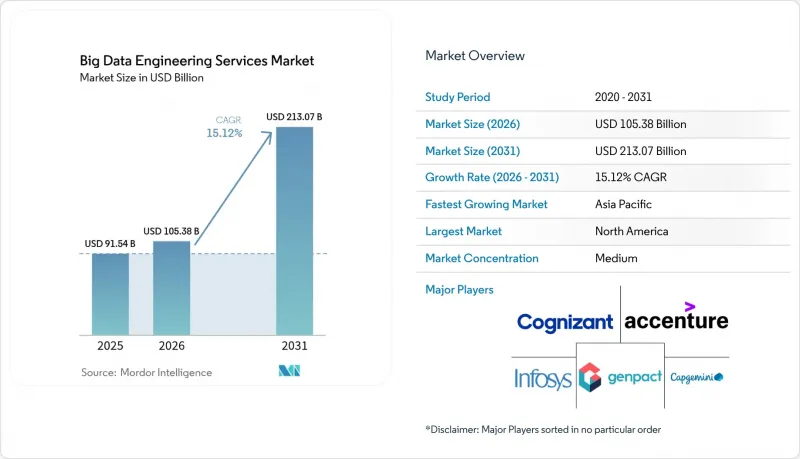
根據 Mordor Intelligence 預測,巨量資料工程服務的市場規模預計將從 2025 年的 915.4 億美元成長到 2026 年的 1053.8 億美元,然後從 2026 年到 2031 年以 15.12% 的複合年成長率,到 2031 年達到 2130.7 億美元。
本報告按服務類型(資料整合/ETL、資料品質/管治等)、業務職能(行銷/銷售、財務、營運/供應鏈、人力資源)、組織規模(中小企業/大型企業)、部署模式(雲端、本地部署、混合部署)和地區進行細分。市場預測以美元(USD)計價。
全球巨量資料工程服務市場趨勢與洞察
非結構化物聯網資料和社會資料的激增
如今,企業正在接收毫秒感測器測量數據、監視錄影機影像和對話錄音,到2025年,這些數據總量將超過181澤字節。在生產線上,機器人每個關節的振動數據被傳輸到總合物件儲存庫;零售商將天花板攝影機拍攝的影像與POS收據融合,以最佳化產品陳列方案(平面圖)。來自社群管道的情緒訊號也被添加進來,行銷人員在幾分鐘內即可利用這些數據,這促使數據處理方式從夜間大量處理轉向連續管線。 「讀取時模式」方法允許將建模延遲到查詢執行時,從而避免嚴格的關係約束。因此,在巨量資料工程服務市場,延遲低於一分鐘的串流平台更受青睞,以最大限度地減少客戶流失。
經濟高效、以結果為導向的服務合約
與處理的查詢數量和掃描的記錄數量掛鉤的浮動收費,使財務人員能夠更好地核對支出和收入。服務等級協定 (SLA) 現已保證 99.9% 的管道運轉率,將風險轉移給供應商,並促進自動化,從而減少工時。中型企業受益最大,因為它們無需突然增加資本支出即可部署企業級資料基礎架構。未能達到績效目標的處罰措施提高了供應商的責任感,並鼓勵使用可重複使用的加速器而非自訂程式碼。這種商業性結構調整正在將巨量資料工程服務市場擴展到全球 2000 強企業以外的買家。
數據工程人才嚴重短缺
到2025年,新工具的需求將是供應量的三倍,因為其普及速度將超過大學課程的進度。目前,矽谷的高級工程師年薪為25萬美元。位於印度和東歐的離岸中心正在填補供應缺口,但協調工作產生的額外成本正在抵消節省的成本。這種人才短缺推高了託管服務的價格,同時也減緩了內部專案的進度,並在短期內阻礙了巨量資料工程服務市場的成長。
細分市場分析
到2025年,數據整合和ETL服務將佔據巨量資料工程服務市場佔有率的39.22%,成為該領域最大的收入來源。客戶依賴這些服務將孤立的ERP、CRM和物聯網資料整合到統一的資料庫環境中,確保模式一致性和可靠的資料處理歷程。由於模式漂移和舊有系統特性導致管道持續崩潰,需要不斷重構,因此與整合和ETL相關的巨量資料工程服務市場規模仍然強勁。同時,隨著企業從說明洞察轉向能夠提供即時行動建議的預測性和指導性模型,「進階分析和視覺化」領域預計將以15.91%的複合年成長率成長至2031年。
零ETL複製技術將營運資料直接串流到分析存儲,雖然降低了延遲,但也把資料轉換的責任轉移到了領域團隊,增加了管治的複雜性。供應商現在正將可觀測性、編目和資料處理歷程追蹤整合到核心資料擷取作業中,以確保各業務部門指標的一致性。自動化資料品質檢查正在推動對整合平台的需求,因為它們可以在重複記錄和超出範圍的感測器測量值對經營團隊儀表板產生負面影響之前將其檢測出來。因此,買家越來越傾向於選擇涵蓋從資料擷取到視覺化所有環節的單一供應商解決方案,從而縮短了採購週期,並減少了巨量資料工程服務市場的供應商數量。
到2025年,隨著企業競相建置能夠實現毫秒級個人化的客戶資料平台,行銷和銷售部門將佔據巨量資料工程服務市場34.86%的佔有率。這些項目整合了點選流、客服中心和POS數據,使建議引擎能夠即時調整網站內容。即時受眾細分需要亞秒級的查詢處理效能,這促使企業對記憶體內特徵儲存和串流編配進行大量投資。同時,財務部門正在利用串流分析進行詐欺偵測和監管報告,而人力資源部門正在試行員工離職預測模型,儘管歐洲的隱私問題正在減緩後者的進展。
預計營運和供應鏈的工作量將以 15.96% 的複合年成長率成長,使其成為 2031 年成長最快的業務職能。預測性維護演算法分析來自工業IoT的遙測數據,提前數天預測設備故障,從而避免代價高昂的意外停機。零售商和製造商將貨運清單與 GPS 資料整合,以便根據港口擁塞或地緣政治形勢的變化重新安排庫存路線。反向 ETL 工具將分析結果回饋到業務系統中,使現場團隊能夠在作業現場查看傾向評分和風險警報,從而完成行動閉迴路。這種端到端的整合將營運從單純的成本中心提升為策略性成長驅動力,擴大了其在巨量資料工程服務市場中的作用。
區域分析
預計到2025年,北美將佔全球收入的42.38%,這主要得益於低成本電力地區超大規模超大規模資料中心業者的密集分佈,以及各州隱私法的差異化,這些差異需要精細化的管治。創業投資持續為開放原始碼的商業化提供資金,從而豐富了全球整合商的收購管道。加拿大正努力根據《個人資訊保護和電子文件法》(PIPEDA)評估跨國資料傳輸,而墨西哥則因近岸外包熱潮而迎來供應鏈遙測專案的擴張。
亞太地區預計將成為成長最快的地區,複合年成長率將達到16.14%。印度的「數位印度」基金正在投資12億美元用於該國的數據基礎建設;在中國,省級補貼承擔了國有製造商一半的轉型成本。日本正大力推動物聯網整合,強制要求所有汽車工廠在2026年前部署數位孿生技術。韓國正在擴大資料主體權利,使其涵蓋演算法透明度,從而推動對可解釋人工智慧管道的需求。在澳大利亞,資料中心已被指定為關鍵基礎設施,與工程服務捆綁的託管安全項目也日益活躍。
在歐洲,GDPR仍然有效,並規定在2024年至2025年間,任何違反GDPR的行為都將面臨45億歐元(50億美元)的不確定性,因此資料處理歷程和用戶同意管理是強制性的。由於德國強制要求關鍵基礎設施採用本地部署模式,法國正在資助主權雲,而英國脫歐後的充分性認定仍處於暫定狀態,因此存在著很大的不確定性。在南美洲,相關法規正陸續訂定,首先是巴西的LGPD;在中東,主權財富基金正在資助超大規模資料中心,作為智慧城市計畫的一部分。在非洲,南非和奈及利亞正在進行先導計畫,但電網不穩定阻礙了這些項目的廣泛應用。
其他好處:
- Excel格式的市場預測(ME)表
- 3個月的分析師支持
目錄
第1章:引言
- 研究假設和市場定義
- 調查範圍
第2章:調查方法
第3章執行摘要
第4章 市場狀況
- 市場概覽
- 市場促進因素
- 非結構化物聯網和社交數據的激增
- 經濟高效、以結果為導向的服務合約
- 部署雲端原生巨量資料棧
- 促進監管機構進行數據驅動型決策
- 人工智慧驅動的自動化數據管道的興起
- 產業特定數據市場
- 市場限制因素
- 數據工程人才嚴重短缺
- 網路安全和隱私合規成本
- 整合舊有系統的複雜性
- 雲端出口的經濟效益和供應商鎖定
- 產業價值鏈分析
- 監理情勢
- 技術展望
- 波特五力分析
- 宏觀經濟因素對市場的影響
- 新興科技的發展趨勢
第5章 市場規模與成長預測
- 按服務類型
- 資料建模與架構
- 數據整合與ETL
- 數據品質與管治
- 進階分析和視覺化
- 業務職能
- 行銷與銷售
- 金融
- 營運和供應鏈
- 人力資源
- 按組織規模
- 小型企業
- 大公司
- 部署模式
- 雲
- 現場
- 混合
- 按地區
- 北美洲
- 美國
- 加拿大
- 墨西哥
- 南美洲
- 巴西
- 阿根廷
- 其他南美國家
- 歐洲
- 英國
- 德國
- 法國
- 義大利
- 其他歐洲國家
- 亞太地區
- 中國
- 日本
- 印度
- 韓國
- 其他亞太國家
- 中東和非洲
- 中東
- 阿拉伯聯合大公國
- 沙烏地阿拉伯
- 其他中東國家
- 非洲
- 南非
- 埃及
- 其他非洲國家
- 中東
- 北美洲
第6章 競爭情勢
- 市場集中度
- 策略趨勢
- 市佔率分析
- 公司簡介
- Accenture plc
- International Business Machines Corporation
- Cognizant Technology Solutions Corporation
- Capgemini SE
- Infosys Limited
- Tata Consultancy Services Limited
- Wipro Limited
- Deloitte Touche Tohmatsu Limited
- Ernst and Young Global Limited
- KPMG International Limited
- Genpact Limited
- NTT Data Corporation
- L&T Technology Services Limited
- Hexaware Technologies Limited
- Mphasis Limited
- Tech Mahindra Limited
- Atos SE
- SAP SE
- Amazon Web Services, Inc.
- Microsoft Corporation
- Google LLC
- Snowflake Inc.
- Teradata Corporation
- Palantir Technologies Inc.
- Thoughtworks Holding, Inc.
- Slalom, LLC
第7章 市場機會與未來展望
According to Mordor Intelligence, the big data engineering services market size is expected to grow from USD 91.54 billion in 2025 to USD 105.38 billion in 2026 and is forecast to reach USD 213.07 billion by 2031 at a 15.12% CAGR over 2026-2031.
This report is Segmented by Service Type (Data Integration and ETL, Data Quality and Governance, and More), Business Function (Marketing and Sales, Finance, Operations and Supply-Chain, Human Resources), Organization Size (Small and Medium Enterprises, and Large Enterprises), Deployment Mode (Cloud, On-Premises, Hybrid), and Geography. The Market Forecasts are Provided in Terms of Value (USD).
Global Big Data Engineering Services Market Trends and Insights
Proliferation of Unstructured IoT and Social Data
Enterprises now ingest millisecond sensor readings, surveillance video, and conversational transcripts that together surpassed 181 zettabytes in 2025. Manufacturing lines stream vibration metrics from every robotic joint to remote object stores, while retailers fuse ceiling-mounted camera feeds with point-of-sale receipts to refine planograms. Social channels add sentiment signals that marketers activate within minutes, forcing a pivot from nightly batches to continuous pipelines. Schema-on-read techniques postpone modeling until query time, avoiding rigid relational constraints. The big data engineering services market, therefore, prioritizes streaming platforms that keep latency below 1 minute to minimize customer churn.
Cost-Efficient, Outcome-Based Service Contracts
Variable billing tied to queries processed or records scanned lets finance chiefs match spend with revenue. Service-level agreements now promise 99.9% pipeline uptime, shifting risk to vendors and spurring automation that curbs labor hours. Mid-market firms benefit most, gaining enterprise-grade data infrastructure without capital expenditure shocks. Penalties for missed performance targets heighten provider accountability, fostering the use of reusable accelerators over custom code. This commercial realignment expands the big data engineering services market beyond Global 2000 buyers.
Acute Shortage of Data-Engineering Talent
Demand exceeded supply three-to-one in 2025 as new tools outpaced university curricula. Senior engineers in Silicon Valley now command USD 250,000 packages. Offshore centers in India and Eastern Europe offer relief, yet coordination overhead dilutes savings. The gap fuels premium pricing for managed services, but it also slows internal projects, restraining the big data engineering services market in the near term.
Other drivers and restraints analyzed in the detailed report include:
- Cloud-Native Big-Data Stack Adoption
- Regulatory Push for Data-Driven Decision Making
- Cyber-Security and Privacy Compliance Costs
For complete list of drivers and restraints, kindly check the Table Of Contents.
Segment Analysis
Data Integration and ETL services captured 39.22% of the big data engineering services market share in 2025, making them the single largest revenue stream within the segment mix. Clients depend on these engagements to unify siloed ERP, CRM, and IoT data into lakehouse environments, ensuring schema consistency and reliable lineage. The big data engineering services market size tied to Integration and ETL remains resilient because schema drift and legacy system quirks continue to break pipelines, requiring constant refactoring. Meanwhile, Advanced Analytics and Visualization is projected to grow at a 15.91% CAGR through 2031 as enterprises move beyond descriptive insights to predictive and prescriptive models that recommend real-time actions.
Zero-ETL replication technologies that stream operational data directly into analytical stores are compressing latency, yet they shift transformation ownership to domain teams and heighten governance complexity. Vendors now bundle observability, cataloging, and lineage tracking with core ingestion work to safeguard metric consistency across business units. Automated data quality checks flag duplicate records or out-of-range sensor readings before they tarnish executive dashboards, reinforcing demand for integrated platforms. As a result, buyers increasingly favor single-vendor offerings that span ingestion to visualization, compressing procurement cycles and reducing vendor sprawl within the big data engineering services market.
Marketing and Sales accounted for 34.86% of the big data engineering services market in 2025 as firms raced to build customer data platforms that deliver millisecond-level personalization. These projects stitch together clickstream, call-center, and point-of-sale data so that recommendation engines can adapt website content on the fly. Real-time audience segmentation demands sub-second query performance, which drives heavy investment in in-memory feature stores and streaming orchestration. In parallel, Finance leverages streaming analytics for fraud detection and regulatory reporting, while Human Resources pilots attrition-prediction models, although privacy sensitivities in Europe slow the latter.
Operations and Supply-Chain workloads are set to expand at a 15.96% CAGR, positioning them as the fastest-rising business function through 2031. Predictive maintenance algorithms parse industrial IoT telemetry to forecast equipment failures days in advance, avoiding costly unplanned downtime. Retailers and manufacturers also integrate shipping manifests and GPS feeds to reroute inventory when ports clog or geopolitics shifts. Reverse ETL tools that send analytical outputs back into operational systems ensure frontline teams see propensity scores or risk alerts where they work, closing the action loop. This front-to-back integration elevates Operations from a cost center to a strategic growth lever, widening its role in the big data engineering services market.
Complete Report Scope:
- By Service Type
- Data Modelling and Architecture
- Data Integration and ETL
- Data Quality and Governance
- Advanced Analytics and Visualization
- By Business Function
- Marketing and Sales
- Finance
- Operations and Supply-Chain
- Human Resources
- By Organization Size
- Small and Medium Enterprises
- Large Enterprises
- By Deployment Mode
- Cloud
- On-Premises
- Hybrid
- By Geography
- North America
- United States
- Canada
- Mexico
- South America
- Brazil
- Argentina
- Rest of South America
- Europe
- United Kingdom
- Germany
- France
- Italy
- Rest of Europe
- Asia Pacific
- China
- Japan
- India
- South Korea
- Rest of Asia Pacific
- Middle East and Africa
- Middle East
- United Arab Emirates
- Saudi Arabia
- Rest of Middle East
- Africa
- South Africa
- Egypt
- Rest of Africa
- Middle East
- North America
Geography Analysis
North America contributed 42.38% of 2025 revenue thanks to dense hyperscaler footprints in low-cost power regions and a patchwork of state privacy statutes that necessitate fine-grained governance. Venture capital continues to finance open-source commercializations, feeding a pipeline of acquisition targets for global integrators. Canada grapples with cross-border data transfer assessments under PIPEDA, while Mexico's near-shoring boom boosts supply-chain telemetry projects.
Asia-Pacific is set to be the fastest-growing region, with a 16.14% CAGR. India's Digital India fund injects USD 1.2 billion into national data infrastructure, and China's provincial subsidies offset half of migration costs for state-owned manufacturers. Japan mandates digital twins across automotive plants by 2026, driving IoT integration work. South Korea extends subject rights to algorithmic transparency, increasing demand for explainable AI pipelines. Australia designates data centers as critical infrastructure, triggering managed security projects bundled with engineering services.
Europe remains governed by GDPR, which levied EUR 4.5 billion (USD 5.0 billion) in fines across 2024-2025, making lineage and consent management non-negotiable. Germany enforces on-premises rules for critical infrastructure, France funds a sovereign cloud, and the United Kingdom's post-Brexit adequacy is still provisional, adding uncertainty. South America starts with Brazil's LGPD, while Middle East sovereign funds finance hyperscale data centers as part of smart-city initiatives. Africa sees pilots in South Africa and Nigeria, though unreliable grids restrict broader adoption.
- Accenture plc
- International Business Machines Corporation
- Cognizant Technology Solutions Corporation
- Capgemini SE
- Infosys Limited
- Tata Consultancy Services Limited
- Wipro Limited
- Deloitte Touche Tohmatsu Limited
- Ernst and Young Global Limited
- KPMG International Limited
- Genpact Limited
- NTT Data Corporation
- L&T Technology Services Limited
- Hexaware Technologies Limited
- Mphasis Limited
- Tech Mahindra Limited
- Atos SE
- SAP SE
- Amazon Web Services, Inc.
- Microsoft Corporation
- Google LLC
- Snowflake Inc.
- Teradata Corporation
- Palantir Technologies Inc.
- Thoughtworks Holding, Inc.
- Slalom, LLC
Additional Benefits:
- The market estimate (ME) sheet in Excel format
- 3 months of analyst support
TABLE OF CONTENTS
1 INTRODUCTION
- 1.1 Study Assumptions and Market Definition
- 1.2 Scope of the Study
2 RESEARCH METHODOLOGY
3 EXECUTIVE SUMMARY
4 MARKET LANDSCAPE
- 4.1 Market Overview
- 4.2 Market Drivers
- 4.2.1 Proliferation of Unstructured IoT and Social Data
- 4.2.2 Cost-Efficient, Outcome-Based Service Contracts
- 4.2.3 Cloud-Native Big-Data Stack Adoption
- 4.2.4 Regulatory Push for Data-Driven Decision-Making
- 4.2.5 Rise of AI-Automated Data Pipelines
- 4.2.6 Industry-Specific Data Marketplaces
- 4.3 Market Restraints
- 4.3.1 Acute Shortage of Data-Engineering Talent
- 4.3.2 Cyber-Security and Privacy Compliance Costs
- 4.3.3 Legacy System Integration Complexity
- 4.3.4 Cloud-Egress and Vendor-Lock-In Economics
- 4.4 Industry Value Chain Analysis
- 4.5 Regulatory Landscape
- 4.6 Technological Outlook
- 4.7 Porter's Five Forces Analysis
- 4.7.1 Threat of New Entrants
- 4.7.2 Bargaining Power of Buyers
- 4.7.3 Bargaining Power of Suppliers
- 4.7.4 Threat of Substitutes
- 4.7.5 Competitive Rivalry
- 4.8 Impact of Macroeconomic Factors on the Market
- 4.9 Emerging Technology Trends
5 MARKET SIZE AND GROWTH FORECASTS (VALUE)
- 5.1 By Service Type
- 5.1.1 Data Modelling and Architecture
- 5.1.2 Data Integration and ETL
- 5.1.3 Data Quality and Governance
- 5.1.4 Advanced Analytics and Visualization
- 5.2 By Business Function
- 5.2.1 Marketing and Sales
- 5.2.2 Finance
- 5.2.3 Operations and Supply-Chain
- 5.2.4 Human Resources
- 5.3 By Organization Size
- 5.3.1 Small and Medium Enterprises
- 5.3.2 Large Enterprises
- 5.4 By Deployment Mode
- 5.4.1 Cloud
- 5.4.2 On-Premises
- 5.4.3 Hybrid
- 5.5 By Geography
- 5.5.1 North America
- 5.5.1.1 United States
- 5.5.1.2 Canada
- 5.5.1.3 Mexico
- 5.5.2 South America
- 5.5.2.1 Brazil
- 5.5.2.2 Argentina
- 5.5.2.3 Rest of South America
- 5.5.3 Europe
- 5.5.3.1 United Kingdom
- 5.5.3.2 Germany
- 5.5.3.3 France
- 5.5.3.4 Italy
- 5.5.3.5 Rest of Europe
- 5.5.4 Asia Pacific
- 5.5.4.1 China
- 5.5.4.2 Japan
- 5.5.4.3 India
- 5.5.4.4 South Korea
- 5.5.4.5 Rest of Asia Pacific
- 5.5.5 Middle East and Africa
- 5.5.5.1 Middle East
- 5.5.5.1.1 United Arab Emirates
- 5.5.5.1.2 Saudi Arabia
- 5.5.5.1.3 Rest of Middle East
- 5.5.5.2 Africa
- 5.5.5.2.1 South Africa
- 5.5.5.2.2 Egypt
- 5.5.5.2.3 Rest of Africa
- 5.5.5.1 Middle East
- 5.5.1 North America
6 COMPETITIVE LANDSCAPE
- 6.1 Market Concentration
- 6.2 Strategic Moves
- 6.3 Market Share Analysis
- 6.4 Company Profiles (includes Global Level Overview, Market Level Overview, Core Segments, Financials as available, Strategic Information, Market Rank/Share, Products and Services, Recent Developments)
- 6.4.1 Accenture plc
- 6.4.2 International Business Machines Corporation
- 6.4.3 Cognizant Technology Solutions Corporation
- 6.4.4 Capgemini SE
- 6.4.5 Infosys Limited
- 6.4.6 Tata Consultancy Services Limited
- 6.4.7 Wipro Limited
- 6.4.8 Deloitte Touche Tohmatsu Limited
- 6.4.9 Ernst and Young Global Limited
- 6.4.10 KPMG International Limited
- 6.4.11 Genpact Limited
- 6.4.12 NTT Data Corporation
- 6.4.13 L&T Technology Services Limited
- 6.4.14 Hexaware Technologies Limited
- 6.4.15 Mphasis Limited
- 6.4.16 Tech Mahindra Limited
- 6.4.17 Atos SE
- 6.4.18 SAP SE
- 6.4.19 Amazon Web Services, Inc.
- 6.4.20 Microsoft Corporation
- 6.4.21 Google LLC
- 6.4.22 Snowflake Inc.
- 6.4.23 Teradata Corporation
- 6.4.24 Palantir Technologies Inc.
- 6.4.25 Thoughtworks Holding, Inc.
- 6.4.26 Slalom, LLC
7 MARKET OPPORTUNITIES AND FUTURE OUTLOOK
- 7.1 White-Space and Unmet-Need Assessment

 巨量資料在石油天然氣探勘與生產的應用:市場佔有率分析、產業趨勢與統計數據以及成長預測(2026-2031 年)
 巨量資料軟體即服務(SaaS) 市場-2026-2032 年全球市場預測
 巨量資料智慧引擎市場規模、佔有率和成長分析:按組件類型、引擎功能、部署模式、最終用戶產業和地區分類-2026-2033年產業預測巨量資料商業分析市場:按組件、分析類型、組織規模、資料類型、技術、定價模式、部署方法、應用分類 - 全球市場預測(2026-2032 年)
 永續程式工程市場預測至2034年-全球工程解決方案、製程類型、技術、應用、最終用戶和區域分析汽車產業的巨量資料:市場佔有率分析、產業趨勢與統計數據以及成長預測(2026-2031 年)巨量資料市場:2026-2032年全球市場預測(依組件、資料類型、部署方式、應用領域、產業及組織規模分類)
 巨量資料軟體市場規模、佔有率和成長分析:按軟體類型、部署模式、產業和地區分類-2026-2033年產業預測
 2026年全球資料轉換電路市場報告
 石油天然氣巨量資料市場-全球產業規模、佔有率、趨勢、機會與預測:按組件、應用、資料類型、地區和競爭對手分類,2021-2031年