


 |
市場調查報告書
商品編碼
2124467
新加坡自助倉儲:市場佔有率分析、產業趨勢與統計及成長預測(2026-2031)Singapore Self-Storage - Market Share Analysis, Industry Trends & Statistics, Growth Forecasts (2026 - 2031) |
||||||

※ 本網頁內容可能與最新版本有所差異。詳細情況請與我們聯繫。
據 Mordor Intelligence 稱,新加坡的自助倉儲市場預計到 2026 年將達到 329 萬平方英尺,高於 2025 年的 311 萬平方英尺,預計到 2031 年將達到 437 萬平方英尺。
預計 2026 年至 2031 年的複合年成長率為 5.85%。
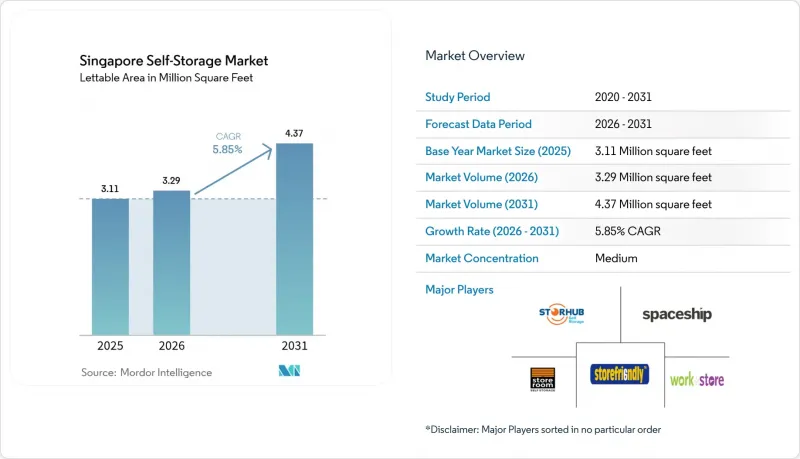
本報告按最終用戶(個人和企業)、儲存空間大小(40平方英尺以下的小型和中型單位、40平方英尺以上的大型單位以及其他)、儲存類型(空調和非空調)以及所有權類型(自有和租賃設施)進行細分。市場預測以數量(單元)為基礎。
新加坡自助倉儲市場趨勢及洞察
人口密度高和富裕人群的存在正在推動對自願儲存的需求。
新加坡的人口密度約為每平方公里8,000人,這數字在亞洲除小國之外幾乎無人能及。居民普遍認為生活空間有限是他們面臨的最大壓力之一,50%的居民表示如果可能,他們會將家居用品存放在其他地方。雖然不斷成長的家庭收入足以支付租金,但預計到2024年將增加5%的非居住者人口則更重視在搬家間隙存放物品的柔軟性。以50層樓高的公共住宅為代表的高層城市規劃,在提高居住密度的同時,也兼顧了宜居性,間接推動了新加坡對自助倉儲的需求。政府推出的GreenGov.SG等項目進一步強化了「使用而非擁有」的概念,從而促進了對付費倉儲的結構性需求。
城市改造計畫導致住宅占地面積減少
儘管主要區域容積率上限的提高導致住宅存量增加,但單一住房單位的面積卻在縮小。 2019 年總體規劃調整了丹戎魯魯區的規劃,以容納 5,000 個新的住宅單元,這清楚地表明了在重建項目中優先考慮緊湊型住房的趨勢。政府 2025 年上半年的土地出售計畫預計將提供 8,505 個私人住宅,主要位於混合用途開發項目中。隨著老舊住宅被大規模重建,居民被迫縮小居住空間,導致他們不得不租用自助倉儲來彌補。這一趨勢將為新加坡的自助倉儲市場提供長期的消費群。
高昂的地價推高了房屋租金。
中央區工業用地的月租金為每平方公尺20至23新加坡元,許多業者為了從裕廊集團(JTC)取得土地,所支付的價格都高於此標準。雖然富裕用戶能夠負擔更高的租金,但對價格敏感的家庭可能會推遲使用或減少使用空間。為了維持入住率,各大品牌紛紛推出促銷活動,例如StorHub提供兩個月免租外加30%的折扣。因此,儘管名目收入有所成長,但持續的租金上漲是限制新加坡自助倉儲市場長期複合年成長率(CAGR)的一個因素。
細分市場分析
新加坡自助倉儲市場正以7.05%的複合年成長率(CAGR)由企業用戶推動成長,而個人用戶在2025年仍將佔據61.12%的市場佔有率。企業用戶優先考慮配備空調的倉儲單位和全天候24小時服務,並願意支付更高的價格以提高每平方英尺的收益。微型經銷商則將自助倉儲設施用作小型履約中心,以縮短配送前置作業時間。同時,由於公寓搬遷和外籍人士流動導致的住房面積縮小,個人用戶市場仍保持穩定的需求基礎。這兩個群體共同維持較高的運轉率,但企業客戶期望更高的服務水平,並在價格製定中佔據主導。在雙邊貿易趨勢推動當日配送(RTS)的背景下,預計到2031年,新加坡自助倉儲市場中企業用戶部分的面積將接近170萬平方英尺。
中小型自助倉儲單元仍佔新加坡自助倉儲市場規模的48.10%,反映出個人消費者在家中存放多餘物品的需求。然而,面積超過40平方英尺的單位正以6.62%的複合年成長率成長,因為企業傾向於將庫存集中存放於更靠近終端用戶的位置。新加坡郵政運力的擴張增加了小包裹處理量,促使經銷商將庫存暫時存放於市區而非偏遠倉庫。企業也透過重新配置樓上空間,根據需要將其分隔成連續的獨立區域來應對這項變化。因此,大型單位的激增表明,市場正從單純的個人物品儲存轉向與全通路零售發展相契合的混合型庫存解決方案。
其他好處:
- Excel格式的市場預測(ME)表
- 3個月的分析師支持
目錄
第1章:引言
- 研究假設和市場定義
- 調查範圍
第2章:調查方法
第3章執行摘要
第4章 市場狀況
- 市場概覽
- 市場促進因素
- 人口密度高,富裕人群數量不斷增加,推高了對可選儲存的需求。
- 城市改造計畫導致住宅占地面積減少
- 隨著微型倉配在中小企業和電子商務中的發展,靈活的庫存空間變得越來越必要。
- 機構投資者的進入提高了資金籌措的便利性,加快了基礎建設的速度。
- 跨境數位遊牧者的興起,他們以新加坡為臨時基地。
- 強制性的綠色標誌要求促使倉儲設施維修,導致需求暫時激增。
- 市場限制因素
- 高昂的地價推高了每套房屋的租金。
- 用於新建工業設施的工業用地有限。
- 2025年實施的更嚴格的消防安全標準正在推動對多層建築的投資增加。
- 提供管家式服務的倉儲新創公司正在蠶食傳統倉儲單位的運轉率。
- 宏觀經濟因素的影響
- 產業價值鏈分析
- 監理情勢
- 技術展望
- 波特五力分析
- 投資分析
- PESTLE分析
- 消費者在選擇自助倉儲設施時優先考慮哪些因素
第5章 新加坡市場動態
- 運轉率分析
- 平均租金趨勢
- 新冠疫情前後市場受到的影響
- 盈利分析
- 新冠疫情前後市場受到的影響
- 設施平均規模
第6章 市場規模與成長預測
- 最終用戶
- 對於個人
- 商業
- 按儲存容量
- 小型至中型單位(小於40平方英尺)
- 大型單元(40平方英尺或以上)
- 其他(置物櫃/雙層)
- 依儲存類型
- 溫控型
- 非溫控型
- 依所有權類型
- 自有設施
- 租賃設施
第7章 競爭情勢
- 市場集中度
- 策略趨勢
- 市佔率分析
- 公司簡介
- StorHub Self Storage Pte Ltd
- Extra Space Self Storage Singapore Pte Ltd
- General Storage Company Pte Ltd("Lock+Store")
- Store Friendly Management(Singapore)Pte Ltd
- Work Plus Store Pte Ltd("Work+Store")
- Spaceship Singapore(Astore Pte Ltd)
- Store Room Pte Limited
- Beam Storage Pte Ltd
- Far East Organization Pte Ltd("Store-Y")
- Mandarin Self Storage Pte Ltd
- Urban Space Self Storage Pte Ltd
- Singapore G Pte Ltd("U-Store@SG")
- Cube Self Storage Pte Ltd
- Extra Space Asia Holdings Pte Ltd(Regional arm)
- MyStore Self Storage Pte Ltd
- Boxpark Storage Pte Ltd
- SelfStore Pte Ltd
- JustStoreIt!Pte Ltd
- StoreHub Group Pte Ltd
- Store-N-Go Pte Ltd
第8章 主要自助倉儲供應商的市場佔有率
第9章 市場機會與未來展望
- 評估閒置頻段和未滿足的需求
According to Mordor Intelligence, Singapore self-Storage market size in 2026 is estimated at 3.29 million sq ft, growing from 2025 value of 3.11 million sq ft with 2031 projections showing 4.37 million sq ft, growing at 5.85% CAGR over 2026-2031.
This report is Segmented by End-User (Personal and Business), Storage Size (Small and Medium Units Less Than 40 Sq Ft, Large Units Above 40 Sq Ft, and More), Storage Type (Climate-Controlled and Non-Climate-Controlled), and Ownership Pattern (Owned Facilities and Leased Facilities). The Market Forecasts are Provided in Terms of Volume (Units).
Singapore Self-Storage Market Trends and Insights
High Population Density and Affluent Demographics Boost Discretionary Storage Demand
Singapore packs around 8,000 residents into each square kilometer, a figure unmatched in Asia outside of micro-states. Residents rank living-space constraints among their top stressors, and 50% admit shelving household items externally when feasible. Rising household incomes support recurring rental fees, while a non-resident population that climbed 5% in 2024 values the flexibility to store possessions between relocations. Vertical city planning, exemplified by 50-storey public-housing blocks, concentrates living yet safeguards livability, indirectly pushing belongings into the Singapore self-storage market. Government programs such as GreenGov.SG further normalize "access over ownership," nurturing structural demand for paid storage.
Shrinking Residential Floor Area from Urban Redevelopment Projects
Higher plot-ratio allowances in prime districts shrink flat sizes even as total housing stock rises. The 2019 Master Plan rezoning of Tanjong Rhu for 5,000 new homes exemplifies how redevelopment favors compact units. The 1H 2025 Government Land Sales program will introduce 8,505 private units, largely within integrated mixed-use projects. As older estates undergo en bloc redevelopment, households downgrade in space and compensate by renting self-storage. This trend guarantees a long-run feedstock of consumers for the Singapore self-storage market.
High Land Costs Inflating Unit Rental Rates
Industrial land in core districts commands SGD 20-23 per sq m monthly, a baseline many operators exceed to secure sites JTC. While affluent users absorb higher fees, price-sensitive households may delay adoption or downgrade unit sizes. To maintain occupancy, leading brands offer promotional bundles, StorHub enables two months free rent alongside 30% discounts. Sustained rental inflation therefore tempers the Singapore self-storage market's longer-term CAGR even as nominal revenue grows.
Other drivers and restraints analyzed in the detailed report include:
- SME and E-commerce Micro-Fulfilment Growth Needing Flexible Inventory Space
- Institutional Investors' Entry Improving Funding Access and Build-Out Pace
- Limited Supply of Industrial-Zoned Land for New Facilities
For complete list of drivers and restraints, kindly check the Table Of Contents.
Segment Analysis
The business segment contributes a 7.05% CAGR to the Singapore self-storage market while personal storage still commands 61.12% share in 2025. Companies favor climate-controlled units and 24/7 access, accepting premium tariffs that elevate revenue per square foot. E-commerce micro-sellers exploit facilities as mini-fulfillment nodes to shorten delivery lead times. Meanwhile, the personal cohort remains a stable volume anchor, driven by apartment downsizing and expatriate churn. Together they sustain broad occupancy, though enterprise clients set the pricing tone through higher service expectations. The Singapore self-storage market size allocated to business users is projected to approach 1.7 million sq ft by 2031, supported by RTS-enabled binational trade flows.
Small and medium units still account for 48.10% of the Singapore self-storage market size, reflecting individual consumers' need to stash household overflow. Yet units exceeding 40 sq ft post a 6.62% CAGR as merchants consolidate inventory nearer to end-customers. SingPost's capacity upgrade lifts parcel volumes, encouraging sellers to stage stock downtown rather than at distant warehouses. Operators respond by reconfiguring upper floors into contiguous blocks that can be subdivided on demand. Large-unit penetration thus signals the market's shift from pure personal-effects storage to hybrid inventory solutions aligned with omnichannel retail growth.
Complete Report Scope:
- By End-User
- Personal
- Business
- By Storage Size
- Small and Medium Units (less than 40 sq ft)
- Large Units (above 40 sq ft)
- Others (Lockers/Double-Stacked)
- By Storage Type
- Climate-Controlled
- Non-Climate-Controlled
- By Ownership Pattern
- Owned Facilities
- Leased Facilities
List of Companies Covered in this Report:
- StorHub Self Storage Pte Ltd
- Extra Space Self Storage Singapore Pte Ltd
- General Storage Company Pte Ltd ("Lock+Store")
- Store Friendly Management (Singapore) Pte Ltd
- Work Plus Store Pte Ltd ("Work+Store")
- Spaceship Singapore (Astore Pte Ltd)
- Store Room Pte Limited
- Beam Storage Pte Ltd
- Far East Organization Pte Ltd ("Store-Y")
- Mandarin Self Storage Pte Ltd
- Urban Space Self Storage Pte Ltd
- Singapore G Pte Ltd ("U-Store@SG")
- Cube Self Storage Pte Ltd
- Extra Space Asia Holdings Pte Ltd (Regional arm)
- MyStore Self Storage Pte Ltd
- Boxpark Storage Pte Ltd
- SelfStore Pte Ltd
- JustStoreIt! Pte Ltd
- StoreHub Group Pte Ltd
- Store-N-Go Pte Ltd
Additional Benefits:
- The market estimate (ME) sheet in Excel format
- 3 months of analyst support
TABLE OF CONTENTS
1 INTRODUCTION
- 1.1 Study Assumptions and Market Definition
- 1.2 Scope of the Study
2 RESEARCH METHODOLOGY
3 EXECUTIVE SUMMARY
4 MARKET LANDSCAPE
- 4.1 Market Overview
- 4.2 Market Drivers
- 4.2.1 High population density and affluent demographics boost discretionary storage demand
- 4.2.2 Shrinking residential floor area from urban redevelopment projects
- 4.2.3 SME and e-commerce micro-fulfilment growth needing flexible inventory space
- 4.2.4 Institutional investors' entry improving funding access and build-out pace
- 4.2.5 Rise of cross-border digital nomads using Singapore as an intermittent base
- 4.2.6 Mandatory Green-Mark retrofit storage compliance spiking temporary demand
- 4.3 Market Restraints
- 4.3.1 High land costs inflating unit rental rates
- 4.3.2 Limited supply of industrial-zoned land for new facilities
- 4.3.3 Stringent Fire-Safety Code-2025 raising cap-ex for multilevel facilities
- 4.3.4 Concierge storage start-ups cannibalising traditional unit occupancy
- 4.4 Impact of Macroeconomic Factors
- 4.5 Industry Value Chain Analysis
- 4.6 Regulatory Landscape
- 4.7 Technological Outlook
- 4.8 Porter's Five Forces Analysis
- 4.8.1 Bargaining Power of Suppliers
- 4.8.2 Bargaining Power of Buyers
- 4.8.3 Threat of New Entrants
- 4.8.4 Threat of Substitutes
- 4.8.5 Intensity of Competitive Rivalry
- 4.9 Investment Analysis
- 4.10 PESTEL Analysis
- 4.11 Key Considerations of Consumers while selecting a Self-Storage Facility
5 MARKET DYNAMICS IN SINGAPORE
- 5.1 Analysis of Occupancy Rates
- 5.2 Average Rental Trends
- 5.2.1 Pre-Covid and Post-Covid Market Implications
- 5.3 Profitability Analysis
- 5.3.1 Pre-Covid and Post-Covid Market Implications
- 5.4 Average Facility Size
6 MARKET SIZE AND GROWTH FORECASTS (UNITS)
- 6.1 By End-User
- 6.1.1 Personal
- 6.1.2 Business
- 6.2 By Storage Size
- 6.2.1 Small and Medium Units (less than 40 sq ft)
- 6.2.2 Large Units (above 40 sq ft)
- 6.2.3 Others (Lockers/Double-Stacked)
- 6.3 By Storage Type
- 6.3.1 Climate-Controlled
- 6.3.2 Non-Climate-Controlled
- 6.4 By Ownership Pattern
- 6.4.1 Owned Facilities
- 6.4.2 Leased Facilities
7 COMPETITIVE LANDSCAPE
- 7.1 Market Concentration
- 7.2 Strategic Moves
- 7.3 Market Share Analysis
- 7.4 Company Profiles (includes Global level Overview, Market level overview, Core Segments, Financials as available, Strategic Information, Market Rank/Share for key companies, Products and Services, Recent Developments)
- 7.4.1 StorHub Self Storage Pte Ltd
- 7.4.2 Extra Space Self Storage Singapore Pte Ltd
- 7.4.3 General Storage Company Pte Ltd ("Lock+Store")
- 7.4.4 Store Friendly Management (Singapore) Pte Ltd
- 7.4.5 Work Plus Store Pte Ltd ("Work+Store")
- 7.4.6 Spaceship Singapore (Astore Pte Ltd)
- 7.4.7 Store Room Pte Limited
- 7.4.8 Beam Storage Pte Ltd
- 7.4.9 Far East Organization Pte Ltd ("Store-Y")
- 7.4.10 Mandarin Self Storage Pte Ltd
- 7.4.11 Urban Space Self Storage Pte Ltd
- 7.4.12 Singapore G Pte Ltd ("U-Store@SG")
- 7.4.13 Cube Self Storage Pte Ltd
- 7.4.14 Extra Space Asia Holdings Pte Ltd (Regional arm)
- 7.4.15 MyStore Self Storage Pte Ltd
- 7.4.16 Boxpark Storage Pte Ltd
- 7.4.17 SelfStore Pte Ltd
- 7.4.18 JustStoreIt! Pte Ltd
- 7.4.19 StoreHub Group Pte Ltd
- 7.4.20 Store-N-Go Pte Ltd
8 MARKET SHARE OF KEY SELF-STORAGE OPERATORS
9 MARKET OPPORTUNITIES AND FUTURE OUTLOOK
- 9.1 White-space and Unmet-Need Assessment

 德國自助倉儲:市場佔有率分析、產業趨勢與統計及成長預測(2026-2031)越南自助倉儲:市場佔有率分析、產業趨勢與統計及成長預測(2026-2031)亞太地區自助倉儲:市場佔有率分析、產業趨勢與統計及成長預測(2026-2031)歐洲自助倉儲:市場佔有率分析、產業趨勢與統計及成長預測(2026-2031 年)美國自助倉儲:市場佔有率分析、產業趨勢與統計及成長預測(2026-2031)自助倉儲:市場佔有率分析、產業趨勢與統計、成長預測(2026-2031)
 城市按需儲存服務市場預測至2034年-按服務類型、儲存格式、預訂模式、儲存容量、服務期限、最終用戶和地區分類的全球分析
 自助倉儲市場規模、佔有率、趨勢和預測:按儲存單元規模、最終用途和地區分類,2026-2034 年
 2026年全球自助倉儲市場報告
 自助倉儲市場:2026-2032年全球市場預測(按單位類型、租賃期限、單位面積、存取方式及最終用戶分類)