

 |
市場調查報告書
商品編碼
2125372
北美策略諮詢:市場佔有率分析、產業趨勢與統計、成長預測(2026-2031)North America Strategic Consulting - Market Share Analysis, Industry Trends & Statistics, Growth Forecasts (2026 - 2031) |
||||||

※ 本網頁內容可能與最新版本有所差異。詳細情況請與我們聯繫。
根據 Mordor Intelligence 預測,北美策略諮詢市場規模預計將在 2025 年達到 275.6 億美元,2026 年達到 283.4 億美元,到 2031 年達到 342.6 億美元,2026 年至 2031 年的複合年成長率為 3.87%。
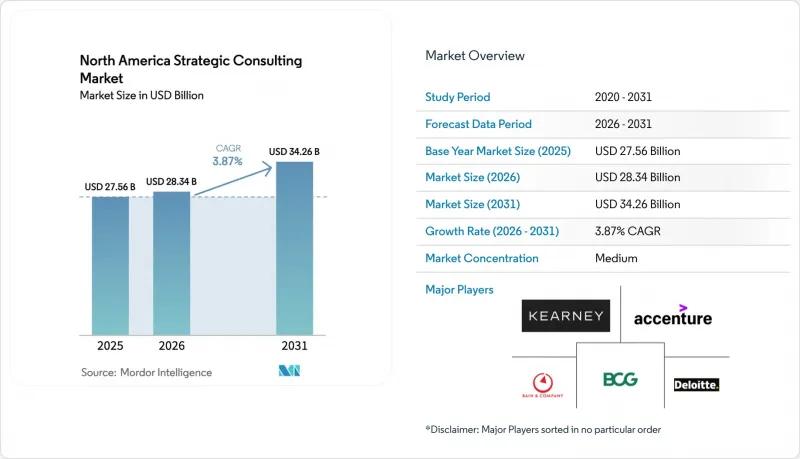
本報告按服務類型(企業策略、經營模式轉型等)、組織規模(大型企業等)、合約類型(企劃為基礎諮詢、長期諮詢等)、最終用戶行業(金融服務、生命科學與醫療保健等)以及國家/地區進行細分。市場預測以美元計價。
北美策略諮詢市場的趨勢與洞察
企業對數位化策略諮詢的需求日益成長。
高階主管預算將2024年收入的7.5%分配給了數位轉型,但只有22%的組織將其生成式人工智慧先導計畫投入生產,凸顯了執行方面的差距,而外部顧問正利用這一差距來獲取諮詢服務。由於傳統技術堆疊、分散式資料資產和謹慎的管治阻礙了規模化發展,諮詢工作的重點正在轉向組織轉型、技術債務修復和投資回報率(ROI)建模。隨著監管機構強制要求對網路安全韌性和資料隱私保護措施進行獨立檢驗,金融機構和醫療保健提供者正在推動市場需求。隨著數位化藍圖與合規工作流程的連結日益緊密,北美策略諮詢市場在公司管治結構中扮演更重要的角色。顧問公司正透過其專有的加速器來脫穎而出,這些加速器可以縮短概念驗證(PoC)週期,並在幾個月內量化業務影響。
擴大併購活動
預計到2025年,北美併購交易總額將達2.04兆美元,較2024年成長63%。這催生了零星但利潤豐厚的實質審查、估值建模和協同效應創造交易。諮詢顧問會在交易完成後駐紮在被收購企業長達24個月,以解決與文化、系統和營運節奏相關的整合瓶頸。生命科學領域也呈現類似的趨勢,收購製藥公司的企業尋求重振產品線,並就監管路徑的可行性和上市後證據的產生獲得指導。根據《美國-墨西哥-加拿大協定》(USMCA),美國、加拿大和墨西哥之間的跨國活動正在加速,這要求諮詢顧問解讀不同的稅法和勞動法。因此,北美策略諮詢市場的薪酬趨勢與該地區的併購週期密切相關。
擴大內部戰略團隊
2025年,財富500強企業聘請了大量前諮詢顧問,建立內部“卓越中心”,以複製傳統的諮詢方法並降低經常性支出。這項轉變主要由科技公司推動,它們無需經過外部採購流程,即可將演算法專業知識重新部署到各個產品線。如今,日常規劃、市場研究和競爭對手情報收集等工作都在企業內部完成,迫使外部公司競標複雜且高風險的專案。諮詢服務提供者的因應策略是,將員工派駐到多年轉型專案中,這些專案模糊了諮詢和管理服務之間的界限,但其利潤率與短期專案工作截然不同。
細分市場分析
2025年,職能策略將佔北美策略諮詢市場規模的39.53%,主要由企業對人力資源系統重塑和供應鏈韌性強化的需求所驅動。同時,數位化策略與創新將以4.65%的複合年成長率(CAGR)實現最高成長,主要得益於企業對人工智慧(AI)應用的迫切需求。客戶調查顯示,65%的企業已試行實施生成式人工智慧,但僅有22%的企業實現了全面部署。因此,能夠彌合實驗階段與生產階段之間差距的顧問擁有定價權。職能諮詢在成本削減專案中仍然至關重要,但隨著雲端架構和高階分析成為現代流程卓越性的基石,數位化團隊正在影響所有重塑專案。儘管企業策略諮詢的需求仍然存在,但投資者在核准資本計劃時越來越重視技術應用,數位化的重要性也已納入董事會討論。併購諮詢交易的數量會隨著宏觀經濟狀況而波動,在為企業帶來暫時的收入成長的同時,也使企業面臨利率週期波動的風險。經濟和政策相關工作在支持政府進行基礎設施和貿易改革方面發揮著至關重要的作用,但繁瑣的採購程序阻礙了業務拓展。總體而言,數位化的興起表明,演算法能力正在超越傳統的規模經濟,並成為北美策略諮詢市場的主要競爭優勢。
次生效應進一步加速了數位化進程。人才流動正轉向諮詢工作,這些工作提供了建立人工智慧工具和應對資料科學挑戰的機會,導致精通數位化的顧問公司與其反應較慢的競爭對手之間的能力差距日益擴大。生命科學和金融服務業的客戶要求進行雙軌項目,將監管合規性融入其數位化藍圖,這使得諮詢顧問必須著眼於更長遠的觀點。因此,儘管北美策略諮詢市場的絕對收入有所成長,但職能諮詢的佔有率卻在逐漸下降,這表明數位化領域對新增支出的貢獻顯著更大。
到2025年,大型企業將佔總收入的62.89%,它們制定了需要董事會批准的多年轉型藍圖。管治規範要求進行外部檢驗,延續了外包給全球整合商的趨勢。同時,儘管我們將年收入低於5000萬美元的企業定義為“中小企業”,但預計該領域的支出將以4.86%的複合年成長率成長,是所有規模類別中成長率最高的。雲端協作套件和人工智慧驅動的研究顯著降低了專案的最低損益平衡點,使得精品諮詢公司能夠訂單以前被認為規模過小的專案。因此,北美策略諮詢市場正在更早滲透到企業生命週期中更具創業精神的領域。
中型企業呈現出一種混合趨勢,它們缺乏簽訂長期顧問合約的預算,但會購買個人化的成長診斷服務。價格敏感性促使這些客戶傾向於按績效付費的契約,從而加速了整個市場實驗性方法的推廣。顧問公司則透過建立模組化服務目錄來應對這一趨勢,這些目錄可根據客戶的成熟度進行擴展,涵蓋從市場准入藍圖到實施指南的各個方面。這種「分層」方法在擴大目標市場規模的同時,也延長了客戶終身價值 (CLV)。然而,為小規模客戶提供服務會對利潤率造成壓力,因為成本並不會隨著專案規模的擴大而線性下降。這進一步鞏固了企業級專案在北美策略諮詢產業的高階定位。
其他好處:
- Excel格式的市場預測(ME)表
- 3個月的分析師支持
目錄
第1章:引言
- 研究假設和市場定義
- 調查範圍
第2章:調查方法
第3章執行摘要
第4章 市場狀況
- 市場概覽
- 市場促進因素
- 企業對數位化策略諮詢的需求日益成長。
- 擴大併購活動
- 監理合規的複雜性
- 成本最佳化和營運效率的需求
- 先進分析技術和人工智慧驅動的策略建模的應用正在加速。
- 在強制推行與永續發展相關的企業策略方面取得進展
- 市場限制因素
- 擴大內部戰略團隊
- 諮詢顧問人才短缺且離職率率高
- 透過生成式人工智慧工具實現傳統策略框架的商品化
- 消費者越來越傾向於按效果付費的定價模式,這導致利潤率下降。
- 投資分析
- 監理情勢
- 宏觀經濟因素對市場的影響
- 技術展望
- 波特五力分析
第5章 市場規模與成長預測
- 按服務類型
- 企業策略
- 經營模式轉型
- 併購和企業融資策略
- 數位策略與創新
- 職能策略(例如,人力資源、供應鏈管理)
- 經濟和政策諮詢
- 按組織規模
- 大公司
- 中型公司
- 小規模企業
- 按合約類型
- 企劃為基礎的諮詢服務
- 保留諮詢服務
- 管理/實施服務
- 基於績效/成功收費的諮詢服務
- 數位化/平台諮詢
- 按最終用戶行業分類
- 金融服務
- 生命科學與醫療保健
- 科技、媒體、通訊
- 能源與資源
- 政府/公共部門
- 消費品和零售
- 工業和製造業
- 其他終端用戶產業
- 國家
- 美國
- 加拿大
- 墨西哥
第6章 競爭情勢
- 市場集中度
- 策略趨勢
- 市佔率分析
- 公司簡介
- Accenture plc
- AT Kearney Inc.
- McKinsey & Company Inc.
- The Boston Consulting Group Inc.
- Bain & Company Inc.
- Deloitte Touche Tohmatsu Limited
- PricewaterhouseCoopers International Limited
- Marsh & McLennan Companies Inc.
- Roland Berger GmbH
- KPMG International Limited
- Ernst & Young Global Limited
- Booz Allen Hamilton Holding Corporation
- Oliver Wyman Inc.
- LEK Consulting LLC
- AlixPartners LLP
- ZS Associates
- IBM Corporation(IBM Consulting)
- CGI Inc.
- Capgemini SE
第7章 市場機會與未來展望
According to Mordor Intelligence, the North America strategic consulting market size is projected to be USD 27.56 billion in 2025, USD 28.34 billion in 2026, and reach USD 34.26 billion by 2031, growing at a CAGR of 3.87% from 2026 to 2031.
This report is Segmented by Service Type (Corporate Strategy, Business-Model Transformation, and More), Organization Size (Large Enterprises, and More), Engagement Model (Project-Based Advisory, Retained Advisory, and More), End-User Industry (Financial Services, Life Sciences and Healthcare, and More), and Country. The Market Forecasts are Provided in Terms of Value (USD).
North America Strategic Consulting Market Trends and Insights
Increasing Demand For Digital Strategy Consulting Among Corporates
C-suite budgets earmarked 7.5% of 2024 revenue for digital transformation, yet only 22% of organizations shifted generative AI pilots into production, underscoring an execution gap that external advisors now monetize. Legacy technology stacks, dispersed data estates, and cautious governance impede scale-up, so engagements pivot toward organizational change, technical-debt remediation, and return-on-investment modeling. Financial institutions and healthcare providers lead demand because regulators require independent validation of cybersecurity resilience and data-privacy safeguards. As digital road maps intertwine with compliance workflows, the North America strategic consulting market deepens its role inside enterprise governance structures. Advisory firms differentiate through proprietary accelerators that compress proof-of-concept cycles and quantify business impact within months.
Growth Of Mergers And Acquisitions Activity
North American deal value reached USD 2.04 trillion in 2025, a 63% jump over 2024, producing episodic but high-margin mandates for due diligence, valuation modeling, and synergy capture. Consultants remain embedded up to 24 months post-close to resolve integration bottlenecks around culture, systems, and operating cadence. Life sciences illustrates the pattern as pharmaceutical acquirers seek pipeline rejuvenation and require guidance on regulatory pathway viability and post-market evidence generation. Cross-border activity among the United States, Canada, and Mexico accelerates under the United States-Mexico-Canada Agreement, compelling advisors to interpret divergent tax regimes and labor codes. The North America strategic consulting market thereby links its own fee trajectory to the region's M&A cycle.
Expansion Of In-House Strategy Teams
Fortune 500 enterprises hired former consultants en masse during 2025 to build internal centers of excellence that replicate traditional advisory methods and lower repeat spend. Technology companies lead the shift, redeploying algorithmic talent across product lines without external procurement cycles. Routine planning, market scans, and competitor intelligence now migrate in-house, leaving external firms to fight for complex, high-stakes mandates. Advisory providers counter by embedding staff for multiyear transformation programs that blur boundaries between consulting and managed services, but margin profiles differ markedly from short-cycle project work.
Other drivers and restraints analyzed in the detailed report include:
- Accelerated Adoption Of Advanced Analytics And AI-Powered Strategic Modeling
- Rising Complexity In Regulatory Compliance
- Commoditization Of Traditional Strategy Frameworks Via Generative AI Tools
For complete list of drivers and restraints, kindly check the Table Of Contents.
Segment Analysis
The functional strategy accounted for 39.53% of the North America strategic consulting market size in 2025, driven by human-resources redesign and supply-chain resilience mandates. Digital strategy and innovation, however, posts the swiftest 4.65% CAGR thanks to enterprise urgency around artificial intelligence deployment. Clients acknowledge that 65% of firms piloted generative AI yet only 22% scaled it, so advisors who can bridge experimentation and production enjoy pricing latitude. Functional advisory retains scale for cost-takeout programs, but digital teams now influence every redesign because cloud architectures and advanced analytics underpin modern process excellence. Corporate-strategy mandates still appear, but investors increasingly evaluate technology leverage when approving capital plans, blending digital imperatives into boardroom conversations. M&A advisory volumes fluctuate with macro conditions, supplying episodic upside yet exposing firms to rate-cycle volatility. Economic and policy engagements serve governments navigating infrastructure or trade reform, but procurement bureaucracy tempers expansion. In aggregate, digital's rise signals that algorithmic capability eclipses classical economies-of-scale logic as the chief competitive weapon inside the North America strategic consulting market.
Second-order effects reinforce digital's pull. Talent migration favors practices offering exposure to AI tool-building and data-science problems, thereby deepening capability gaps between digitally fluent consultancies and slower peers. Clients in life-sciences and financial services request dual-track projects that embed regulatory compliance into digital road maps, anchoring consultants for longer horizons. The North America strategic consulting market share held by functional advisory therefore slides gradually even as its absolute revenue grows, a testament to digital's disproportionate contribution to incremental spend.
Large enterprises represented 62.89% of 2025 revenue, securing multiyear transformation road maps that require board-level sign-off. Governance norms oblige external validation, sustaining engagement flow to global integrators. Yet small enterprises, defined here as firms below USD 50 million in annual revenue, are projected to expand their spend at a 4.86% CAGR, the fastest across size tiers. Cloud collaboration suites and AI-assisted research have slashed minimum project economics, letting boutiques win deals once considered too small. As a result, the North America strategic consulting market penetrates entrepreneurial segments earlier in company life cycles.
Medium enterprises exhibit hybrid patterns, purchasing discrete growth diagnostics while lacking budgets for continuous retainers. Price sensitivity pushes these clients toward outcome-linked contracts, accelerating experimentation across the market. Consultants respond by curating modular service catalogs that scale with client maturity, from market-entry blueprints to implementation playbooks. This staircase approach lengthens customer lifetime value while expanding addressable volume. Margins, however, compress when serving smaller clients because delivery costs do not fall linearly with project size, reinforcing the premium positioning of enterprise programs inside the North America strategic consulting industry.
Complete Report Scope:
- By Service Type
- Corporate Strategy
- Business-Model Transformation
- M&A and Corporate Finance Strategy
- Digital Strategy and Innovation
- Functional Strategy (HR, SCM, etc.)
- Economic and Policy Advisory
- By Organization Size
- Large Enterprises
- Medium Enterprises
- Small Enterprises
- By Engagement Model
- Project-based Advisory
- Retained Advisory
- Managed / Implementation Services
- Outcome-based / Success-fee Consulting
- Digital / Platform-enabled Consulting
- By End-user Industry
- Financial Services
- Life Sciences and Healthcare
- Technology, Media and Telecom
- Energy and Resources
- Government and Public Sector
- Consumer and Retail
- Industrial and Manufacturing
- Other End-user Industries
- By Country
- United States
- Canada
- Mexico
List of Companies Covered in this Report:
- Accenture plc
- A.T. Kearney Inc.
- McKinsey & Company Inc.
- The Boston Consulting Group Inc.
- Bain & Company Inc.
- Deloitte Touche Tohmatsu Limited
- PricewaterhouseCoopers International Limited
- Marsh & McLennan Companies Inc.
- Roland Berger GmbH
- KPMG International Limited
- Ernst & Young Global Limited
- Booz Allen Hamilton Holding Corporation
- Oliver Wyman Inc.
- L.E.K. Consulting LLC
- AlixPartners LLP
- Strategy&
- ZS Associates
- IBM Corporation (IBM Consulting)
- CGI Inc.
- Capgemini SE
Additional Benefits:
- The market estimate (ME) sheet in Excel format
- 3 months of analyst support
TABLE OF CONTENTS
1 INTRODUCTION
- 1.1 Study Assumptions and Market Definition
- 1.2 Scope of the Study
2 RESEARCH METHODOLOGY
3 EXECUTIVE SUMMARY
4 MARKET LANDSCAPE
- 4.1 Market Overview
- 4.2 Market Drivers
- 4.2.1 Increasing Demand for Digital Strategy Consulting Among Corporates
- 4.2.2 Growth of Mergers and Acquisitions Activity
- 4.2.3 Rising Complexity in Regulatory Compliance
- 4.2.4 Need for Cost Optimization and Operational Efficiency
- 4.2.5 Accelerated Adoption of Advanced Analytics and AI-Powered Strategic Modeling
- 4.2.6 Emergence of Sustainability-Linked Corporate Strategy Mandates
- 4.3 Market Restraints
- 4.3.1 Expansion of In-House Strategy Teams
- 4.3.2 Talent Shortages and High Consultant Turnover
- 4.3.3 Commoditization of Traditional Strategy Frameworks via Generative AI Tools
- 4.3.4 Increasing Client Preference for Outcome-Based Pricing Models Reducing Margins
- 4.4 Investment Analysis
- 4.5 Regulatory Landscape
- 4.6 Impact of Macroeconomic Factors on the Market
- 4.7 Technological Outlook
- 4.8 Porter's Five Forces Analysis
- 4.8.1 Threat of New Entrants
- 4.8.2 Bargaining Power of Buyers
- 4.8.3 Bargaining Power of Suppliers
- 4.8.4 Threat of Substitute Products
- 4.8.5 Intensity of Competitive Rivalry
5 MARKET SIZE AND GROWTH FORECASTS (VALUE)
- 5.1 By Service Type
- 5.1.1 Corporate Strategy
- 5.1.2 Business-Model Transformation
- 5.1.3 M&A and Corporate Finance Strategy
- 5.1.4 Digital Strategy and Innovation
- 5.1.5 Functional Strategy (HR, SCM, etc.)
- 5.1.6 Economic and Policy Advisory
- 5.2 By Organization Size
- 5.2.1 Large Enterprises
- 5.2.2 Medium Enterprises
- 5.2.3 Small Enterprises
- 5.3 By Engagement Model
- 5.3.1 Project-based Advisory
- 5.3.2 Retained Advisory
- 5.3.3 Managed / Implementation Services
- 5.3.4 Outcome-based / Success-fee Consulting
- 5.3.5 Digital / Platform-enabled Consulting
- 5.4 By End-user Industry
- 5.4.1 Financial Services
- 5.4.2 Life Sciences and Healthcare
- 5.4.3 Technology, Media and Telecom
- 5.4.4 Energy and Resources
- 5.4.5 Government and Public Sector
- 5.4.6 Consumer and Retail
- 5.4.7 Industrial and Manufacturing
- 5.4.8 Other End-user Industries
- 5.5 By Country
- 5.5.1 United States
- 5.5.2 Canada
- 5.5.3 Mexico
6 COMPETITIVE LANDSCAPE
- 6.1 Market Concentration
- 6.2 Strategic Moves
- 6.3 Market Share Analysis
- 6.4 Company Profiles (Includes Global Level Overview, Market Level Overview, Core Segments, Financials as Available, Strategic Information, Market Rank/Share, Products and Services, and Recent Developments)
- 6.4.1 Accenture plc
- 6.4.2 A.T. Kearney Inc.
- 6.4.3 McKinsey & Company Inc.
- 6.4.4 The Boston Consulting Group Inc.
- 6.4.5 Bain & Company Inc.
- 6.4.6 Deloitte Touche Tohmatsu Limited
- 6.4.7 PricewaterhouseCoopers International Limited
- 6.4.8 Marsh & McLennan Companies Inc.
- 6.4.9 Roland Berger GmbH
- 6.4.10 KPMG International Limited
- 6.4.11 Ernst & Young Global Limited
- 6.4.12 Booz Allen Hamilton Holding Corporation
- 6.4.13 Oliver Wyman Inc.
- 6.4.14 L.E.K. Consulting LLC
- 6.4.15 AlixPartners LLP
- 6.4.16 Strategy&
- 6.4.17 ZS Associates
- 6.4.18 IBM Corporation (IBM Consulting)
- 6.4.19 CGI Inc.
- 6.4.20 Capgemini SE
7 MARKET OPPORTUNITIES AND FUTURE OUTLOOK
- 7.1 White-Space and Unmet-Need Assessment

 歐洲諮詢服務:市場佔有率分析、產業趨勢與統計、成長預測(2026-2031)東南亞顧問服務:市場佔有率分析、產業趨勢與統計、成長預測(2026-2031)策略諮詢服務:市場佔有率分析、產業趨勢與統計、成長預測(2026-2031)
 2026-2030年全球諮詢服務市場美國策略諮詢服務:市場佔有率分析、產業趨勢與統計、成長預測(2026-2031)
 人工智慧和機器學習研究服務
 諮詢4.0市場:2026-2032年全球市場預測(按服務類型、類別、交付方式、技術、應用、最終用戶產業和最終用戶分類)亞太地區策略諮詢服務:市場佔有率分析、產業趨勢與統計、成長預測(2026-2031)
 2026年全球營運諮詢市場報告南美供應鏈諮詢服務:市場佔有率分析、產業趨勢與統計、成長預測(2026-2031)