


 |
市場調查報告書
商品編碼
2124261
消毒機器人:市場佔有率分析、產業趨勢與統計、成長預測(2026-2031)Disinfectant Robot - Market Share Analysis, Industry Trends & Statistics, Growth Forecasts (2026 - 2031) |
||||||

※ 本網頁內容可能與最新版本有所差異。詳細情況請與我們聯繫。
據 Mordor Intelligence 稱,2025 年消毒機器人市場價值 16.1 億美元,預計到 2031 年將從 2026 年的 19.7 億美元成長至 53.7 億美元,預測期(2026-2031 年)的複合年成長率預計為 22.27%。
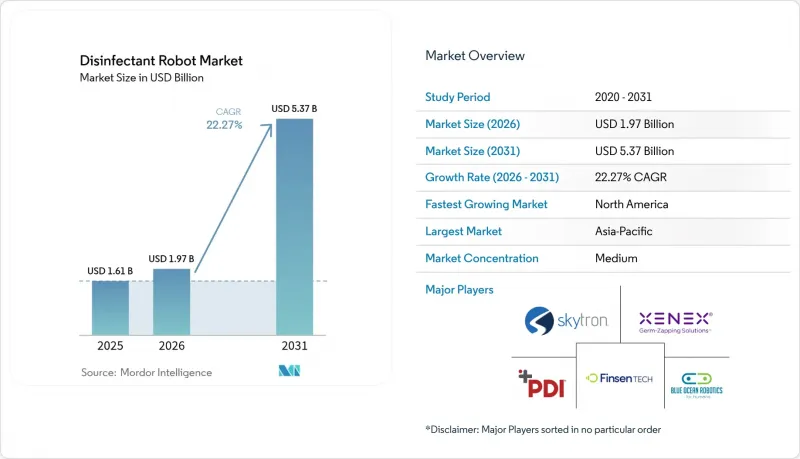
本報告依消毒技術(紫外線C波段、過氧化氫蒸氣等)、移動等級(全自動移動機器人、半自動/遙控機器人、推播平台)、最終用戶(醫院/診所、交通樞紐/車輛等)、應用(硬表面消毒等)和地區進行細分。市場預測以美元計價。
全球消毒機器人市場趨勢及洞察
醫院感染發生率高
在美國,每天有三十一分之一的住院病人感染院內感染,每年共造成68.7萬例感染,經濟損失在280億至450億美元之間。全球範圍內也存在類似的趨勢。儘管有針對性的應對措施降低了耐甲氧西林金黃色困難梭狀桿菌(MRSA)和中心靜脈導管相關血流感染(CLABSI)的發生率,但產孢艱難梭菌仍然持續存在,這增加了對消毒機器人的需求,這些機器人能夠在10至30分鐘內可靠地對硬表面達到3至6個對數單位的殺菌效果。疾病成本估算表明,每例人工呼吸器相關性肺炎的成本可能超過10萬美元。因此,能夠減少病房週轉率的自動化紫外線C波段或過氧化氫消毒循環可以提高投資報酬率,並加強對感染預防效果的評估。
已開發國家嚴格的感染控制法規
美國醫療保險和醫療補助服務中心 (CMS) 的「醫院感染控制計畫」導致 1661 家醫院在 2024 會計年度因感染控制指標不達標而被處以 1% 的聯邦醫療保險 (Medicare) 付款減免。此外,美國食品藥物管理局 (FDA) 的 510(k) 核准流程和歐洲的 MDR 2017/745 法規均要求產品在上市前進行嚴格的臨床檢驗。目前,認證審核要求提交可審核的衛生數據,獎勵醫療機構採用市場上的消毒機器人解決方案,這些機器人能夠自動記錄循環時間、噴灑量和病原體減少情況。
高資本投資與總擁有成本
7.5萬至12.5萬美元的標價仍然很高,構成了一大障礙,尤其對於那些環境服務人員時薪低於5美元的機構而言更是如此。此外,耗材和年度維護成本還會使總支出增加10%至20%。因此,預算緊張的機構往往對採用該系統猶豫不決,尤其是在採購委員會低估了培訓、維護和運作風險的情況下。
細分市場分析
憑藉數十年來經證實的殺菌功效數據以及FDA II類認證,UV-C平台預計將在2025年佔據消毒機器人市場62.74%的佔有率,從而安撫規避風險的買家。該細分市場將佔據消毒機器人市場的大部分規模,到2025年將達到10.1億美元。 222nm遠UVC技術的突破使得在人員密集場所的應用成為可能,從而減少了消毒週期,並擴大了其在高人流量場所的部署。同時,等離子體和臭氧設備雖然仍在發展中,但由於尋求不受能見度限制的解決方案的場所的需求,其複合年成長率(CAGR)仍高達25.05%。儘管這些氣態自由基能夠擴散到封閉空間,但OSHA臭氧濃度限制的合規性限制了它們在短期內的普及應用。
第二代過氧化蒸氣(HPV) 和脈衝氙氣系統能夠滿足徹底清潔的需求,尤其適用於強制要求 6-log 孢子滅菌的場所,同時也能將孢子成長率控制在個位數中段。供應商目前正在將雙模式功能(包括連續空氣淨化和高強度表面聚焦照射)結合,以確保在各種病原體滋生環境中都能有效殺死病原體。
到2025年,半自動設備將佔據消毒機器人市場46.10%的佔有率,受到注重預算的買家青睞,他們願意犧牲操作員監控來降低30-40%的資本支出(CAPEX)。然而,在人事費用高昂的地區,降低勞動成本是首要任務,全自動平台預計將以每年24.55%的速度成長,超過半自動設備。配備SLAM技術的機器人透過最佳化停留時間和動態藥物輸送,通常能將循環時間縮短20-30%,優於人工操作的機器人。隨著固態雷射雷達價格的下降和開放原始碼自動駕駛技術的普及,成本曲線呈下降趨勢,與遠端操作機器人的價格差距正在縮小。
區域分析
預計到2025年,北美將佔全球銷售額的37.85%,並憑藉FDA II類藥物批准和CMS將報銷金額與院內感染(HAI)指標掛鉤的懲罰機制,保持著強勁的成長勢頭。大學附屬醫院仍是早期採用者,而中型醫院則轉向設備即服務(DaaS)模式,以規避資本投資的核准要求。從匹茲堡到西雅圖的機場都在夜間公開展示UV-C消毒機器人的運作狀態,以提高大眾對主動衛生管理的認知。
亞太地區正以25.08%的複合年成長率成長,這得益於中國醫院建設的蓬勃發展和日本先進的機器人技術。中國本土廠商正在部署價格低於1萬美元的半自動機器人,推動了二線城市的普及。在韓國和新加坡,機器人正被整合到智慧建築生態系統中,並透過物聯網儀錶板管理運作計畫。在印度,消費者對價格較為敏感,因此包含維護服務的訂閱模式更受歡迎,從而縮小了價格差距,使機器人更經濟實惠。
歐洲佔據了十幾個百分點的市場佔有率,這主要受到嚴格的醫療器材法規 (MDR) 要求的影響,這些要求優先考慮獲得 ISO 13485 認證和 CE 標誌的公司。英國國家醫療服務體系 (NHS) 受預算限制,主要依賴服務合約;而在德國,由弗勞恩霍夫研究所支持的創新 UVC-LED 技術正在推動能源效率的提升。在中東,沙烏地阿拉伯和阿拉伯聯合大公國的醫療旅遊中心正在大型企劃中部署 UV-C 設備,感染控制是其關鍵優勢。在非洲,南非和奈及利亞正在實施由津貼資助的試驗計畫,重點是節省勞動力和數據記錄功能。
其他好處
- Excel格式的市場預測(ME)表
- 3個月的分析師支持
目錄
第1章:引言
- 研究假設和市場定義
- 調查範圍
第2章:調查方法
第3章執行摘要
第4章 市場狀況
- 市場概覽
- 市場促進因素
- 醫院感染的發生率相對較高。
- 已開發國家嚴格的感染控制法規
- UV-C 技術和自動駕駛演算法的進步
- 新冠疫情後感染預防預算激增
- 在主要交通樞紐強制實施
- 「消毒即服務 (DaaS)」經營模式的成長
- 市場限制因素
- 大量資本投資和總擁有成本
- 對運行安全和影子追蹤的擔憂
- 新發現的抗紫外線病原菌株
- 透過持久抗菌塗層展開競爭
- 產業價值鏈分析
- 監理情勢
- 技術展望
- 波特五力分析
- 宏觀經濟因素的影響
第5章 市場規模與成長預測
- 透過消毒技術
- UV-C
- 過氧化氫蒸氣
- 脈衝氙氣
- 等離子體/臭氧及其他消毒技術
- 按流動性水平
- 全自動移動機器人
- 半自動/遙控機器人
- 推送平台
- 最終用戶
- 醫院和診所
- 交通樞紐和車輛
- 飯店和零售設施
- 教育設施及政府設施
- 工業及其他商業設施
- 其他
- 透過使用
- 硬表面消毒
- 空氣和暖通空調系統的消毒
- 設備和器械的消毒
- 其他
- 按地區
- 北美洲
- 美國
- 加拿大
- 墨西哥
- 南美洲
- 巴西
- 阿根廷
- 其他南美國家
- 歐洲
- 德國
- 英國
- 法國
- 義大利
- 西班牙
- 俄羅斯
- 其他歐洲國家
- 亞太地區
- 中國
- 日本
- 印度
- 韓國
- 澳洲
- 其他亞太國家
- 中東和非洲
- 中東
- 沙烏地阿拉伯
- 阿拉伯聯合大公國
- 土耳其
- 其他中東國家
- 非洲
- 南非
- 奈及利亞
- 埃及
- 其他非洲地區
- 中東
- 北美洲
第6章 競爭情勢
- 市場集中度
- 策略趨勢
- 市佔率分析
- 公司簡介
- Blue Ocean Robotics A/S
- Xenex Disinfection Services LLC
- Finsen Technologies Ltd
- Skytron LLC
- PDI Healthcare Inc.
- Akara Robotics Ltd
- Mediland Enterprise Corporation
- TMiRob Technology Co. Ltd.
- OTSAW Digital Pte. Ltd.
- Bioquell PLC(Ecolab Inc.)
- Fetch Robotics Inc.(Zebra Technologies)
- Solustar Pte. Ltd.
- Ateago Technology(Shenzhen)Co. Ltd.
- Decon-X International AS
- AUDITE Robotics GmbH
- Nevoa Inc.
- UVDI(UltraViolet Devices Inc.)
- UV Medico ApS
第7章 市場機會與未來展望
According to Mordor Intelligence, the disinfectant robot market size was valued at USD 1.61 billion in 2025 and estimated to grow from USD 1.97 billion in 2026 to reach USD 5.37 billion by 2031, at a CAGR of 22.27% during the forecast period (2026-2031).
This report is Segmented by Disinfection Technology (UV-C, Hydrogen Peroxide Vapour, and More), Mobility Level (Fully Autonomous Mobile Robots, Semi-Autonomous/Tele-operated Robots, Manual-Push Platforms), End-User (Hospitals and Clinics, Transportation Hubs and Vehicles, and More), Application (Hard-Surface Disinfection, and More), and Geography. The Market Forecasts are Provided in Terms of Value (USD).
Global Disinfectant Robot Market Trends and Insights
High Incidence of Hospital-Acquired Infections
One in 31 U.S. inpatients suffers an HAI each day, totaling 687,000 infections yearly and costing USD 28-45 billion; similar patterns persist globally. While targeted programs trimmed MRSA and CLABSI rates, spore-forming Clostridioides difficile remains stubborn, reinforcing demand for disinfectant robot market deployments that deliver reproducible 3- to 6-log kill levels on hard surfaces within 10-30 minutes. Cost-of-illness estimates indicate that a ventilator-associated pneumonia episode can exceed USD 100,000. Therefore, automated UV-C or hydrogen peroxide cycles that shorten patient room turnover can boost return on investment and elevate infection prevention scores.
Stringent Infection-Control Regulations in Developed Economies
The CMS Hospital-Acquired Condition Reduction Program penalized 1,661 hospitals in FY 2024, withholding 1% of Medicare payments for poor infection metrics, while FDA 510(k) pathways and European MDR 2017/745 require rigorous clinical validation before market entry. Accreditation audits now demand auditable hygiene data, incentivizing facilities to adopt disinfectant robot market solutions that automatically log cycle times, delivered dose, and pathogen reduction evidence.
High Capital Expenditure and Total Cost of Ownership
List prices between USD 75,000 and USD 125,000 remain daunting, particularly where environmental services wages are below USD 5 per hour; consumables and annual service add 10-20% to outlays. Budget-strained facilities thus hesitate, particularly when procurement committees undervalue training, maintenance, and the risk of downtime.
Other drivers and restraints analyzed in the detailed report include:
- Technological Advances in UV-C and Autonomy Algorithms
- Post-COVID Surge in Infection-Prevention Budgets
- Operational Safety and Shadowing Concerns
For complete list of drivers and restraints, kindly check the Table Of Contents.
Segment Analysis
UV-C platforms held a 62.74% market share in the disinfectant robot market in 2025, supported by decades of germicidal evidence and FDA Class II clearances that reassure risk-averse buyers. This segment generated the bulk of the disinfectant robot market size, reaching USD 1.01 billion by 2025. Far-UVC's 222 nm breakthrough unlocks occupied-space use, reducing cycle overhead and broadening adoption in high-traffic venues. Meanwhile, plasma and ozone devices, although nascent, are growing at a 25.05% CAGR as facilities seek solutions that are immune to line-of-sight constraints. Their gaseous radicals diffuse into occluded spaces, yet they must adhere to OSHA ozone limits, tempering near-term penetration.
Second-generation hydrogen-peroxide vapor (HPV) and pulsed-xenon units address deep-clean demands where 6-log spore kills are mandated, sustaining mid-single-digit growth. Vendors now bundle dual-modality payloads, including continuous air purification and high-intensity surface bursts, to hedge efficacy across pathogen niches.
Semi-autonomous machines retained 46.10% disinfectant robot market size in 2025, appealing to budget-conscious buyers willing to trade operator oversight for 30-40% lower capex. Yet, fully autonomous platforms are forecast to outpace them, expanding at a 24.55% annual rate as high-wage regions seek labor savings. SLAM-equipped robots routinely log 20-30% shorter cycles than manual-push models by optimizing dwell times and dynamic dosing. Cost curves are bending downward as solid-state LiDAR prices fall and open-source autonomy stacks proliferate, eroding the price gap versus tele-operated units.
Complete Report Scope:
- By Disinfection Technology
- UV-C
- Hydrogen Peroxide Vapour
- Pulsed-Xenon
- Plasma / Ozone and Other Disinfection Technology
- By Mobility Level
- Fully Autonomous Mobile Robots
- Semi-Autonomous / Tele-operated Robots
- Manual-Push Platforms
- By End-user
- Hospitals and Clinics
- Transportation Hubs and Vehicles
- Hospitality and Retail Facilities
- Educational and Government Buildings
- Industrial and Other Commercial Sites
- Other End-user
- By Application
- Hard-Surface Disinfection
- Air and HVAC Disinfection
- Equipment and Device Disinfection
- Other Application
- By Geography
- North America
- United States
- Canada
- Mexico
- South America
- Brazil
- Argentina
- Rest of South America
- Europe
- Germany
- United Kingdom
- France
- Italy
- Spain
- Russia
- Rest of Europe
- Asia Pacific
- China
- Japan
- India
- South Korea
- Australia
- Rest of Asia Pacific
- Middle East and Africa
- Middle East
- Saudi Arabia
- United Arab Emirates
- Turkey
- Rest of Middle East
- Africa
- South Africa
- Nigeria
- Egypt
- Rest of Africa
- Middle East
- North America
Geography Analysis
North America generated 37.85% of 2025 revenue and maintains momentum through FDA Class II clearances and CMS penalty structures that tie reimbursement to HAI metrics. Academic medical centers remain early adopters, while mid-tier hospitals pivot toward DaaS to sidestep capital approval requirements. Airports from Pittsburgh to Seattle broadcast UV-C robot runs overnight, reinforcing public perception of proactive hygiene.
Asia Pacific, charting a 25.08% CAGR, benefits from China's hospital-build boom and Japan's robotics prowess. Domestic Chinese vendors have introduced semi-autonomous units under USD 10,000, catalyzing uptake across tier-2 cities. South Korea and Singapore integrate robots into smart-building ecosystems, scheduling cycles via IoT dashboards. India's price sensitivity favors subscription models bundled with maintenance, bridging affordability gaps.
Europe holds a mid-teens slice, shaped by strict MDR requirements that privilege ISO 13485 holders and CE marks. The United Kingdom's National Health Service, constrained by budgetary limitations, relies on service contracts, while Germany's Fraunhofer-backed UVC-LED innovations drive energy efficiency. Middle East mega-projects in Saudi Arabia and the UAE deploy UV-C fleets in medical-tourism hubs, positioning infection control as a differentiator. Africa sees pilot programs in South Africa and Nigeria backed by donor grants that emphasize labor-saving and data-logging capabilities.
- Blue Ocean Robotics A/S
- Xenex Disinfection Services LLC
- Finsen Technologies Ltd
- Skytron LLC
- PDI Healthcare Inc.
- Akara Robotics Ltd
- Mediland Enterprise Corporation
- TMiRob Technology Co. Ltd.
- OTSAW Digital Pte. Ltd.
- Bioquell PLC (Ecolab Inc.)
- Fetch Robotics Inc. (Zebra Technologies)
- Solustar Pte. Ltd.
- Ateago Technology (Shenzhen) Co. Ltd.
- Decon-X International AS
- AUDITE Robotics GmbH
- Nevoa Inc.
- UVDI (UltraViolet Devices Inc.)
- UV Medico ApS
Additional Benefits:
- The market estimate (ME) sheet in Excel format
- 3 months of analyst support
TABLE OF CONTENTS
1 INTRODUCTION
- 1.1 Study Assumptions and Market Definition
- 1.2 Scope of the Study
2 RESEARCH METHODOLOGY
3 EXECUTIVE SUMMARY
4 MARKET LANDSCAPE
- 4.1 Market Overview
- 4.2 Market Drivers
- 4.2.1 High Incidence Of Hospital-Acquired Infections
- 4.2.2 Stringent Infection-Control Regulations In Developed Economies
- 4.2.3 Technological Advances In UV-C And Autonomy Algorithms
- 4.2.4 Post-COVID Surge In Infection-Prevention Budgets
- 4.2.5 Deployment Mandates at Major Transit Hubs
- 4.2.6 Growth Of Disinfection-As-A-Service Business Models
- 4.3 Market Restraints
- 4.3.1 High Capital Expenditure and Total Cost of Ownership
- 4.3.2 Operational Safety and Shadowing Concerns
- 4.3.3 Emerging UV-Resistant Pathogen Strains
- 4.3.4 Competition From Long-Lasting Antimicrobial Coatings
- 4.4 Industry Value Chain Analysis
- 4.5 Regulatory Landscape
- 4.6 Technological Outlook
- 4.7 Porter's Five Forces Analysis
- 4.7.1 Bargaining Power of Suppliers
- 4.7.2 Bargaining Power of Consumers
- 4.7.3 Threat of New Entrants
- 4.7.4 Threat of Substitutes
- 4.7.5 Intensity of Competitive Rivalry
- 4.8 Impact of Macroeconomic Factors
5 MARKET SIZE AND GROWTH FORECASTS (VALUE)
- 5.1 By Disinfection Technology
- 5.1.1 UV-C
- 5.1.2 Hydrogen Peroxide Vapour
- 5.1.3 Pulsed-Xenon
- 5.1.4 Plasma / Ozone and Other Disinfection Technology
- 5.2 By Mobility Level
- 5.2.1 Fully Autonomous Mobile Robots
- 5.2.2 Semi-Autonomous / Tele-operated Robots
- 5.2.3 Manual-Push Platforms
- 5.3 By End-user
- 5.3.1 Hospitals and Clinics
- 5.3.2 Transportation Hubs and Vehicles
- 5.3.3 Hospitality and Retail Facilities
- 5.3.4 Educational and Government Buildings
- 5.3.5 Industrial and Other Commercial Sites
- 5.3.6 Other End-user
- 5.4 By Application
- 5.4.1 Hard-Surface Disinfection
- 5.4.2 Air and HVAC Disinfection
- 5.4.3 Equipment and Device Disinfection
- 5.4.4 Other Application
- 5.5 By Geography
- 5.5.1 North America
- 5.5.1.1 United States
- 5.5.1.2 Canada
- 5.5.1.3 Mexico
- 5.5.2 South America
- 5.5.2.1 Brazil
- 5.5.2.2 Argentina
- 5.5.2.3 Rest of South America
- 5.5.3 Europe
- 5.5.3.1 Germany
- 5.5.3.2 United Kingdom
- 5.5.3.3 France
- 5.5.3.4 Italy
- 5.5.3.5 Spain
- 5.5.3.6 Russia
- 5.5.3.7 Rest of Europe
- 5.5.4 Asia Pacific
- 5.5.4.1 China
- 5.5.4.2 Japan
- 5.5.4.3 India
- 5.5.4.4 South Korea
- 5.5.4.5 Australia
- 5.5.4.6 Rest of Asia Pacific
- 5.5.5 Middle East and Africa
- 5.5.5.1 Middle East
- 5.5.5.1.1 Saudi Arabia
- 5.5.5.1.2 United Arab Emirates
- 5.5.5.1.3 Turkey
- 5.5.5.1.4 Rest of Middle East
- 5.5.5.2 Africa
- 5.5.5.2.1 South Africa
- 5.5.5.2.2 Nigeria
- 5.5.5.2.3 Egypt
- 5.5.5.2.4 Rest of Africa
- 5.5.5.1 Middle East
- 5.5.1 North America
6 COMPETITIVE LANDSCAPE
- 6.1 Market Concentration
- 6.2 Strategic Moves
- 6.3 Market Share Analysis
- 6.4 Company Profiles (includes Global level Overview, Market level overview, Core Segments, Financials as available, Strategic Information, Market Rank/Share for key companies, Products and Services, and Recent Developments)
- 6.4.1 Blue Ocean Robotics A/S
- 6.4.2 Xenex Disinfection Services LLC
- 6.4.3 Finsen Technologies Ltd
- 6.4.4 Skytron LLC
- 6.4.5 PDI Healthcare Inc.
- 6.4.6 Akara Robotics Ltd
- 6.4.7 Mediland Enterprise Corporation
- 6.4.8 TMiRob Technology Co. Ltd.
- 6.4.9 OTSAW Digital Pte. Ltd.
- 6.4.10 Bioquell PLC (Ecolab Inc.)
- 6.4.11 Fetch Robotics Inc. (Zebra Technologies)
- 6.4.12 Solustar Pte. Ltd.
- 6.4.13 Ateago Technology (Shenzhen) Co. Ltd.
- 6.4.14 Decon-X International AS
- 6.4.15 AUDITE Robotics GmbH
- 6.4.16 Nevoa Inc.
- 6.4.17 UVDI (UltraViolet Devices Inc.)
- 6.4.18 UV Medico ApS
7 MARKET OPPORTUNITIES AND FUTURE OUTLOOK
- 7.1 White-space and unmet-need assessment

 消毒機器人市場報告:按產品類型、技術、最終用戶和地區分類(2026-2034 年)
 環境消毒機器人市場:按類型、應用、最終用戶、分銷管道分類,全球預測(2026-2032年)
 2026年全球消毒機器人市場報告
 消毒機器人市場 - 全球產業規模、佔有率、趨勢、機會、預測:按類型、技術、最終用途、地區和競爭格局分類,2021-2031年紫外線臭氧淨化器市場按類型、功率輸出、應用和銷售管道分類-2026-2032年全球預測
 消毒機器人市場規模、佔有率及成長分析(按類型、技術、應用和地區分類)-2026-2033年產業預測
 2026 年至 2032 年消毒機器人市場(按類型、技術、最終用戶和地區)UV-C 消毒機器人市場規模(按類型、應用、區域範圍、預測)
 2025-2029年全球環境消毒機器人市場
 消毒機器人市場:依產品類型、依最終用戶、依地區