

 |
市場調查報告書
商品編碼
2124271
群眾集資:市場佔有率分析、產業趨勢與統計、成長預測(2026-2031)Crowdfunding - Market Share Analysis, Industry Trends & Statistics, Growth Forecasts (2026 - 2031) |
||||||

※ 本網頁內容可能與最新版本有所差異。詳細情況請與我們聯繫。
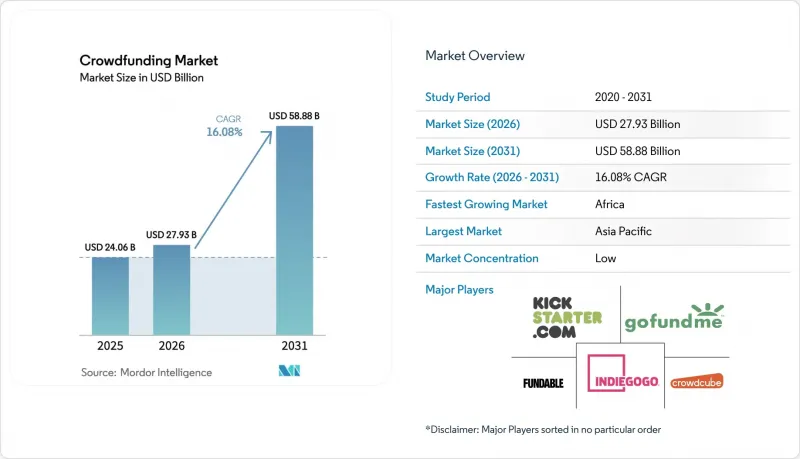
根據 Mordor Intelligence 預測,群眾集資市場規模預計將在 2025 年達到 240.6 億美元,2026 年達到 279.3 億美元,到 2031 年達到 588.8 億美元,2026 年至 2031 年的複合年成長率為 16.08%。
本報告依資金籌措模式(獎勵型、股權型、其他)、投資規模(微型(低於1萬美元)、小規模(1萬至25萬美元)、其他)、平台部署模式(雲端、本地部署)、投資者類型(個人投資者、其他)、應用領域(科技創新、食品飲料、其他)和地區進行分類。市場預測以美元計價。
全球群眾集資市場趨勢及洞察
歐盟範圍內的ECSP法規擴大了跨境群眾集資的可能性。
歐洲群眾集資服務供應商監管條例(2020/1503)引入了「單一通行證」制度,允許平台無需設立本地實體即可觸及所有成員國的投資者。這降低了法律成本,集中了流動性,並擴大了發行方的覆蓋範圍。然而,該條例也對募資規模設定了500萬歐元(424萬美元)的上限,並強制要求進行標準化資訊揭露。 Seedrs和Crowdcube目前正在向南歐和東歐市場擴張,而海灣地區和非洲的監管機構正在以該框架為標桿,以加速監管趨同。然而,在洗錢防制(AML)方面的解讀仍然存在差異,導致合規工作重疊,並使擁有大規模法律團隊的平台更具優勢。
人工智慧驅動的宣傳活動分析正在提高全球的成功率。
機器學習引擎分析歷史投資承諾數據和即時互動指標,以最佳化定價、獎勵結構和宣傳活動啟動時間。同行評審的研究表明,人工智慧驅動的宣傳活動成功率提高了15-20個百分點。自然語言處理模型提升了宣傳內容的質量,異常檢測功能則能攔截虛假支持者和重複錢包。這些雙重功能增強了投資者信心,並促進了先前受詐騙阻礙的市場的發展。
亞太地區平台的大規模詐欺性損失正在削弱投資者信心。
在監管體系未能跟上交易量成長的地區,詐欺宣傳活動和資金挪用依然猖獗。一些業者規避隔離帳戶和審計要求,損害了老用戶的信任。儘管日本證券交易監督委員會正在加強監管,但執法力度仍然參差不齊,這使得惡意平台有機可乘,鑽監管薄弱地區的空子。
細分市場分析
到2025年,基於獎勵的宣傳活動將佔群眾集資市場佔有率的34.44%,而混合代幣正以16.22%的複合年成長率快速成長,因為智慧合約將獎勵和所有權融合在一起。股權融資輪次也推動了群眾集資市場的擴張,這得益於美國證券交易委員會(SEC)2021年訂定的規則變更,該規則允許最高500萬美元的資金籌措。債務融資模式滿足了新興經濟體金融服務取得管道有限的借款人的需求,而慈善宣傳活動在健康危機期間也蓬勃發展。
混合型發行方式既滿足了投資人對潛在收益的需求,也滿足了他們對流動性的需求。 Republic 目前正透過滾動基金將收益轉化為股權,而日本新的小規模發行製度也明確允許代幣發行。有關二級市場的稅收政策和法規仍在製定中,這加速了混合型發行方式的普及,但也增加了營運的複雜性。
即使到了2025年,低於1萬美元的小額投資仍將佔據50.24%的市場佔有率,但隨著退休基金和家族辦公室進入群眾集資市場,預計超過100萬美元的大額資金籌措將以17.06%的複合年成長率成長。美國證券交易委員會(SEC)取消合格投資者投資額上限的改革也刺激了七位數投資的成長。 1萬至25萬美元的小額投資面向合格天使投資者和企業聯合組織投資機構,他們匯集資金以在平台上獲得精選項目;而25萬至100萬美元的中額投資則填補了天使輪融資和機構A輪資金籌措之間的空白。
各平台都在採取措施吸引經驗豐富的投資者,例如分階段進行 KYC(了解你的客戶)驗證、簽署補充協議以及與股權結構表整合。 AngelList 的數據顯示,其種子輪融資交易中有三分之一投向了人工智慧新創公司,這凸顯了機構投資者正將資金集中在高成長領域。另一方面,人們擔心那些將社群建設置於財務回報之上的個人投資者可能會被排除在市場之外。
區域分析
亞太地區佔全球整體交易總量的一半,這主要得益於行動錢包的普及、有利的沙盒監管以及日本2024年將小規模IPO限額提高四倍的改革。該地區的區塊鏈中心,如新加坡、香港和東京,位置眾多安全符記交易所,這些交易所增強了流動性並支持群眾集資市場。儘管在中國和東南亞部分地區,詐騙問題仍然令人擔憂,但人工智慧驅動的監控正在縮小信任差距。
非洲17.54%的複合年成長率主要得益於行動支付的普及和企業ESG相關資金的流入。各平台正透過與M-Pesa支付網路整合並接受無銀行帳戶用戶的投資來擴大其覆蓋範圍。然而,西非地區高昂的網路費用和卡片付款閘道器的限制推高了營運成本,減緩了其向法語國家的擴張。
北美受惠於龐大的合格投資者群體和美國證券交易委員會(SEC)較為寬鬆的資金籌措上限,推動了大規模融資,模糊了創業投資與其他產業之間的界線。歐洲正利用歐洲證券及期貨服務提供者(ECSP)護照連接分散的市場,但由於洗錢防制(AML)法規的差異,合規成本仍然很高,導致大型企業市場佔有率集中度上升。
在南美洲,貨幣波動性是一個挑戰,巴西和阿根廷的平台提供以穩定幣計價的宣傳活動,以對沖通膨風險。在中東,符合伊斯蘭教法的機制正日益受到關注,而資產支持的利潤分享模式在沿岸地區尤其受歡迎,因為它符合伊斯蘭金融原則。
其他好處
- Excel格式的市場預測(ME)表
- 3個月的分析師支持
目錄
第1章:引言
- 研究假設和市場定義
- 調查範圍
第2章:調查方法
第3章執行摘要
第4章 市場狀況
- 市場概覽
- 市場促進因素
- 社群媒體主導的病毒式傳播效應促進了北美和歐洲的獎勵型宣傳活動。
- 歐盟範圍內的ECSP法規為跨境群眾集資開闢了道路。
- 利用人工智慧驅動的宣傳活動分析提高全球成功率
- 基於區塊鏈的代幣化技術的興起,使得亞太地區的房地產交易成為可能。
- 推動企業 ESG 舉措,為非洲和南美洲的社會影響力宣傳活動籌集資金。
- 符合伊斯蘭教法的群眾集資平台在中東地區日益普及
- 市場限制因素
- 亞太地區因平台濫用詐騙造成的巨額損失和投資者信心喪失。
- 歐洲和美國的 KYC 和 AML 法規碎片化,導致合規成本上升。
- 由於宣傳活動激增,人們對群眾集資疲勞,導致捐款轉換率下降。
- 新興非洲市場對付款閘道的進入限制了群眾集資平台的推出。
- 產業價值鏈分析
- 監理展望
- 技術展望
- 宏觀經濟因素對市場的影響
- 波特五力分析
第5章 市場規模與成長預測
- 按資金籌措模式
- 獎勵類型
- 庫存基礎
- 債務/P2P借貸
- 基於捐贈
- 混合/基於區塊鏈
- 專注於房地產的群眾集資
- 按投資規模
- 微型(10,000 美元以下)
- 小規模(10,000 美元至 250,000 美元)
- 中型(25萬美元至100萬美元)
- 大型專案(超過100萬美元)
- 透過平台實施
- 基於雲端的
- 現場
- 按投資者類型
- 個人投資者
- 合格投資者/高淨資產投資者
- 機構投資者
- 企業策略
- 按應用程式字段
- 技術與創新
- 飲食
- 媒體與娛樂
- 房地產和建築
- 醫療保健和生命科學
- 社會影響力與非營利組織
- 消費品和時尚
- 其他應用領域
- 按地區
- 北美洲
- 美國
- 加拿大
- 墨西哥
- 南美洲
- 巴西
- 阿根廷
- 其他南美國家
- 歐洲
- 德國
- 英國
- 法國
- 義大利
- 西班牙
- 俄羅斯
- 其他歐洲國家
- 亞太地區
- 中國
- 日本
- 印度
- 韓國
- 澳洲和紐西蘭
- 東南亞
- 其他亞太國家
- 中東
- 沙烏地阿拉伯
- 阿拉伯聯合大公國
- 土耳其
- 其他中東國家
- 非洲
- 南非
- 奈及利亞
- 肯亞
- 其他非洲地區
- 北美洲
第6章 競爭情勢
- 市場集中度
- 策略趨勢
- 市佔率分析
- 公司簡介
- Kickstarter PBC
- Indiegogo Inc.
- GoFundMe Inc.
- Crowdcube Limited
- Fundable LLC
- Wefunder Inc.
- CircleUp Network Inc.
- SeedInvest Technology Inc.
- Patreon Inc.
- Fundrise LLC
- Crowdfunder Inc.
- StartEngine Crowdfunding Inc.
- AngelList Holdings LLC
- GoGetFunding
- RealCrowd Inc.
- MicroVentures
- LendingClub Corporation
- Seedrs Limited
- Ulule SAS
- Campfire Inc.
- Milaap Social Ventures India Private Limited
- Makestar Co., Ltd.
- Mightycause Corporation
第7章 市場機會與未來展望
According to Mordor Intelligence, the crowdfunding market size is projected to be USD 24.06 billion in 2025, USD 27.93 billion in 2026, and reach USD 58.88 billion by 2031, growing at a CAGR of 16.08% from 2026 to 2031.
This report is Segmented by Funding Model (Reward-Based, Equity-Based, and More), Investment Size (Micro (Less Than USD 10, 000), Small (USD 10, 000 - 25, 000), and More), Platform Deployment (Cloud-Based, and On-Premises), Investor Type (Individual Retail, and More), Application Sector (Technology and Innovation, Food and Beverage, and More), and Geography. The Market Forecasts are Provided in Terms of Value (USD).
Global Crowdfunding Market Trends and Insights
EU-Wide ECSP Regulation Unlocking Cross-Border Equity Crowdfunding
The European Crowdfunding Service Providers Regulation 2020/1503 offers a single passport that lets platforms reach investors across all member states without opening local entities. This lowers legal overhead, aggregates liquidity, and expands issuer reach, all while capping offering size at EUR 5 million (USD 4.24 million) and mandating standardized disclosures. Seedrs and Crowdcube now penetrate Southern and Eastern Europe, while regulators in the Gulf and Africa benchmark the framework to accelerate convergence. Persistent divergence in AML interpretations still raises compliance duplication, favoring platforms with large legal teams.
AI-Powered Campaign Analytics Increasing Success Rates Globally
Machine-learning engines parse historical pledge data and real-time engagement metrics to optimize pricing, reward tiers, and launch timing. Peer-reviewed studies show a 15-20-percentage-point lift in success rates for AI-enhanced campaigns. Natural-language models refine pitch quality, while anomaly detection blocks fake backers and duplicate wallets. These dual functions enhance investor trust and drive adoption in markets previously hamstrung by fraud.
High Platform Fraud Losses Undermining Investor Trust in Asia Pacific
Fraudulent campaigns and misappropriation of funds persist where supervision lags transaction volumes. Some operators bypass requirements for segregated accounts and audits, eroding confidence among repeat backers. Japan's Securities and Exchange Surveillance Commission has tightened oversight, yet enforcement remains uneven, allowing rogue platforms to arbitrage weak jurisdictions.
Other drivers and restraints analyzed in the detailed report include:
- Emergence of Blockchain Tokenization Enabling Fractional Real Estate in Asia Pacific
- Corporate ESG Commitments Channeling Funds Into Social-Impact Campaigns
- Fragmented KYC/AML Rules Elevating Compliance Costs
For complete list of drivers and restraints, kindly check the Table Of Contents.
Segment Analysis
Reward campaigns accounted for a 34.44% crowdfunding market share in 2025, yet hybrid tokens are advancing at a 16.22% CAGR as smart contracts blend perks with equity rights. Equity rounds benefit from the SEC's 2021 rule change allowing raises up to USD 5 million, broadening the crowdfunding market. Debt-based models meet underserved borrowers in emerging economies, while donation drives surge during health crises.
Hybrid offerings satisfy investor hunger for upside and liquidity. Republic now converts perks into equity through rolling funds, and Japan's new small-offering regime expressly accommodates token offerings. Tax clarity and secondary-market rules remain works in progress, adding operational complexity even as adoption accelerates.
Micro pledges below USD 10,000 still account for 50.24% share in 2025, but large-ticket rounds over USD 1 million show a 17.06% CAGR as pension funds and family offices embrace the crowdfunding market. SEC reforms that drop caps for accredited investors encourage seven-figure checks. Small investments between USD 10,000 and USD 250,000 serve accredited angels and syndicates that pool capital to access deal flow curated by platforms, while medium-sized investments between USD 250,000 and USD 1 million bridge the gap between angel rounds and institutional Series A financings.
Platforms respond with tiered KYC, side letters, and cap-table integrations acceptable to sophisticated allocators. AngelList reports that one-third of its seed deals involve AI startups, illustrating how institutional flows favor high-growth themes. The risk is crowding out retail backers who value community over financial returns.
Complete Report Scope:
- By Funding Model
- Reward-Based
- Equity-Based
- Debt / P2P Lending
- Donation-Based
- Hybrid / Blockchain-Based
- Real-Estate-Specific Crowdfunding
- By Investment Size
- Micro (Less Than USD 10 k)
- Small (USD 10 k - 250 k)
- Medium (USD 250 k - 1 m)
- Large (Greater Than USD 1 m)
- By Platform Deployment
- Cloud-Based
- On-Premise
- By Investor Type
- Individual Retail
- Accredited / High-Net-Worth
- Institutional
- Corporate Strategic
- By Application Sector
- Technology and Innovation
- Food and Beverage
- Media and Entertainment
- Real Estate and Construction
- Healthcare and Life Sciences
- Social Impact and Non-Profit
- Consumer Products and Fashion
- Other Application Sectors
- By Geography
- North America
- United States
- Canada
- Mexico
- South America
- Brazil
- Argentina
- Rest of South America
- Europe
- Germany
- United Kingdom
- France
- Italy
- Spain
- Russia
- Rest of Europe
- Asia Pacific
- China
- Japan
- India
- South Korea
- Australia and New Zealand
- Southeast Asia
- Rest of Asia Pacific
- Middle East
- Saudi Arabia
- United Arab Emirates
- Turkey
- Rest of Middle East
- Africa
- South Africa
- Nigeria
- Kenya
- Rest of Africa
- North America
Geography Analysis
Asia Pacific commands half of global volume, driven by mobile wallets, supportive sandbox regulations, and the 2024 Japanese reforms that quadrupled small-offering limits. The region's blockchain hubs Singapore, Hong Kong, and Tokyo host security-token exchanges that deepen liquidity and anchor the crowdfunding market. Fraud concerns remain pronounced in China and parts of Southeast Asia, yet AI-powered monitoring is narrowing the trust gap.
Africa's 17.54% CAGR stems from mobile-money ubiquity and corporate ESG inflows. Platforms integrate M-Pesa rails to accept pledges without bank accounts, broadening reach. However, high network fees and restricted card gateways in West Africa raise operating costs, delaying expansion into francophone countries.
North America benefits from a deep base of accredited investors and the SEC's relaxed caps, fueling mega rounds that blur lines with venture capital. Europe leverages the ECSP passport to knit fragmented markets, but divergent AML rules keep compliance costs high, consolidating share among larger operators.
South America faces currency volatility, so Brazilian and Argentine platforms now offer stablecoin-denominated campaigns to hedge inflation. The Middle East's Shariah-compliant structures are gaining traction, especially in the Gulf, where asset-backed profit-sharing aligns with Islamic finance principles.
- Kickstarter PBC
- Indiegogo Inc.
- GoFundMe Inc.
- Crowdcube Limited
- Fundable LLC
- Wefunder Inc.
- CircleUp Network Inc.
- SeedInvest Technology Inc.
- Patreon Inc.
- Fundrise LLC
- Crowdfunder Inc.
- StartEngine Crowdfunding Inc.
- AngelList Holdings LLC
- GoGetFunding
- RealCrowd Inc.
- MicroVentures
- LendingClub Corporation
- Seedrs Limited
- Ulule SAS
- Campfire Inc.
- Milaap Social Ventures India Private Limited
- Makestar Co., Ltd.
- Mightycause Corporation
Additional Benefits:
- The market estimate (ME) sheet in Excel format
- 3 months of analyst support
TABLE OF CONTENTS
1 INTRODUCTION
- 1.1 Study Assumptions and Market Definition
- 1.2 Scope of the Study
2 RESEARCH METHODOLOGY
3 EXECUTIVE SUMMARY
4 MARKET LANDSCAPE
- 4.1 Market Overview
- 4.2 Market Drivers
- 4.2.1 Social-Media-Driven Virality Boosting Reward Campaigns in North America and Europe
- 4.2.2 EU-Wide ECSP Regulation Unlocking Cross-Border Equity Crowdfunding
- 4.2.3 AI-Powered Campaign Analytics Increasing Success Rates Globally
- 4.2.4 Emergence of Blockchain-Based Tokenization Enabling Fractional Real-Estate Deals in Asia Pacific
- 4.2.5 Corporate ESG Commitments Channelling Funds into Social-Impact Campaigns in Africa and South America
- 4.2.6 Rising Adoption of Shariah-Compliant Crowdfunding Platforms in Middle East
- 4.3 Market Restraints
- 4.3.1 High Platform Fraud Losses Undermining Investor Trust in Asia Pacific
- 4.3.2 Fragmented KYC/AML Rules Elevating Compliance Costs in Europe and United States
- 4.3.3 Crowdfunding Fatigue Amid Campaign Proliferation Lowering Donation Conversion Rates
- 4.3.4 Restricted Payment Gateway Access Limiting Crowdfunding Platform Launches in Emerging African Markets
- 4.4 Industry Value Chain Analysis
- 4.5 Regulatory Outlook
- 4.6 Technological Outlook
- 4.7 Impact of Macroeconomic Factors on the Market
- 4.8 Porter's Five Forces Analysis
- 4.8.1 Threat of New Entrants
- 4.8.2 Bargaining Power of Buyers/Consumers
- 4.8.3 Bargaining Power of Suppliers
- 4.8.4 Threat of Substitute Products
- 4.8.5 Intensity of Competitive Rivalry
5 MARKET SIZE AND GROWTH FORECASTS (VALUE)
- 5.1 By Funding Model
- 5.1.1 Reward-Based
- 5.1.2 Equity-Based
- 5.1.3 Debt / P2P Lending
- 5.1.4 Donation-Based
- 5.1.5 Hybrid / Blockchain-Based
- 5.1.6 Real-Estate-Specific Crowdfunding
- 5.2 By Investment Size
- 5.2.1 Micro (Less Than USD 10 k)
- 5.2.2 Small (USD 10 k - 250 k)
- 5.2.3 Medium (USD 250 k - 1 m)
- 5.2.4 Large (Greater Than USD 1 m)
- 5.3 By Platform Deployment
- 5.3.1 Cloud-Based
- 5.3.2 On-Premise
- 5.4 By Investor Type
- 5.4.1 Individual Retail
- 5.4.2 Accredited / High-Net-Worth
- 5.4.3 Institutional
- 5.4.4 Corporate Strategic
- 5.5 By Application Sector
- 5.5.1 Technology and Innovation
- 5.5.2 Food and Beverage
- 5.5.3 Media and Entertainment
- 5.5.4 Real Estate and Construction
- 5.5.5 Healthcare and Life Sciences
- 5.5.6 Social Impact and Non-Profit
- 5.5.7 Consumer Products and Fashion
- 5.5.8 Other Application Sectors
- 5.6 By Geography
- 5.6.1 North America
- 5.6.1.1 United States
- 5.6.1.2 Canada
- 5.6.1.3 Mexico
- 5.6.2 South America
- 5.6.2.1 Brazil
- 5.6.2.2 Argentina
- 5.6.2.3 Rest of South America
- 5.6.3 Europe
- 5.6.3.1 Germany
- 5.6.3.2 United Kingdom
- 5.6.3.3 France
- 5.6.3.4 Italy
- 5.6.3.5 Spain
- 5.6.3.6 Russia
- 5.6.3.7 Rest of Europe
- 5.6.4 Asia Pacific
- 5.6.4.1 China
- 5.6.4.2 Japan
- 5.6.4.3 India
- 5.6.4.4 South Korea
- 5.6.4.5 Australia and New Zealand
- 5.6.4.6 Southeast Asia
- 5.6.4.7 Rest of Asia Pacific
- 5.6.5 Middle East
- 5.6.5.1 Saudi Arabia
- 5.6.5.2 United Arab Emirates
- 5.6.5.3 Turkey
- 5.6.5.4 Rest of Middle East
- 5.6.6 Africa
- 5.6.6.1 South Africa
- 5.6.6.2 Nigeria
- 5.6.6.3 Kenya
- 5.6.6.4 Rest of Africa
- 5.6.1 North America
6 COMPETITIVE LANDSCAPE
- 6.1 Market Concentration
- 6.2 Strategic Moves
- 6.3 Market Share Analysis
- 6.4 Company Profiles (Includes Global Level Overview, Market Level Overview, Core Segments, Financials as Available, Strategic Information, Market Rank/Share for Key Companies, Products and Services, and Recent Developments)
- 6.4.1 Kickstarter PBC
- 6.4.2 Indiegogo Inc.
- 6.4.3 GoFundMe Inc.
- 6.4.4 Crowdcube Limited
- 6.4.5 Fundable LLC
- 6.4.6 Wefunder Inc.
- 6.4.7 CircleUp Network Inc.
- 6.4.8 SeedInvest Technology Inc.
- 6.4.9 Patreon Inc.
- 6.4.10 Fundrise LLC
- 6.4.11 Crowdfunder Inc.
- 6.4.12 StartEngine Crowdfunding Inc.
- 6.4.13 AngelList Holdings LLC
- 6.4.14 GoGetFunding
- 6.4.15 RealCrowd Inc.
- 6.4.16 MicroVentures
- 6.4.17 LendingClub Corporation
- 6.4.18 Seedrs Limited
- 6.4.19 Ulule SAS
- 6.4.20 Campfire Inc.
- 6.4.21 Milaap Social Ventures India Private Limited
- 6.4.22 Makestar Co., Ltd.
- 6.4.23 Mightycause Corporation
7 MARKET OPPORTUNITIES AND FUTURE OUTLOOK
- 7.1 White-Space and Unmet-Need Assessment

 另類資金籌措:市場佔有率分析、產業趨勢與統計、成長預測(2026-2031)
 全球群眾集資市場規模、佔有率、趨勢和成長分析報告(2026-2034年)
 商家現金預支市場:依還款方式、最終用戶及地區分類
 另類資金籌措市場規模、佔有率和成長分析:按提供者類型、部署模式、企業規模、最終用戶產業和地區分類-2026-2033年產業預測
 群眾集資平台市場預測至2034年:按資金籌措模式、宣傳活動類型、平台功能、部署模式和最終用戶分類的全球分析
 2026-2030年全球群眾集資市場醫療群眾集資市場:按群眾集資類型、應用、適應症、最終用戶和地區分類。另類資金籌措市場規模、佔有率、成長及全球產業分析:按類型、應用和地區分類,並預測至2026-2034年
 2026年全球群眾集資市場報告群眾集資市場規模、佔有率、成長率及全球產業分析:按類型、應用和地區分類的洞察,以及2026-2034年的預測