


 |
市場調查報告書
商品編碼
2125653
歐洲太陽能追蹤器:市場佔有率分析、行業趨勢和統計數據以及成長預測(2026-2031 年)Europe Solar Tracker - Market Share Analysis, Industry Trends & Statistics, Growth Forecasts (2026 - 2031) |
||||||

※ 本網頁內容可能與最新版本有所差異。詳細情況請與我們聯繫。
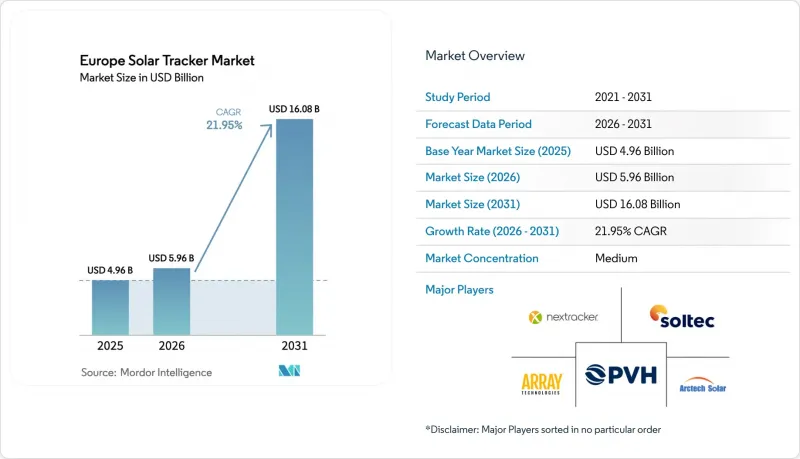
歐洲太陽能追蹤器市場預計到 2025 年將達到 49.6 億美元,到 2026 年將達到 59.6 億美元,到 2031 年將達到 160.8 億美元,2026 年至 2031 年的複合年成長率為 21.95%。
本報告涵蓋軸類型(單軸和雙軸)、技術(光伏、聚光型太陽光電、聚光型太陽光電)、驅動系統(馬達、線性致動器、液壓)、應用(公用事業規模、商業和工業、住宅和微電網、農光互補/農光互補)以及地區(英國、德國、法國、義大利、西班牙、荷蘭等)。
歐洲太陽能追蹤器市場的趨勢和洞察
南歐地區太陽輻射充足
在安達盧西亞和西西里島,年太陽輻射量超過1800千瓦時/平方米,與固定傾角系統相比,追蹤式太陽能發電系統可提高15-20%的能源產量,且投資回收期不到兩年。在西班牙,2024年新增太陽能發電裝置容量9.4吉瓦,其中以590兆瓦的弗朗西斯科·皮薩羅(Francisco Pizarro)電站最為突出,該電站採用單軸追蹤器,以最大限度地提高夏季的峰值發電量。義大利2024年新增的5.3吉瓦裝置容量包括多個採用雙面組件和追蹤器的項目,以最大限度地提高淺色土壤背面的發電量。希臘也緊隨其後,Nextracker公司於2025年6月獲得了奧裡凱奧(Orikeio)PPC Ptolemaida改造專案的550兆瓦訂單。這清楚地表明,追蹤器如何為昔日的煤礦區創造價值。在北歐,由於太陽輻射低、積雪重,此因素的影響有限,但南歐偏遠地區的優勢仍是長期成長的支柱。
歐盟綠色交易與再生能源歐盟太陽能發電目標
REPowerEU已將歐盟2030年的太陽能累積裝置目標提高至700吉瓦,相當於每年約60吉瓦的建設速度,是2023年速度的兩倍。德國的授權製度改革已將超過1兆瓦的地面光伏陣列的核准週期縮短至9個月,從而釋放出大片適合部署追蹤器的土地。西班牙在2024年6月的競標中獲得了3.8吉瓦的裝置容量,平均中標價格為0.029歐元/千瓦時。這進一步鞏固了追蹤器作為低成本購電協定(PPA)預設選項的地位。法國的CRE-7競標分配了3.7吉瓦的裝置容量,但仍面臨當地居民的反對,顯示各國實施速度不一。修訂後的《可再生能源指令》強制推行的「可再生能源加速區」的快速發展預計將在2027年前釋放出新的土地,而對能夠最大限度提高能量密度的追蹤系統的需求預計將持續成長。
高初始資本支出(CAPEX)與固定傾斜式
單軸追蹤器比固定式太陽能系統貴15%至25%(每瓦直流電0.08至0.12美元),在太陽輻射量低或利率高的市場,投資回收期可能延長至一年以上。波蘭和羅馬尼亞的開發商為了最大限度地降低債務償還成本,將追蹤器的採用率控制在30%以下。同樣,屋頂安裝普遍的德國市場也更傾向於結構簡單的固定式太陽能系統。歐洲央行貨幣政策的調整,例如降低折現率,可以緩解這些不利因素,但預計短期內這些不利因素仍將持續存在。
細分市場分析
預計到2025年,雙軸追蹤系統將佔新增收入的42.5%,複合年成長率達23.0%,比歐洲太陽能追蹤系統市場整體成長率高出約1個百分點。然而,由於單軸系統成本低15-20%,維護更簡便,其在總裝置容量方面仍佔據主導地位。在西班牙,得益於地勢平坦和太陽輻射量高的優勢,到2024年,單軸追蹤系統約佔9.4吉瓦裝置容量的70%。同時,在義大利,農業太陽能(農光互補)補貼政策使雙軸系統更具優勢,因為它們可以改變方向,避開作物生長關鍵階段的作物。
就規模經濟而言,大型單軸馬達製造商仍佔優勢。 Nextracker在2025會計年度全球整體出貨量達到33.6吉瓦,而雙軸馬達供應商的出貨量均未超過1吉瓦。然而,能夠適應地形的混合系統正在模糊不同類型馬達之間的界限。希臘的550兆瓦Ptolemaida再生計畫採用了沿著地層下陷區起伏方向佈置的成排鉸接式單軸馬達系統,在不增加額外成本的情況下,享受到了雙軸馬達系統的諸多優勢。在德國北部等太陽輻射量較低的地區,開發商仍然優先考慮固定傾角或基礎單軸追蹤系統,以確保盈利。
儘管到2025年,標準光伏(PV)將以87.1%的市場佔有率佔據主導地位,但預計到2031年,聚光光伏(CPV)將憑藉南歐地區超過2000千瓦時/平方米的直接太陽輻照度(DNI)優勢,實現27.1%的複合年成長率(CAGR)。聚光光電模組30-35%的效率僅在西班牙、希臘和義大利的部分地區才能抵銷40-50%的資本支出(CAPEX)溢價。伊維爾德羅拉公司的弗朗西斯科·皮薩羅發電廠就是一個例子,該電廠採用雙面光伏追蹤器,從背面發電量提高了8-10%,在許多競標中取代了聚光燈光伏。
儘管歐洲用於聚光光伏(CPV)系統的太陽能追蹤器市場規模仍低於5億美元,但研究機構和工程總承包(EPC)公司開展的早期先導計畫表明,超高效陣列在土地資源有限的地區具有成為利基市場的潛力。相較之下,用於聚光太陽能發電(CSP)系統的追蹤器仍處於輔助地位,因為其平準化能源成本(LCOE)為每千瓦時0.10-0.15美元,無法與「光伏+儲能」系統競爭。隨著聚光光伏供應鏈的成熟和標準化進程的推進,雙軸追蹤的精確度將變得至關重要,並成為未來市場擴張的基礎。
其他好處:
- Excel格式的市場預測(ME)表
- 3個月的分析師支持
目錄
第1章:引言
- 研究假設和市場定義
- 調查範圍
第2章:調查方法
第3章執行摘要
第4章 市場狀況
- 市場概覽
- 市場促進因素
- 南歐地區太陽輻射充足
- 歐盟綠色新政與再生能源歐盟太陽能發電目標
- 更低的硬體成本和更高的追蹤器可靠性
- 農用車輛/棕地地形追蹤器
- 透過人工智慧驅動的預測性維護降低平準化能源成本
- 歐盟《淨零排放產業法案》下的本地生產獎勵措施
- 市場限制因素
- 初始資本支出(CAPEX)較高與固定傾斜式
- 北歐風雪荷載設計
- 鋼材價格波動推高了音樂銀行的成本。
- 系統約束風險會降低盈利。
- 供應鏈分析
- 監理情勢
- 技術展望
- 波特五力模型
第5章 市場規模與成長預測
- 按軸類型
- 單軸
- 雙軸
- 透過技術
- 太陽能發電(PV)
- 聚光型太陽熱能發電(CSP)
- 聚光型太陽光電(CPV)
- 透過驅動系統
- 電動機
- 線性致動器
- 油壓
- 透過使用
- 公用事業規模
- 商業和工業用途 (CandI)
- 住宅及微電網
- 農光伏/農太陽能
- 按地區
- 英國
- 德國
- 法國
- 義大利
- 西班牙
- 北歐國家
- 荷蘭
- 俄羅斯
- 其他歐洲國家
第6章 競爭情勢
- 市場集中度
- 策略趨勢(併購、聯盟、購電協議)
- 市場佔有率分析(主要公司的市場排名和市場佔有率)
- 公司簡介
- Nextracker Inc.
- Array Technologies Inc.
- Soltec Power Holdings SA
- PV Hardware(PVH)
- Arctech Solar Holding Co. Ltd.
- Ideematec Deutschland GmbH
- Convert Italia SpA
- Solar FlexRack
- Valmont Solar
- TrinaTracker(Trina Solar)
- Axial Structural Solutions
- Gonvarri Solar Steel
- FTC Solar Inc.
- GameChange Solar
- Optimum Tracker
- Mecasolar
- DEGERenergie GmbH
- SunPower Corporation
- Sun Action Trackers
- Antaisolar
第7章 市場機會與未來展望
According to Mordor Intelligence, the Europe solar tracker market size is projected to be USD 4.96 billion in 2025, USD 5.96 billion in 2026, and reach USD 16.08 billion by 2031, growing at a CAGR of 21.95% from 2026 to 2031.
This report is Segmented by Axis Type (Single Axis and Dual Axis), Technology (Photovoltaic, Concentrated Solar Power, and Concentrated Photovoltaic), Drive Type (Electric Motor, Linear Actuator, and Hydraulic), Application (Utility-Scale, Commercial and Industrial, Residential and Micro-Grid, and Agrivoltaic/Agri-solar), and Geography (United Kingdom, Germany, France, Italy, Spain, Netherlands, and More)
Europe Solar Tracker Market Trends and Insights
Abundant Solar Irradiation Across Southern Europe
Annual irradiation above 1,800 kWh/m2 in Andalusia and Sicily lifts tracker energy yield 15-20% versus fixed-tilt and compresses payback to under two years. Spain added 9.4 GW of new solar capacity in 2024, spearheaded by the 590 MW Francisco Pizarro plant that employs single-axis trackers to harvest peak summer output. Italy's 5.3 GW of 2024 additions included multiple bifacial-with-tracker projects that maximize rear-side gain on light-colored soils. Greece is following suit: in June 2025, Nextracker won a 550 MW order for the Oricheio PPC Ptolemaida redevelopment, underscoring how trackers unlock value on reclaimed coal land. Northern Europe's lower irradiation and heavier snow loads moderate this driver's influence, but Southern Europe's isolation edge remains a long-term growth pillar.
EU Green Deal & REPowerEU Solar Targets
REPowerEU raises the bloc's cumulative solar objective to 700 GW by 2030, translating into an annual build-rate near 60 GW, double the 2023 pace. Permitting reforms in Germany trimmed approval cycles for >1 MW ground-mount arrays to nine months, unlocking sizable tracker-ready parcels. Spain cleared 3.8 GW of capacity in its June 2024 auction with winning bids averaging EUR 0.029/kWh, reinforcing trackers as the default choice to honor low-priced PPAs. France's CRE-7 tender allocated 3.7 GW but still battles local opposition, illustrating divergent national execution speeds. Fast-track "renewable acceleration areas" mandated by the revised Renewable Energy Directive are expected to release fresh land banks by 2027, sustaining demand for tracker systems that can maximize energy density.
High Upfront CAPEX vs. Fixed-Tilt
Single-axis trackers carry a 15-25% premium (USD 0.08-0.12/WDC) over fixed-tilt, extending payback by up to a year in lower-irradiation or higher-interest-rate markets. Polish and Romanian developers keep tracker penetration below 30% as they seek to minimize debt service costs. Germany's rooftop-heavy market likewise favors simpler fixed systems. A monetary-policy pivot by the European Central Bank would soften this drag by lowering discount rates, but near-term headwinds persist.
Other drivers and restraints analyzed in the detailed report include:
- Declining Tracker Hardware Costs & Improved Reliability
- Terrain-Following Trackers for Agrivoltaics/Brownfields
- Wind & Snow-Load Engineering in Northern Europe
For complete list of drivers and restraints, kindly check the Table Of Contents.
Segment Analysis
Dual-axis installations captured 42.5% of incremental revenue in 2025 and are poised to rise at a 23.0% CAGR, outpacing the overall European solar tracker market by roughly 1 percentage point. Single-axis systems nonetheless dominate headline volumes because they cost 15-20% less and offer simpler maintenance protocols. Spain deployed single-axis trackers on roughly 70% of its 9.4 GW 2024 build, leveraging flat terrain and high irradiation. Italy's agrivoltaic subsidies tilt the scales toward dual-axis, which can orient away from crops during sensitive growth stages.
Economies of scale still favor single-axis giants; Nextracker shipped 33.6 GW globally in fiscal 2025, while no dual-axis supplier breached 1 GW. Even so, terrain-adaptive hybrids are blurring classification: Greece's 550 MW Ptolemaida rehabilitation relies on articulated single-axis rows that contour subsidence zones, capturing many benefits of dual-axis without incurring full incremental cost. In lower-irradiation geographies such as Northern Germany, developers continue to prioritize fixed-tilt or basic single-axis to protect return profiles.
Standard PV dominated with 87.1% share in 2025, yet CPV is projected to post a 27.1% CAGR through 2031 by monetizing Southern Europe's >2,000 kWh/m2 DNI corridors. CPV's 30-35% module efficiency offsets its 40-50% CAPEX premium only in Spain, Greece, and parts of Italy. Iberdrola's Francisco Pizarro plant illustrates how bifacial PV trackers capture 8-10% rear-side gain, crowding out CPV in many bids.
The European solar tracker market size for CPV remains below USD 0.5 billion, but early-stage pilots by research institutes and EPCs signal a niche future for ultra-high-efficiency arrays where land is scarce. CSP trackers, in contrast, remain sidelined because their USD 0.10-0.15/kWh LCOE cannot match PV-plus-storage. As CPV supply chains mature and standardization improves, dual-axis tracking precision will be indispensable, anchoring their future expansion.
Complete Report Scope:
- By Axis Type
- Single Axis
- Dual Axis
- By Technology
- Photovoltaic (PV)
- Concentrated Solar Power (CSP)
- Concentrated Photovoltaic (CPV)
- By Drive Type
- Electric Motor
- Linear Actuator
- Hydraulic
- By Application
- Utility-Scale
- Commercial and Industrial (CandI)
- Residential and Micro-grid
- Agrivoltaics/Agri-solar
- By Geography
- United Kingdom
- Germany
- France
- Italy
- Spain
- NORDIC Countries
- Netherlands
- Russia
- Rest of Europe
List of Companies Covered in this Report:
- Nextracker Inc.
- Array Technologies Inc.
- Soltec Power Holdings SA
- PV Hardware (PVH)
- Arctech Solar Holding Co. Ltd.
- Ideematec Deutschland GmbH
- Convert Italia SpA
- Solar FlexRack
- Valmont Solar
- TrinaTracker (Trina Solar)
- Axial Structural Solutions
- Gonvarri Solar Steel
- FTC Solar Inc.
- GameChange Solar
- Optimum Tracker
- Mecasolar
- DEGERenergie GmbH
- SunPower Corporation
- Sun Action Trackers
- Antaisolar
Additional Benefits:
- The market estimate (ME) sheet in Excel format
- 3 months of analyst support
TABLE OF CONTENTS
1 Introduction
- 1.1 Study Assumptions & Market Definition
- 1.2 Scope of the Study
2 Research Methodology
3 Executive Summary
4 Market Landscape
- 4.1 Market Overview
- 4.2 Market Drivers
- 4.2.1 Abundant solar irradiation across Southern Europe
- 4.2.2 EU Green Deal & REPowerEU solar targets
- 4.2.3 Declining tracker hardware costs & improved reliability
- 4.2.4 Terrain-following trackers for agrivoltaics/brownfields
- 4.2.5 AI-enabled predictive maintenance lowering LCOE
- 4.2.6 EU Net-Zero Industry Act incentives for local production
- 4.3 Market Restraints
- 4.3.1 High upfront CAPEX vs. fixed-tilt
- 4.3.2 Wind & snow-load engineering in Northern Europe
- 4.3.3 Steel-price volatility inflating BoM costs
- 4.3.4 Grid-curtailment risk reducing yield economics
- 4.4 Supply-Chain Analysis
- 4.5 Regulatory Landscape
- 4.6 Technological Outlook
- 4.7 Porter's Five Forces
- 4.7.1 Bargaining Power of Suppliers
- 4.7.2 Bargaining Power of Buyers
- 4.7.3 Threat of New Entrants
- 4.7.4 Threat of Substitutes
- 4.7.5 Intensity of Competitive Rivalry
5 Market Size & Growth Forecasts
- 5.1 By Axis Type
- 5.1.1 Single Axis
- 5.1.2 Dual Axis
- 5.2 By Technology
- 5.2.1 Photovoltaic (PV)
- 5.2.2 Concentrated Solar Power (CSP)
- 5.2.3 Concentrated Photovoltaic (CPV)
- 5.3 By Drive Type
- 5.3.1 Electric Motor
- 5.3.2 Linear Actuator
- 5.3.3 Hydraulic
- 5.4 By Application
- 5.4.1 Utility-Scale
- 5.4.2 Commercial and Industrial (CandI)
- 5.4.3 Residential and Micro-grid
- 5.4.4 Agrivoltaics/Agri-solar
- 5.5 By Geography
- 5.5.1 United Kingdom
- 5.5.2 Germany
- 5.5.3 France
- 5.5.4 Italy
- 5.5.5 Spain
- 5.5.6 NORDIC Countries
- 5.5.7 Netherlands
- 5.5.8 Russia
- 5.5.9 Rest of Europe
6 Competitive Landscape
- 6.1 Market Concentration
- 6.2 Strategic Moves (M&A, Partnerships, PPAs)
- 6.3 Market Share Analysis (Market Rank/Share for key companies)
- 6.4 Company Profiles (includes Global-level Overview, Market-level Overview, Core Segments, Financials, Strategic Info, Products & Services, Recent Developments)
- 6.4.1 Nextracker Inc.
- 6.4.2 Array Technologies Inc.
- 6.4.3 Soltec Power Holdings SA
- 6.4.4 PV Hardware (PVH)
- 6.4.5 Arctech Solar Holding Co. Ltd.
- 6.4.6 Ideematec Deutschland GmbH
- 6.4.7 Convert Italia SpA
- 6.4.8 Solar FlexRack
- 6.4.9 Valmont Solar
- 6.4.10 TrinaTracker (Trina Solar)
- 6.4.11 Axial Structural Solutions
- 6.4.12 Gonvarri Solar Steel
- 6.4.13 FTC Solar Inc.
- 6.4.14 GameChange Solar
- 6.4.15 Optimum Tracker
- 6.4.16 Mecasolar
- 6.4.17 DEGERenergie GmbH
- 6.4.18 SunPower Corporation
- 6.4.19 Sun Action Trackers
- 6.4.20 Antaisolar
7 Market Opportunities & Future Outlook
- 7.1 White-space & Unmet-Need Assessment
- 7.2 Emerging Agrivoltaic Tracker Solutions
- 7.3 Repowering & Retrofitting Fixed-Tilt Plants
- 7.4 Hybrid PV+Storage Tracker Synergies

 全球單軸太陽能追蹤器市場(2026-2030 年)
 太陽能追蹤器:市場佔有率分析、行業趨勢和統計數據、成長預測(2026-2031)
 太陽能追蹤器市場-2026-2032年全球市場預測雙軸太陽能追蹤器市場—2026-2032年全球市場預測
 雙軸太陽能追蹤器市場規模、佔有率和趨勢分析報告:按類型、應用、地區和細分市場分類(2026-2033 年)太陽能追蹤器市場規模、佔有率和趨勢分析報告:按技術、類型、應用、地區和細分市場分類(2026-2033 年)
 太陽能追蹤器市場機會、成長促進因素、產業趨勢分析及預測(2026-2035)
 單軸太陽能追蹤器市場預測至2034年—按產品類型、旋轉軸、應用和區域分類的全球分析
 太陽能追蹤器市場規模、佔有率和成長分析:按類型、軸類型、應用和地區分類-2026-2033年產業預測
 太陽能追蹤器市場規模、佔有率、趨勢和預測:按類型、追蹤方法、技術、應用和地區分類(2026-2034 年)