


 |
市場調查報告書
商品編碼
2125260
中國即時支付:市場佔有率分析、產業趨勢與統計及成長預測(2026-2031年)China Real Time Payments - Market Share Analysis, Industry Trends & Statistics, Growth Forecasts (2026 - 2031) |
||||||

※ 本網頁內容可能與最新版本有所差異。詳細情況請與我們聯繫。
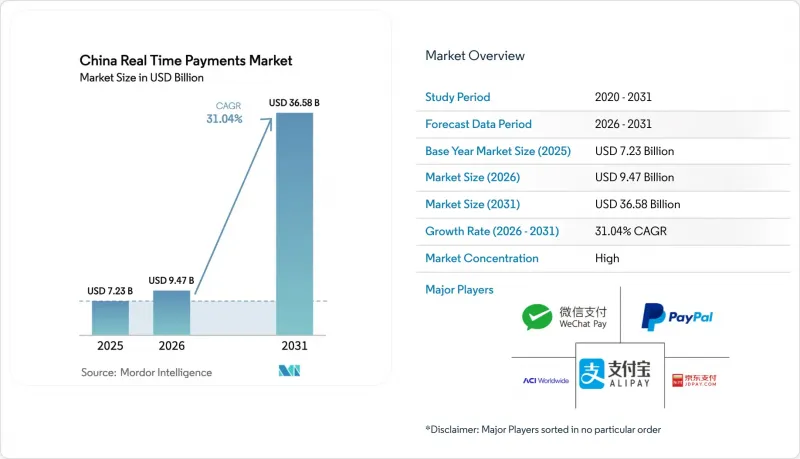
據 Mordor Intelligence 稱,2025 年中國即時支付市值為 72.3 億美元,預計到 2031 年將達到 365.8 億美元,而 2026 年為 94.7 億美元,預測期(2026-2031 年)的複合年成長率為 31.04%。
本報告按交易類型(點對點 (P2P)、點對點 (P2B))、組件(平台/解決方案、服務)、部署模式(雲端、本地部署)、公司規模(大型企業、中小企業)和最終用戶行業(零售/電子商務、銀行、金融服務和保險 (BFSI)、公共產業/電信、醫療保健等)進行細分。市場預測以美元 (USD) 為單位。
中國即時支付市場的趨勢和洞察
行動錢包的爆炸式成長,得益於“支付寶Lite”小程式的推動。
透過將支付按鈕無縫整合到社群媒體動態中,轉換漏斗正在重塑。支付寶的「一觸即付」功能自2024年6月推出以來,光是11個月用戶量就突破了1億。由於無需切換應用程式,全家便利商店等線下連鎖店的會員註冊量增加了兩倍。這表明,嵌入式支付不僅能夠提升用戶忠誠度,還能同時豐富消費者數據。支付寶投資14億美元(100億元)將其生態系統擴展到400個城市和5000個品牌,這表明競爭的重點正在從費用折扣宣傳活動轉向透過體驗和全通路數據來留住客戶。
中國人民銀行(PBoC)強制要求企業接取網路連線平台。
2024年,非銀行結算機構全面過渡到中央清算中心,標準化API的實施消除了銀行間雙邊合作的必要性,提高了監管透明度,並增強了反洗錢措施的分析能力。企業獲得即時結算能力的同時,服務供應商為了維持利潤率,不得不承擔新的清算費用,並打包合規儀錶板和流動性管理附加元件。因此,網聯的架構鼓勵平台業者透過增值金融功能而非價格來脫穎而出。
城市商業銀行ISO 20022實施的片段化問題
儘管CNAPS2和CIPS等大規模支付方案已採用ISO 20022標準,但仍有超過120家城市商業銀行同時使用兩種格式,導致訊息截斷和匹配延遲。預算限制延緩了升級進程,迫使支付服務提供者維護格式轉換工具,從而推高了其營運成本。隨著2025年7月全球合規期限的臨近,壓力只會加劇,在小型銀行完成核心系統重建之前,本地交易成長可能會暫時停滯。
細分市場分析
到2025年,P2P轉帳將佔中國即時支付市場的71.85%,凸顯了社群媒體錢包普及催生的個人對個人支付習慣已根深蒂固。這種主導地位源自於即時分期付款和「紅包」等功能,這些功能持續吸引消費者每天使用應用程式。 P2B(個人對企業)資金流動雖然規模較小,但其複合年成長率高達33.68%,隨著企業優先考慮即時現金轉帳和自動發票匹配,企業資金管理模式正在重塑。京東的跨境穩定幣計畫旨在降低90%的支付成本,並實現10秒結算,這表明即時流動性最佳化對於貿易競爭至關重要。
這一趨勢表明,企業正在調整應付帳款週期,轉向持續結算,減少營運資金緩衝,並降低交易對手風險。供應鏈市場和B2B金融科技公司正透過將信用評分與即時支付結合,拓展交易費以外的收入來源。這種轉變進一步提升了P2B在中國即時支付市場的重要性,預示著一個「以企業為中心」的時代即將到來,其交易量成長將超越以消費者為中心的P2P模式。
隨著銀行和支付服務供應商(PSP) 採用核心交換引擎、開放 API 和帳本服務,預計到 2025 年,平台/解決方案堆疊將佔總收入的 63.92%。隨著基礎架構的日趨成熟,服務業正以 32.8% 的複合年成長率 (CAGR) 成長,需求主要集中在 ISO 20022 遷移、電子人民幣整合和人工智慧驅動的詐欺預防方面。顧問公司和專業整合商透過將傳統核心銀行平台與雲端原生處理器整合,並實施符合 NetsUnion 報告格式的基於規則的合規層,從而創造價值。
螞蟻國際的嵌入式金融套件在2024年使其管理的貸款餘額加倍,這表明服務主導的貨幣化模式優於一次性授權收入。雖然隨著標準化工具包在未來取代客製化編碼,專業服務的利潤率預計將趨於穩定,但出於監管合規調整的策略需求,螞蟻國際在中國更廣泛的即時支付行業中,其諮詢業務仍將保持持續成長。
其他好處:
- Excel格式的市場預測(ME)表
- 3個月的分析師支持
目錄
第1章:引言
- 研究假設和市場定義
- 調查範圍
第2章:調查方法
第3章執行摘要
第4章 市場狀況
- 市場概覽
- 市場促進因素
- 行動錢包的爆炸式成長,得益於“支付寶Lite”小程式的推動。
- 中國人民銀行(PBoC)強制要求企業接取「網聯」平台。
- QR碼的強制性互通性正在加速區域城市中小企業對2D碼的採用。
- 在「一帶一路」計劃下,跨境電子人民幣(e-CNY)數位貿易試點運作正在加速推進。
- 一項提供「零手續費」的國內個人匯款政策正在推動市場發展。
- 高頻社交電商正在推動聊天中的小額支付。
- 市場限制因素
- 城市商業銀行對 ISO 20022 的採用情況各不相同。
- 針對2D碼鐵路的即時「詐欺即服務」組織
- 亞毫秒級支付服務等級協定 (SLA) 會增加 CPU 和網路成本。
- 主要城市用戶群飽和阻礙了市場成長。
- 價值鏈分析
- 監理展望
- 波特五力分析
- 中國支付產業的演變
- 無現金交易的關鍵趨勢
- 市場宏觀經濟趨勢的評估
第5章 市場規模與成長預測
- 按交易類型
- 點對點(P2P)
- Peer-to-Business(P2B)
- 按組件
- 平台/解決方案
- 服務
- 部署模式
- 雲
- 現場
- 按公司規模
- 大公司
- 小型企業
- 按最終用戶行業分類
- 零售與電子商務
- BFSI
- 公共產業及通訊
- 衛生保健
- 政府/公共部門
- 其他終端用戶產業
第6章 競爭情勢
- 市場集中度
- 策略趨勢
- 市佔率分析
- 公司簡介
- Ant Group Co., Ltd.(Alipay)
- Tencent Holdings Ltd.(WeChat Pay)
- China UnionPay Co., Ltd.
- JD.com, Inc.(JD Pay)
- Apple Inc.(Apple Pay China)
- PayPal Holdings Inc.
- ACI Worldwide Inc.
- Fidelity National Information Services, Inc.(FIS)
- Fiserv, Inc.
- Mastercard Inc.
- Visa Inc.
- NetsUnion Clearing Corp.
- Lakala Payment Co., Ltd.
- 99Bill Corporation
- China UMS Co., Ltd.
- Shanghai Pudong Development Bank Co., Ltd.
- Industrial and Commercial Bank of China Ltd.(ICBC)
- China Construction Bank Corp.
- Ping An OneConnect Bank
- Huawei Technologies Co., Ltd.(Huawei Pay)
第7章 市場機會與未來展望
According to Mordor Intelligence, the China real time payments market size was valued at USD 7.23 billion in 2025 and estimated to grow from USD 9.47 billion in 2026 to reach USD 36.58 billion by 2031, at a CAGR of 31.04% during the forecast period (2026-2031).
This report is Segmented by Transaction Type (Peer-To-Peer (P2P), Peer-To-Business (P2B)), Component (Platform / Solution, Services), Deployment (Cloud, On-Premise), Enterprise Size (Large Enterprises, Small and Medium Enterprises), End-User Industry (Retail and E-Commerce, BFSI, Utilities & Telecom, Healthcare, and More). The Market Forecasts are Provided in Terms of Value (USD).
China Real Time Payments Market Trends and Insights
Explosive Mobile Wallet Adoption Fuelled by "Alipay-Lite" Mini-Programs
The seamless insertion of payment buttons inside social feeds is reshaping conversion funnels as Alipay's "Tap Once" feature surpassed 100 million users within 11 months of its June 2024 launch. Eliminating app-switch friction triples membership registrations for offline chains such as FamilyMart, proving that embedded payments amplify loyalty acquisition while enriching shopper data lakes. Alipay's USD 1.4 billion (RMB 10 billion) capital commitment to extend the ecosystem across 400 cities and 5,000 brands signals that the competitive axis is shifting from fee-discount campaigns to experiential stickiness and omnichannel data leverage.
Mandatory Corporate Connectivity to PBoC NetsUnion Platform
Full migration of non-bank payment institutions to the central clearing hub in 2024 standardized APIs and removed bilateral bank integrations, raising regulatory visibility and improving anti-money-laundering analytics. Corporates gain instant settlement capability, but service providers absorb a new layer of clearing fees, prompting them to bundle compliance dashboards and liquidity-management add-ons to defend margins. The NetsUnion architecture therefore incentivizes platform players to differentiate on value-added treasury functions rather than price.
Fragmented ISO 20022 Implementation Among City Commercial Banks
Large schemes such as CNAPS2 and CIPS already run on ISO 20022, yet 120-plus city commercial banks still juggle dual formats, creating message truncation and reconciliation lags. Budget constraints delay upgrades, forcing payment providers to maintain format converters that inflate operating cost structures. The July 2025 global compliance deadline intensifies pressure and could temporarily cap rural transaction growth until smaller banks finish rewiring core systems.
Other drivers and restraints analyzed in the detailed report include:
- QR-Code Interoperability Mandate Accelerating SME Uptake in Lower-Tier Cities
- Accelerated Cross-Border e-CNY Pilots for Belt & Road Digital Trade
- Real-Time Fraud-as-a-Service Rings Targeting QR Rail
For complete list of drivers and restraints, kindly check the Table Of Contents.
Segment Analysis
P2P transfers commanded 71.85% of the China Real Time Payments market in 2025, underlining entrenched peer payment habits that arose from social media wallet penetration. The dominance stems from features such as instant split bills and red-packet gifting that lock consumers into daily app usage. P2B flows, while smaller, are charting a 33.68% CAGR that is reshaping corporate treasury norms as businesses prioritize instantaneous cash application and automated invoice reconciliation. JD.com's cross-border stablecoin program targets a 90% reduction in settlement cost and 10-second clearing, reinforcing that real-time liquidity optimization is now integral to trade competitiveness.
The trajectory shows enterprises recalibrating accounts-payable cycles toward continuous settlement, shrinking working capital buffers, and lowering counterparty risk. Supply-chain marketplaces and B2B fintechs bundle credit scoring with instant disbursement, broadening monetization beyond payment fees. The shift elevates P2B relevance within the China Real Time Payments market, signaling a future where merchant centricity overtakes consumer P2P in driving transaction value.
Platform/Solution stacks accounted for 63.92% of 2025 revenue as banks and PSPs implemented core switching engines, open APIs, and ledger services. As the foundation matures, the Services segment is expanding at 32.8% CAGR, with demand clustering around ISO 20022 migration, e-CNY integration, and AI fraud orchestration. Consulting houses and specialist integrators capture value by bridging legacy core banking platforms to cloud-native processors and by deploying rule-based compliance layers that satisfy NetsUnion reporting formats.
Ant International's embedded finance suite doubled loans under administration in 2024, proof that service-led monetization outperforms one-time license revenue. Over time, professional services margins are expected to stabilize as standardized toolkits replace bespoke coding, yet the strategic need for regulatory choreography ensures durable growth for advisory portfolios within the wider China Real Time Payments industry.
Complete Report Scope:
- By Transaction Type
- Peer-to-Peer (P2P)
- Peer-to-Business (P2B)
- By Component
- Platform / Solution
- Services
- By Deployment Mode
- Cloud
- On-Premise
- By Enterprise Size
- Large Enterprises
- Small and Medium Enterprises
- By End-User Industry
- Retail and E-Commerce
- BFSI
- Utilities and Telecom
- Healthcare
- Government and Public Sector
- Other End-user Industries
List of Companies Covered in this Report:
- Ant Group Co., Ltd. (Alipay)
- Tencent Holdings Ltd. (WeChat Pay)
- China UnionPay Co., Ltd.
- JD.com, Inc. (JD Pay)
- Apple Inc. (Apple Pay China)
- PayPal Holdings Inc.
- ACI Worldwide Inc.
- Fidelity National Information Services, Inc. (FIS)
- Fiserv, Inc.
- Mastercard Inc.
- Visa Inc.
- NetsUnion Clearing Corp.
- Lakala Payment Co., Ltd.
- 99Bill Corporation
- China UMS Co., Ltd.
- Shanghai Pudong Development Bank Co., Ltd.
- Industrial and Commercial Bank of China Ltd. (ICBC)
- China Construction Bank Corp.
- Ping An OneConnect Bank
- Huawei Technologies Co., Ltd. (Huawei Pay)
Additional Benefits:
- The market estimate (ME) sheet in Excel format
- 3 months of analyst support
TABLE OF CONTENTS
1 INTRODUCTION
- 1.1 Study Assumptions and Market Definition
- 1.2 Scope of the Study
2 RESEARCH METHODOLOGY
3 EXECUTIVE SUMMARY
4 MARKET LANDSCAPE
- 4.1 Market Overview
- 4.2 Market Drivers
- 4.2.1 Explosive Mobile Wallet Adoption Fuelled by "Alipay-Lite" Mini-Programs
- 4.2.2 Mandatory Corporate Connectivity to PBoC NetsUnion Platform
- 4.2.3 QR-Code Interoperability Mandate Accelerating SME Uptake in Lower-Tier Cities
- 4.2.4 Accelerated Cross-Border e-CNY Pilots for Belt and Road Digital Trade
- 4.2.5 "Zero-Fee" Domestic Retail Transfers Policy Drives the Market
- 4.2.6 High-Frequency Social Commerce Driving In-Chat Micro-Payments
- 4.3 Market Restraints
- 4.3.1 Fragmented ISO 20022 Implementation Among City Commercial Banks
- 4.3.2 Real-Time Fraud-as-a-Service Rings Targeting QR Rail
- 4.3.3 Rising CPU and Network Costs for Sub-Millisecond Settlement SLAs
- 4.3.4 Saturation in Tier-1 Urban User Base Hinders the Market
- 4.4 Value Chain Analysis
- 4.5 Regulatory Outlook
- 4.6 Porter's Five Forces Analysis
- 4.6.1 Bargaining Power of Suppliers
- 4.6.2 Bargaining Power of Buyers/Consumers
- 4.6.3 Threat of New Entrants
- 4.6.4 Threat of Substitute Products
- 4.6.5 Intensity of Competitive Rivalry
- 4.7 Evolution of China's Payments Landscape
- 4.8 Key Trends in Cashless Transactions
- 4.9 Assessment of Macro Economic Trends on the Market
5 MARKET SIZE AND GROWTH FORECASTS (VALUES)
- 5.1 By Transaction Type
- 5.1.1 Peer-to-Peer (P2P)
- 5.1.2 Peer-to-Business (P2B)
- 5.2 By Component
- 5.2.1 Platform / Solution
- 5.2.2 Services
- 5.3 By Deployment Mode
- 5.3.1 Cloud
- 5.3.2 On-Premise
- 5.4 By Enterprise Size
- 5.4.1 Large Enterprises
- 5.4.2 Small and Medium Enterprises
- 5.5 By End-User Industry
- 5.5.1 Retail and E-Commerce
- 5.5.2 BFSI
- 5.5.3 Utilities and Telecom
- 5.5.4 Healthcare
- 5.5.5 Government and Public Sector
- 5.5.6 Other End-user Industries
6 COMPETITIVE LANDSCAPE
- 6.1 Market Concentration
- 6.2 Strategic Moves
- 6.3 Market Share Analysis
- 6.4 Company Profiles (includes Global level Overview, Market level overview, Core Segments, Financials as available, Strategic Information, Market Rank/Share for key companies, Products and Services, and Recent Developments)
- 6.4.1 Ant Group Co., Ltd. (Alipay)
- 6.4.2 Tencent Holdings Ltd. (WeChat Pay)
- 6.4.3 China UnionPay Co., Ltd.
- 6.4.4 JD.com, Inc. (JD Pay)
- 6.4.5 Apple Inc. (Apple Pay China)
- 6.4.6 PayPal Holdings Inc.
- 6.4.7 ACI Worldwide Inc.
- 6.4.8 Fidelity National Information Services, Inc. (FIS)
- 6.4.9 Fiserv, Inc.
- 6.4.10 Mastercard Inc.
- 6.4.11 Visa Inc.
- 6.4.12 NetsUnion Clearing Corp.
- 6.4.13 Lakala Payment Co., Ltd.
- 6.4.14 99Bill Corporation
- 6.4.15 China UMS Co., Ltd.
- 6.4.16 Shanghai Pudong Development Bank Co., Ltd.
- 6.4.17 Industrial and Commercial Bank of China Ltd. (ICBC)
- 6.4.18 China Construction Bank Corp.
- 6.4.19 Ping An OneConnect Bank
- 6.4.20 Huawei Technologies Co., Ltd. (Huawei Pay)
7 MARKET OPPORTUNITIES AND FUTURE OUTLOOK
- 7.1 White-Space and Unmet-Need Assessment

 亞太地區即時支付:市場佔有率分析、行業趨勢和統計數據以及成長預測(2026-2031 年)印度即時支付:市場佔有率分析、行業趨勢和統計數據以及成長預測(2026-2031 年)德國即時支付:市場佔有率分析、行業趨勢和統計數據以及成長預測(2026-2031 年)日本即時支付:市場佔有率分析、行業趨勢和統計數據以及成長預測(2026-2031 年)歐洲即時支付:市場佔有率分析、行業趨勢和統計數據以及成長預測(2026-2031 年)美國即時支付:市場佔有率分析、行業趨勢和統計數據、成長預測(2026-2031 年)西班牙即時支付:市場佔有率分析、行業趨勢和統計數據以及成長預測(2026-2031 年)英國即時支付:市場佔有率分析、行業趨勢和統計數據以及成長預測(2026-2031 年)
 即時支付市場:按組件、部署模式、組織規模、交易類型、應用程式和最終用戶分類-2026-2032年全球市場預測即時支付:市場佔有率分析、行業趨勢和統計數據、成長預測(2026-2031 年)