


 |
市場調查報告書
商品編碼
2121241
歐洲塑膠瓶蓋和封蓋:市場佔有率分析、行業趨勢和統計數據以及成長預測(2026-2031 年)Europe Plastic Caps And Closures - Market Share Analysis, Industry Trends & Statistics, Growth Forecasts (2026 - 2031) |
||||||

※ 本網頁內容可能與最新版本有所差異。詳細情況請與我們聯繫。
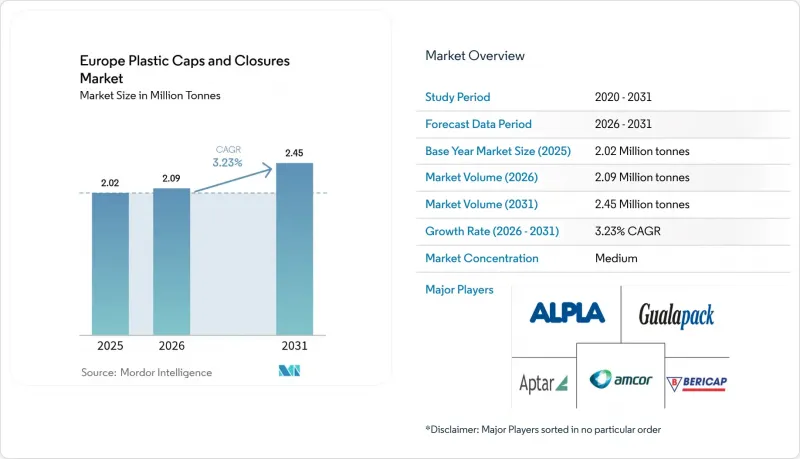
根據 Mordor Intelligence 預測,歐洲塑膠瓶蓋和封蓋市場規模預計在 2025 年達到 202 萬噸,2026 年達到 209 萬噸,到 2031 年達到 245 萬噸,2026 年至 2031 年的複合年成長率為 3.23%。
本報告材料類型(PET、PP、LDPE、HDPE、PVC 及其他)、產品類型(螺旋蓋、按扣蓋、分配蓋、嬰兒安全蓋及其他)、製造程序(射出成型及其他)、終端用戶行業(飲料、食品及其他)和地區進行細分。市場預測以數量(噸)為單位。
歐洲塑膠瓶蓋和封蓋市場的趨勢和洞察
在歐盟指令 2024 年實施期限到來之前,繫繩式水箱蓋的使用率正在不斷提高。
隨著一次性塑膠指令的實施,對繫繩式瓶蓋的需求激增,迫使4.5億條飲料生產線迅速升級設備。 Guala Closures公司2024年的訂單成長了340%,模具前置作業時間延長至16週。由於新型鉸鏈必須承受1萬次開合循環,因此通用型PP材料已被有效排除。 BERICAP公司取得專利的應力消除槽可將現場檢查的故障率控制在0.5%以下。雖然採用繫繩式結構會使每個瓶蓋的樹脂用量增加8-12%,但這種設計如今已成為碳酸飲料的必備之選,歐洲塑膠瓶蓋市場的短期銷售成長已成定局。
歐盟包裝法規要求減輕包裝重量。
第 2025/40 號規則對瓶蓋品質設定了限制,並強制要求符合 ISO 18604 可回收性設計標準。可口可樂歐洲合作夥伴公司報告稱,透過改用更薄的瓶蓋,到 2025 年樹脂用量將減少 18%,相當於 12,000 噸。然而,較薄的瓶蓋在運輸過程中,於零度以下低溫下存在鉸鏈脆化的風險,迫使加工商轉向使用高分子量聚丙烯 (PP) 等級。對於早期採用者而言,用於生產 2 克或更輕瓶蓋的精密模具具有成本優勢,但由於學習曲線的存在,其廢品率將會上升。預計這些綜合因素將導致預測期內複合年成長率 (CAGR) 顯著提高至 0.9%。
飲料製造商透過押金返還制度過渡到鋁罐包裝
儘管目前主要押金返還計畫(DRS)市場的易拉罐回收率已超過92%,但寶特瓶的回收率仍維持在78%至82%之間。可口可樂歐洲太平洋合作夥伴公司預測,到2025年,易拉罐將佔其歐洲銷售的38%。市佔率每下降一個百分點,就意味著每年減少4.5億個塑膠瓶蓋的使用,這項結構性不利因素將使預計的複合年成長率下降0.9%。為了緩解這一影響,瓶蓋供應商正轉向非碳酸飲料和功能性飲用水。
細分市場分析
聚丙烯兼具耐熱性和低成本,預計到 2025 年將佔據歐洲塑膠瓶蓋和封蓋市場 46.16% 的佔有率。成長主要集中在低密度聚乙烯 (LDPE) 上,預計到 2031 年,LDPE 的複合年成長率將達到 5.52%,因為較軟的樹脂更適合用於化妝品和調味品的擠壓管,方便用指尖操作。
由於低密度聚乙烯 (LDPE) 的熔體黏度較低,因此可以形成更薄的壁,平均每個瓶蓋可減少 12% 的樹脂用量。高密度聚苯乙烯(HDPE) 則佔據著一定的市場,例如藥品和需要符合 ISO 8317 抗扭標準的兒童安全產品。同時,獲得 ISCC PLUS 認證的生物基聚丙烯 (PP) 預計將在 2028 年實現價格持平,為注重永續性的品牌提供一種無需更換模具的直接替代選擇。
預計到2025年,旋蓋將佔歐洲塑膠瓶蓋和封蓋市場瓶裝水和碳酸飲料(CSD)細分市場的57.85%佔有率,這反映出旋蓋在該細分市場的強勁地位。同時,分配器瓶蓋的種類正以每年5.21%的速度成長,部分原因是無氣泵在保護抗氧化精華液免受氧化方面發揮了重要作用。
Aptar 的無矽閥門可消除彈性體遷移,這是清潔美妝的關鍵要求。到 2025 年,具備兒童安全功能的按壓旋轉式閥門將增加 4.3%,而支援 NFC 功能的防篡改環將使瓶蓋本身俱備身份驗證功能。此外,為了滿足補水和調味品的需求,產品線還將增加運動瓶蓋和翻蓋式瓶蓋。
其他好處
- Excel格式的市場預測(ME)表
- 3個月的分析師支持
目錄
第1章:引言
- 研究假設和市場定義
- 調查範圍
第2章:調查方法
第3章執行摘要
第4章 市場狀況
- 市場概覽
- 市場促進因素
- 歐盟法規要求減少包裝重量和包裝廢棄物。
- 在歐盟指令 2024 年實施期限到來之前,繫繩式水箱蓋的使用率正在不斷提高。
- 即飲乳製品產品線對高阻隔阻隔性、無菌灌裝瓶蓋的需求不斷成長。
- 品牌所有者正逐步轉向使用回收材料製成的帽子。
- 精釀烈酒的蓬勃發展導致了高級產品和防篡改瓶蓋的廣泛應用。
- 電子商務補充裝產品的快速成長需要防漏瓶蓋。
- 市場限制因素
- 立式袋對家用化學品SKU的侵蝕
- 飲料製造商透過押金返還制度過渡到鋁罐包裝
- 整個非洲大陸食品級rPET/rHDPE供不應求。
- 將傳統PET生產線改造為繫繩式瓶蓋生產線需要高額的資本投入。
- 產業價值鏈分析
- 監理情勢
- 技術展望
- 波特五力分析
第5章 市場規模與成長預測
- 依材料類型
- 聚對苯二甲酸乙二醇酯(PET)
- 聚丙烯(PP)
- 低密度聚乙烯(LDPE)
- 高密度聚苯乙烯(HDPE)
- 聚氯乙烯(PVC)
- 其他
- 依產品類型
- 螺帽
- 卡扣式帽
- 分配蓋
- 幼兒安全帽
- 防篡改蓋
- 其他
- 按製造類型
- 射出成型
- 壓縮成型
- 吹塑成型
- 按最終用戶行業分類
- 飲料
- 食物
- 藥品和醫療保健
- 化妝品和盥洗用品
- 家用化學品
- 其他
- 國家
- 德國
- 英國
- 西班牙
- 法國
- 義大利
- 斯洛維尼亞
- 奧地利
- 瑞士
- 匈牙利
- 克羅埃西亞
- 羅馬尼亞
- 希臘
- 俄羅斯
- 其他歐洲國家
第6章 競爭情勢
- 市場集中度
- 策略趨勢
- 市佔率分析
- 公司簡介
- BERICAP GmbH and Co. KG
- Guala Closures Group
- Pelliconi and CSpA
- UNITED CAPS Luxembourg SA
- Closure Systems International Europe GmbH
- AptarGroup Inc.
- Amcor plc
- ALPLA Werke Alwin Lehner GmbH and Co KG
- Georg Menshen GmbH and Co. KG
- Weener Plastics Group
- Tetra Pak International SA
- Coral Products PLC
- Greiner Packaging International GmbH
- Logoplaste
- Pano Cap Europe Ltd.
第7章 市場機會與未來展望
According to Mordor Intelligence, the Europe plastic caps and closures market size is projected to be 2.02 Million Tonnes in 2025, 2.09 Million Tonnes in 2026, and reach 2.45 Million Tonnes by 2031, growing at a CAGR of 3.23% from 2026 to 2031.
This report is Segmented by Material Type (PET, PP, LDPE, HDPE, PVC, and More), Product Type (Screw Caps, Snap-On Caps, Dispensing Closures, Child-Resistant Closures, and More), Manufacturing Technology (Injection Molding, and More), End-User Industry (Beverage, Food, and More), and Geography. The Market Forecasts are Provided in Terms of Volume (Tonnes).
Europe Plastic Caps And Closures Market Trends and Insights
High Adoption of Tethered Caps Ahead of the 2024 Deadline
Demand for tethered designs spiked once the Single-Use Plastics Directive became enforceable, forcing 450 million beverage lines to retool at speed. Orders at Guala Closures surged 340% in 2024, stretching mold lead times to 16 weeks. The new hinges must withstand 10,000 open-close cycles, effectively excluding commodity PP grades. Patent-protected stress-relief grooves from BERICAP keep failure rates below 0.5% in field trials. Although tethering raises per-cap resin use by 8-12%, the design is now non-negotiable for carbonated drinks, locking in a near-term volume uplift for the Europe plastic caps and closures market.
Lightweighting Mandates from EU Packaging Regulation
Regulation 2025/40 caps closure mass and links compliance to design-for-recycling criteria under ISO 18604. Coca-Cola European Partners reported an 18% resin saving after switching to thin-wall caps, equivalent to 12,000 metric tons in 2025. Thin walls, however, risk hinge brittleness at sub-zero haulage temperatures, pushing converters toward higher-molecular-weight PP grades. Precision tooling for sub-2-gram closures gives early movers a cost edge, even as higher scrap rates accompany the learning curve. The combined effect is a measurable 0.9% uplift to CAGR across the forecast period.
Deposit-Return Schemes Steering Brands Toward Aluminium Cans
Collection rates for cans now exceed 92% in key DRS markets, compared with 78-82% for PET bottles. Coca-Cola Europacific Partners raised its can mix to 38% of European volume in 2025. Each 1-point share shift removes 450 million plastic closures per year, a structural drag that subtracts 0.9% from forecast CAGR. Closure suppliers are pivoting toward non-carbonated beverages and functional waters to cushion the blow.
Other drivers and restraints analyzed in the detailed report include:
- Aseptic-Ready Closure Demand in Dairy RTD Lines
- Brand-Owner Shift Toward Recycled-Content Caps
- High Capital Intensity for Tethered-Cap Retrofits
For complete list of drivers and restraints, kindly check the Table Of Contents.
Segment Analysis
Polypropylene claimed 46.16% of the Europe plastic caps and closures market share in 2025 because it balances heat resistance with low unit cost. Growth skews toward low-density polyethylene, which is advancing at a 5.52% CAGR through 2031 as squeezable tubes in beauty and condiment lines favour softer resins for fingertip control.
Lower melt viscosity allows LDPE to form thinner walls, shaving 12% average resin per cap. High-density polyethylene retains pharma and child-resistant niches that demand ISO 8317 torque resistance, while bio-attributed PP under ISCC PLUS is on track for price parity by 2028, giving sustainability-minded brands a drop-in alternative without tooling changes.
Threaded screw caps still accounted for 57.85% of 2025 revenue, confirming their ubiquity in water and CSD segments of the Europe plastic caps and closures market. Dispensing variants, however, are growing 5.21% per year as airless pumps protect antioxidant serums from oxidation.
Aptar's silicone-free valve removes elastomer migration, a key clean-beauty ask. Child-resistant push-and-turn formats climbed 4.3% in 2025, and NFC-enabled tamper-evident bands are turning closures into authentication tools. Sports caps and flip-tops round out the portfolio, chasing hydration and condiment trends.
Complete Report Scope:
- By Material Type
- Polyethylene Terephthalate (PET)
- Polypropylene (PP)
- Low-Density Polyethylene (LDPE)
- High-Density Polyethylene (HDPE)
- Polyvinyl Chloride (PVC)
- Other Materials
- By Product Type
- Screw Caps
- Snap-On Caps
- Dispensing Closures
- Child-Resistant Closures
- Tamper-Evident Closures
- Other Product Types
- By Manufacturing Type
- Injection Molding
- Compression Molding
- Blow Molding
- By End-User Industry
- Beverage
- Food
- Pharmaceutical and Healthcare
- Cosmetics and Toiletries
- Household Chemicals
- Other Industries
- By Country
- Germany
- United Kingdom
- Spain
- France
- Italy
- Slovenia
- Austria
- Switzerland
- Hungary
- Croatia
- Romania
- Greece
- Russia
- Rest of Europe
List of Companies Covered in this Report:
- BERICAP GmbH and Co. KG
- Guala Closures Group
- Pelliconi and C. S.p.A.
- UNITED CAPS Luxembourg S.A.
- Closure Systems International Europe GmbH
- AptarGroup Inc.
- Amcor plc
- ALPLA Werke Alwin Lehner GmbH and Co KG
- Georg Menshen GmbH and Co. KG
- Weener Plastics Group
- Tetra Pak International S.A.
- Coral Products PLC
- Greiner Packaging International GmbH
- Logoplaste
- Pano Cap Europe Ltd.
Additional Benefits:
- The market estimate (ME) sheet in Excel format
- 3 months of analyst support
TABLE OF CONTENTS
1 INTRODUCTION
- 1.1 Study Assumptions and Market Definition
- 1.2 Scope of the Study
2 RESEARCH METHODOLOGY
3 EXECUTIVE SUMMARY
4 MARKET LANDSCAPE
- 4.1 Market Overview
- 4.2 Market Drivers
- 4.2.1 Lightweighting mandates from EU Packaging and Packaging-Waste Regulation
- 4.2.2 High adoption of tethered caps ahead of 2024 EU directive deadline
- 4.2.3 Growing demand for high-barrier, aseptic-ready closures in dairy RTD lines
- 4.2.4 Brand-owner shift toward recycled-content caps
- 4.2.5 Craft spirits boom driving premium, tamper-evident closures
- 4.2.6 Rapid growth of e-commerce refill formats requiring leak-proof closures
- 4.3 Market Restraints
- 4.3.1 Stand-up pouches encroaching on household-chemical SKUs
- 4.3.2 Deposit-return schemes steering beverage players to aluminum cans
- 4.3.3 Lack of continent-wide rPET/rHDPE food-grade supply
- 4.3.4 High capital intensity for tethered-cap retrofits in legacy PET lines
- 4.4 Industry Value Chain Analysis
- 4.5 Regulatory Landscape
- 4.6 Technological Outlook
- 4.7 Porter's Five Forces Analysis
- 4.7.1 Bargaining Power of Suppliers
- 4.7.2 Bargaining Power of Buyers
- 4.7.3 Threat of New Entrants
- 4.7.4 Intensity of Competitive Rivalry
- 4.7.5 Threat of Substitute Products
5 MARKET SIZE AND GROWTH FORECASTS (VOLUME)
- 5.1 By Material Type
- 5.1.1 Polyethylene Terephthalate (PET)
- 5.1.2 Polypropylene (PP)
- 5.1.3 Low-Density Polyethylene (LDPE)
- 5.1.4 High-Density Polyethylene (HDPE)
- 5.1.5 Polyvinyl Chloride (PVC)
- 5.1.6 Other Materials
- 5.2 By Product Type
- 5.2.1 Screw Caps
- 5.2.2 Snap-On Caps
- 5.2.3 Dispensing Closures
- 5.2.4 Child-Resistant Closures
- 5.2.5 Tamper-Evident Closures
- 5.2.6 Other Product Types
- 5.3 By Manufacturing Type
- 5.3.1 Injection Molding
- 5.3.2 Compression Molding
- 5.3.3 Blow Molding
- 5.4 By End-User Industry
- 5.4.1 Beverage
- 5.4.2 Food
- 5.4.3 Pharmaceutical and Healthcare
- 5.4.4 Cosmetics and Toiletries
- 5.4.5 Household Chemicals
- 5.4.6 Other Industries
- 5.5 By Country
- 5.5.1 Germany
- 5.5.2 United Kingdom
- 5.5.3 Spain
- 5.5.4 France
- 5.5.5 Italy
- 5.5.6 Slovenia
- 5.5.7 Austria
- 5.5.8 Switzerland
- 5.5.9 Hungary
- 5.5.10 Croatia
- 5.5.11 Romania
- 5.5.12 Greece
- 5.5.13 Russia
- 5.5.14 Rest of Europe
6 COMPETITIVE LANDSCAPE
- 6.1 Market Concentration
- 6.2 Strategic Moves
- 6.3 Market Share Analysis
- 6.4 Company Profiles (includes Global level Overview, Market level overview, Core Segments, Financials as available, Strategic Information, Market Rank/Share for key companies, Products and Services, and Recent Developments)
- 6.4.1 BERICAP GmbH and Co. KG
- 6.4.2 Guala Closures Group
- 6.4.3 Pelliconi and C. S.p.A.
- 6.4.4 UNITED CAPS Luxembourg S.A.
- 6.4.5 Closure Systems International Europe GmbH
- 6.4.6 AptarGroup Inc.
- 6.4.7 Amcor plc
- 6.4.8 ALPLA Werke Alwin Lehner GmbH and Co KG
- 6.4.9 Georg Menshen GmbH and Co. KG
- 6.4.10 Weener Plastics Group
- 6.4.11 Tetra Pak International S.A.
- 6.4.12 Coral Products PLC
- 6.4.13 Greiner Packaging International GmbH
- 6.4.14 Logoplaste
- 6.4.15 Pano Cap Europe Ltd.
7 MARKET OPPORTUNITIES AND FUTURE OUTLOOK
- 7.1 White-Space and Unmet-Need Assessment

 美國塑膠瓶蓋:市場佔有率分析、產業趨勢與統計及成長預測(2026-2031)北美塑膠瓶蓋和封蓋市場:市場佔有率分析、行業趨勢和統計數據以及成長預測(2026-2031 年)塑膠蓋子與封口裝置:市場佔有率分析、行業趨勢和統計數據以及成長預測(2026-2031 年)
 2026年全球無內襯瓶蓋市場報告
 塑膠蓋子與封口裝置市場:2026-2032年全球市場預測(按產品類型、材料、製造流程、最終用途和分銷管道分類)
 塑膠瓶蓋及瓶蓋市場報告:按產品類型、原料、容器類型、技術、最終用途和地區分類(2026-2034 年)
 全球塑膠蓋子與封口裝置市場:市場規模、佔有率、成長和行業分析:按材料、產品類型、最終用途和地區分類的預測(至2034年)南美洲塑膠瓶蓋和封蓋:市場佔有率分析、行業趨勢和統計數據以及成長預測(2026-2031 年)
 全球塑膠瓶蓋和封蓋市場規模、佔有率、趨勢和成長分析報告(2026-2034年)2026年全球塑膠瓶蓋和封蓋市場報告