


 |
市場調查報告書
商品編碼
2121521
美國下游油氣加工製程:市場佔有率分析、產業趨勢與統計、成長預測(2026-2031)United States Oil And Gas Downstream - Market Share Analysis, Industry Trends & Statistics, Growth Forecasts (2026 - 2031) |
||||||

※ 本網頁內容可能與最新版本有所差異。詳細情況請與我們聯繫。
根據Mordor Intelligence預測,美國油氣下游加工市場規模預估在2026年達到226.2億美元,高於2025年的217.6億美元。預計到2031年,該市場規模將達到274.6億美元,從2026年到2031年的複合年成長率將達到3.95%。
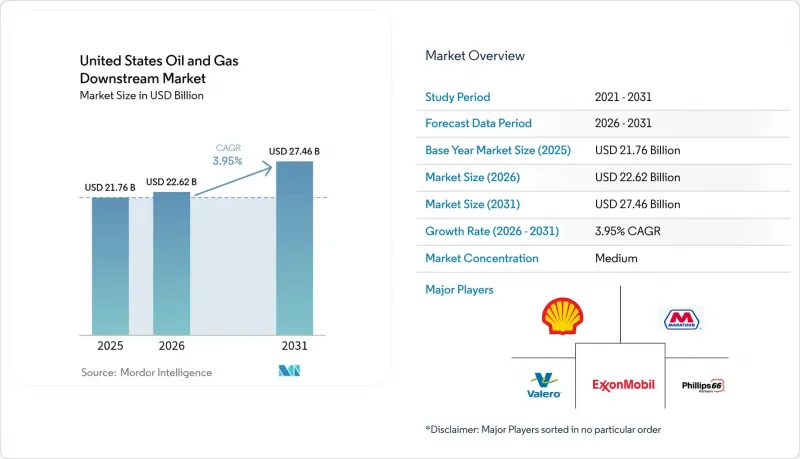
本報告按類型(煉油廠、石化廠)、產品類型(成品油、石化產品、潤滑油)和分銷管道(直銷/批發、經銷商/商業、零售)進行細分。市場規模和預測均以美元計價。
美國油氣下游加工市場趨勢與洞察
由於車輛行駛里程持續成長,汽油需求增加。
2023年,車輛年行駛里程(VMT)達到3.26兆英里,年增2.1%。這一成長勢頭支撐了運輸燃料的需求基礎,即便電動車的普及速度正在加快。電子商務履約和最後一公里物流正在推動柴油和汽油消費量的成長,其成長抵消了乘用車銷售放緩的影響。陽光地帶各州引領了這一成長,年車輛行駛里程成長率超過3%,這主要得益於人口湧入和建設活動的推動。美國運輸部預測,到2027年,商用車輛行駛里程的成長速度將是乘用車行駛里程的兩倍,這將為煉油廠提供穩定的汽油、柴油和噴射機燃料需求基礎。這種可預測的需求趨勢有助於生產力計畫決策,並支撐了美國油氣下游加工市場4.00%的複合年成長率預期。
計畫中的煉油廠現代化改造和產能擴張
已公佈項目的總價值超過150億美元,工廠維修項目正在美國各地進行,其中墨西哥灣沿岸地區佔最大。埃克森美孚投資20億美元的博蒙特擴建項目將使日處理能力提高25萬桶,而雪佛龍投資4.75億美元的帕薩迪納維修項目將使處理能力提高15%,使該設施能夠處理重質原油。馬拉松石油公司投資25億美元擴大其可再生柴油生產設施,體現了其投資傳統燃料和低碳燃料生產線的雙管齊下策略。新的加氫裂解裝置和流體化媒裂裝置將提高中間餾分油的產率,能源效率提高高達8%,並打造一座能適應原油成分變化的未來型工廠。這一輪現代化改造將擴大美國油氣下游加工市場的基礎設施,同時降低平均營運成本。
電動車的加速普及將抑制汽油需求。
2023年,美國電動車銷量超過140萬輛,占美國所有新註冊輕型車輛的9.1%。加州以25%的佔有率領先,華盛頓州和奧勒岡州緊隨其後,合計超過15%。這些地區的汽油需求均出現局部下降。根據《基礎設施投資與就業法案》,一項耗資75億美元的全國充電網路建設正在加速電動車的普及,而有效期至2032年的購車補貼也提升了消費者的購買意願。在人口密集的都市區,車隊營運商正在將貨車和廂型車電動化,以降低生命週期成本,從而減少某些路線的柴油需求。
細分市場分析
2025年,煉油廠在美國國內油氣下游加工市場收入中佔比56.75%,而石化設施預計到2031年將以4.12%的複合年成長率成長,成為所有資產類型中成長最快的。埃克森美孚在貝城投資20億美元,凸顯了其向一體化設施策略轉型,這將實現公用設施共用、降低原料運輸成本並提高化學品生產利潤率。
在一體化煉油廠中,當裂解價差收窄時,石腦油、丁烷和乙烷可以重新用於乙烯和丙烯的生產,有助於穩定現金流。歷史數據顯示,2019年至2024年,石化工廠預計將以每年2.8%的速度成長,但由於北美液態天然氣(NGL)的主導地位以及對亞洲出口的擴大,增速預計將加快至4.12%。獨立煉油廠面臨一個抉擇:要麼繼續進行類似的設備升級,要麼接受盈利下降,轉而採用純燃料生產的經營模式。這種轉變將增強多元化營運商的長期競爭力,並深化美國油氣下游加工市場。
其他好處:
- Excel格式的市場預測(ME)表
- 3個月的分析師支持
目錄
第1章:引言
- 市場分析與定義的前提條件
- 分析範圍
第2章 分析方法
第3章執行摘要
第4章 市場狀況
- 市場概覽
- 市場促進因素
- 由於車輛行駛里程持續成長,汽油需求增加。
- 計畫中的煉油廠現代化改造和產能擴張
- 石油化學原料需求激增
- 可再生柴油和SAF項目擴展
- 利用碳捕獲稅額扣抵的項目
- 人工智慧驅動的煉油廠最佳化和利潤率提升
- 市場限制因素
- 電動車的加速普及正在抑制汽油需求。
- 聯邦和州政府的脫碳合規成本
- 由於缺水,煉油廠的廢水排放規定
- 企業重組和專案中的技術純熟勞工短缺
- 供應鏈分析
- 監理情勢
- 技術展望
- 淨化能力分析
- 波特五力分析
- PESTLE分析
第5章 市場規模與成長預測
- 按類型
- 煉油廠
- 石化廠
- 依產品類型
- 石油精煉產品
- 石油化學產品
- 潤滑劑
- 透過分銷管道
- 直銷/批發
- 銷售代理商/商業
- 零售
第6章 競爭情勢
- 市場集中度
- 策略趨勢(企業合併、聯盟、購電協議)
- 市場佔有率分析(主要公司的市場排名和市場佔有率)
- 公司簡介
- Marathon Petroleum Corporation
- Valero Energy Corporation
- Phillips 66
- Exxon Mobil Corporation
- Chevron Corporation
- Shell plc
- PBF Energy Inc.
- HF Sinclair Corporation
- CITGO Petroleum Corporation
- HollyFrontier Cheyenne Refining(HF Sinclair)
- Delek US Holdings
- Koch Industries-Flint Hills Resources
- LyondellBasell(Houston Refining)
- Calumet Specialty Product Partners
- Monroe Energy(Delta Air Lines)
- Hunt Refining Company
- US Oil & Refining Co.
- Par Pacific Holdings
- Chalmette Refining(PBF/Torres)
- Delta's Trainer Refinery(Monroe)
第7章 市場機會與未來展望
According to Mordor Intelligence, the United States oil and gas downstream market size in 2026 is estimated at USD 22.62 billion, growing from 2025 value of USD 21.76 billion with 2031 projections showing USD 27.46 billion, growing at 3.95% CAGR over 2026-2031.
This report is Segmented by Type (Refineries and Petrochemical Plants), Product Type (Refined Petroleum Products, Petrochemicals, and Lubricants), and Distribution Channel (Direct Sales/Wholesale, Distributors/Commercial, and Retail). The Market Sizes and Forecasts are Provided in Terms of Value (USD).
United States Oil And Gas Downstream Market Trends and Insights
Rising Gasoline Demand from Sustained VMT Growth
U.S. VMT reached 3.26 trillion miles in 2023, a 2.1% year-over-year increase, and this momentum anchors the baseline transportation fuel demand even as EV penetration accelerates. E-commerce fulfillment and last-mile logistics are lifting diesel and gasoline consumption at a pace that counterbalances slower passenger-car volumes. Sun Belt states lead with annual VMT increases above 3%, propelled by population inflows and construction activity. The U.S. Department of Transportation projects that commercial-vehicle mileage will grow at double the pace of passenger travel through 2027, providing refiners with a reliable user base for gasoline, diesel, and jet fuel production. The predictable demand profile aids capacity-planning decisions and undergirds the 4.00% CAGR outlook for the United States oil and gas downstream market.
Planned Refinery Modernization & Capacity Additions
More than USD 15 billion in announced projects are revamping U.S. plants, with the Gulf Coast absorbing the largest share. ExxonMobil's USD 2 billion Beaumont expansion adds 250,000 barrels per day (b/d) of throughput, while Chevron's USD 475 million Pasadena revamp lifts capacity by 15% and equips the site to process heavier crudes. Marathon Petroleum's USD 2.5 billion renewable-diesel build-out exemplifies the dual path of investing in both legacy and low-carbon fuel lines. New hydrocrackers and fluid catalytic crackers raise middle-distillate yields, improve energy efficiency by up to 8%, and future-proof plants for shifting crude slates. The modernization cycle expands the installed base that feeds the United States oil and gas downstream market while nudging average operating costs downward.
Accelerating EV Adoption Curbing Gasoline Demand
Electric-vehicle (EV) sales crossed 1.4 million units in 2023, taking 9.1% of total U.S. light-duty registrations. California leads with a 25% share, while Washington and Oregon account for over 15%, creating localized dips in gasoline demand. The USD 7.5 billion national charging-network rollout under the Infrastructure Investment and Jobs Act compresses adoption timelines, and purchase credits valid through 2032 keep consumer interest high. Fleet operators in dense urban corridors are electrifying vans and step-trucks to capture lifecycle savings, reducing diesel demand on specific routes.
Other drivers and restraints analyzed in the detailed report include:
- Surging Petrochemical Feedstock Demand
- Expansion of Renewable Diesel & SAF Projects
- Federal & State Decarbonization Compliance Costs
For complete list of drivers and restraints, kindly check the Table Of Contents.
Segment Analysis
Plants classified as refineries generated 56.75% of 2025 revenue inside the United States oil and gas downstream market, but petrochemical facilities are expected to advance at a 4.12% CAGR to 2031, the fastest pace among asset types. ExxonMobil's USD 2 billion Baytown investment underscores the strategic migration toward integrated footprints that share utilities, lower feedstock transport costs, and unlock high-margin chemical streams.
Integrated complexes can divert naphtha, butane, and ethane toward ethylene or propylene production when crack spreads narrow, cushioning cash flow. Historical data indicate that petrochemical plants are expected to grow at a rate of 2.8% annually from 2019 to 2024; the acceleration to 4.12% is attributed to the advantages of North American natural-gas liquids and expanding exports to Asia. Independent refineries must decide whether to pursue similar upgrades or risk compressing profitability in fuel-only models. The shift bolsters the long-term competitiveness of diversified operators and enhances the depth of the United States' oil and gas downstream market.
Complete Report Scope:
- By Type
- Refineries
- Petrochemical Plants
- By Product Type
- Refined Petroleum Products
- Petrochemicals
- Lubricants
- By Distribution Channel
- Direct Sales/Wholesale
- Distributors/Commercial
- Retail
List of Companies Covered in this Report:
- Marathon Petroleum Corporation
- Valero Energy Corporation
- Phillips 66
- Exxon Mobil Corporation
- Chevron Corporation
- Shell plc
- PBF Energy Inc.
- HF Sinclair Corporation
- CITGO Petroleum Corporation
- HollyFrontier Cheyenne Refining (HF Sinclair)
- Delek US Holdings
- Koch Industries - Flint Hills Resources
- LyondellBasell (Houston Refining)
- Calumet Specialty Product Partners
- Monroe Energy (Delta Air Lines)
- Hunt Refining Company
- U.S. Oil & Refining Co.
- Par Pacific Holdings
- Chalmette Refining (PBF/Torres)
- Delta's Trainer Refinery (Monroe)
Additional Benefits:
- The market estimate (ME) sheet in Excel format
- 3 months of analyst support
TABLE OF CONTENTS
1 Introduction
- 1.1 Study Assumptions & Market Definition
- 1.2 Scope of the Study
2 Research Methodology
3 Executive Summary
4 Market Landscape
- 4.1 Market Overview
- 4.2 Market Drivers
- 4.2.1 Rising gasoline demand from sustained VMT growth
- 4.2.2 Planned refinery modernization & capacity additions
- 4.2.3 Surging petrochemical feed-stock demand
- 4.2.4 Expansion of renewable diesel & SAF projects
- 4.2.5 Carbon capture tax credit driven projects
- 4.2.6 AI-based refinery optimization & margin gains
- 4.3 Market Restraints
- 4.3.1 Accelerating EV adoption curbing gasoline demand
- 4.3.2 Federal & state decarbonization compliance costs
- 4.3.3 Water-stress-driven effluent restrictions at refineries
- 4.3.4 Skilled labor shortages for turn-arounds & projects
- 4.4 Supply-Chain Analysis
- 4.5 Regulatory Landscape
- 4.6 Technological Outlook
- 4.7 Refining Capacity Analysis
- 4.8 Porters Five Forces
- 4.8.1 Threat of New Entrants
- 4.8.2 Bargaining Power of Suppliers
- 4.8.3 Bargaining Power of Buyers
- 4.8.4 Threat of Substitutes
- 4.8.5 Competitive Rivalry
- 4.9 PESTLE Analysis
5 Market Size & Growth Forecasts
- 5.1 By Type
- 5.1.1 Refineries
- 5.1.2 Petrochemical Plants
- 5.2 By Product Type
- 5.2.1 Refined Petroleum Products
- 5.2.2 Petrochemicals
- 5.2.3 Lubricants
- 5.3 By Distribution Channel
- 5.3.1 Direct Sales/Wholesale
- 5.3.2 Distributors/Commercial
- 5.3.3 Retail
6 Competitive Landscape
- 6.1 Market Concentration
- 6.2 Strategic Moves (M&A, Partnerships, PPAs)
- 6.3 Market Share Analysis (Market Rank/Share for key companies)
- 6.4 Company Profiles (includes Global level Overview, Market level overview, Core Segments, Financials as available, Strategic Information, Products & Services, and Recent Developments)
- 6.4.1 Marathon Petroleum Corporation
- 6.4.2 Valero Energy Corporation
- 6.4.3 Phillips 66
- 6.4.4 Exxon Mobil Corporation
- 6.4.5 Chevron Corporation
- 6.4.6 Shell plc
- 6.4.7 PBF Energy Inc.
- 6.4.8 HF Sinclair Corporation
- 6.4.9 CITGO Petroleum Corporation
- 6.4.10 HollyFrontier Cheyenne Refining (HF Sinclair)
- 6.4.11 Delek US Holdings
- 6.4.12 Koch Industries - Flint Hills Resources
- 6.4.13 LyondellBasell (Houston Refining)
- 6.4.14 Calumet Specialty Product Partners
- 6.4.15 Monroe Energy (Delta Air Lines)
- 6.4.16 Hunt Refining Company
- 6.4.17 U.S. Oil & Refining Co.
- 6.4.18 Par Pacific Holdings
- 6.4.19 Chalmette Refining (PBF/Torres)
- 6.4.20 Delta's Trainer Refinery (Monroe)
7 Market Opportunities & Future Outlook
- 7.1 White-space & Unmet-Need Assessment

 2026-2030年石油天然氣幕後市場
 石油天然氣產業下游領域:市場佔有率分析、產業趨勢與統計資料、成長預測(2026-2031 年)東南亞下游油氣市場:市場佔有率分析、產業趨勢與統計及成長預測(2026-2031年)印度油氣下游產業:市場佔有率分析、產業趨勢與統計及成長預測(2026-2031年)泰國下游油氣市場:市場佔有率分析、產業趨勢與統計及成長預測(2026-2031年)印尼下游油氣市場:市場佔有率分析、產業趨勢與統計及成長預測(2026-2031年)
 2026年全球下游石油產品市場報告
 油氣下游市場-全球產業規模、佔有率、趨勢、機會和預測,按類型(煉油廠、石化廠)、地區和競爭格局分類,2020-2030年預測
 全球下游石油與天然氣市場南美石油天然氣下游:市場佔有率分析、產業趨勢、統計、成長趨勢預測(2025-2030)