


 |
市場調查報告書
商品編碼
2120760
行動分析:市場佔有率分析、產業趨勢與統計、成長預測(2026-2031 年)Mobile Analytics - Market Share Analysis, Industry Trends & Statistics, Growth Forecasts (2026 - 2031) |
||||||

※ 本網頁內容可能與最新版本有所差異。詳細情況請與我們聯繫。
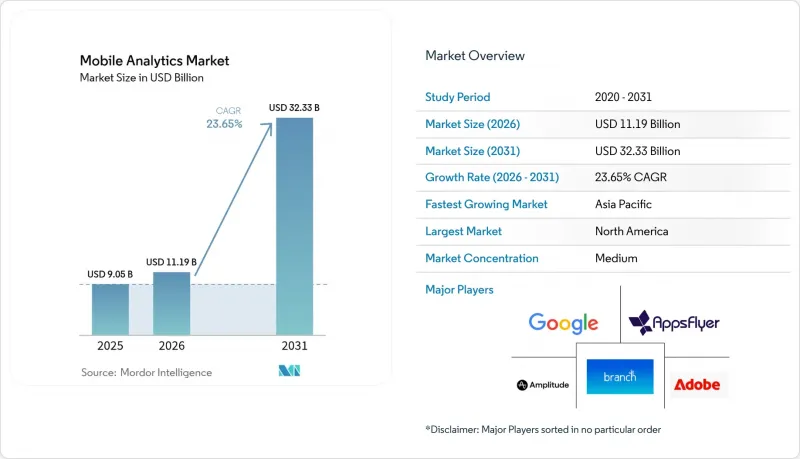
據 Mordor Intelligence 稱,2025 年行動分析市值為 90.5 億美元,預計到 2031 年將達到 323.3 億美元,而 2026 年為 111.9 億美元,預測期(2026-2031 年)的複合年成長率為 23.65%。
本報告按組件(軟體、服務)、分析類型(應用分析、宣傳活動分析、服務分析、應用程式內行為分析)、部署模式(雲端、本地部署)、組織規模(大型企業、中小企業)、最終用戶產業(銀行、金融服務和保險、媒體和娛樂等)以及地區進行細分。市場預測以美元計價。
全球行動分析市場趨勢與洞察
智慧型手機的廣泛使用正在產生Exabyte級行為數據。
2024年,全球智慧型手機用戶數將達到68億,每台裝置每月發送約2.5GB的行為訊號。從點擊、捲動到位置傳輸,這些持續不斷的資料流使企業能夠深入了解客戶旅程,而5G頻寬支援即時推斷。零售應用現在能夠分析滾動速度等細微行為,以高達89%的準確率預測購買意願。為了降低延遲並保護隱私,設備邊緣處理正變得越來越普遍,供應商提供輕量級SDK以支援本地運算。這些SDK透過在不影響效能的前提下減少資料傳輸並滿足日益嚴格的隱私法規,鞏固了邊緣分析作為行動分析市場關鍵價值創造驅動力的地位。
行動商務交易的爆炸性成長
到2024年,行動商務將佔全球電子商務交易的58.9%,這使得應用程式內即時客戶行為追蹤變得至關重要。光是在中國,2024年行動支付交易額就將達到49.2兆美元,將推動對詐欺偵測和多點觸控歸因分析的需求。社群電商和直播購物正在形成過於複雜和快速的轉換漏斗,標準網路工具難以捕捉。供應商正透過提供專用模組來應對這項挑戰,這些模組可以在幾秒鐘內整合聊天、影片和應用程式內商店的購買路徑,進一步提升了行動分析市場在全通路成長策略中的重要性。
嚴格的資料隱私法規,例如 GDPR 和 CCPA。
企業每年投入約 130 萬美元,以確保其行動分析系統符合 GDPR 的要求。加州的《消費者隱私法案》(CCPA) 正在將類似的義務擴展到美國主要市場,巴西和印度也在製定類似的立法。供應商透過引入差分隱私和聯邦學習技術,最大限度地減少原始資料收集,確保模型在分散式資料上運行。谷歌面向 Android 的隱私沙盒就是這項轉變的例證,它用聚合訊號取代了應用間的識別碼。合規性提高了准入門檻,降低了行動分析市場的成長潛力,但也使那些掌握了「隱私設計」技術的平台脫穎而出。
細分市場分析
到2025年,軟體產品將佔總收入的68.62%,凸顯其作為行動分析市場大多數買家的預設切入點的地位。許多公司傾向於使用視覺化、自助式的儀表板,這些儀表板可以連接到現有的資料湖和行銷雲,而無需進行大規模的編碼工作。然而,日益複雜的監管環境以及SDK整合方面的挑戰,正在推動諮詢和託管服務的重要性日益凸顯,預計到2031年,該細分市場的複合年成長率將達到25.4%。實施合作夥伴可以幫助企業遷移傳統的追蹤環境、實施隱私保護模型以及調整即時個人化引擎——這些任務通常是內部團隊缺乏資源來完成的。在銀行業等高度監管的行業中,外部專家會設計符合GDPR要求的流程,在維持預測準確性的同時,縮減資料收集的範圍。
託管服務透過將維護、數據工程和實驗支援打包成訂閱模式,彌補了中小企業的技能缺口。因此,儘管核心軟體仍然是預算中的一大筆開支,但業務收益在行動分析市場中的佔有率正在不斷成長。供應商正透過行業特定的操作指南(例如,為醫療產業提供模板以加速 HIPAA 合規性)來實現差異化競爭。這一趨勢表明,未來平台授權將與基於結果的服務合約相結合,從而強化行動分析市場的混合收入模式。
應用分析(著重於數位團隊熟悉的獲取、留存和轉換指標)預計到 2025 年將佔據 34.98% 的市場佔有率。緊隨其後的是宣傳活動分析和服務分析,它們支援廣告歸因和客戶支援最佳化。然而,應用內行為分析的成長速度最快,複合年成長率高達 24.1%,因為企業逐漸意識到,僅憑表面指標無法捕捉到重要的使用者意圖徵兆。串流媒體服務透過在播放 30 秒內偵測到用戶放棄觀看並推送替代內容,將用戶參與度提高了 23%。遊戲工作室正在透過讀取手指壓力模式來即時調整遊戲難度曲線,從而建立獲利模式的基礎。
機器學習模型日趨成熟,能夠可靠地解讀細微的手勢、情境變化和會話節奏。因此,行為分析已從單純的診斷發展到預測性調整,並成為行動分析市場價值創造的基石。隨著應用範圍的擴大,行為分析與人工智慧驅動的個人化之間的界限日益模糊,供應商正將推理引擎直接整合到其軟體開發工具包 (SDK) 中,以實現零延遲決策。
區域分析
北美擁有成熟的數位廣告生態系統、極高的人均行動消費額以及雄厚的創業融資,預計到2025年將佔全球收入的38.25%。美國立法者透過《加州消費者隱私法案》(CCPA)建構了法律規範,推動了基於「隱私設計」的資料架構在全美範圍內的普及。金融科技分析在加拿大蓬勃發展,而墨西哥不斷擴展的電子商務基礎設施則為本地化西班牙語儀錶板的供應商創造了新的未開發市場。該地區豐富的技術人才正在加速邊緣人工智慧的實驗,進一步鞏固了其在行動分析市場的領先地位。
亞太地區正以最快的速度成長,預計到2031年複合年成長率將達到24.05%。中國、印度和東南亞的行動普及率均超過85%,而「數位印度」等政府主導的措施正在推動行動優先的公共服務。中國的社群電商巨頭正在收集語音、影片和聊天數據,這些數據需要Petabyte級的分析;印度的統一支付介面(UPI)框架正在促進支付數據的成長。日本和韓國正在利用5G技術實現低延遲遊戲分析,而澳洲則專注於最佳化銀行和旅遊應用程式的客戶體驗(CX)。儘管資料保護條例的差異阻礙了整合,但擁有本地託管服務的跨境供應商正在不斷擴大市場佔有率,這凸顯了亞太地區作為行動分析市場主要成長引擎的地位。
在GDPR的嚴格監管下,歐洲市場穩定成長,擁有先進用戶授權管理能力的供應商正逐漸佔優勢。德國是工業IoT分析領域的先驅,其分析技術已嵌入聯網汽車應用;英國正積極利用開放銀行的發展趨勢;法國則在媒體串流分析領域不斷創新。俄羅斯強制推行資料在地化,不僅使其生態系統保持相對獨立,也為本土企業進入市場創造了空間。儘管全部區域有所放緩,但歐洲的政策影響力正在推動全球發展藍圖的製定,而專為歐盟客戶開發的合規功能也正逐漸成為行動分析市場其他地區的標準。
其他好處:
- Excel格式的市場預測(ME)表
- 3個月的分析師支持
目錄
第1章:引言
- 研究假設和市場定義
- 調查範圍
第2章:調查方法
第3章執行摘要
第4章 市場狀況
- 市場概覽
- 市場促進因素
- 智慧型手機的廣泛使用正在產生Exabyte級行為數據。
- 行動商務交易的爆炸性成長
- 企業向雲端原生分析平台的快速遷移
- 行動廣告預算的增加推動了對應用程式內洞察的需求。
- 透過人工智慧驅動的預測分析實現高度個人化。
- 設備內部的隱私保護分析框架正受到越來越多的關注。
- 市場限制因素
- 嚴格的資料隱私法規,例如 GDPR 和 CCPA。
- 行動資料安全漏洞的風險更高。
- 蘋果的「應用追蹤透明度」限制了歸因數據的取得。
- SDK碎片化導致應用程式效能下降。
- 產業價值/價值鏈分析
- 監管情勢和標準
- 技術趨勢(邊緣運算和人工智慧分析)
- 波特五力分析
第5章 市場規模與成長預測
- 按組件
- 軟體
- 服務
- 按分析類型
- 應用分析
- 宣傳活動分析
- 服務分析
- 應用內行為分析
- 部署模式
- 雲
- 現場
- 按組織規模
- 大公司
- 中小企業
- 按最終用戶行業分類
- 零售與電子商務
- 銀行、金融服務和保險(BFSI)
- 政府/公共部門
- 資訊科技/通訊
- 媒體與娛樂
- 旅遊與飯店
- 醫療保健和生命科學
- 按地區
- 北美洲
- 美國
- 加拿大
- 墨西哥
- 歐洲
- 德國
- 英國
- 法國
- 俄羅斯
- 其他歐洲國家
- 亞太地區
- 中國
- 日本
- 印度
- 韓國
- 澳洲
- 其他亞太國家
- 中東和非洲
- 中東
- 沙烏地阿拉伯
- 阿拉伯聯合大公國
- 其他中東國家
- 非洲
- 南非
- 埃及
- 其他非洲國家
- 中東
- 南美洲
- 巴西
- 阿根廷
- 其他南美國家
- 北美洲
第6章 競爭情勢
- 市場集中度
- 策略性舉措(併購、資金籌措、合作)
- 市佔率分析
- 公司簡介
- Adobe Inc.
- Alphabet Inc.(Google LLC)
- Amplitude, Inc.
- AppsFlyer Ltd.
- Branch Metrics, Inc.
- CleverTap Pvt. Ltd.
- Contentsquare SAS
- Data.ai Inc.(App Annie)
- Heap Inc.
- International Business Machines Corporation(IBM)
- Localytics(Upland Software, Inc.)
- Meta Platforms, Inc.
- Microsoft Corporation
- Mixpanel, Inc.
- MoEngage, Inc.
- Oracle Corporation
- OXFORD University Press(Adjust GmbH)-Adjust
- Piwik PRO Sp. z oo
- Salesforce, Inc.(Tableau Mobile)
- Snowplow Analytics Ltd.
第7章 市場機會與未來展望
According to Mordor Intelligence, the mobile analytics market size was valued at USD 9.05 billion in 2025 and estimated to grow from USD 11.19 billion in 2026 to reach USD 32.33 billion by 2031, at a CAGR of 23.65% during the forecast period (2026-2031).
This report is Segmented by Component (Software, Services), Analytics Type (Application-Analytics, Campaign-Analytics, Service-Analytics, In-App Behavioral Analytics), Deployment Mode (Cloud, On-Premise), Organisation Size (Large Enterprises, Small and Medium Enterprises), End-User Vertical (BFSI, Media and Entertainment, and More), and Geography. The Market Forecasts are Provided in Terms of Value (USD).
Global Mobile Analytics Market Trends and Insights
Smartphone proliferation generates exabytes of behavioral data.
Global smartphone users reached 6.8 billion in 2024, each device emitting roughly 2.5 GB of behavioral signals per month. Continuous streams of taps, scrolls, and location pings give enterprises fine-grained views of customer journeys, and 5G bandwidth makes real-time inference feasible. Retail apps now mine micro-gestures such as scroll velocity to predict purchase intent with up to 89% accuracy. Processing at device edge is gaining ground to reduce latency and safeguard privacy, prompting vendors to ship lightweight SDKs capable of local computation. These SDKs shrink data transfer volumes and meet tightening privacy mandates while keeping performance intact, cementing edge analytics as a key value driver for the mobile analytics market.
Explosive growth of mobile-commerce transactions
Mobile commerce generated 58.9% of global e-commerce value in 2024, placing heavy emphasis on real-time journey tracking within apps. China alone processed USD 49.2 trillion in mobile payments in 2024, fueling demand for fraud detection and multi-touch attribution. Social commerce and live-stream shopping create complex, rapid funnels that standard web tools cannot map. Vendors respond with specialized modules that stitch together purchase pathways across chat, video, and in-app stores within seconds, reinforcing the strategic relevance of the mobile analytics market to omnichannel growth agendas.
Stringent data-privacy regulations such as GDPR and CCPA
Enterprises allocate about USD 1.3 million per year to keep mobile analytics stacks GDPR-ready. California's CCPA extends similar duties to large U.S. markets, while Brazil and India draft parallel laws. Vendors embed differential privacy and federated learning so models run on decentralized data, minimizing raw collection. Google's Privacy Sandbox for Android exemplifies this pivot, replacing cross-app identifiers with aggregated signals. Compliance lifts barriers to entry and trims the attainable growth curve for the mobile analytics market, even as it differentiates platforms that master privacy-by-design engineering.
Other drivers and restraints analyzed in the detailed report include:
- Rapid enterprise shift to cloud-native analytics platforms
- Rising mobile advertising budgets are driving demand for in-app insights.
- Apple's App Tracking Transparency limits attribution data.
For complete list of drivers and restraints, kindly check the Table Of Contents.
Segment Analysis
Software products contributed 68.62% of 2025 revenue, underscoring their role as the default entry point for most buyers in the mobile analytics market. Many enterprises favor visual, self-service dashboards that plug into existing data lakes and marketing clouds without extensive coding. Yet rising regulatory complexity and SDK integration pain points elevate consulting and managed services, propelling the segment at 25.4% CAGR to 2031. Implementation partners help migrate legacy tracking setups, deploy privacy-preserving models, and tune real-time personalization engines, workstreams that internal teams often lack bandwidth for. For heavily regulated sectors such as banking, external experts design GDPR-compliant funnels that retain predictive strength while lowering data collection footprints.
Managed services address skill shortages for SMEs by bundling maintenance, data engineering, and experimentation support under subscription. As a result, services revenue captures an expanding slice of the mobile analytics market, even though core software still anchors budget line items. Vendors differentiate via industry playbooks-for instance, healthcare templates that expedite HIPAA alignment. The trend suggests a future where outcome-based service contracts accompany platform licenses, reinforcing mixed-revenue models across the mobile analytics market.
Application-analytics held a 34.98% share in 2025, thanks to its focus on acquisition, retention, and conversion metrics familiar to digital teams. Campaign analytics and service analytics follow, supporting ad attribution and customer support optimization. However, in-app behavioral analytics is scaling fastest at 24.1% CAGR as enterprises recognize that surface metrics miss crucial intent cues. Streaming services detect abandonment within 30 seconds of playback and push alternate content to improve engagement by 23%. Gaming studios read finger-pressure patterns to tune difficulty curves in real time, anchoring monetization.
Machine learning models have matured to interpret micro-gestures, context switching, and session cadence with high reliability. Consequently, behavioral analytics graduates move from mere diagnostics to predictive orchestration, positioning it as a cornerstone of value creation in the mobile analytics market. As adoption widens, the boundary blurs between behavioral analytics and AI-driven personalization, prompting vendors to bake inference engines directly into SDKs for latency-free decisioning.
Complete Report Scope:
- By Component
- Software
- Services
- By Analytics Type
- Application-Analytics
- Campaign-Analytics
- Service-Analytics
- In-App Behavioral Analytics
- By Deployment Mode
- Cloud
- On-Premise
- By Organisation Size
- Large Enterprises
- Small and Medium Enterprises (SMEs)
- By End-User Vertical
- Retail and E-commerce
- Banking, Financial Services and Insurance (BFSI)
- Government and Public Sector
- Information Technology and Telecommunications
- Media and Entertainment
- Travel and Hospitality
- Healthcare and Life-Sciences
- By Geography
- North America
- United States
- Canada
- Mexico
- Europe
- Germany
- United Kingdom
- France
- Russia
- Rest of Europe
- Asia-Pacific
- China
- Japan
- India
- South Korea
- Australia
- Rest of Asia-Pacific
- Middle East and Africa
- Middle East
- Saudi Arabia
- United Arab Emirates
- Rest of Middle East
- Africa
- South Africa
- Egypt
- Rest of Africa
- Middle East
- South America
- Brazil
- Argentina
- Rest of South America
- North America
Geography Analysis
North America produced 38.25% of 2025 revenue owing to entrenched digital ad ecosystems, high mobile spend per capita, and robust venture funding. U.S. lawmakers shaped the regulatory agenda through CCPA, which spurred nationwide adoption of privacy-by-design data architectures. Canada shows momentum in fintech analytics, while Mexico's expanding e-commerce base creates new white space for vendors that localize Spanish-language dashboards. The region's deep technical workforce accelerates experimentation with edge AI, reinforcing its leadership in the mobile analytics market.
Asia-Pacific registers the fastest expansion at 24.05% CAGR through 2031. Penetration surpasses 85% in China, India, and Southeast Asia, and government schemes such as Digital India promote mobile-first citizen services. China's social-commerce giants capture streams of voice, video, and chat that require petabyte-scale analytics, while India's UPI framework fuels payment data growth. Japan and South Korea leverage 5G to power low-latency gaming insights, and Australia emphasizes CX optimization for banking and travel apps. Fragmented data-protection rules create integration hurdles, yet cross-border providers that secure localized hosting win share, highlighting Asia-Pacific as the prime acceleration engine in the mobile analytics market.
Europe grows steadily under tight GDPR oversight, favoring vendors with advanced consent orchestration. Germany pioneers industrial IoT analytics embedded in connected-car apps, the U.K. capitalizes on open banking trends, and France innovates in media streaming intelligence. Russia enforces compulsory data localization, isolating its ecosystem and opening room for domestic players. Despite a slower regional CAGR, Europe's policy influence steers global roadmaps, making compliance features developed for EU clients standard elsewhere within the mobile analytics market.
- Adobe Inc.
- Alphabet Inc. (Google LLC)
- Amplitude, Inc.
- AppsFlyer Ltd.
- Branch Metrics, Inc.
- CleverTap Pvt. Ltd.
- Contentsquare SAS
- Data.ai Inc. (App Annie)
- Heap Inc.
- International Business Machines Corporation (IBM)
- Localytics (Upland Software, Inc.)
- Meta Platforms, Inc.
- Microsoft Corporation
- Mixpanel, Inc.
- MoEngage, Inc.
- Oracle Corporation
- OXFORD University Press (Adjust GmbH) - Adjust
- Piwik PRO Sp. z o.o.
- Salesforce, Inc. (Tableau Mobile)
- Snowplow Analytics Ltd.
Additional Benefits:
- The market estimate (ME) sheet in Excel format
- 3 months of analyst support
TABLE OF CONTENTS
1 INTRODUCTION
- 1.1 Study Assumptions and Market Definition
- 1.2 Scope of the Study
2 RESEARCH METHODOLOGY
3 EXECUTIVE SUMMARY
4 MARKET LANDSCAPE
- 4.1 Market Overview
- 4.2 Market Drivers
- 4.2.1 Smart-phone proliferation generates exabytes of behavioral data
- 4.2.2 Explosive growth of mobile-commerce transactions
- 4.2.3 Rapid enterprise shift to cloud-native analytics platforms
- 4.2.4 Rising mobile advertising budgets driving demand for in-app insights
- 4.2.5 AI-powered predictive analytics enabling hyper-personalization
- 4.2.6 On-device, privacy-preserving analytics frameworks gain traction
- 4.3 Market Restraints
- 4.3.1 Stringent data-privacy regulations such as GDPR and CCPA
- 4.3.2 High risk of mobile data security breaches
- 4.3.3 Apple's App Tracking Transparency limits attribution data
- 4.3.4 SDK fragmentation causing app-performance overhead
- 4.4 Industry Value / Supply-Chain Analysis
- 4.5 Regulatory Landscape and Standards
- 4.6 Technological Outlook (Edge and AI analytics)
- 4.7 Porter's Five Forces Analysis
- 4.7.1 Bargaining Power of Suppliers
- 4.7.2 Bargaining Power of Buyers
- 4.7.3 Threat of New Entrants
- 4.7.4 Threat of Substitutes
- 4.7.5 Intensity of Competitive Rivalry
5 MARKET SIZE AND GROWTH FORECASTS (VALUE)
- 5.1 By Component
- 5.1.1 Software
- 5.1.2 Services
- 5.2 By Analytics Type
- 5.2.1 Application-Analytics
- 5.2.2 Campaign-Analytics
- 5.2.3 Service-Analytics
- 5.2.4 In-App Behavioral Analytics
- 5.3 By Deployment Mode
- 5.3.1 Cloud
- 5.3.2 On-Premise
- 5.4 By Organisation Size
- 5.4.1 Large Enterprises
- 5.4.2 Small and Medium Enterprises (SMEs)
- 5.5 By End-User Vertical
- 5.5.1 Retail and E-commerce
- 5.5.2 Banking, Financial Services and Insurance (BFSI)
- 5.5.3 Government and Public Sector
- 5.5.4 Information Technology and Telecommunications
- 5.5.5 Media and Entertainment
- 5.5.6 Travel and Hospitality
- 5.5.7 Healthcare and Life-Sciences
- 5.6 By Geography
- 5.6.1 North America
- 5.6.1.1 United States
- 5.6.1.2 Canada
- 5.6.1.3 Mexico
- 5.6.2 Europe
- 5.6.2.1 Germany
- 5.6.2.2 United Kingdom
- 5.6.2.3 France
- 5.6.2.4 Russia
- 5.6.2.5 Rest of Europe
- 5.6.3 Asia-Pacific
- 5.6.3.1 China
- 5.6.3.2 Japan
- 5.6.3.3 India
- 5.6.3.4 South Korea
- 5.6.3.5 Australia
- 5.6.3.6 Rest of Asia-Pacific
- 5.6.4 Middle East and Africa
- 5.6.4.1 Middle East
- 5.6.4.1.1 Saudi Arabia
- 5.6.4.1.2 United Arab Emirates
- 5.6.4.1.3 Rest of Middle East
- 5.6.4.2 Africa
- 5.6.4.2.1 South Africa
- 5.6.4.2.2 Egypt
- 5.6.4.2.3 Rest of Africa
- 5.6.4.1 Middle East
- 5.6.5 South America
- 5.6.5.1 Brazil
- 5.6.5.2 Argentina
- 5.6.5.3 Rest of South America
- 5.6.1 North America
6 COMPETITIVE LANDSCAPE
- 6.1 Market Concentration
- 6.2 Strategic Moves (M&A, Funding, Partnerships)
- 6.3 Market Share Analysis
- 6.4 Company Profiles (includes Global level Overview, Market level overview, Core Segments, Financials as available, Strategic Information, Market Rank/Share, Products and Services, Recent Developments)
- 6.4.1 Adobe Inc.
- 6.4.2 Alphabet Inc. (Google LLC)
- 6.4.3 Amplitude, Inc.
- 6.4.4 AppsFlyer Ltd.
- 6.4.5 Branch Metrics, Inc.
- 6.4.6 CleverTap Pvt. Ltd.
- 6.4.7 Contentsquare SAS
- 6.4.8 Data.ai Inc. (App Annie)
- 6.4.9 Heap Inc.
- 6.4.10 International Business Machines Corporation (IBM)
- 6.4.11 Localytics (Upland Software, Inc.)
- 6.4.12 Meta Platforms, Inc.
- 6.4.13 Microsoft Corporation
- 6.4.14 Mixpanel, Inc.
- 6.4.15 MoEngage, Inc.
- 6.4.16 Oracle Corporation
- 6.4.17 OXFORD University Press (Adjust GmbH) - Adjust
- 6.4.18 Piwik PRO Sp. z o.o.
- 6.4.19 Salesforce, Inc. (Tableau Mobile)
- 6.4.20 Snowplow Analytics Ltd.
7 MARKET OPPORTUNITIES AND FUTURE OUTLOOK
- 7.1 White-Space and Unmet-Need Assessment

 行動分析市場 - 全球產業規模、佔有率、趨勢、機會、預測、產品/服務、類型、終端用戶產業、地區及競爭格局(2021-2031 年)
 蘋果公司效能追蹤器,2025 年第四季
 行動分析市場規模、佔有率和成長分析(按產品、應用、公司規模和地區分類)—產業預測(2026-2033 年)
 行動分析:全球市場佔有率和排名、總收入和需求預測(2025-2031年)
 全球行動分析市場規模研究與預測(依類型、組織規模、垂直和區域分類)2025 年至 2035 年
 到 2030 年的行動分析市場預測:按組件、部署模式、公司規模、應用程式、最終用戶和地區進行的全球分析2024 年至 2031 年按類型、最終用戶產業和地區劃分的行動分析市場