


 |
市場調查報告書
商品編碼
2121678
義大利石油和天然氣:市場佔有率分析、行業趨勢和統計數據以及成長預測(2026-2031 年)Italy Oil And Gas - Market Share Analysis, Industry Trends & Statistics, Growth Forecasts (2026 - 2031) |
||||||

※ 本網頁內容可能與最新版本有所差異。詳細情況請與我們聯繫。
據 Mordor Intelligence 稱,2025 年義大利石油和天然氣市場價值 9.4 億美元,預計到 2031 年將從 2026 年的 9.7 億美元成長到 11.2 億美元,預測期(2026-2031 年)的複合年成長率為 2.98%。
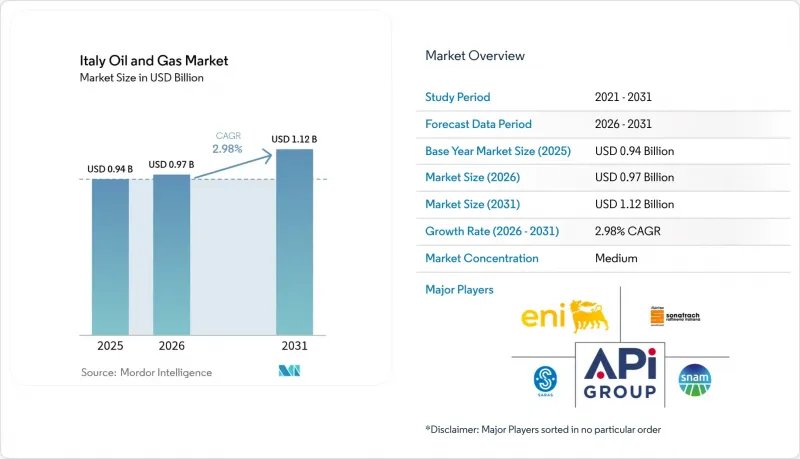
本報告按行業(上游、中游、下游)、地區(陸上和海上)和服務(建設、維護/檢修、退役)進行細分。市場規模和預測均以美元計價。
義大利油氣市場趨勢與洞察
為因應俄羅斯天然氣供應危機,轉向多元化發展
2021年,俄羅斯佔義大利天然氣供應的40%,但緊急立法使得LNG接收站計畫以及與阿爾及利亞和亞塞拜然的替代管道協議得以快速核准,使2024年,俄羅斯的佔有率降至5%以下。一項40億歐元的國家安全計畫資助了兩座浮體式儲存再氣化裝置(FSRU),每年新增100億立方公尺的供給能力,並提高了供應柔軟性。到2024年,來自阿爾及利亞的管道天然氣供應量佔進口總量的32%,同時來自美國和卡達的新液化天然氣貨物抵達皮翁比諾和拉文納,鞏固了義大利作為中歐天然氣門戶的地位。 2025年冬季前,倉儲設施的佔用率超過90%,這清楚地表明了供應韌性的提高,而中游承包商也受益於壓縮站和計量設備的加速升級。供應鏈的結構性重組鞏固了義大利作為地中海地區各種天然氣流動的關鍵樞紐的地位,其影響遠遠超出了眼前的危機。
發電用天然氣需求激增
燃煤發電廠的關閉以及可再生能源的間歇性,增加了對快速可調發電能力的需求,導致義大利國內發電中燃氣電廠的佔有率從2019年的43%上升至2024年的48%。複合循環燃氣渦輪機效率的提高降低了邊際成本,使天然氣成為理想的調節燃料,尤其是在尖峰時段,此時工業供暖需求旺盛而太陽能發電量較低。普利亞和Campania地區資料中心的投資進一步推高了基本負載需求,促使開發商擴大簽訂長期天然氣供應契約,以對沖價格波動風險。儘管義大利制定了長期脫碳目標,但這些趨勢仍為中期需求設定了下限,從而支撐了義大利油氣市場的進一步成長。
提高可再生能源的競爭力
到2024年,太陽能和風力發電裝置容量將達到60吉瓦,佔總發電量的35%,西西里島的均等化成本達到40歐元/兆瓦時。電網級電池儲能的引入開始緩解電力波動,減少了白天太陽能發電高峰時段燃氣電廠(用於高峰負載)的運作。國家復甦與韌性計畫在2026年將撥款150億歐元用於發展更多再生能源來源,這意味著電力結構中天然氣將面臨更激烈的競爭。然而,由於季節性波動和缺乏長期儲能方案,高度柔軟性的燃氣電廠仍扮演備用電源的角色,從而降低了義大利油氣市場面臨的短期替代風險。
細分市場分析
預計到2031年,義大利油氣中游業務的複合年成長率將達到4.27%,成長超過義大利油氣市場其他任何領域。 Snam公司81億歐元的資本計畫包括興建1,200公里氫能管線和40億立方公尺的新倉儲設施,這些計畫以及定價機制帶來的收入將擴大義大利油氣市場中游服務的市場規模。諸如亞得里亞海輸油管等跨國互聯項目將增強南北之間的柔軟性,提高運輸收入,並為未來氫燃料的開發創造更多選擇。上游業務仍然是最大的收入來源,但其產量成長緩慢,服務供應商正轉向維護和現有設施改造項目,這些項目雖然收益穩定,但收入成長有限。
下游領域也呈現強勁的轉型趨勢。生物精煉生產的優質燃料利潤率高於傳統產品,從而緩解了歐洲日益嚴格的燃料標準所帶來的影響。因此,該行業正從以產量為導向的加工模式向以利潤主導的特種燃料模式轉型,這種轉型使得義大利油氣市場的參與者能夠在滿足歐盟永續商業運營分類標準的同時,繼續參與整個價值鏈。
其他好處:
- Excel格式的市場預測(ME)表
- 3個月的分析師支持
目錄
第1章:引言
- 研究假設和市場定義
- 調查範圍
第2章:調查方法
第3章執行摘要
第4章 市場狀況
- 市場概覽
- 市場促進因素
- 發電用天然氣的需求正在激增。
- 為因應俄羅斯天然氣供應危機,轉向多元化發展
- 煉油廠維修和向生物煉製廠的轉型
- 擴大液化天然氣進口(皮翁比諾和拉文納的浮式儲存再氣化裝置)
- 海上二氧化碳儲存中心協助藍氫叢集
- 亞得里亞海航線小規模液化天然氣燃料庫的成長
- 市場限制因素
- 加速可再生能源的競爭力
- 國內蘊藏量飽和及產量下降
- 嚴格禁止海上鑽探和規範地震探勘。
- 擴大中產階級領域的許可流程出現延誤
- 供應鏈分析
- 監理情勢
- 技術展望
- 原油產量和消費量預測
- 天然氣生產與消費預測
- 管道設置容量分析
- 非傳統資源(緻密油、油砂、深海油田)資本投資預測
- 波特五力模型
- PESTLE分析
第5章 市場規模與成長預測
- 按行業
- 上游部門
- 中游
- 下游產業
- 按位置
- 陸上
- 離岸
- 按服務
- 建造
- 維護和檢修
- 退休
第6章 競爭情勢
- 市場集中度
- 策略趨勢(併購、聯盟、購電協議)
- 市場佔有率分析(主要公司的市場排名和佔有率)
- 公司簡介
- Eni SpA
- Snam SpA
- Saras SpA
- Sonatrach Raffineria Italiana Srl
- API Anonima Petroli Italiana SpA
- Edison SpA
- TotalEnergies SE
- Shell PLC
- BP PLC
- Saipem SpA
- Maire SpA
- Italgas SpA
- Engie SA(Italy)
- GOI Energy(ISAB Priolo)
- Raffineria di Milazzo ScpA
- SGS Italia SpA
- Zenith Energy Ltd
- Schlumberger NV
- Baker Hughes Italy Srl
- ERG SpA
第7章 市場機會與未來展望
According to Mordor Intelligence, the Italy oil and gas market size was valued at USD 0.94 billion in 2025 and estimated to grow from USD 0.97 billion in 2026 to reach USD 1.12 billion by 2031, at a CAGR of 2.98% during the forecast period (2026-2031).
This report is Segmented by Sector (Upstream, Midstream, and Downstream), Location (Onshore and Offshore), and Service (Construction, Maintenance and Turn-Around, and Decommissioning). The Market Sizes and Forecasts are Provided in Terms of Value (USD).
Italy Oil And Gas Market Trends and Insights
Diversification Push After Russian-Gas Supply Crisis
Russia supplied 40% of Italy's gas in 2021, but this share fell to under 5% by 2024, as emergency legislation enabled the rapid approval of LNG terminal projects and alternative pipeline deals with Algeria and Azerbaijan. The EUR 4 billion national security package funded two FSRUs, which together add 10 billion m3 of annual capacity, thereby strengthening supply flexibility. Algerian pipeline flows rose to 32% of 2024 imports, while new U.S. and Qatari LNG cargoes reached Piombino and Ravenna, anchoring Italy's role as a Central European gas gateway. Storage fill rates above 90% ahead of winter 2025 underscore improved resiliency, and midstream contractors benefit from accelerated compression-station and metering upgrades. The structural reshaping of supply chains solidifies Italy's position as the Mediterranean conduit for diversified gas flows, extending well beyond the immediate crisis horizon.
Surging Natural-Gas Demand for Power Generation
Gas-fired plants accounted for 48% of national electricity in 2024, up from 43% in 2019, as coal closures and renewable energy intermittency necessitated the need for fast-ramping capacity. Efficiency gains in combined-cycle turbines lowered marginal costs, making gas the preferred balancing fuel, especially during winter peaks when industrial heating coincides with subdued solar output. Data-center investments in Apulia and Campania drive additional baseload requirements, and developers are increasingly signing long-term gas supply contracts to hedge against price volatility. These dynamics establish a medium-term demand floor that supports further growth in Italy's oil and gas market, despite long-term decarbonization targets.
Accelerating Renewable-Energy Competitiveness
Solar and wind capacity reached 60 GW in 2024, supplying 35% of generation and achieving EUR 40/MWh levelized costs in Sicily. Grid-scale battery deployments begin to smooth hourly volatility, trimming gas peaker dispatch during midday solar peaks. The National Recovery and Resilience Plan allocates EUR 15 billion for additional renewable energy sources through 2026, signaling an intensification of competition for gas in the power mix. Yet seasonal variability and the absence of long-duration storage maintain a reserve role for flexible gas plants, mitigating immediate displacement risks for the Italy oil and gas market.
Other drivers and restraints analyzed in the detailed report include:
- LNG Import Expansion (Piombino & Ravenna FSRUs)
- Refinery Upgrades & Bio-Refinery Conversions
- Mature Domestic Reserves and Declining Production
For complete list of drivers and restraints, kindly check the Table Of Contents.
Segment Analysis
Midstream activities are projected to account for a 4.27% CAGR to 2031, a faster pace than any other sector within the Italian oil and gas market. Snam's EUR 8.1 billion capital plan includes 1,200 kilometers of hydrogen-ready pipelines and 4 billion cubic meters of new storage, expanding Italy's oil and gas market size for midstream services alongside tariff-backed earnings. Cross-border interconnections such as the Adriatic Line enhance north-south flexibility, reinforce transit revenue, and create optionality for future hydrogen blends. Upstream remains the largest revenue source but faces plateauing production volumes, prompting service providers to shift toward maintenance and brownfield enhancement projects that generate predictable, albeit slower, revenue streams.
A robust downstream conversion trend also manifests. Bio-refineries supply premium fuels that fetch higher margins than traditional products, moderating the impact of tightening European fuel-spec standards. The sector therefore evolves from volume-driven processing to margin-driven specialty fuels, a shift that keeps Italy oil and gas market players engaged across the full value chain while meeting EU taxonomy criteria for sustainable operations.
Complete Report Scope:
- By Sector
- Upstream
- Midstream
- Downstream
- By Location
- Onshore
- Offshore
- By Service
- Construction
- Maintenance and Turn-around
- Decommissioning
List of Companies Covered in this Report:
- Eni SpA
- Snam SpA
- Saras SpA
- Sonatrach Raffineria Italiana Srl
- API Anonima Petroli Italiana SpA
- Edison SpA
- TotalEnergies SE
- Shell PLC
- BP PLC
- Saipem SpA
- Maire SpA
- Italgas SpA
- Engie SA (Italy)
- GOI Energy (ISAB Priolo)
- Raffineria di Milazzo ScpA
- SGS Italia SpA
- Zenith Energy Ltd
- Schlumberger NV
- Baker Hughes Italy Srl
- ERG SpA
Additional Benefits:
- The market estimate (ME) sheet in Excel format
- 3 months of analyst support
TABLE OF CONTENTS
1 Introduction
- 1.1 Study Assumptions & Market Definition
- 1.2 Scope of the Study
2 Research Methodology
3 Executive Summary
4 Market Landscape
- 4.1 Market Overview
- 4.2 Market Drivers
- 4.2.1 Surging natural-gas demand for power generation
- 4.2.2 Diversification push after Russian-gas supply crisis
- 4.2.3 Refinery upgrades & bio-refinery conversions
- 4.2.4 LNG import expansion (Piombino & Ravenna FSRUs)
- 4.2.5 Offshore CO?-storage hubs enabling blue-hydrogen clusters
- 4.2.6 Growth in small-scale LNG bunkering for Adriatic shipping
- 4.3 Market Restraints
- 4.3.1 Accelerating renewable-energy competitiveness
- 4.3.2 Mature domestic reserves & declining production
- 4.3.3 Strict offshore drilling moratoria & seismic rules
- 4.3.4 Slow permitting for midstream expansions
- 4.4 Supply-Chain Analysis
- 4.5 Regulatory Landscape
- 4.6 Technological Outlook
- 4.7 Crude-Oil Production & Consumption Outlook
- 4.8 Natural-Gas Production & Consumption Outlook
- 4.9 Installed Pipeline Capacity Analysis
- 4.10 Unconventional Resources CAPEX Outlook (tight oil, oil sands, deep-water)
- 4.11 Porter's Five Forces
- 4.11.1 Bargaining Power of Suppliers
- 4.11.2 Bargaining Power of Buyers
- 4.11.3 Threat of New Entrants
- 4.11.4 Threat of Substitutes
- 4.11.5 Industry Rivalry
- 4.12 PESTLE Analysis
5 Market Size & Growth Forecasts
- 5.1 By Sector
- 5.1.1 Upstream
- 5.1.2 Midstream
- 5.1.3 Downstream
- 5.2 By Location
- 5.2.1 Onshore
- 5.2.2 Offshore
- 5.3 By Service
- 5.3.1 Construction
- 5.3.2 Maintenance and Turn-around
- 5.3.3 Decommissioning
6 Competitive Landscape
- 6.1 Market Concentration
- 6.2 Strategic Moves (M&A, Partnerships, PPAs)
- 6.3 Market Share Analysis (Market Rank/Share for key companies)
- 6.4 Company Profiles (includes Global level Overview, Market level overview, Core Segments, Financials as available, Strategic Information, Products & Services, and Recent Developments)
- 6.4.1 Eni SpA
- 6.4.2 Snam SpA
- 6.4.3 Saras SpA
- 6.4.4 Sonatrach Raffineria Italiana Srl
- 6.4.5 API Anonima Petroli Italiana SpA
- 6.4.6 Edison SpA
- 6.4.7 TotalEnergies SE
- 6.4.8 Shell PLC
- 6.4.9 BP PLC
- 6.4.10 Saipem SpA
- 6.4.11 Maire SpA
- 6.4.12 Italgas SpA
- 6.4.13 Engie SA (Italy)
- 6.4.14 GOI Energy (ISAB Priolo)
- 6.4.15 Raffineria di Milazzo ScpA
- 6.4.16 SGS Italia SpA
- 6.4.17 Zenith Energy Ltd
- 6.4.18 Schlumberger NV
- 6.4.19 Baker Hughes Italy Srl
- 6.4.20 ERG SpA
7 Market Opportunities & Future Outlook
- 7.1 White-space & Unmet-need Assessment

 英國石油與天然氣:市場佔有率分析、產業趨勢與統計、成長預測(2026-2031)馬來西亞油氣:市場佔有率分析、產業趨勢與統計及成長預測(2026-2031)中國油氣市場:市場佔有率分析、產業趨勢與統計及成長預測(2026-2031年)印尼油氣市場:市場佔有率分析、產業趨勢與統計及成長預測(2026-2031年)東南亞油氣市場:市場佔有率分析、產業趨勢與統計及成長預測(2026-2031年)美國石油和天然氣:市場佔有率分析、行業趨勢和統計數據以及成長預測(2026-2031 年)印度石油和天然氣:市場佔有率分析、行業趨勢和統計數據以及成長預測(2026-2031 年)
 2026年全球油氣管道及相關結構建設市場報告
 石油和天然氣市場規模、佔有率和成長分析(按產品類型、產業類型、部署類型、應用和地區分類)-2026-2033年產業預測越南石油天然氣:市場佔有率分析、產業趨勢與統計、成長預測(2026-2031年)